

The most expensive misunderstanding in this category costs a garden. A mechanical water timer is a countdown device: you turn the dial, it runs for that long, it shuts off, and it does nothing else until somebody turns the dial again. It does not water tomorrow. People buy one before a week away, come home to dead plants, and conclude the product was faulty when it did exactly what it was built to do. We compared 8 drip irrigation timer options from Orbit, Raindrip, RAINPOINT on scheduling, duty cycle, pressure requirements and battery behaviour.
Our top pick is the Orbit Programmable Digital Hose Watering Timer, because programmable scheduling is the whole reason to automate watering in the first place. For applying what the timer delivers, our guide to the best lawn and garden sprayers covers the other end of the hose.

Pros
- Repeating schedules water while you are away
- Independent outlets allow different programmes per line
- Rain delay pauses without reprogramming
- Very large body of buyer feedback
Cons
- Battery failure can stop watering while the display still works
- Must be brought indoors before the first freeze
This is what most people actually mean when they search for a watering timer: a device that waters on its own, repeatedly, without anyone present. Programmable scheduling is the entire point and this delivers it simply.
Two independently programmed outlets is the feature that earns the top spot. Vegetable beds on drip want a long run every day or two; a lawn on sprinklers wants a short run less often. One outlet forces a compromise, two removes it.
Two things to plan for. Batteries are the common failure and they fail unhelpfully, since a fading cell can stop the valve opening while the screen still shows a schedule. And the timer must come indoors before winter, because trapped water freezing is what kills these devices.
Bottom line: the default choice for automated garden watering, provided you change batteries each spring.
- Type: programmable digital timer
- Outlets: 2, independently programmed
- Scheduling: repeating daily or interval
- Rain delay: yes
- Power: batteries
- Winter: remove and store frost free
Programme drip zones for longer runs and sprinkler zones for shorter ones, since the two deliver water at very different rates.
Run a manual cycle after programming and watch water reach the plants, rather than trusting the display.
Fit fresh batteries at the start of each season and before any trip away.
Disconnect, drain and store indoors before the first freeze, and remove the batteries during storage so they cannot leak.
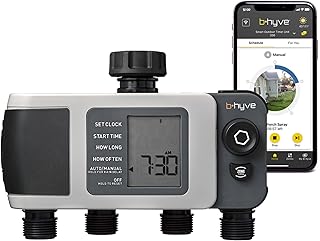
Pros
- Remote control and monitoring from a phone
- Weather based adjustment reduces wasted watering
- Four ports cover several zones independently
- Schedules can be changed without going outside
Cons
- Needs reliable connectivity at the tap, often a weak spot
- More to configure and more that can fail than a simple timer
The case for a connected timer is strongest for people who are not there. Being able to check that watering ran, or extend it during a heatwave from a phone, addresses the anxiety that makes people ask a neighbour to water instead.
Forecast based adjustment is the other genuine benefit, skipping a cycle when rain is expected rather than watering into a downpour and then again the next day.
The dependency is connectivity. Taps are usually at the far corner of a house where signal is weakest, and a smart timer that cannot reach the network is a manual timer with extra steps. There is also simply more to set up than with a dial. For someone at home most of the time, a programmable timer with a rain delay button covers most of this for less.
Bottom line: worth it for frequent travellers with signal at the tap, unnecessary otherwise.
- Type: connected smart timer
- Ports: 4, independently scheduled
- Control: app based plus on device
- Weather: forecast based adjustment
- Connectivity: required at the tap
- Power: batteries
People who travel often, and gardens with several zones needing different schedules.
Not worth the complexity if you are home most days or signal at the tap is poor.
Check signal strength at the tap before buying, since that is the single point of failure for the connected features.
Set up a sensible schedule on the device itself so it still waters correctly if connectivity drops.

Pros
- Repeating schedules with no connectivity needed
- Simple programming compared with smart models
- Rain delay included
- Good value for a programmable timer
Cons
- Single outlet limits zone flexibility
- Screen can be hard to read in bright sun
Not everyone wants an app involved in watering a garden. This covers the core requirement, repeating schedules that run without anyone present, with nothing to pair and no network to depend on.
Rain delay is included, which is the feature people use most after the schedule itself, pausing watering for a few days without dismantling the programme.
Two limits. A single outlet means everything downstream runs on one schedule, which is fine for a uniform setup and awkward once drip and sprinklers are mixed. And like most timers in this class, the screen is easier to read indoors than crouched by a tap in sunshine.
Bottom line: solid unconnected programmable timer, best where one schedule suits everything.
- Type: programmable digital timer
- Outlets: single
- Scheduling: repeating
- Rain delay: yes
- Connectivity: none required
- Power: batteries
Gardeners wanting automation without apps, where one schedule covers everything on the line.
Less suitable where drip and sprinkler zones need different programmes.
Programme it indoors before fitting it to the tap if the screen is hard to read outside.
Verify with a manual run and check water reaches the far end of the line.

Pros
- Needs no batteries at all
- Simple and very reliable mechanically
- Solves the forgotten sprinkler problem cheaply
- Nothing to programme
Cons
- Does not repeat, so it cannot water while you are away
- Timing is approximate rather than precise
Judged for what it is rather than what people assume it is, this is an excellent product. Turn the dial, the water runs, it stops. No batteries to die, no schedule to misconfigure, nothing to fail electronically.
The problem it solves is real: a sprinkler left running for four hours because you got distracted, which wastes water and can waterlog a lawn.
What it categorically cannot do is water in your absence. There is no clock inside, so it will not run tomorrow. Every complaint about this class of product killing plants during a holiday comes from this misunderstanding, and it is worth being clear about before buying.
Bottom line: buy it to stop a hose you would forget, never to cover a trip away.
- Type: mechanical countdown timer
- Power: none, spring driven
- Scheduling: none, single countdown
- Repeat: no
- Best use: preventing a forgotten hose running
- Timing: approximate
Gardeners who water by hand and occasionally forget to turn the tap off.
Not for anyone needing watering while away from home.
If your requirement includes the word holiday, buy a programmable timer instead.
Treat the dial markings as approximate rather than precise minutes.
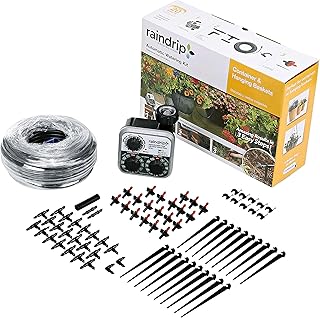
Pros
- Includes the components a bare timer does not
- Removes guesswork for a first drip setup
- Designed as a matched system
- Suits container gardens and beds
Cons
- Kit contents may not match a large or unusual layout
- Timer capability is basic compared with standalone units
Buying a timer and then discovering you also need tubing, emitters, a filter and a pressure regulator is the usual way a first drip project stalls. A kit collapses that into one purchase with parts intended to work together.
For containers, raised beds and small borders, the contents are usually about right, and the matched design removes the compatibility questions that make component shopping tedious.
Two caveats. A kit is sized for a typical layout, so a large or awkward garden will need extra parts anyway. And the included timer is generally basic, so anyone wanting multi zone scheduling will end up replacing it while keeping the rest of the kit.
Bottom line: the easiest way to start drip irrigation, with the timer as the part most likely to be upgraded later.
- Type: complete drip kit with timer
- Includes: timer, tubing, emitters and fittings
- Best use: containers, raised beds, small borders
- Expandable: additional parts sold separately
- Timer capability: basic scheduling
- Power: batteries
Lay the tubing out in the sun for a while before assembly; warm tubing is far easier to push onto fittings.
Run the system and check every emitter delivers before covering tubing with mulch.
Anyone setting up drip irrigation for the first time who wants matched components in one purchase.
Less suitable for large gardens needing custom layouts.

Pros
- Dial controls are readable in bright sunlight
- Programming without menus or manuals
- Repeating schedules unlike a mechanical timer
- Simple and hard to misconfigure
Cons
- Less scheduling flexibility than menu driven timers
- Single outlet only
Programming a timer happens crouched by a tap in sunlight, which is where small screens and multi button menus become genuinely difficult. A dial sidesteps all of it.
Crucially this is still a programmable timer rather than a countdown one, so it repeats on a schedule and will water while you are away, which is the distinction that matters most in this category.
What you give up is granularity. A dial offers set positions rather than any interval you like, so schedules are chosen from a menu of options rather than specified precisely. For most gardens that is sufficient, and the reduced chance of misconfiguring it is worth something.
Bottom line: the choice when readability and simplicity matter more than fine control.
- Type: dial programmable timer
- Outlets: single
- Scheduling: repeating, preset intervals
- Controls: physical dial
- Readability: good in sunlight
- Power: batteries
Anyone who finds small screens and button menus awkward, and gardens where one straightforward schedule is enough.
Not for complex multi zone scheduling.
Change batteries each spring and verify with a manual run.
Store indoors over winter with the batteries removed.

Pros
- Two zones on independent schedules
- Programmable without connectivity
- Rain delay included
- Good value for a dual zone timer
Cons
- Zones run in sequence rather than together
- Screen readability outdoors is average
Two zones is the feature that makes a mixed garden workable. Drip beds want long, infrequent runs; a lawn wants shorter, more regular ones. One schedule cannot serve both, and a two zone timer removes the compromise without adding an app.
Rain delay and standard programmable scheduling cover the rest of what most gardens need.
Two practical notes. Zones run one after another rather than simultaneously, which is deliberate, since running both at once splits available pressure and can drop emitters below their working range. And as with most timers here, the screen is easier to read indoors than by the tap.
Bottom line: the value pick for a garden with two different watering needs.
- Type: programmable digital timer
- Zones: 2, independently scheduled
- Operation: zones run sequentially
- Rain delay: yes
- Connectivity: none required
- Power: batteries
Gardens combining drip beds with a lawn or containers on one tap.
Less relevant where everything wants the same schedule.
Schedule zones so they do not overlap, since sequential operation is what preserves pressure.
Give the drip zone a longer run than the sprinkler zone; the delivery rates are not comparable.

Pros
- Three dials cover frequency, start and duration clearly
- Readable and settable outdoors
- Repeating schedules without a screen
- Simple to hand over to someone else
Cons
- Preset dial positions rather than free scheduling
- No rain delay on analogue controls
Three dials map neatly onto the three questions a watering schedule asks: how often, when, and for how long. Setting each on its own control is faster to understand than any menu system and needs no manual.
It is also easy to explain to someone else, which matters when a neighbour is checking on the garden while you are away.
The trade is that dials offer preset positions rather than arbitrary values, so you choose from available options rather than specifying exact times. Analogue controls also mean no rain delay button, so pausing during wet weather means turning it off and remembering to turn it back on.
Bottom line: the clearest controls here, at the cost of flexibility and rain delay.
- Type: analogue dial timer
- Controls: 3 dials for frequency, start and duration
- Scheduling: repeating, preset positions
- Rain delay: not available
- Power: batteries
- Best use: simple repeating schedules
Gardeners who want physical controls they can read and set outdoors, and anyone handing the garden over to someone else temporarily.
Not for those who want rain delay or precise scheduling.
Turn it off manually during prolonged wet spells, since there is no rain delay function.
Remove batteries and store indoors before freezing weather.
How to Choose a Drip Irrigation Timer
Mechanical Timers Run Once and Stop

This is the distinction to settle before looking at anything else. A mechanical timer is a spring driven shut off valve. Turn the dial to thirty minutes, the water runs for thirty minutes, and it closes. There is no clock inside and no concept of tomorrow.
What it is genuinely good for is preventing the classic mistake of leaving a sprinkler running all afternoon. Set it, walk away, and the water stops whether you remember or not. For someone who waters manually and occasionally forgets, that is a real problem solved cheaply.
What it cannot do is cover a holiday. If the requirement is watering while you are away, or watering at dawn every day without thinking about it, a mechanical timer is the wrong product no matter how well made.
Drip and Sprinkler Are Different Duty Cycles
Drip irrigation delivers a small volume slowly, so a drip zone typically runs for thirty to sixty minutes to put down a useful amount of water. Sprinklers deliver a much larger volume, so a sprinkler zone runs for a fraction of that time.
That difference matters when reading a timer’s specification. A device whose shortest interval is fifteen minutes is useless for a small sprinkler zone that needs five, while a device that maxes out at thirty minutes per cycle is awkward for drip beds that want an hour.
Where one timer serves both, look for a wide range of run times and, ideally, separate outlets that can be programmed independently. Running drip and sprinkler on the same schedule means one of them is always getting the wrong amount.
Minimum Pressure to Open the Valve
Most electronic timers use a solenoid valve that needs a minimum water pressure to operate reliably. Below that threshold the valve may not open fully, or may not close cleanly, which produces the confusing symptom of a timer that appears to work but delivers a trickle or never quite stops.
This bites hardest in low pressure situations: a rain barrel feeding a drip line by gravity, a long run of hose, or a property at the end of a low pressure supply. Gravity fed systems in particular often need a timer specifically rated for low or zero pressure.
Check the stated minimum pressure against your own supply before buying. Where a timer will run off a barrel, that specification is not a detail, it is the difference between a working system and a puzzle.
Batteries, and the Way They Fail
Almost every hose timer runs on batteries, and the failure mode is unhelpful. As voltage drops, some timers stop opening the valve while the display still shows a schedule, so everything looks correct and nothing is being watered.
Replace batteries at the start of every season regardless of whether they seem fine, and use good quality alkaline or lithium cells rather than whatever is in the drawer. Lithium holds voltage better in heat, which matters for a device sitting on a sunny wall all summer.
Before any trip, run a manual cycle and watch water actually come out. A schedule on a screen proves nothing; water on the ground proves the whole chain works.
Zones, Outlets and Watering Different Things
A single outlet timer waters everything downstream on one schedule. That is fine when everything downstream wants the same thing, and a problem the moment you have vegetable beds on drip and a lawn on sprinklers.
Two and four outlet models give each line its own programme, which is what allows containers to be watered daily and a lawn twice a week from the same tap. For most gardens that flexibility is worth more than any other feature on the box.
Note that outlets on a hose timer generally run in sequence rather than simultaneously, which is deliberate. Running several zones at once divides the available pressure and can drop the whole system below what the emitters need.
Rain Delay, Skipping and Smart Control

A rain delay button pauses the schedule for a set number of days and resumes automatically, which stops the familiar sight of sprinklers running during a downpour. It is a small feature that gets used constantly.
Connected timers go further, adjusting schedules using local forecasts and letting you change settings from a phone. For someone who travels, being able to check and adjust remotely is a genuine benefit rather than a gimmick.
The trade is dependency. Connected models need a hub or a reliable signal at the tap, which is often at the far corner of a house, and they add another thing that can fail. A simple programmable timer with a rain delay button covers most of the same ground with nothing to configure.
Filters and Pressure Regulators for Drip
Drip systems need two components that sprinkler users never think about. A filter catches the particles that would otherwise block emitters, and a pressure regulator drops mains pressure to the low figure drip tubing is designed for.
Skip the regulator and full pressure will blow fittings off tubing, usually at the least convenient moment and often while you are away. Skip the filter and emitters clog gradually, producing the maddening situation where some plants thrive and others quietly die.
Some drip kits include both, which is one reason a complete kit is often better value than assembling parts. If you are buying a timer to add to existing drip tubing, check that these are already in the line.
Winter Will Destroy a Timer Left Outside
Water trapped inside a timer expands when it freezes and cracks the housing or the valve. This is the single most common way these devices die, and it is entirely preventable.
At the end of the season, disconnect the timer, drain it, remove the batteries and store it somewhere frost free. Removing the batteries matters separately, since cells left in over winter can leak and corrode the contacts.
The same applies to the drip line. Blowing or draining the lines before the first freeze prevents split tubing and cracked fittings that only reveal themselves when you turn the water back on in spring.
Programming It Where It Lives

You will programme this device crouched by a tap in bright sunlight, which is worth remembering when comparing models. Small low contrast screens that look fine indoors become unreadable outside, and menu systems that require holding buttons in combinations are hard to work through in that position.
Dial based analogue controls sidestep the problem entirely. Turning a physical dial to a run time and another to a frequency is legible in any light and needs no manual, at the cost of finer scheduling options.
Whichever you choose, programme it once and verify by watching a cycle run. Most reports of a timer not working turn out to be a schedule that was set incorrectly rather than a device that failed.
Watering at the Right Time of Day
A timer’s real advantage is not that it remembers, it is that it can water at an hour nobody is willing to get up for.
Early morning, roughly from first light until shortly after sunrise, is the window most horticultural guidance points to. Temperatures are low so less water evaporates before it reaches the root zone, wind is usually calmer so sprinkler patterns land where intended, and foliage that does get wet dries as the sun comes up. That last point matters for plants prone to fungal problems, where leaves staying wet for hours is part of the trouble.
Evening watering is the common alternative and it is second best for that reason: the water goes in efficiently, but anything wet stays wet all night. For drip systems this concern largely disappears, since water is delivered at soil level and foliage never gets wet, which is one of the quieter advantages of drip over sprinklers.
Midday watering is the one to avoid, not because droplets scorch leaves, which is largely a myth, but because a substantial share of what you apply evaporates before it does any good. If a timer is going to run unattended anyway, there is no reason not to set it for dawn.
| Timer | Type | Outlets | Best For |
|---|---|---|---|
| Orbit Programmable Digital | Programmable digital | Multiple options | Everyday automated watering |
| Orbit B-hyve XD Smart | Connected smart timer | 4 port | Remote control and forecast adjustment |
| RAINPOINT Sprinkler Timer | Programmable digital | Single | Straightforward scheduled watering |
| Orbit Mechanical Water Timer | Mechanical countdown | Single | Stopping a hose you would forget |
| Raindrip R560DP Drip System | Drip kit with timer | Single | Starting a drip system from scratch |
| Orbit One Outlet Single Dial | Dial programmable | Single | Simple programming outdoors |
| RAINPOINT 2 Zone Timer | Programmable digital | 2 zone | Drip beds and lawn on one tap |
| Raindrip R675CT Analog 3 Dial | Analogue dial | Single | Readable controls without menus |
For the rest of the garden, our patio, lawn and garden guides cover soil and equipment, and the full library sits at our article index.
Why You Should Trust Us
We separated mechanical countdown timers from programmable ones at the top of this guide rather than ranking them together, because they solve different problems and the confusion between them is the most common complaint in the category. A countdown timer bought for a holiday is a failure that looks like a faulty product.
From there we sorted by scheduling capability, outlet count and pressure requirements. Real customer ratings informed the shortlist, with attention to repeated reports about valves failing to close and batteries dying mid season, and where a brand lists the same timer in one, two and three outlet versions we treated it as one product.
Final Thoughts
For most gardens the Orbit Programmable Digital Hose Watering Timer is the easiest recommendation. It does the thing people actually want, which is watering on a repeating schedule without anyone being present, and the multi outlet versions let a vegetable bed and a lawn run on different programmes from one tap.
If you travel often, the Orbit B-hyve XD adds remote control and forecast based adjustment, provided there is signal at the tap. For a first drip setup, the Raindrip R560DP kit includes the parts that a timer alone does not cover, and the Orbit Mechanical timer remains an excellent cheap answer to the narrower problem of forgetting to turn a hose off.
Whatever you choose, fit fresh batteries each spring, watch a full cycle run before relying on it, and bring the timer indoors before the first freeze. Browse more of our category guides for the rest of the yard.
Frequently Asked Questions
What is the best drip irrigation timer in 2026?
The Orbit Programmable Digital Hose Watering Timer is our overall pick for 2026, because repeating schedules are the point of automating watering. For remote control while travelling, the Orbit B-hyve XD adds app access and forecast adjustment.
Will a mechanical timer water my garden while I am away?
No. A mechanical timer is a countdown shut off: it runs for the time you dial in and then closes, with no clock and no repeat. For watering while away, you need a programmable timer with a repeating schedule.
Can I run a timer from a rain barrel?
Only with a timer rated for low or zero pressure. Most electronic timers use a solenoid valve that needs a minimum pressure to open and close properly, and gravity fed barrels sit below that. Check the stated minimum pressure before buying.
Why did my timer stop watering with the display still on?
Usually failing batteries. As voltage drops, some timers stop driving the valve while the screen continues to show a schedule, so everything looks correct. Replace the batteries every spring and verify by watching a cycle actually deliver water. Our garden guides cover other seasonal maintenance.
Do I need a filter and pressure regulator for drip?
Yes to both. A filter stops particles blocking emitters, and a regulator drops mains pressure to what drip tubing is designed for. Without the regulator, fittings blow off under full pressure. Many complete drip kits include both, which is part of why a kit is often better value than separate parts.



Write Your Review
No reviews yet. Be the first to share your experience!