


Most homes turn the heat on when the indoor temperature stops recovering on its own and settles below about 68 degrees Fahrenheit for two or three days running. In the northern half of the country that usually happens between the last week of September and the middle of October. In the mid South it is closer to early November, and along the Gulf Coast and in coastal California it may never happen at all. The date on the calendar is the least useful part of the question.
What follows is the practical version: the three numbers that actually decide the date, what the first week of heating costs you, the five cheaper moves worth trying first, the situations where waiting is a genuinely bad idea, what your landlord is legally on the hook for, and the short list of checks to run before the furnace fires for the first time since spring.
The short answer in three numbers
Forget the date and watch these instead.
- Indoor temperature below 68 degrees. This is the comfort setting almost every efficiency guideline uses as its winter baseline. When the house sits under it during the evening without recovering, the season has started.
- Overnight lows in the mid 40s or colder. A well sealed home coasts through a single chilly night on stored heat. Once the overnight low sits in the 40s for several nights, the house loses more than the day can put back.
- Two to three consecutive days. One cold snap in late September is weather. Three cold mornings in a row is the season changing, and that is the signal worth acting on.
If all three line up, turn it on. If only one does, put on a sweater and wait a few days. Most of the money wasted on early heating goes to a single cold week that reverses itself.
Why 68 degrees is the number everyone quotes
Sixty eight degrees is the winter setting recommended by ENERGY STAR for the hours when you are awake and at home, with a lower setting while you sleep or while the house is empty. It is not a health threshold, it is a compromise between comfort and running cost that happens to suit most people wearing normal indoor clothing.
The floor is lower. The World Health Organization housing guidelines put 18 degrees Celsius, about 64 degrees Fahrenheit, as the minimum indoor temperature for healthy adults, with a higher minimum suggested for homes with infants, older residents or anyone unwell. So the honest range for a healthy household is roughly 64 to 68, and where you land inside it is a preference rather than a rule.
Two practical qualifiers. Humidity changes how a given temperature feels, and a dry house at 68 feels cooler than a slightly humid one at 66. And your own tolerance is not the whole story if you share the place with an infant, an older relative, a reptile or a houseplant collection.
The overnight low matters more than the daytime high
People watch the afternoon forecast and make the wrong call. A sunny 60 degree afternoon puts real heat into a house through south facing glass, and a well insulated room can hold that warmth into the evening. The number that empties the house is the overnight low, because that is the stretch with no solar gain and eight or nine hours for heat to leak out.
This is why the first heating day so often arrives after a clear, calm night rather than after a cold cloudy day. Clear skies let a building radiate heat upward with nothing to bounce it back. A cloudy night at the same temperature is noticeably kinder to the house.
The practical version: look at the overnight lows for the coming week, not the daytime highs, and pay attention to how cold the house is at seven in the morning rather than how it feels at four in the afternoon.
Typical first heat dates by region
These are ordinary patterns rather than a forecast, and a mild or early autumn will move them by a week or two in either direction.
| Region | Overnight lows reach the mid 40s | Typical first week of heat |
|---|---|---|
| Upper Midwest, northern New England, Montana | Mid to late September | Last week of September |
| Great Lakes, Northeast, Mountain West | Late September | First half of October |
| Mid Atlantic, Pacific Northwest | Early to mid October | Middle to end of October |
| Mid South, southern Plains | Mid to late October | Early November |
| Deep South, desert Southwest | Mid to late November | Late November, and some years not at all |
| Coastal California, South Florida, Hawaii | Rarely | A handful of nights, if any |
Two things shift a home earlier in this table regardless of geography: single pane windows, and a top floor apartment with an uninsulated roof above it. Two things shift it later: a middle floor apartment with heated units on all sides, and a modern building with tight construction.
What starting early actually costs
Heating cost tracks the gap between the indoor temperature you hold and the outdoor temperature you are holding it against. A wider gap for more hours means more fuel, and that relationship is close enough to linear over an ordinary winter that you can reason about it without doing any arithmetic.
The Department of Energy puts a useful figure on the other side of the same idea: turning the thermostat back 7 to 10 degrees from its normal setting for eight hours a day can save as much as 10 percent a year on heating and cooling. That is the single largest saving available to most households, and it costs nothing but a schedule.
Applied to the question of timing, this cuts both ways. Starting two weeks early adds two weeks of fuel to the season. But holding out while wearing a coat indoors and running two space heaters usually costs more than turning the central system on at a sensible setting, because resistance heating converts every unit of electricity into exactly one unit of heat and nothing better.
Five cheaper moves to make first
Every one of these buys you days or weeks at the shoulder of the season, and all of them keep paying once the heat is on.
| Move | Effort | What it buys you |
|---|---|---|
| Open south facing curtains by day, close everything at dusk | Two minutes daily | Free solar gain in the afternoon, less radiant loss through glass at night |
| Reverse the ceiling fan to clockwise on low | One switch on the motor housing | Pushes warm ceiling air down the walls without a draft |
| Rope caulk or foam tape on the worst window | Twenty minutes, fully removable | Stops the draft you can feel from across the room |
| Draft stopper at the bottom of exterior doors | Five minutes | Closes the single biggest gap in most homes |
| Rugs on bare floors, wool socks, a throw on the sofa | None | Raises comfort by a couple of degrees at no running cost |
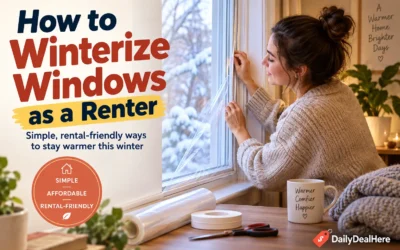
If you rent, the sealing work has its own rules and its own removable materials, which is a whole project of its own. The companion guide on how to winterize windows as a renter covers what comes off cleanly in spring. If glare and heat loss through a large window are the problem year round, heat reflective window film is the longer lived version of the same idea.
When waiting is a bad idea
There are five situations where the thrift stops making sense.
- Freezing pipes. Water lines are at risk once the outdoor temperature drops toward 20 degrees, and pipes in unheated garages, crawl spaces and exterior walls go first. Never let an occupied or empty home fall below 55 degrees in a cold snap, and open cabinet doors under sinks on exterior walls so warm air reaches the plumbing.
- Infants and older adults. Both groups regulate body temperature poorly. The 64 degree floor for healthy adults is not the right number for a nursery or for a relative recovering from illness.
- Condensation and mold. When interior surfaces get cold while the air holds moisture, water forms on glass and on the cold side of exterior walls. Persistent condensation on a window in October is an early warning, not a curiosity.
- Pets. Short haired dogs, older cats, birds and reptiles all have narrower comfort ranges than you do, and reptiles depend on ambient warmth entirely.
- You are already running space heaters daily. At that point the central system is almost certainly the cheaper way to hold the same temperature.
Renters, heat season, and what the landlord owes you
In cold cities the answer is not up to your landlord at all. Many have a defined heat season with minimum indoor temperatures written into the housing code.
New York City is the clearest example. Its heat season runs October 1 through May 31. Between six in the morning and ten at night, if the outdoor temperature falls below 55 degrees, the inside of the apartment has to be at least 68 degrees. Overnight, from ten at night to six in the morning, the apartment has to be at least 62 degrees no matter what it is doing outside. Chicago, Boston, Minneapolis and many other cold cities run their own version with different dates and thresholds, so the one worth reading is your own.
If your unit is under the line, three things make a complaint effective. Put the request in writing so there is a dated record. Keep a simple log of indoor readings with times, which means owning a thermometer rather than trusting a phone app. And describe the failure precisely, because there is a real difference between a system that never comes on and one that runs constantly and still cannot reach the setting.
The checklist before the first burn
The system has been sitting idle for five or six months. Twenty minutes now prevents the two most common first week complaints, which are weak airflow and a smell nobody can identify.
- Replace the filter. A filter left in since spring is loaded with summer dust, and a clogged filter makes the blower work harder while heating less. Note the size printed on the frame before you throw the old one out.
- Clear every supply and return vent. Furniture moved for summer, a rug over a floor register, a box in front of a return. Blocked returns cause more uneven heating than blocked supplies.
- Bleed hot water radiators. Air trapped at the top of the radiator keeps the upper half cold. A radiator key and a cup take care of it in a minute per unit.
- Check the alarms. Any combustion appliance means a working carbon monoxide alarm, and the start of heating season is the natural moment to press the button on every alarm and replace batteries. If yours are past their service life, this is the week to deal with it, and the guide to battery powered smoke alarms covers what to look for.
- Look outside. High efficiency furnaces vent through a plastic pipe in an exterior wall. Leaves, nests and lawn debris block them, and a blocked intake shuts the unit down.
- Run it once on a mild day. Finding a fault at 55 degrees outdoors with the windows open is far better than finding it on the first freezing night, when every technician in town is already booked.
That burning dust smell on the first run
A hot, dusty, slightly scorched smell for the first twenty to sixty minutes of the season is normal. Dust settles on the heat exchanger and the electric elements over the summer and burns off once they come up to temperature. Open a couple of windows, let it run, and it clears.
What is not normal: a sharp electrical or plastic smell, a burning smell that is still there after an hour or that returns days later, any smell of rotten eggs or sulfur, or soot marks around a vent. The sulfur smell is the additive put into natural gas so leaks can be noticed, and it means leaving the building first and calling from outside.
A thermostat schedule that works
The savings come from the hours nobody is enjoying the heat, not from suffering while you are home. Set the schedule once in October and leave it alone.
| Block | Suggested setting | Reason |
|---|---|---|
| Morning, waking hours | 68 | The standard comfort baseline while you are up and moving |
| Weekday, house empty | 60 to 62 | The single biggest saving block in the day |
| Evening, home and settled | 68 | The hours you actually feel, worth spending on |
| Overnight | 62 to 65 | Cooler sleeping is fine for most people and runs cheaply |
| Away for a weekend or longer | 55 minimum | Comfort no longer matters, but the plumbing still does |
Give the house a lead time of about half an hour before each step up, because most systems raise the indoor temperature at roughly one to two degrees per hour depending on insulation and outdoor conditions.
Heat pumps are the exception to setbacks
A heat pump moves heat rather than making it, which is why it is efficient, and it recovers slowly by design. Ask it to climb 8 degrees in the morning and most systems bring in the auxiliary electric strips to catch up. Those strips are ordinary resistance heat, so a deep setback on a heat pump can spend more than it saves.
Keep the swing to two or three degrees, use the schedule feature built into a thermostat that knows it is driving a heat pump, and leave the emergency or auxiliary heat switch alone unless the compressor has genuinely failed. If the auxiliary indicator is lit for hours on a mild day, something is wrong and it is worth a service call.
Old buildings, steam radiators, and no control at all
Plenty of apartments have no thermostat. The boiler is in the basement, the building super decides, and your only inputs are the radiator valve and the window. A few things help.
- On single pipe steam, the valve is meant to be fully open or fully closed, never halfway. Halfway traps condensate and produces the banging that keeps the whole line awake.
- The small air vent on the side of the radiator controls how quickly it fills. An adjustable vent turned down slows that room without touching anyone else.
- A reflective panel between the radiator and an exterior wall sends heat into the room instead of into the brick.
- Do not drape laundry or a blanket over a radiator. It blocks convection and creates a fire risk.
- If the building overheats, cracking one window is the normal remedy in steam heated buildings, and it is a building problem rather than a personal failing.
Space heaters, and when they are actually cheaper
A space heater only saves money in one arrangement: you lower the central setting for the whole home and heat a single occupied room. Run one in a warm house, or run three at once, and it costs more than central heat, because every electric heater delivers the same amount of warmth per unit of electricity regardless of price or marketing.
The safety rules are short and they are not optional. Plug the heater directly into a wall outlet, never into an extension cord or a power strip. Keep three feet of clear space on every side. Put it on a hard flat floor, not a rug edge or a chair. Turn it off when you sleep and when you leave the room. Any heater that burns fuel needs a carbon monoxide alarm in the same room.
The dry air problem that arrives with the heat
Heating cold outdoor air lowers its relative humidity sharply, which is why the first week of the season brings static shocks, dry skin, scratchy throats and dust that seems to appear from nowhere. The Environmental Protection Agency suggests keeping indoor relative humidity between 30 and 50 percent, and most heated homes drift below that range within days.
A hygrometer costs very little and turns this from guesswork into a number. If the reading sits in the twenties, adding moisture solves several complaints at once, and the guide to humidifiers covers sizing for a room against a whole floor. The shocks themselves have their own causes and fixes, covered in the piece on why static shocks happen indoors.
Forced air heating also stirs up everything that settled over the summer, which is why dust and allergy symptoms spike in the first fortnight. If that is your pattern, the notes on why an apartment gets dusty and on when to replace an air purifier filter are the two places to start, because both problems get worse the moment the blower runs daily.
Signs the system is undersized or failing
The first two weeks of running tell you most of what you need to know about the winter ahead.
- Short cycling. Starting and stopping every few minutes usually means an oversized unit, a blocked filter or a thermostat placed somewhere it gets false readings, such as above a lamp or in direct sun.
- Running constantly without reaching the setting. On a mild day this points at the equipment. On the coldest night of the year it may simply be the limit of the system.
- One cold room. Almost always airflow: a closed damper, a crushed flexible duct or a blocked return rather than a broken furnace.
- Cold air from the vents at startup on a heat pump. Normal during a defrost cycle, worth investigating if it persists.
- Consumption climbing while the weather holds steady. The clearest early sign that something has changed inside the system.
A two week switchover plan
Start about two weeks before your region’s usual first heating week.
Week one. Replace the filter, clear the vents, press the button on every alarm, bleed the radiators, and run the system for ten minutes on a mild afternoon with a window open. Seal the worst window and fit a draft stopper on the door that leaks most.
Week two. Program the schedule, put a hygrometer in the main living space, reverse the ceiling fans, and note the indoor reading at seven in the morning each day. When that morning number lands under 68 on three consecutive days, the season has arrived and the system is already ready for it.
Frequently asked questions
What temperature should I set the heat to in winter?
ENERGY STAR recommends 68 degrees while you are awake and at home, with a lower setting overnight and while the house is empty. The health floor is lower, around 64 degrees for healthy adults, and higher for homes with infants or older residents.
Is it cheaper to leave the heat on all day or turn it down?
Turning it down is cheaper. A house loses heat faster the bigger the gap between inside and outside, so holding a lower temperature while you are out costs less than holding a high one all day. The Department of Energy puts the saving from a 7 to 10 degree setback for eight hours a day at as much as 10 percent a year.
What is the lowest safe temperature for an empty house?
Keep it at 55 degrees or above. Below that, water lines in exterior walls, crawl spaces and unheated garages start to be at risk, and the damage from one burst pipe costs far more than a winter of heating.
When do most people turn the heat on?
In the northern half of the country it is usually the last week of September through the middle of October, in the mid South closer to early November, and in the deep South and coastal California often not at all. Watch overnight lows in the mid 40s rather than the calendar.
Should I turn the heat on if the house is 65 degrees?
Not necessarily. Sixty five is within the range most healthy adults handle comfortably with a layer on. Turn it on if the house stays there for several days, if there is an infant or an older adult at home, or if condensation is forming on the windows.
Do landlords have to provide heat?
In most cold cities, yes, and the requirement is written into the housing code with dates and minimum indoor temperatures. New York City runs its heat season from October 1 to May 31 with a daytime minimum of 68 degrees when it is below 55 outside and an overnight minimum of 62. Other cities set their own dates and numbers.
Why does my heat smell like burning dust when I first turn it on?
Dust that settled on the heat exchanger and elements over the summer burns off as they reach temperature. Twenty to sixty minutes with a window open is normal. A sharp electrical smell, a smell that lasts beyond an hour, or any sulfur or rotten egg odor is not, and the last of those means leaving the building and calling for help from outside.
Is a space heater cheaper than running central heat?
Only if you lower the central setting for the whole home and heat one occupied room. Running a space heater in an already warm house, or running several at once, costs more, because electric heaters all convert electricity into heat at the same rate.
The pattern that works is simple: watch the overnight lows rather than the date, get the system checked before you need it, seal the worst two leaks while the weather is still mild, and let a schedule handle the hours nobody is home.









Write Your Review
No reviews yet. Be the first to share your experience!