

Managing audio at a live event requires instant responsiveness, crystal-clear signal reproduction, and the flexibility to balance varied sound sources on the fly. Whether you are dialing in vocals for an acoustic coffeehouse set, balancing instruments in a house of worship, or managing a dynamic stage presentation, having the right console at front of house makes all the difference. When your hardware lacks headroom or introduces unwanted hum, every performance suffers. In this comprehensive guide, we evaluated 7 mixing board for live sound options from Yamaha MG06, YAMAHA MG10XU, Mackie and more for September 2026 to pinpoint the most dependable consoles available for small to mid-sized stage setups. Our top pick is the YAMAHA MG10XU 10-Input Stereo Mixer with Effects for its studio grade discrete class A D PRE amps, SPX digital effects, and 1 knob compressors. If you are also outfitting other parts of your stage rig, you can explore our general Musical Instruments deals and reviews to complete your setup. Investing in the proper mixing console ensures your live sound remains articulate, balanced, and feedback-free from soundcheck all the way through the final encore.

Pros
- Versatile wireless Bluetooth and USB audio playback
- Four combo XLR inputs with switchable phantom power
- Built-in 16-bit DSP effects engine
- Compact chassis with an easy-to-read LCD screen
Cons
- Uses rotary knobs instead of linear channel faders
- Bluetooth streaming range is limited to around 15 feet
- Audio interface records at 16-bit rather than 24-bit resolution
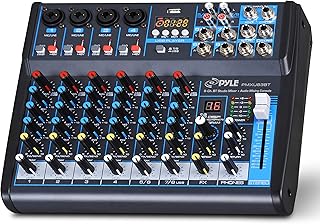
The Pyle PMXU83BT.5 is an 8-channel audio console engineered for small-scale live sound setups, home studios, and content creators. It combines traditional analog mixing controls with modern digital playback options, offering a practical control center for vocals, acoustic instruments, and background tracks.
Input flexibility is a significant highlight, featuring four XLR and 1/4-inch combo inputs equipped with switchable 48V phantom power for condenser mics. The onboard Bluetooth receiver facilitates instant wireless audio streaming from smartphones, while the 16-bit DSP effects engine delivers reverb and delay to enhance live performances without external outboard gear.
Larger event setups may find the channel layout somewhat compact, as it relies on rotary level knobs rather than long-throw faders on individual channels. Furthermore, the USB recording interface operates at basic 16-bit resolution, which works well for live documentation but lacks the headroom required for high-end studio mastering.
Bottom line: For acoustic duos, small venue presenters, and podcasters who want built-in effects and flexible media playback without complex routing, this mixer offers strong utility in a portable footprint.
- Total Channels: 8 input channels
- Microphone Inputs: 4 XLR and 1/4-inch combo jacks
- Wireless Connectivity: Bluetooth 4.0 (15+ foot range)
- Digital Signal Processing: Built-in 16-bit DSP effects
- Equalization: 3-band EQ (High, Mid, Low) per channel
- Phantom Power: +48V switchable
- Digital Playback: USB flash drive port supporting MP3 and WAV files
- Audio Interface: Direct-to-computer USB recording
- Monitoring: 1/4-inch headphone output with dedicated volume control
Connecting this mixer to a computer is straightforward using a standard USB cable, enabling direct recording into digital audio workstations without requiring proprietary drivers. The front USB port also allows instant playback from flash drives, controlled via the built-in LCD interface.
For live sound reinforcement, the console accommodates both dynamic and condenser microphones across its four front combo jacks. Main stereo outputs connect directly to powered PA speakers or an external amplifier, while dedicated RCA inputs and outputs allow easy integration with legacy media players or outboard recording gear.
- Solo musicians and acoustic duos who need an easy-to-carry board with vocal reverb and backing track streaming.
- Coffeehouse performers, open mic hosts, and small houses of worship looking for simple speech and vocal mixing.
- Livestreamers and podcasters seeking multi-microphone capabilities alongside computer audio routing.
- Mobile DJs and event organizers who require Bluetooth connectivity and flash drive playback in a single console.
Pros
- Built-in Bluetooth streaming capability
- Universal multi-voltage power supply
- Individual 3-band EQ on all channels
- +48V phantom power for condenser mics
- Durable steel chassis with sealed knobs
Cons
- Uses rotary knobs instead of long-throw faders for channel volume
- Line inputs use unbalanced 1/4-inch jacks instead of balanced connections
- Limited advanced routing options for complex multi-monitor setups
The Pyle PMXU83BT 8-Channel Audio Mixer is a compact mixing console designed for small live performances, DJ sets, public speaking, and karaoke. It provides a straightforward control layout, making it accessible for beginners while offering the core audio tools needed for clear live sound reproduction.
A major strength of this console is its diverse input flexibility. Combining standard XLR and 1/4-inch line inputs with wireless Bluetooth streaming and a USB audio interface, it allows operators to mix live vocals with digital backing tracks seamlessly. Each channel features a dedicated 3-band EQ and LED peak indicators to prevent distortion during peak performance moments.
Because the unit relies entirely on rotary dials rather than long-throw faders, precise volume adjustments during high-energy live shows can feel slightly less tactile. Bands requiring complex multi-bus routing or independent monitor mixes might find the output routing limited for larger stage setups.
Bottom line: The Pyle PMXU83BT delivers essential mixing capabilities, wireless convenience, and solid steel construction, making it a dependable pick for intimate gigs, rehearsals, and mobile sound setups.
- Channels: 8 input channels
- Inputs: XLR mic inputs and unbalanced 1/4-inch line inputs
- Wireless Connectivity: Bluetooth audio streaming
- Computer Interface: USB port for MP3 support and connection
- Phantom Power: +48V phantom power switch
- Equalization: 3-band EQ per channel
- Chassis Material: Rugged steel construction with sealed rotary controls
- Power Supply: Multi-voltage 100V-240V (+/-15V DC adapter)
Connecting your equipment to this mixer is straightforward thanks to its versatile input jacks and multi-voltage power supply. XLR inputs accept dynamic and condenser microphones with phantom power support, while 1/4-inch jacks accommodate keyboards, drum machines, and line-level instruments.
For digital sources, pair your smartphone or tablet wirelessly via Bluetooth to stream backing tracks without extra cables. The integrated USB interface also links directly with computers for straightforward digital audio playback and recording.
This 8-channel mixer is best suited for mobile DJs, acoustic duos, karaoke hosts, and podcasters who need an easy-to-carry console with modern digital inputs. Its compact footprint makes it easy to transport between small venues, houses of worship, and home studio spaces.
It is also a great fit for presenters and event organizers who need a dependable sound hub to mix multiple microphones and background music simultaneously without complicated routing menus.

Pros
- Pristine Class-A D-PRE microphone preamps
- Durable powder-coated metal construction
- Intuitive one-knob compression control
- Built-in SPX multi-effects processor
- Integrated USB audio interface for recording
Cons
- No dedicated mute buttons on individual channels
- Rotary knobs instead of long-throw faders
- Single-knob compression limited to channels 1 and 2
The Yamaha MG10XU is a compact 10-channel analog mixer designed for live performances, small venue sound, and desktop recording setups. It features discrete Class-A D-PRE preamps that deliver transparent audio reproduction with smooth highs and articulated low frequencies.
Live sound engineers and performers will appreciate the intuitive control layout, which includes one-knob compressors and a 3-band EQ per channel. The onboard SPX digital multi-effects processor provides high-grade reverbs, delays, and modulation to enrich vocals and instruments without external gear.
While the compact chassis is built from rugged powder-coated metal, larger touring bands might find the rotary level controls and the lack of dedicated channel mute switches limiting during complex live performances.
Bottom line: The Yamaha MG10XU offers exceptional audio clarity, durable hardware, and versatile onboard effects for solo acts, small ensembles, and portable sound reinforcement.
- Input Channels: 10 channels (4 mono mic/line, 3 stereo line)
- Microphone Preamps: Discrete Class-A D-PRE preamps with inverted Darlington circuit
- Equalization: 3-band EQ with high-pass filters
- Compression: 1-knob compressors on channels 1 and 2
- Effects Processor: SPX digital multi-effects suite
- Digital Audio: 2-in/2-out USB 2.0 interface
- Chassis Material: Impact-resistant powder-coated metal
- Dimensions: 9.6 x 2.8 x 11.6 inches (244 x 71 x 294 mm)
- Noise Specifications: -128 dBu equivalent input noise, -102 dBu residual output noise
The Yamaha MG10XU integrates smoothly with both analog sound systems and modern digital audio workstations. Its 2-in/2-out USB connectivity allows direct connection to computers for high-resolution recording and playback without needing extra converter boxes.
For live stages, the mixer accommodates dynamic and condenser microphones via XLR inputs with switchable +48V phantom power. Line-level instruments such as keyboards, acoustic guitars, and electronic drum sets plug directly into dedicated 1/4-inch mono and stereo inputs.
This mixer is tailored for solo performers, acoustic duos, and small bands playing coffeehouses, bars, or house concerts. Its compact footprint makes it easy to transport while delivering the sound quality of larger consoles.
Content creators, podcasters, and home studio producers will also benefit from its pristine preamps and USB routing, allowing effortless vocal capture and background audio mixing in real time.

Pros
- Rugged all-metal construction
- Low-noise microphone preamps with ample headroom
- Responsive 3-band EQ on all channels
- Compact and lightweight footprint for travel
Cons
- Only two XLR microphone inputs
- Lacks onboard digital effects processing
- No integrated USB audio output
The Mackie Mix8 is an eight-channel compact analog mixer designed for straightforward live sound and audio routing. It is built for performers, speakers, and podcasters who need an intuitive layout without navigating digital menus.
Its primary strengths include clean microphone preamps that offer low noise and high headroom, along with built-in phantom power for condenser mics. The 3-band EQ on every channel makes balancing vocals and acoustic instruments simple during live sets.
With only two XLR inputs and no built-in USB interface or digital effects, it is not suitable for full bands or complex studio sessions. Groups that require multiple vocal mics or onboard reverb should consider a larger mixing console.
Bottom line: The Mackie Mix8 delivers dependable build quality, clean analog audio, and essential channel controls in a portable metal chassis.
- Channels: 8 total input channels
- Microphone Inputs: 2 XLR with phantom power
- Line Inputs: 2 mono mic/line and 2 stereo 1/4-inch
- EQ: 3-band EQ on all channels
- Auxiliary Routing: 1 aux send with stereo 1/4-inch returns
- Chassis: Rugged metal construction
- Indicators: Pan, level, and overload LEDs
The Mackie Mix8 is tailored for solo acoustic performers, coffeehouse duos, and public speakers who need a dependable mixer that easily fits into a backpack. Its straightforward knob-per-function layout allows quick adjustments on stage without requiring audio engineering expertise.
It also serves content creators, podcasters, and home studio users who need to combine a pair of microphones with keyboards, drum machines, or playback devices. Anyone seeking a durable utility mixer for basic audio summing will appreciate its simplicity.
Connecting gear to the Mix8 is straightforward thanks to its clearly organized top panel. The two XLR inputs accommodate both dynamic and condenser microphones, while dual stereo 1/4-inch inputs handle keyboards, synthesizers, and media players.
The dedicated aux send and stereo return loop allows you to connect outboard hardware processors such as reverb or delay pedals. For output routing, the main 1/4-inch outputs connect directly to powered PA speakers, studio monitors, or external recorders.

Pros
- Three XLR microphone preamps with 48V phantom power
- Integrated USB recording interface and flash drive playback
- Built-in echo and delay vocal effects
- Dedicated 3.5mm headphone monitoring jack
- Compact, portable footprint for mobile setups
Cons
- Cannot use Bluetooth, USB playback, and channels 4/5 simultaneously
- Bluetooth function supports audio input only, not wireless output
- Headphone monitor uses a 3.5mm jack rather than a 1/4-inch port
The Aveek 5-Channel Audio Mixer is an ultra-compact console engineered for small-scale live events, streaming, and content creation. It equips creators with three microphone inputs and flexible stereo routing in a portable form factor.
Strengths include switchable 48V phantom power across all XLR jacks, making it compatible with both dynamic and condenser mics. Integrated delay effects, two-band channel equalizers, and direct USB connectivity allow quick vocal shaping and seamless audio capture to a computer or flash drive.
Keep in mind that the mixer shares routing between Bluetooth, USB media, and stereo channels 4 and 5, so only one of these sources can be active at a time. The Bluetooth feature also functions strictly for incoming audio, meaning external speakers must be wired directly.
Bottom line: The Aveek 5-Channel Audio Mixer delivers essential live sound controls and recording versatility, making it a dependable pick for small venues, mobile presenters, and home studios.
- Channels: 5 total (3 mono mic/line, 1 stereo pair)
- Microphone Inputs: 3 x XLR with switchable +48V phantom power
- Stereo Line Inputs: 1 pair 1/4-inch (6.35mm) and 1 pair RCA
- Main Outputs: 1 pair 1/4-inch (6.35mm) and 1 pair RCA
- Monitoring: 1 x 3.5mm headphone jack
- Digital Connectivity: USB-B PC interface, USB-A drive port, Bluetooth (15 ft range)
- Equalization: 2-band EQ (High/Low) and gain controls per channel
- Built-In Effects: Delay and Echo processing
- Warranty Policy: 45-day replacement or refund satisfaction guarantee
Setting up the mixer with active PA speakers or studio monitors is straightforward using either the stereo 1/4-inch main outputs or RCA connectors. Because the unit outputs at line level, it connects directly to powered speakers or a dedicated external power amplifier.
For computer setups, the built-in USB-B recording chip enables driver-free operation with Windows and Mac systems. Connect the included 59-inch cable to instantly route the stereo mix into your digital audio workstation, streaming platform, or web conferencing software.
Wireless pairing is simple with phones and tablets within a 15-foot range. If pairing stalls, holding down the Play/Pause button for three seconds restarts the onboard Bluetooth module for a clean connection.
- 1 Aveek 5-Channel Audio Mixer
- 1 AC Power Adapter
- 1 USB to Type-C Power Cable
- 1 USB PC Recording and Playback Cable (59 inches)
- 1 Owner's Manual

Pros
- Pristine Class-A D-PRE microphone preamplifiers
- Durable powder-coated metal build
- Compact, highly portable footprint
- Switchable phantom power and pad controls
Cons
- No built-in USB audio interface
- No onboard digital effects processing
- Limited channel count for larger musical ensembles
The Yamaha MG06 is a rugged, compact six-input analog mixer engineered for performers and presenters who require dependable sound in a portable format. Built around Yamaha studio-grade discrete Class-A D-PRE preamplifiers, it delivers natural bass and clean high frequencies for vocal and instrument amplification.
Its standout attribute is the solid powder-coated metal chassis, which handles the wear and tear of live stage work with ease. With features like switchable phantom power, pad attenuation switches, and high-pass filters, the mixer allows quick correction of unwanted rumble and hot input signals on the fly.
Because this is a purely analog standalone unit, it lacks USB audio connectivity and onboard digital effects like reverb or delay. Bands needing complex monitor mixes, multiple microphone channels, or integrated computer routing should consider larger models in the MG series.
Bottom line: The Yamaha MG06 is an exceptional audio solution for solo acts, acoustic duos, and public speakers seeking high preamp clarity and bulletproof build quality without unnecessary bulk.
- Channel Count: 6 standalone channels
- Preamps: Discrete Class-A D-PRE with inverted Darlington circuit
- Chassis: Impact-resistant powder-coated metal
- Phantom Power: Switchable +48V
- Audio Controls: High-pass filters and pad switches
- Metering: LED level indicators
- Connectivity: Analog standalone (No USB interface)
This compact mixer is designed primarily for solo musicians, singer-songwriters, and acoustic duos who need to blend a couple of microphones with acoustic-electric guitars or keyboards.
It is also a great fit for conference presenters, fitness instructors, and worship leaders who require a no-nonsense, reliable desktop audio hub that easily connects into existing house sound systems.
The MG06 offers two combo XLR and quarter-inch inputs capable of handling microphone or line-level signals, complete with switchable 48V phantom power for condenser mics.
Two additional stereo line channels let you connect keyboards, electronic drum kits, or external audio media players, while balanced stereo master outputs ensure clean signal flow to your powered PA speakers.

Pros
- Durable solid metal chassis
- Clean mic preamp with phantom power
- Compact, portable footprint
- Simple, intuitive control layout
Cons
- Only one XLR microphone input
- No built-in digital effects
- Lacks a dedicated power switch
The Mackie Mix5 is a streamlined desktop mixer built for performers and creators who need clean audio routing without excess bulk. Featuring a single microphone channel alongside two stereo line inputs, it offers straightforward control for basic live performances, acoustic gigs, and audio setups.
A key strength is the mixer's rugged metal construction and low-noise analog circuitry. The dedicated microphone input features a studio-grade preamp with phantom power and a responsive 2-band EQ, allowing users to shape vocal tone quickly during live sessions.
With only one XLR input and no onboard digital effects, this unit is not built for full bands or complex multi-mic stages. Those needing multiple vocal channels or built-in reverbs will want to look at larger mixing consoles.
Bottom line: The Mackie Mix5 delivers solid build quality and pristine audio routing for solo acts, presenters, and small venue operators who prioritize simplicity and durability.
- Channels: 5 total input channels
- Microphone Inputs: 1 XLR / 1/4-inch mic/line input
- Stereo Line Inputs: 2 dual 1/4-inch inputs
- EQ: 2-band tone control on microphone channel
- Phantom Power: Included for condenser microphones
- RCA I/O: Dedicated stereo RCA inputs and outputs
- Main Outputs: Left and Right 1/4-inch main outs
- Chassis: Heavy-duty metal construction
Solo acoustic performers who need to blend one vocal microphone with an acoustic guitar or backing tracks for small venue performances.
Podcasters, streamers, and public speakers seeking a compact analog mixing hub for a desktop condenser microphone and auxiliary computer audio.
Keyboard players and multi-instrumentalists who need a compact sub-mixer to combine stereo instruments into a single stereo feed for a main PA system.
The Mackie Mix5 integrates effortlessly into small live sound rigs, powered PA speakers, and home audio setups via standard 1/4-inch main outputs.
Channel 1 accepts both dynamic and condenser microphones with switchable phantom power, while the 1/4-inch and RCA inputs connect directly to electronic keyboards, drum machines, smartphones, and external playback devices without requiring special adapters.
How to Choose the Best Mixing Boards for Live Sound: Buying Guide
Channel Capacity and Input Configuration

Calculating the correct input capacity is the foundation of choosing a reliable console for live performances. Every microphone, acoustic pickup, synthesizer, and auxiliary media player demands its own dedicated input path. If you run short on channels during a live event, you are forced to make sonic compromises that degrade the mix quality. Choosing a console with enough mono microphone preamps and stereo line inputs gives you the headroom needed to accommodate unexpected guest performers or secondary instruments.
For mid-sized acoustic acts and small ensembles, having a combination of XLR and stereo quarter-inch inputs is essential. The YAMAHA MG10XU 10-Input Stereo Mixer with Effects delivers ten input channels, making it easy to route lead vocals, backing microphones, acoustic instruments, and stereo keyboards simultaneously. Similarly, the Pyle 8 Channel Bluetooth Studio Mixer offers eight total channels, including four XLR and quarter-inch combo inputs alongside mono and stereo channels with RCA connections. If your performances feature solo vocalists with acoustic instruments, you might also be evaluating the best acoustic guitars for intermediate players alongside these versatile front-end mixers.
When your operational needs are minimal, ultra-compact consoles provide a streamlined footprint without cluttering your performance area. The Mackie Mix Series Mix8 8-Channel Mixer, Black features two dedicated mic and line inputs paired with two stereo quarter-inch line inputs, which handles a straightforward duo setup efficiently. For even simpler setups, the Aveek 5 Channel Audio Mixer provides three XLR line inputs plus stereo quarter-inch and RCA inputs, while the Mackie Mix5 5-Channel Compact Mixer, Black offers a single mic and line input with two stereo line pairs. Planning your channel needs in advance guarantees you never run out of critical inputs on stage.
Preamp Quality, Headroom, and Low-Noise Performance

Microphone preamplifiers represent the most critical analog component in any live sound mixing board. The preamp is responsible for elevating low-level microphone signals to line level without introducing audible hiss, distortion, or unwanted coloration. High headroom is equally vital in live performance environments where vocal dynamics and percussive peaks can instantly clip an inferior circuit. The Audio Engineering Society’s Pro Audio Reference defines headroom as a term related to dynamic range, used to express in dB the level between the typical operating level and the maximum operating level, or onset of clipping. Clean gain ensures that delicate vocal nuances remain transparent while powerful instrumental passages stay crisp and defined.
Console engineering plays a massive role in maintaining signal purity across long cable runs. The YAMAHA MG10XU 10-Input Stereo Mixer with Effects and the Yamaha MG06 6-Input Compact Stereo Mixer both feature studio grade discrete class A D PRE amps with an inverted Darlington circuit. This specialized circuit architecture delivers fat, natural sounding bass combined with smooth, soaring highs, ensuring that your vocalists and acoustic sources cut through the venue acoustics. The MG10XU boasts an equivalent input noise rating of negative 128 dBu and residual output noise of negative 102 dBu, reflecting a very low noise floor. In the same AES glossary, equivalent input noise (EIN) is defined as the output noise of a system or device referred to the input.
Similarly, Mackie has long been recognized for reliable analog audio performance. The Mackie Mix Series Mix8 8-Channel Mixer, Black and the Mackie Mix5 5-Channel Compact Mixer, Black are engineered with proven high-headroom, low-noise performance, maintaining audio quality across dynamic microphone sources and line-level playback devices. The Pyle 8 Channel DJ Audio Mixer, Bluetooth, DSP FX also emphasizes an ultra-low noise, high headroom design equipped with highly accurate LED peak level indicators. Selecting a board with pristine preamps guarantees that your front-of-house sound system receives clean, uncorrupted audio.
Tone Shaping, Equalization Bands, and Filtering

Acoustic environments vary wildly from one venue to the next, making onboard equalization an indispensable tool for every live audio engineer. Room resonances, boomy stage corners, and harsh high-frequency reflections can quickly ruin a live performance if you cannot shape the frequency response of individual channels. Effective equalization allows you to carve out muddy low-end frequencies, bring vocal presence forward in the mid-range, and soften harsh sibilance before the signal reaches your power amplifiers and main speakers.
Three-band equalizers offer the sweet spot of control and speed for fast-paced live adjustments. Consoles such as the YAMAHA MG10XU 10-Input Stereo Mixer with Effects, the Yamaha MG06 6-Input Compact Stereo Mixer, and the Mackie Mix Series Mix8 8-Channel Mixer, Black provide three-band EQ controls across channels to give you clean, precise tone shaping. Furthermore, the Yamaha models include dedicated high pass filters that allow you to reduce stage rumble, handling noise, and unwanted low-frequency feedback with the press of a button. Shure’s guide to choosing a podcasting microphone notes that a high-pass filter switch on the mic or the mixer adds a second layer of protection from unwanted thumps and bumps, and reduces low-frequency room noise as well. The Pyle 8 Channel Bluetooth Studio Mixer and Pyle 8 Channel DJ Audio Mixer, Bluetooth, DSP FX also feature ultra-musical 3-band EQ sections with high, mid, and low rotary controls.
In contrast, more streamlined units utilize two-band tone shaping to maintain a compact layout. The Aveek 5 Channel Audio Mixer and the Mackie Mix5 5-Channel Compact Mixer, Black provide onboard 2-band EQ controls, focusing on high and low frequency adjustments. While two-band equalization is perfectly adequate for spoken word presentations, podcasting, and solo performers with minimal frequency conflicts, multi-instrument acts benefit substantially from the dedicated midrange sweep of a three-band system. Matching the EQ capabilities to your performance complexity ensures balanced tonal delivery.
Dynamic Control and Onboard Digital Effects
Managing dynamics and adding spatial dimension during a live show can elevate an amateur mix to a polished, professional production. Dynamic compression controls the distance between the quietest and loudest passages of an instrument or vocal track, preventing sudden vocal bursts from distorting the PA system. Wikipedia’s entry on dynamic range compression describes it as an audio signal processing operation that reduces the volume of loud sounds or amplifies quiet sounds, and notes that it is commonly used in live sound reinforcement. Meanwhile, onboard spatial effects like reverb and delay help create depth, gluing dry vocal tracks into the overall acoustic space of the venue without requiring bulky outboard gear racks.
Integrated dynamics and effects processing simplify your live stage setup significantly. The YAMAHA MG10XU 10-Input Stereo Mixer with Effects excels here with its built-in SPX digital effects and proprietary 1-knob compressors. These 1-knob compressors allow easy control, resulting in livelier guitars, punchier bass lines, a tighter snare, and a cleaner vocal sound with a single turn of a dial. The Yamaha MG06 6-Input Compact Stereo Mixer also incorporates 1-knob compressors for instant dynamic smoothing across primary channels.
For performers who enjoy ambient enhancements, the Pyle 8 Channel Bluetooth Studio Mixer incorporates analog FX and 16-bit DSP processing with an easy-to-read LCD display and dedicated front-panel controls. The Aveek 5 Channel Audio Mixer provides onboard delay and echo effects, which are well-suited for live streaming, karaoke, and small band shows. Alternatively, the Mackie Mix Series Mix8 8-Channel Mixer, Black includes a dedicated aux send with stereo quarter-inch returns, allowing sound technicians to patch in their preferred external hardware processors seamlessly.
Digital Connectivity, Bluetooth Streaming, and Media Playback
Modern live sound environments frequently require versatile playback and recording options alongside standard microphone mixing. Venue managers and sound operators need the ability to play break music between band sets, trigger backing tracks directly from mobile devices, or capture multi-track audio to a computer workstation. Digital interfaces built directly into the console eliminate the clutter of external audio interfaces and specialized breakout cables.
Wireless Bluetooth capabilities make interval music management effortless. The Pyle 8 Channel DJ Audio Mixer, Bluetooth, DSP FX and the Pyle 8 Channel Bluetooth Studio Mixer feature built-in Bluetooth wireless streaming with a range of over fifteen feet, allowing operators to stream playlists directly from smartphones, tablets, or laptops. For context, the Bluetooth SIG explains that the effective, reliable range between Bluetooth devices is anywhere from more than a kilometer down to less than a meter, and that the answer depends on factors such as transmit power, receiver sensitivity, antenna gain, and path loss. The Aveek 5 Channel Audio Mixer also includes wireless Bluetooth streaming alongside a built-in PC recording chip and USB stick playback and recording capabilities. These multi-functional features make casual live gigs, weddings, and network anchoring far more convenient.
For direct-to-computer audio tasks, the YAMAHA MG10XU 10-Input Stereo Mixer with Effects provides a high-quality USB connection designed to integrate into a DAW-based workflow for both stage and studio tracking. Conversely, purist analog performers may prefer standalone consoles like the Yamaha MG06 6-Input Compact Stereo Mixer or the Mackie Mix5 5-Channel Compact Mixer, Black, which focus strictly on pure analog routing without USB or digital wireless overhead. Deciding between digital integration and straightforward analog simplicity depends on your regular workflow.
Build Durability, Chassis Construction, and Power Flexibility
Stage gear is subject to constant transport, accidental drops, vibrational stress, and dusty venue environments. A flimsy mixing board with fragile plastic pots and loose jacks will quickly develop scratchy knobs and intermittent channel dropouts. Investing in a mixer built around an all-metal chassis ensures that your sensitive internal circuit boards and audio op-amps remain shielded from physical impact and electromagnetic interference.
Chassis construction is a key differentiator among top-tier portable mixers. Both the YAMAHA MG10XU 10-Input Stereo Mixer with Effects and the Yamaha MG06 6-Input Compact Stereo Mixer are built inside rugged, impact-resistant, powder-coated metal chassis engineered to withstand the rigors of frequent touring. Mackie also emphasizes durability with the rugged metal chassis on the Mackie Mix Series Mix8 8-Channel Mixer, Black and Mackie Mix5 5-Channel Compact Mixer, Black. These solid enclosures protect internal connections from flexing during heavy cable patching.
Environmental protection and electrical versatility are equally valuable for traveling musicians. The Pyle 8 Channel DJ Audio Mixer, Bluetooth, DSP FX features a rugged steel chassis equipped with sealed rotary controls designed specifically to resist dust and grime during outdoor gigs or stage setups. In addition, this unit includes a multi-voltage power supply compatible with 100V to 240V systems, making it suitable for worldwide touring. Choosing hardware with reinforced structural integrity prevents unexpected technical failures in the middle of a live performance.
| Product | Channel Count | Equalization | Digital Effects / Processing |
|---|---|---|---|
| YAMAHA MG10XU 10-Input Stereo Mixer with Effects | 10 channel mixer | 3 band EQ and high pass filters | SPX digital effects |
| Mackie Mix Series Mix8 8-Channel Mixer, Black | 8-channel compact mixer | 3-band EQ on all channels | 1 aux send with stereo 1/4” returns |
| Pyle 8 Channel Bluetooth Studio Mixer | 8 channel mixer | 3-band EQ | 16-bit DSP processing and analog FX |
| Aveek 5 Channel Audio Mixer | 5 channel | onboard 2-band EQ | Delay or echo effects |
| Yamaha MG06 6-Input Compact Stereo Mixer | 6 channel standalone mixer | 3 band EQ and high pass filters | 1 Knob compressors |
Why You Should Trust Us
At Daily Deal Here, our audio editorial team approaches gear recommendations with a rigorous, methodical mindset. We understand the high stakes of live audio engineering, where equipment reliability directly impacts performers and audiences. To provide genuine buying advice, we analyze verified customer reviews, cross-reference manufacturer specification sheets, and scrutinize structural schematics. We examine thousands of real-world user experiences across music venues, worship centers, and streaming setups to identify recurring strengths and mechanical weaknesses.
Our evaluation focuses on key hardware criteria, including preamplifier discrete circuit topology, signal-to-noise ratios, thermal performance, fader smoothness, and chassis resilience. We deliberately bypass promotional marketing claims to evaluate how these mixing boards perform when subjected to continuous touring schedules, humid environments, and complex routing demands. By pairing technical analysis with real-world buyer feedback, we curate objective, reliable gear guides designed to help you invest with complete confidence. You can also explore our broader directory of All buying guides and reviews to see how we analyze audio and consumer gear across multiple categories.
Final Thoughts
Selecting the best mixing board for your live sound setup requires balancing input capacity, tonal flexibility, build quality, and specialized features. Whether you run sound for a touring band, manage audio for a house of worship, or mix acoustic sets at local venues, your console serves as the nerve center of your entire sound system. Taking the time to evaluate your channel requirements, microphone preamp quality, and dynamic processing needs ensures you achieve a clear, balanced mix every time you take the stage.
Our top overall recommendation is the YAMAHA MG10XU 10-Input Stereo Mixer with Effects. It combines studio grade discrete class A D PRE preamps, intuitive 1-knob compressors, and versatile SPX digital effects inside a rugged metal chassis that easily withstands live stage use. For performers and venues seeking maximum capability on a tight budget, the Aveek 5 Channel Audio Mixer represents our top value choice, delivering three XLR inputs, USB recording capabilities, and wireless Bluetooth streaming in an ultra-accessible format.
If your priority is straightforward, no-nonsense analog mixing with exceptional headroom in a compact footprint, the Mackie Mix Series Mix8 8-Channel Mixer, Black is an outstanding option for small acoustic ensembles. Alternatively, those who require wireless playback and multi-voltage flexibility for mobile gigs will appreciate the Pyle 8 Channel DJ Audio Mixer, Bluetooth, DSP FX. To discover more gear tailored to your performance needs, check out our full collection of Browse all categories and stage accessories.
Frequently Asked Questions About Mixing Boards for Live Sound
How many channels do I need on a mixing board for live sound?
The ideal channel count depends on your ensemble size and the complexity of your live setup. A solo performer or acoustic duo can comfortably manage with a five-channel or six-channel console that accommodates two vocal microphones and an instrument input. However, small bands, worship teams, or setups with multiple vocalists, keyboards, and drum mics generally require an eight-channel or ten-channel mixing board. It is always wise to choose a console with two extra channels beyond your current setup to accommodate guest performers or unexpected audio sources.
Why is 48V phantom power important on a mixing board for live sound?
Phantom power supplies forty-eight volts of direct current through standard XLR cables to power active electronics in condenser microphones and active direct injection boxes. While dynamic microphones operate passively without external voltage, condenser microphones require phantom power to charge their internal capacitor elements and onboard preamplifier circuits. Having integrated 48V phantom power on your mixing console ensures you can deploy studio-grade condenser vocal mics, acoustic instrument clip-ons, and active DI boxes on stage without needing external battery packs or dedicated standalone power supply units during your live performances.
How do onboard EQ and high-pass filters improve a live sound mix?
Onboard equalization and high-pass filters allow you to tailor the tonal balance of each channel to counteract the acoustic quirks of a performance space. High-pass filters roll off sub-audible low-frequency rumble, stage vibrations, and wind noise below eighty hertz, freeing up valuable system headroom. Meanwhile, three-band equalizers let you attenuate harsh vocal frequencies, boost mid-range clarity, and carve space between competing instruments. If you are balancing delicate acoustic instruments like those featured in our guide to the best nylon string guitars, precise equalization prevents muddiness across the PA.
What features make a mixing board for live sound suitable for streaming and recording in 2026?
A modern mixing console suitable for live streaming and recording should feature a built-in USB audio interface that connects directly to a computer without requiring specialized external converter boxes. This allows seamless two-way digital communication, sending your live stereo master mix straight to broadcast software while simultaneously receiving playback audio from your computer. Having dedicated headphone monitoring controls, accurate LED peak meters, and plug-and-play driver compatibility further streamlines workflow, making it simple to broadcast clear live audio to online audiences while mixing for a physical venue.
Should I choose an analog mixer or one with Bluetooth wireless streaming?
Choosing between a traditional analog mixer and a Bluetooth-enabled console depends on your gig workflow and playback requirements. Traditional analog mixers focus exclusively on low-noise signal paths, high headroom, and physical knob-per-function simplicity, making them exceptionally reliable for pure instrument and vocal mixing. Mixers with integrated Bluetooth wireless streaming add convenience for venue managers, solo performers, and DJ sets by allowing cable-free music playback directly from mobile devices during event intermissions. If you frequently handle background music or media playback, Bluetooth saves time and eliminates adapter clutter.

Write Your Review
No reviews yet. Be the first to share your experience!