

Buying a smart bulb looks simple until the first one refuses to join the app, and then you learn that “works with Alexa” covers at least three different setup experiences. Some bulbs are found by an Echo the moment they are powered on. Some need a manufacturer app first and an account you did not want. A few still expect a hub plugged into your router. We sorted 7 of them from SYLVANIA, Sengled, Kasa and more by what actually separates them once the box is open in September 2026: how they pair, whether they change color or only warmth, and how bright they really are.
Our top pick is the Sengled Alexa Light Bulb S1 for pairing itself with an Echo automatically, with no separate app and no account to create. Below we sort the field from the simplest setup up to full color bulbs so you can match one to how much fiddling you are willing to do. For the rest of the room, our electronics section covers adjacent kit.

Pros
- Pairs automatically with an Echo, no second app to install
- No manufacturer account to create
- Standard A19 shape and E26 base fits normal fixtures
- Dimming and scheduling through the Alexa app you already have
Cons
- Warm white only, no color and no tunable range
- Tied to the Alexa ecosystem rather than neutral
This is the bulb to hand someone who does not want a project. Screw it in, ask the Echo to discover devices, name it, done. No app store, no email address, no password.
That matters more than the spec sheet suggests, because pairing is where this category loses people. A bulb that sets up in ninety seconds gets used; one that needs an account often sits in a drawer.
What you give up is color and color temperature. This is warm white, dimmable, and nothing else. For a hallway, a bedside lamp or a porch light, that is the whole requirement anyway.
Bottom line: the easiest smart bulb here to live with, and the right default unless you specifically want color.
- Light: warm white, dimmable
- Pairing: automatic with Echo devices
- App: none required beyond Alexa
- Shape and base: A19, E26
- Hub: not required
- Network: works via the Echo
- Color: not supported
- Tunable white: not supported
Buy this for a household that already has an Echo and wants the least possible setup, or as a gift for someone who would abandon a bulb that needed an account. It suits hallways, bedrooms and lamps. Choose a color or tunable bulb instead if you want scenes or want to shift between warm and cool light.
Power the bulb, then ask the Echo to discover devices rather than opening any other app. Name it after the room and the fixture, not the brand, then put it in a room group so one command controls everything there. Leave the wall switch on permanently, since cutting power at the wall makes any smart bulb unreachable.

Pros
- Sets up in the Alexa app without a third party account
- Color changing and dimmable at an entry price
- 800 lumen output in white mode
- Standard A19 and E26 fitting
Cons
- Color output is dimmer than the white figure suggests
- Basic app features compared with the specialist brands
The value pick, and a sensible way to put color in a room without committing to a brand ecosystem. Setup runs through the Alexa app, so there is no second account.
Brightness in white mode sits at the usual 800 lumen mark, which is the standard 60W equivalent point. As with every color bulb, saturated colors come out dimmer, because only part of the LED array is doing the work.
App features are basic next to the specialist brands: fewer effects, simpler scheduling. For most households that is exactly enough.
Bottom line: the cheapest honest way into color bulbs, especially if the house is already on Alexa.
- Light: color changing plus white
- Brightness: 800 lumens in white mode
- Equivalence: 60W
- Shape and base: A19, E26
- Setup: through the Alexa app
- Hub: not required
- Network: Wi-Fi, 2.4 GHz
- Dimmable: yes
This suits a first color bulb, a child's room, or anywhere you want a scene without spending much. It fits households already using Alexa for everything. Anyone who wants elaborate effects or a strong app should look at the specialist brands here instead.
Compare it against the specialist color bulbs on app features rather than on the light itself, since output at this tier is broadly similar. If you want music sync and animated effects, pay more. If you want on, off, dim and a couple of colors, this covers it. Check fixture size, since smart bulbs run slightly longer than plain LEDs.

Pros
- Effects and scene library are the best developed here
- 800 lumens in white mode
- Well rated across a large owner base
- Works with Alexa and Google Home
Cons
- Requires the maker app and an account
- Effects drain attention more than they change daily use
Govee builds its reputation on effects, and if color is the reason you are buying, this is where the software is strongest. Scenes, transitions and music reactive modes are all there and they work.
The bulb itself is a conventional 800 lumen A19, so in white mode it is comparable with everything else here. The difference is what the app lets you do with color.
You do need the maker app and an account, which is the standard cost of a specialist ecosystem. If effects are the point, that trade is reasonable.
Bottom line: the pick when color and scenes are the actual reason for buying, rather than an afterthought.
- Light: color changing plus white
- Brightness: 800 lumens in white mode
- App: maker app with scene library
- Shape and base: A19, E26
- Platforms: Alexa and Google Home
- Hub: not required
- Network: Wi-Fi, 2.4 GHz
- Account: required
Choose this for a living room, a gaming setup or anywhere color is decorative and you will actually use scenes. It suits people who enjoy setting things up. If you want one bulb that just turns on when asked, the auto pairing white bulb is a better fit and costs less.
Set up in the maker app first, then link the account to Alexa so voice control works alongside the effects. Build two or three scenes you will actually use and name them plainly. Remember that saturated colors are dimmer than white, so a room lit only in color will need more bulbs than you expect.

Pros
- App is stable and the scheduling is dependable
- Full color plus tunable white range
- Backed by an established networking company
- Works with Alexa and Google Home
Cons
- Requires the maker app and account
- Fewer flashy effects than the effects focused brands
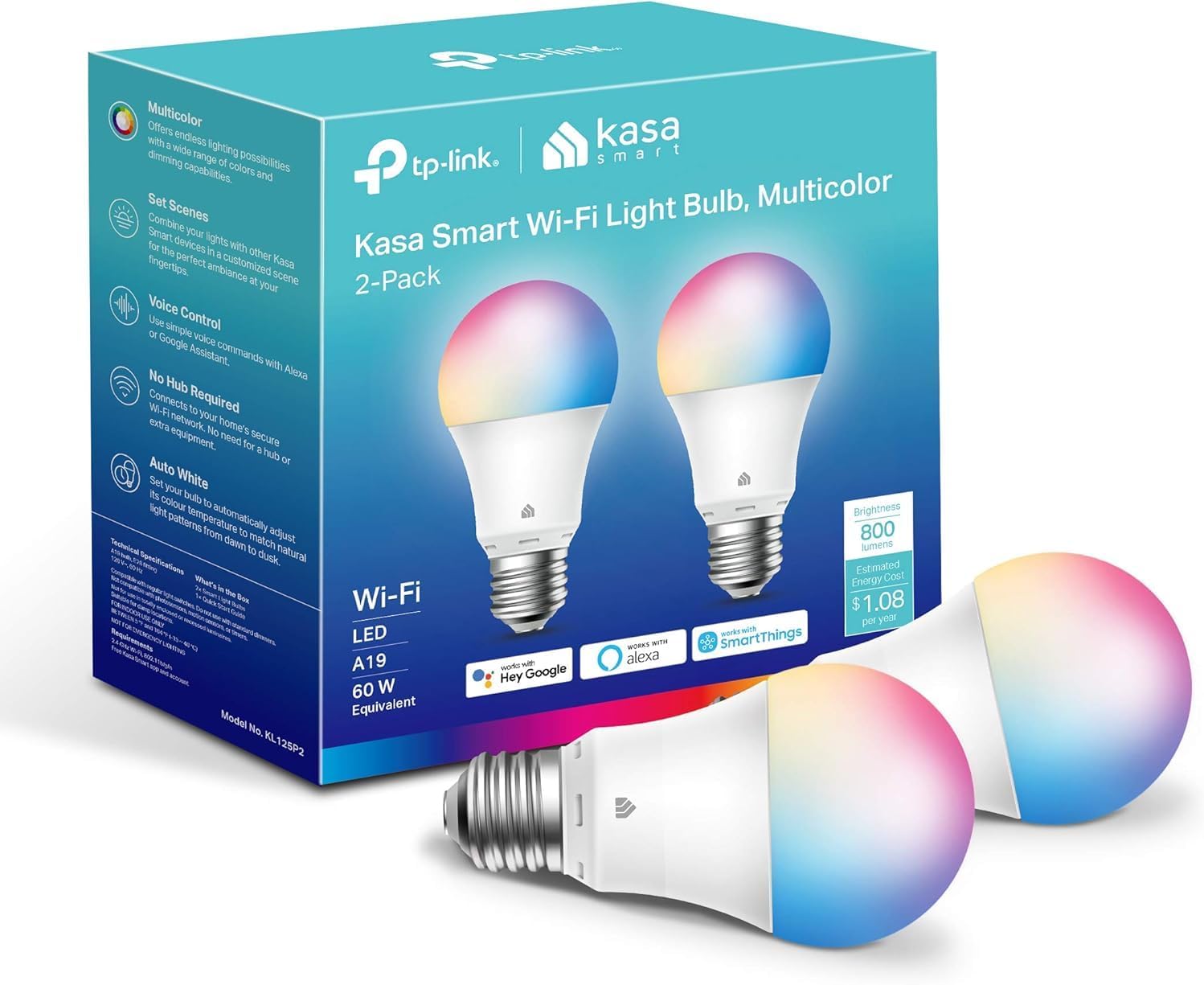
Kasa comes from a networking company and it shows in the least exciting and most valuable way: the app is stable and the schedules fire when they should. In a category where a missed routine is the common complaint, that counts.
The bulb covers full color plus a tunable white range, so it works as a reading light in the day and a scene at night from the same fitting.
The effect library is thinner than the specialist brands. If you want animation and music sync, look elsewhere; if you want lights that behave predictably, this is the one.
Bottom line: the dependable full color option, and the pick when routines matter more than effects.
- Light: full color plus tunable white
- App: maker app with scheduling and away mode
- Shape and base: A19, E26
- Platforms: Alexa and Google Home
- Hub: not required
- Network: Wi-Fi, 2.4 GHz
- Dimmable: yes
- Account: required
Buy this if you want schedules and away modes that work reliably, and colors as a bonus rather than the main event. It suits a main living space or a bedroom. Anyone chasing animated effects should choose the effects focused brand, and anyone who wants no app at all should take the auto pairing bulb.
Weigh this against the other full color bulbs on app reliability rather than on light quality, which is close across the tier. If you already own other kit from the same maker, staying in one app is worth real convenience. Confirm the fixture is not fully enclosed unless the listing states it is rated for one.

Pros
- Matter support means pairing by QR code, no brand account
- Mixes with other Matter devices in one app
- Multicolor plus white, 60W equivalent
- Future proof as more controllers adopt Matter
Cons
- Needs a reasonably recent Echo or another Matter controller
- Matter setup can be less forgiving than a maker app on older hardware
Matter is the answer to the problem of one app per brand, and this is the bulb in the group that supports it. Scan a code, and it joins whatever Matter controller you have, including a recent Echo.
For a household planning to add devices from several makers over time, that is the difference between one app and five. It is the forward looking choice rather than the cheapest one.
The requirement is a controller that speaks Matter. An older Echo may not, and in that case the bulb falls back to a more conventional setup, which is worth checking before ordering.
Bottom line: the pick if you expect to mix brands, and you have a recent enough Echo to act as the controller.
- Standard: Matter compatible
- Light: multicolor plus white
- Equivalence: 60W
- Pairing: QR code to a Matter controller
- Shape and base: A19, E26
- Hub: not required with a Matter controller
- Platforms: any Matter ecosystem
- Requires: a reasonably recent Echo or other controller
Choose this if you plan to build a smart home from more than one brand and would rather not collect accounts, and if your Echo is recent enough to act as a Matter controller. If everything you own is from one maker and their app suits you, Matter buys you nothing today.
Check your Echo model supports Matter before ordering. Keep the QR code on the bulb or photograph it before installing, since it is needed to pair and is unreadable once the bulb is in a ceiling fixture. Pair from the Alexa app using the Matter option rather than a brand specific flow.

Pros
- Full color plus a proper tunable white range
- From a lighting company rather than a gadget brand
- 60W equivalent A19 in a standard base
- No hub needed, joins Wi-Fi directly
Cons
- Maker app and account required
- App is more basic than the specialist smart home brands
SYLVANIA has been making light bulbs far longer than anyone else in this list has been making smart devices, and the light quality reflects that: the white range is well judged and the color rendering is unfussy.
Tunable white plus full color from one fitting covers both jobs, which suits a room that is a workspace during the day and something softer in the evening.
The app is functional rather than rich. If you want elaborate effects, this is not the brand; if you want a good bulb that also happens to be smart, it is.
Bottom line: the pick when light quality matters more than app features.
- Light: full color plus tunable white
- Equivalence: 60W
- Shape and base: A19, E26
- Connection: direct Wi-Fi
- Platform: works with Alexa
- Hub: not required
- App: maker app required
- Dimmable: yes
This suits someone who cares how the light actually looks and wants both tunable white and color from one bulb, in a room used for different things through the day. If effects and scene libraries are the draw, one of the specialist brands will satisfy more. If you want zero setup, take the auto pairing bulb.
Check whether the fixture is fully enclosed before fitting, since trapped heat is what shortens the life of the electronics in any smart bulb. Give it the 2.4 GHz band during setup rather than 5 GHz. Keep the wall switch on so the bulb stays reachable, and set the power loss behavior in the app if it offers one.

Pros
- Cheapest tier that still gives voice control and dimming
- Reliable scheduling from a stable app
- No color to configure or forget about
- A19 and E26 fits standard fixtures
Cons
- White only, no color and no tunable range
- Still needs the maker app and account
Most smart bulb use turns out to be turning lights on, off and down. This is the bulb that does exactly that and nothing else, at the cheapest tier.
In a hallway, a landing, a garage or a bedside lamp, color would never be used, and paying for it is money on a feature that sits idle. Scheduling is the feature that actually earns its place here, and Kasa's is dependable.
The one cost is that it still wants the maker app and account, unlike the auto pairing bulb at the top of this list.
Bottom line: the sensible bulb for the rooms nobody wants a light show in.
- Light: dimmable white
- Color: not supported
- App: maker app with scheduling
- Shape and base: A19, E26
- Platforms: Alexa and Google Home
- Hub: not required
- Network: Wi-Fi, 2.4 GHz
- Account: required
Buy this for hallways, landings, garages and bedside lamps, and anywhere you want schedules rather than scenes. It is also the sensible bulk purchase for a whole house. If you want no account at all, the auto pairing bulb does the same job with less setup.
Decide by room rather than by house. Color bulbs belong in one or two social spaces; plain white ones belong everywhere else, and buying white where white is all you need leaves budget for the rooms that benefit. Check total device count if you are buying many, since Wi-Fi bulbs each take a network address.
How to Choose a Smart Bulb
Setup first, then what the light actually does. Read the first section even if you skip the rest, because pairing is where this category frustrates people.
Auto Pairing, Matter, and the App Question
The easiest bulbs announce themselves to an Echo when they first get power, and the Alexa app finds them without you installing anything else. That is the whole setup: screw it in, say the discovery command, name the bulb. For a gift or for someone who does not want another app, this is the feature that matters most.
Most bulbs instead ask you to install the maker’s app, create an account, join the bulb to your Wi-Fi there, then link that account to Alexa. It works and it takes a few minutes, but it means a second app and a second account per brand, which adds up in a house with bulbs from three makers.
Matter is the newer standard meant to end that. A Matter bulb joins any Matter controller, and a recent Echo counts as one, so pairing is a QR code rather than an account. The Matter bulb in this list is the forward looking option if you expect to mix brands later.
Group naming is the setup step people skip and later wish they had not. Naming a bulb “Lamp” and putting it in a room group means a single command controls everything in that room, which is what makes voice control feel worth having. Bulbs named after brands or model numbers produce commands nobody in the household remembers.
Hub or No Hub
Older smart bulbs used low power radios that a phone cannot talk to directly, so they needed a hub plugged into the router. Every bulb here is hub free: they either join your Wi-Fi directly or talk to an Echo that is already in the house.
Wi-Fi bulbs have one practical limit worth knowing before you buy a dozen. Each one takes an address on your network, and consumer routers get unhappy somewhere between thirty and sixty connected devices depending on the model. For one or two rooms this never comes up; for a whole house it does.
They also want the 2.4 GHz band rather than 5 GHz. On a router that merges both bands under one name, that occasionally causes a bulb to fail setup, and the fix is usually to separate the bands temporarily while pairing.
Routines are where the value actually shows up, and they are free once the bulb is paired. Lights that come on at sunset, a bedroom that fades up in the morning, a lamp that switches off an hour after everyone is normally asleep: none of that needs a voice command, and it is the part people keep long after the novelty of shouting at a lamp has worn off.
White Only, Tunable White, or Full Color

Three tiers, and most people overbuy. A plain smart white bulb turns on, off and dims on command, which covers the actual daily use in a hallway or a bedroom. It is the cheapest tier and it is the one people keep using.
Tunable white shifts between warm and cool without changing color. That is genuinely useful: warm in the evening, cool and bright for reading or working. If you only upgrade one thing above plain white, this is the one that changes how a room feels day to day.
Full color bulbs do everything plus millions of colors. They are fun for a week, then most households settle on two or three scenes and leave it there. Buy color where it is decorative, such as a living room or a child’s room, and buy tunable white where you actually read.
Brightness, and What 60W Equivalent Means

Ignore the watts. A smart bulb drawing nine watts described as 60W equivalent is telling you roughly how bright it looks compared with an old incandescent, and the number that actually matters is lumens. Around 800 lumens is the common 60W equivalent point, and most bulbs here sit there.
Color bulbs have a catch. The lumen figure is usually measured in white mode, and output drops substantially in saturated colors, because a deep blue is only using part of the LED array. A room lit entirely by colored bulbs is dimmer than the box suggests.
For a fixture that needs real light, check the lumens rather than the equivalence claim, and consider that a shade or a recessed can eats a share of it. Our article archive covers more household kit.
Dimming quality separates bulbs more than the specification sheets admit. Cheap bulbs step visibly between levels and can flicker at the bottom of the range, while better ones fade smoothly down to a low glow. If a bulb is going in a bedroom where you want it very dim at night, that low end behavior matters more than the maximum brightness does.
Base Size and Whether It Fits
Almost everything here is an E26 base in an A19 shape, which is the standard household bulb in North America. It fits table lamps, ceiling fixtures and most recessed cans without an adapter.
Where it goes wrong is the physical size rather than the thread. Smart bulbs carry electronics in the base, so they are usually a few millimeters longer and fatter than a plain LED. In a tight enclosed fixture or a small shade, that difference is the reason a bulb does not seat or the glass will not close.
Check whether the fixture is fully enclosed too. Heat has nowhere to go in a sealed globe, and heat is what shortens the life of the electronics inside a smart bulb. Several makers state explicitly whether a bulb is rated for enclosed fixtures.
Power outages are worth a thought too. Most bulbs return to whatever state they were in, but some default to full brightness white when power comes back, which at three in the morning after a brief cut is memorable. Several apps let you set the behavior after a power loss, and it is worth setting once rather than being surprised.
What Happens at the Wall Switch
This is the thing nobody explains and everybody meets. A smart bulb needs constant power to listen for commands. Turn the wall switch off and the bulb is simply off: Alexa cannot reach it, and voice control stops working until someone flips the switch back on.
In a household where other people use the room, that becomes a daily annoyance. The usual answers are a switch guard so the switch cannot be flipped, or a small battery powered remote stuck beside the switch that people press instead.
It is also the argument for smart switches over smart bulbs in some rooms. A smart switch controls whatever bulb is in the fixture and keeps the wall control working normally, which suits a hallway better than a bulb does.
Buying in multipacks is usually the cheaper route once you have decided a room needs more than one, and it also keeps the light consistent. Mixing brands within a single fixture or a single room is where color temperature differences show: two bulbs both described as warm white can sit noticeably apart, and the eye picks that up immediately in a ceiling fitting with several lamps.
| Type | Best at | Weak at |
|---|---|---|
| Auto pairing white | Simplest setup, no extra app or account | White only, no color scenes |
| Tunable white | Warm evenings and cool task light from one bulb | Costs more than plain white for no color |
| Full color Wi-Fi | Scenes, decoration, color for occasions | Dimmer in saturated colors, needs the maker app |
| Matter bulb | Pairs by QR code, mixes with other brands later | Needs a reasonably recent Echo or hub |
One last practical note on lifespan. LED bulbs are rated in tens of thousands of hours, but the electronics in a smart bulb usually fail before the diodes do, especially in a hot enclosed fixture. Treat the rated hours as the ceiling rather than the expectation, and check warranty length, which for this category typically runs one to three years.
Why You Should Trust Us
We build these lists from published specification and from the pattern of what long-term owners report rather than from marketing copy. For each bulb here we checked how it pairs and whether a separate app and account are required, whether it supports Matter, the stated lumen output rather than the wattage equivalence, whether it is white, tunable or full color, the base and shape, and whether the maker rates it for enclosed fixtures.
We kept this list to bulbs rather than fixtures and strips, because a search for a smart bulb should return things that screw into a lamp. Where a bulb only reaches its quoted brightness in white mode, we say so rather than repeating the headline figure.
Final Thoughts
Best overall is the Sengled Alexa Light Bulb S1. It pairs itself with an Echo the moment it has power, with no second app and no account, which is the single biggest source of friction in this category removed entirely.
Best value is the Amazon Basics Smart A19 LED Bulb. It covers color changing and dimming at the lowest outlay here and sets up inside the Alexa app you already have.
For specific needs, the Govee Smart Light Bulb is the pick if scenes and color effects are the point, the Kasa full color bulb suits someone who wants a well supported app with schedules and away modes, the Sengled Matter bulb is the forward looking choice if you expect to mix brands, the SYLVANIA Wi-Fi bulb covers tunable white plus color from a long established lighting name, and the Kasa dimmable white bulb is the sensible one for a hallway or bedroom where color would never get used. More picks are indexed across our category index.
Smart Bulb FAQs
Do I need a hub?
Not for any bulb in this list. They either join your Wi-Fi directly or talk to an Echo you already have. Hubs belonged to an earlier generation that used low power radios a phone could not reach. The tradeoff with Wi-Fi bulbs is that each one occupies an address on your network, which is fine for a few rooms and can strain a consumer router once you are past a few dozen devices.
Why did my bulb stop responding to Alexa?
Nine times out of ten the wall switch is off. A smart bulb needs constant power to listen, so cutting power at the switch makes it unreachable until someone flips it back. The rest of the time it is the network: the bulb wants the 2.4 GHz band, and a router that merges both bands under one name sometimes pushes it to 5 GHz where it cannot connect. Separating the bands during setup usually fixes it.
Is a color bulb worth it over tunable white?
Depends on the room. Color is genuinely good in a living room, a child’s room or anywhere you want a scene, and most households settle on two or three favorites within a month. In a room where you read or work, tunable white does more real work: warm in the evening, cool and bright during the day. Colors also come out dimmer than the lumen figure suggests, since that number is measured in white mode.
Can I use these in an enclosed fixture?
Only if the maker says so. Smart bulbs carry electronics in the base and heat is what kills those electronics early. A sealed globe or a fully enclosed ceiling fixture traps that heat. Check the listing for an enclosed fixture rating, and if it is absent, assume the bulb is not intended for one. Also check physical size, since smart bulbs run slightly longer and wider than plain LEDs. Our electronics archive covers related gear.
What is Matter and do I need it?
Matter is a shared standard so devices from different makers pair with any compatible controller, usually by scanning a QR code, without a per brand account. If all your bulbs come from one maker and you are happy with their app, you do not need it. If you expect to mix brands, or you would rather not create another account, a Matter bulb is the one that ages better. It does need a reasonably recent Echo or another Matter controller.




Write Your Review
No reviews yet. Be the first to share your experience!