

The word tactical does a lot of work in this category and very little of it is technical. In practice it describes a look and a finish, a black coated body, a nylon sheath, a squared off frame, rather than any capability a plain stainless tool lacks. What actually separates one of these from another is far more ordinary: how many of the listed tools you can reach without unfolding the pliers, whether the blade locks, and whether the thing is comfortable enough to keep carrying after the first week. We sorted 7 multi tools from Leatherman, Gerber, RoverTac and more by usable tool count, plier shape, locking, steel and how each one rides in a pocket or on a belt. Our sports and outdoors section covers the rest of the kit.
Our top pick is the Leatherman Wingman for pairing spring action pliers and scissors with a blade that opens one handed from the outside of the handle, which is the layout that gets used rather than admired. Below we keep the three formats separate, full size plier tools, keychain minis and pen shaped carry tools, because they answer different questions and comparing them on tool count alone tells you nothing useful.

Pros
- Blade opens one handed with the handles still closed
- Spring action pliers and scissors do not need a grip reset between cuts
- Scissors are genuinely usable rather than a token inclusion
- 25 year guarantee on the tool
- Stainless construction throughout
Cons
- Heavier in a pocket than a skeletonised frame
- No bit driver socket, so drivers are fixed rather than swappable
- No sheath supplied in every listing configuration
The Wingman is the tool in this list that behaves most like a pocket knife you happen to be able to grip things with. The blade sits on the outside of the closed handle and opens with one thumb, so the knife is available in the second it takes to think of it rather than after a two handed unfolding.
Spring action is the other feature doing real work. Pliers and scissors that return on their own let you make repeated cuts without releasing and regripping, which sounds minor until you strip a length of wire or open a run of packaging.
The scissors deserve their own mention because most multi tool scissors are unusable. These are sprung, they meet properly along the blades, and they handle fabric and tape rather than folding it over.
What you give up is a bit driver socket, so the drivers are the ones built into the handle rather than a swappable set, and the tool is heavier than the skeletonised competition. The guarantee is the counterweight: this is a tool bought once.
Bottom line: the most useful layout here and the one to buy if the tool is going to be carried every day.
- Format: full size plier multi tool
- Pliers: spring action, with wire cutters and stripper
- Scissors: spring action
- Blade: one hand opening, outside accessible, locking
- Drivers: fixed screwdrivers
- Material: stainless steel
- Warranty: 25 years
Buy this if the tool is going to be carried daily and used without warning, in a pocket or on a belt, for packages, wire, fasteners and the small repairs that turn up. Skip it if you want a swappable bit set for serious driving work, where a tool with a bit socket and nine bits does more, or if you want the lightest possible thing on a keyring.
Put a drop of light oil at each pivot once a season, because folding tools seize at the pivots long before anything else fails. Rinse and dry the tool the same day if it has been near salt water. Always confirm the blade lock has engaged before cutting toward yourself, and release the lock deliberately with the blade pointing away rather than folding it against a thumb.

Pros
- Spring loaded needle nose jaws reach into recesses and hold small work
- Pocket clip means it carries without a sheath
- Skeletonised frame keeps the weight down
- Wire stripper built into the jaw
Cons
- Skeletonised handles dig into the palm under heavy squeezing
- Most tools sit inside the handles, so they need two hands to reach
- Needle nose tips will bend if used to turn stubborn fasteners
The Suspension NXT is the light, clip carried option here. The frame is skeletonised to cut weight and the pliers are spring loaded, which together make it a tool people actually keep in a pocket rather than in a drawer.
Needle nose jaws are the defining choice. They reach into places blunt jaws cannot, hold small wire and split rings, and suit electronics, tackle and hobby work. The same taper that makes them useful makes them the wrong tool for turning a stuck nut, and bent tips are the most common way these get retired.
The pocket clip is worth more than it looks on a spec list. A tool that clips rides upright and reachable, and it removes the need to find a sheath and a belt position for it.
The compromise is comfort. Cut out handles save weight and leave edges, so hard squeezing is less pleasant than on a solid framed tool, and most of the implements live inside the handles and need two hands to deploy.
Bottom line: the pick for needle nose work in a light frame you will carry clipped.
- Format: butterfly opening plier multi tool
- Listed tools: 15
- Pliers: spring loaded needle nose
- Cutting: wire cutters and wire stripper
- Carry: pocket clip
- Finish: black
- Body: skeletonised stainless
Buy this if your work involves small wire, connectors, tackle or anything that needs a jaw to reach into a gap, and if you would rather clip a tool than wear a sheath. Skip it if the job is heavy gripping and twisting, where blunt jaws and a solid handle are the right answer, or if you need most of the tools reachable one handed.
Open the frame with both hands and let the spring hold the jaws rather than gripping continuously, which is what the spring is for. Use the base of the jaws for anything that needs force and keep the tips for reaching and holding. When stripping wire, use the dedicated notch rather than the cutters, since closing cutters on insulation nicks the conductor underneath.

Pros
- Self locking implements rather than friction detents alone
- Screwdriver sleeve keeps driving capability in one place
- Sheath supplied, so it carries properly from the start
- Solid handles are comfortable under hard squeezing
Cons
- The 21 function count includes screwdriver tips and openers counted separately
- Heavier than skeletonised frames of the same size
- Most implements sit inside the handles
The Mossy Oak 21 in 1 is the fully equipped, sheath carried option in this list. Solid handles, a locking mechanism across the implements and a screwdriver sleeve give it the feel of a tool designed to be leaned on rather than admired.
Locking is the specification that matters most and it is often glossed over. An implement that folds under load is how people get hurt with these, and a tool that locks the drivers and the saw as well as the knife is measurably safer in awkward positions.
Treat the headline number as marketing arithmetic. Twenty one functions resolves to the same core set as everything else here once you stop counting individual driver tips and a bottle opener and a can opener as separate items. That is not dishonest, it is just how the category counts.
Solid handles cost weight compared with a cut out frame, and they buy comfort in return. If the tool is going in a sheath rather than a trouser pocket, that is the right trade.
Bottom line: the sheath carried workhorse here, and the one to pick if locking implements matter more than pocket weight.
- Format: full size plier multi tool
- Listed functions: 21
- Locking: self locking implements
- Included: screwdriver sleeve and sheath
- Material: stainless steel
- Carry: belt sheath
Compare this against the other 21 function tool here on two points rather than the number. First, which implements lock, since that is the safety difference. Second, whether the drivers are fixed or a sleeve of bits, because a bit sleeve gives more real capability but is a separate object to lose. If you are choosing between a sheath tool and a clipped tool, decide on carry first and features second.
Confirm the lock has engaged before applying force to any implement, and release it deliberately rather than folding against a thumb. Oil the pivots once a season and after any soaking. Keep the sheath dry, because a damp nylon sheath holds moisture against the steel and that is where corrosion starts on a tool that is otherwise looked after.

Pros
- Nine swappable bits give more real driving capability than fixed drivers
- Locking mechanism on the implements
- Nylon sheath included for belt carry
- Bottle and can openers built into the frame
Cons
- Bits are a separate set that can be lost
- Bulkier in the sheath because the bit holder travels with it
- Listed tool count folds the bits into the total
The RoverTac takes a different route to capability than the rest of this list. Instead of folding three or four fixed screwdrivers into the handles, it carries a single bit socket and a set of nine bits, which covers far more fastener types in the same space.
That matters in practice. Fixed drivers on a multi tool are always a compromise size, and the one you need is usually between two of them. A bit set gets you the actual size, and phillips, flat, torx and hex are all covered rather than approximated.
The locking mechanism puts it alongside the better tools here on safety, and the nylon sheath means it carries on a belt rather than living loose in a bag where it grinds against everything else.
The obvious weakness is that bits are separate objects. A bit left in a car door pocket is not a tool you have, so the discipline of returning them to the holder is part of owning this design.
Bottom line: the most driving capability per unit of bulk here, and the sensible pick if fasteners are most of what you deal with.
- Format: full size plier multi tool
- Listed tools: 15
- Drivers: bit socket with 9 bits
- Locking: locking mechanism on implements
- Included: nylon sheath
- Extras: bottle opener and can opener
Buy this if screws and bolts are the majority of what you meet, whether that is flat pack furniture, bike work, or fixing things around a campsite. It suits anyone who would otherwise carry a small driver as well as a multi tool. Skip it if you want a single sealed object with nothing loose to keep track of, in which case fixed drivers are the safer choice.
Seat the bit fully in the socket before applying force, since a partly seated bit rounds both itself and the screw. Keep the bit holder in the sheath rather than loose in a pocket, and count the bits back in when you finish a job. For stubborn fasteners, use the pliers to grip the tool body for extra leverage rather than twisting the handles out of line.
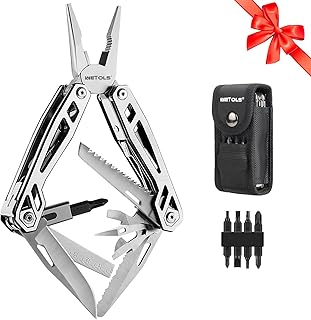
Pros
- Self locking implements across the tool
- Multiple screwdrivers built into the handles, nothing separate to lose
- Sheath included for belt carry
- Solid handles take hard squeezing comfortably
Cons
- The 21 function figure counts driver tips and openers individually
- Fixed drivers are always a compromise size compared with swappable bits
- Heavier than clip carried tools of similar capability
The WETOLS is the self contained option here: everything folds into the body, nothing travels separately, and the sheath is the only accessory. For people who lose small parts, that is a genuine advantage over a bit set.
Self locking is the feature to weigh it on. Implements that lock at full extension stay put under load, which is what separates a tool you can push on from one you have to be careful with.
Built in screwdrivers are the trade against the bit socket approach. They are always present and always the size they are, which covers most household fasteners and occasionally leaves you between two sizes on something awkward.
Like every 21 function listing, the count includes driver tips and openers as separate entries. The core set is pliers, cutters, knife, drivers and openers, which is what you should compare against other tools rather than the headline.
Bottom line: a solid self contained sheath tool, and the better choice than a bit set tool if you would rather nothing came loose.
- Format: full size plier multi tool
- Listed functions: 21
- Pliers: stainless steel
- Drivers: multiple fixed screwdrivers
- Locking: self locking implements
- Included: EDC sheath
The real decision is fixed drivers against a bit socket. Fixed drivers are always with the tool and never the exact size; a bit socket is the exact size and can be left behind. Choose fixed if the tool lives in a bag that gets emptied, and a bit set if you work through fasteners deliberately. After that, compare locking and plier shape, and treat the function count as noise.
Check the lock has engaged before loading any implement and release it with the tool pointed away from you. Oil the pivots occasionally, since a stiff pivot is the first sign of grit rather than of wear. Store the tool out of a damp sheath if it has been rained on, because trapped moisture against steel is what starts pitting on an otherwise well kept tool.

Pros
- Small enough to live on a keyring, so it is genuinely always present
- Needle nose jaws in a tool this size are unusual
- Scissors and package opener cover the jobs that come up most
- Butterfly frame keeps it flat in a pocket
Cons
- Very little leverage from short handles
- Not a substitute for a full size tool on anything stiff
- Small implements are fiddly with cold or gloved hands
The Dime answers a different question from everything else here. It is not trying to be a capable tool; it is trying to be the tool that is present when something small goes wrong, and on that measure it beats every full size option.
Getting needle nose jaws and working wire cutters into a keychain body is the achievement. They will hold a split ring, pull a staple and grip a small connector, all of which are the jobs that come up when you are nowhere near a toolbox.
The scissors and the package opener are the implements that get used most. Blister packs, tags, cable ties and tape make up most of what a carried tool actually does, and this handles all of them.
The honest limit is leverage. Short handles mean short arms, so anything stiff simply will not move. It is a supplement to a real tool, not a replacement for one.
Bottom line: the tool you will actually have on you, and the best answer for small everyday jobs.
- Format: keychain sized butterfly multi tool
- Listed tools: 12
- Pliers: needle nose with wire cutters
- Blades: fine edge knife and package opener
- Scissors: yes
- Carry: keychain clip
- Finish: black
Buy this as a second tool rather than a first one: on a keyring, in a bag, or in a jacket that always travels. It suits anyone who keeps finding themselves without scissors or pliers at the wrong moment. Skip it as your only multi tool if the work involves anything that needs force, because short handles cannot deliver it.
Use it for what its size allows: packages, tags, split rings, small connectors and bottle caps. Do not try to turn stiff fasteners with the plier tips, since a mini tool bends before it grips. Because it travels on a keyring, remember that it carries a blade and therefore cannot go through airport security in hand luggage, so detach it before you fly.

Pros
- Carries in a shirt pocket where a plier tool cannot
- No blade, so it travels where bladed tools are not allowed
- LED light and stylus are genuinely used rather than filler
- Supplied as a pair, so one can live in a bag
Cons
- No pliers and no cutting capability at all
- Small screwdrivers suit light fasteners only
- The spirit level and ruler are approximate rather than precise
A pen format tool is a different category of object from everything else on this list, and it is worth being clear about that. There are no pliers and nothing that cuts, so it is not competing with the plier tools above on capability.
What it offers instead is presence in places the others cannot go. It clips into a shirt pocket, it looks like a pen because it is one, and with no blade it passes through the checks that stop a bladed tool travelling.
The functions that get used are the pen, the LED light, the stylus and the small drivers. Those cover writing, finding a keyhole, using a screen with gloves on and tightening the fasteners on glasses, battery covers and small electronics.
The level and the ruler are approximate by nature. Treat them as a rough check rather than a measuring tool and they are useful; expect precision and they will disappoint.
Bottom line: the tool for a shirt pocket and for travel, bought alongside a plier tool rather than instead of one.
- Format: pen shaped carry tool
- Listed functions: 11
- Writing: ballpoint with refills supplied
- Light: LED
- Drivers: phillips and flat
- Extras: spirit level, ruler, bottle opener, stylus
- Quantity: pack of two
- Blade: none
Buy this if you want something useful in a shirt pocket, if you travel often and cannot carry a blade, or if the small jobs in your day are glasses screws, battery covers and finding things in the dark. Skip it as your only tool, because it does not grip, cut or provide leverage, all of which are what a plier tool exists for.
Keep one clipped and the second in a bag or a car, which is the point of a pair. Use the drivers on light fasteners only, since a pen body gives you very little torque and rounding a small screw is easy. Treat the level as an indication rather than a measurement, and check the battery in the LED once in a while, because a light that is never used still goes flat.
How to Choose a Tactical Multi Tool
Start with the tool count section, because the number on the packaging is the least reliable figure in this category and it is the one most buyers compare first. Everything else here is easier to judge once you stop counting.
Count the Tools You Will Actually Use

A tool listed as 21 in 1 is rarely offering twenty one distinct capabilities. Makers count each screwdriver tip separately, count a bottle opener and a can opener as two, count the ruler printed on the handle, and count a wire stripper notch cut into the plier jaw. Strip that out and most full size tools in this class carry the same core: pliers, wire cutters, a knife, a saw or file, a few drivers and an opener. The rest is arithmetic.
What varies genuinely between tools is which of those you can reach quickly. A driver buried inside the handle, reachable only after you open the pliers and fold everything back, gets used for planned jobs and never for spontaneous ones. Outside accessible tools, ones that swing out with the handles closed, are the ones people report actually using. Count those separately when you compare two listings.
Bit drivers change the arithmetic in the other direction. A tool with a single bit socket and a set of nine bits offers more real driving capability than one with three fixed screwdrivers, even though the packaging may count them the same way. The catch is that a bit set is a separate object to keep track of, and a bit that is not in your pocket is not a tool you have.
Needle Nose or Blunt Nose Pliers

Plier shape is the single biggest functional difference between two multi tools that look alike on a listing page. Needle nose jaws taper to a point, reach into recesses, grip small wire and are the right shape for electronics, fishing tackle and anything with a clip or a split ring. They are also the shape that bends or snaps if you use the tips as a wrench.
Blunt or regular nose jaws trade reach for strength. They grip a nut properly, they take twisting force without complaining, and they are the better choice if the tool is mainly going to see hose clamps, fence wire and stubborn fasteners. Most listings show the jaw clearly in the photographs even when the description does not mention the shape at all.
Look at the cutters as well as the jaws. Wire cutters sit at the base of the jaw on almost every tool here, and the useful questions are whether they meet cleanly along their whole length and whether the tool has replaceable cutter inserts, which the better made examples do. Cutters that only meet at the tip will crush wire rather than cut it, and that is a defect you notice on the first use.
One Hand Opening and Where the Tools Live
Two designs dominate. A butterfly frame opens outward from the middle to expose the pliers, with the individual tools folded into the handles. A plunger or slip joint design deploys the pliers with a squeeze or a flick. Either way, the question that matters day to day is whether you can get to the blade without putting down whatever you are holding.
Tools with an outside accessible blade let you open the knife with one thumb while the tool stays closed. That sounds like a small convenience and it is the difference between a multi tool that replaces a pocket knife and one that sits in a drawer next to it. Spring action pliers and scissors work the same way: a spring that returns the jaws lets you cut repeatedly without resetting your grip.
Weight and handle shape decide the rest. Skeletonised handles cut weight but leave edges that dig into a palm under load, and a tool that is uncomfortable to squeeze hard is a tool you stop reaching for. Where a maker publishes a weight, compare it against the format rather than against everything else: a full size plier tool that undercuts its rivals by a couple of ounces has usually removed material from somewhere that mattered.
Blade Locks and Why They Matter Here
An unlocked blade folded into a handle can close on your fingers when the cut binds, and it is the most common way people hurt themselves with a multi tool. A lock holds the blade open until you deliberately release it, and on a tool that will be used at odd angles with one hand it is not an optional feature.
Listings describe this in several ways. Self locking, liner lock and safety lock generally mean the same thing at this level: a spring steel liner or a sliding catch drops behind the blade tang when it reaches full extension. What varies is how positively it engages and how easy it is to release without folding the blade onto a thumb, which is worth checking in the photographs since a release lever placement is visible even when the mechanism is not described.
Check whether the lock covers every tool or only the blade. On better tools the saw, the file and the drivers all lock too, which matters because a screwdriver that folds under load is a bruised knuckle. On simpler tools only the knife locks and everything else relies on detent friction, which is acceptable for light work and unpleasant when you lean on a driver.
Steel, Coating and What Rust Does to a Folding Tool
Almost everything here is stainless steel, and stainless is a family rather than a specification. The steels used in this class hold a working edge adequately and resist rust well, which is the correct trade for a tool that lives in a pocket and gets wet. Do not expect a folding blade in a multi tool to take the same edge as a dedicated knife: the geometry is thicker and the grind is more robust on purpose.
Surface finish is what the word tactical usually refers to. A black oxide or titanium nitride coating cuts glare and adds a thin layer of corrosion resistance, and it wears at the pivots and the plier jaws first, which is cosmetic rather than functional. Bead blasted and satin finishes show fewer marks over time. None of these coatings makes the steel underneath harder.
Rust in a folding tool starts in the pivots rather than on the visible faces, and that is where it stops the tool working. A drop of light oil at each pivot once a season does more for longevity than anything on the specification sheet, and a tool that has been through salt water needs a rinse and a dry the same day.
Carry: Pocket Clip, Belt Sheath or Keyring

How a tool carries decides whether you have it when you need it, and it is the specification people think about last. A pocket clip keeps a full size tool upright and reachable but puts weight on one side of a pocket and wears the fabric at the clip line. It suits people already carrying a clipped knife and dressing around it.
A belt sheath moves the weight off your pockets entirely and is the practical answer for work and outdoor use. Nylon sheaths are light and quiet, they take a beating, and they are easy to replace when the stitching goes. The drawback is visibility: a sheath on a belt is obvious in a way a clip is not, which matters in some workplaces and not at all in others.
Keyring and pen formats solve a different problem. A mini tool on a keyring is the one that is genuinely always present, which for opening packages, tightening glasses and pulling a splinter beats a capable tool left at home. A pen shaped carry tool clips to a shirt pocket and covers writing plus light driver work, and it is the format that goes places a bladed tool cannot. Neither replaces pliers you can lean on. More carry gear sits in our tools and home improvement section.
| Format | Best at | Weak at |
|---|---|---|
| Full size plier tool | Real leverage, bit drivers, sheath or clip carry | Bulk and weight in a trouser pocket |
| Keychain mini | Always being present, packages, small fasteners | Small jaws, very little leverage |
| Pen format | Writing plus light driver work, shirt pocket carry | No pliers and no real cutting |
Why You Should Trust Us
We build these lists from published specification and from the pattern of what long term owners consistently report, rather than from marketing copy. For every tool here we looked at the plier shape, which tools are reachable with the handles closed, whether the blade and the other implements lock, whether the pliers or scissors are spring loaded, the steel and surface finish, and how the tool is designed to be carried. Where a listing counts screwdriver tips or a printed ruler toward its headline number, we say so rather than repeating the figure.
We also set aside near identical listings that differ only in colour or bundled accessories, so each entry is a genuinely different tool. Owner feedback is read for patterns rather than individual opinions: one complaint about a stiff pivot tells you nothing, while the same complaint appearing across years of feedback tells you what that pivot design does once dust gets into it.
Final Thoughts
Best overall is the Leatherman Wingman. The blade opens one handed from the outside of the closed handle, the pliers and the scissors are both spring loaded so repeated cuts do not need a grip reset, and the tool is backed by a warranty measured in decades rather than months. It is the layout that turns a multi tool into the thing you reach for first instead of the thing you own as well as a pocket knife.
Best value is the RoverTac Pocket Knife 15-in-1 Multitool. A single bit socket with nine screwdriver bits gives it more real driving capability than tools with a longer feature list, the blade locks, and the nylon sheath means it can be carried properly rather than rattling in a bag.
For specific needs, the Gerber Suspension NXT is the pick if you want needle nose jaws and a pocket clip in a light frame, the Mossy Oak 21-in-1 Multitool and the WETOLS 21-in-1 Multitool are the self locking sheath carried options for people who want everything folded into one body, the Gerber Dime is the one that lives on a keyring and is therefore the one you will actually have, and the RAK Multitool Pen is the choice when the tool has to clip to a shirt pocket and go where a bladed tool cannot. More outdoor picks are indexed in our article archive, and the full category index covers everything else.
Tactical Multi Tool FAQs
Does tactical mean anything on a tactical multi tool?
Mostly it describes appearance rather than capability. In this category the label generally signals a dark coating, a squared frame and a nylon sheath rather than any change to the steel, the pliers or the lock. That is not a criticism, since a matte finish genuinely cuts glare and a sheath is a better way to carry weight than a pocket, but it does mean you should compare two tools on plier shape, locking and outside accessible tools rather than on which one is described as tactical.
How many tools does a tactical multi tool really need?
Fewer than the packaging suggests. Most people use the pliers, the wire cutters, the knife and one or two drivers, and everything else is occasional at best. A headline number of 21 usually resolves to a similar core set once you stop counting individual screwdriver tips, the ruler and a wire stripper notch. The more useful question is how many of those core tools you can reach with the handles closed, since a driver that requires unfolding the pliers gets used far less than one that swings out on its own.
Needle nose or blunt nose pliers?
Needle nose for reach, blunt nose for grip. Tapered jaws get into recesses, hold small wire and split rings and suit electronics, fishing tackle and hobby work, but the tips will bend if you use them to turn a stubborn nut. Blunt jaws give up that reach and take twisting force without complaint, which is what you want for hose clamps, fence wire and general repairs. If the tool is going in a tackle box, choose needle nose; if it is going in a truck, choose blunt.
What does a locking blade actually change?
It stops the blade folding onto your fingers when a cut binds, which is the most common injury with a folding tool. A lock is a liner or a catch that drops behind the tang at full extension and holds until you release it deliberately. On better tools the saw, file and drivers lock as well as the knife, which matters because a driver that folds under pressure takes a knuckle with it. On simpler tools only the blade locks and the rest rely on friction, which is fine for light work.
How should I carry a tactical multi tool in 2026?
Match the format to where you will be. A belt sheath is the most comfortable way to carry a full size tool all day and keeps the weight off your pockets; a pocket clip suits people already carrying a clipped knife; a keychain mini is the one that is always there. Remember that any tool with a blade cannot go in aircraft hand luggage regardless of size, so a pen format tool without a blade is the one that travels, and a bladed tool needs to go in checked baggage or stay home.
Write Your Review
No reviews yet. Be the first to share your experience!