

A propane grill is the appliance people buy so dinner can happen outside on a Tuesday, not just for the two big cookouts a year. That is why this category stretches from a one burner tabletop you can carry in one hand to a five burner cart that needs a permanent corner of the patio, and why the number that matters most is the one nobody prints in large type: how much usable grate you get at a temperature you can actually hold. We sorted 9 grills from Char-Broil, Cuisinart, Megamaster and more by burner count, real cooking area, grate material and how much of the job is scraping afterward. The wider patio, lawn and garden section covers the rest of the yard.
Our top pick is the Megamaster 3 Burner Gas Grill for pairing three independently controlled burners with folding side shelves, which is the combination that gives you a genuine two zone fire without claiming a permanent corner of a small patio. Below we keep the two ends of this category apart, because almost nobody cross shops between them: portables that run on a small cylinder, and carts that stay outside on a 20 lb tank.

Pros
- Three independently controlled burners give a real hot zone and cool zone
- 429 square inches of primary grate suits a normal household cook
- Side shelves fold flat, so it stores narrower than it cooks
- Built in lid thermometer and warming rack are both standard
- Push and turn ignition needs no battery
Cons
- Porcelain coated grate chips if you attack it with a wire brush
- Folding shelves flex under a heavily loaded tray
- No side burner, so sauces still happen in the kitchen
The Megamaster three burner sits in the size class most households actually need. Three burners across 429 square inches is enough grate to cook a dozen burgers, and enough separation to leave one burner off so thicker cuts can finish away from direct flame.
The 30,000 BTU rating works out to roughly 70 BTU per square inch of primary grate, which is a sensible match rather than a headline number. It means the grill recovers at a reasonable pace after you lift the lid, without burning fuel to heat surface you are not using.
Folding side shelves are the feature that decides where this grill lives. Dropped down, the cart narrows enough to sit against a wall or slide beside a door, which matters far more on a small patio than any specification on the box.
The limitations are the ones common to this class of grill. The porcelain coated grate needs a soft scraper rather than a wire brush, the shelves are for tools and plates rather than a full tray of raw meat, and there is no side burner.
Bottom line: the most balanced grill here, and the one to buy if you want a single grill that handles weeknight dinners and the occasional crowd.
- Burners: 3, independently controlled
- Main burner output: 30,000 BTU
- Primary cooking area: 429 square inches
- Warming rack: yes
- Ignition: push and turn
- Thermometer: built into the lid
- Shelves: two folding side shelves
- Fuel: standard 20 lb propane tank
Buy this if you grill for four to six people most weeks and want two zone cooking without giving up a permanent corner of the patio. Skip it if you regularly cook for a crowd, where a four or five burner cart makes more sense, or if the grill has to travel, in which case a tabletop portable on a 1 lb cylinder is the right shape.
Scrape the grate warm with a soft edged scraper rather than a wire brush, since a chipped coating is where rust starts. Empty the grease tray before it fills, because pooled grease is what turns into a flare up. Check the hose and regulator with soapy water at the start of each season, and keep a fitted cover on the grill between cooks.

Pros
- Porcelain coating on the firebox as well as the grate, which slows corrosion
- Stainless lid holds up better than painted steel outdoors
- Two fixed side tables give real working space beside the grate
- Warming rack and lid thermometer included
Cons
- 27,000 BTU is modest for 429 square inches, so recovery after opening is slower
- Fixed side tables mean a wider footprint in storage
- No side burner
Nexgrill builds this as a straightforward three burner cart, and the detail worth noticing is that the porcelain coating extends to the firebox rather than stopping at the grate. The firebox is where grease and rainwater collect together, and it is the part that usually decides how long a gas grill survives outdoors.
The stainless lid is the other durability choice. Painted steel lids chalk and then rust at the hinge, while stainless simply discolours, which is cosmetic rather than structural.
Output is the honest weak point. At 27,000 BTU across 429 square inches, this grill sits at the lower end of the useful band, so it takes longer to come back up to temperature after you open the lid. In practice that matters when searing and barely matters when cooking with the lid down.
The two side tables are fixed rather than folding. They are genuinely useful while cooking and genuinely inconvenient when you want the cart to tuck into a narrow gap.
Bottom line: the pick if you want the grill to survive several seasons outside and you are willing to trade a little heat recovery for it.
- Burners: 3
- Main burner output: 27,000 BTU
- Primary cooking area: 429 square inches
- Grate: porcelain coated steel
- Firebox: porcelain coated steel
- Lid: stainless steel
- Warming rack: yes
- Thermometer: built into the lid
Compare this against the other three burner grills on two points rather than the whole specification sheet. First, whether the firebox is coated, since that is where corrosion starts and few listings mention it. Second, whether you need folding shelves, because fixed tables are better to cook on and worse to store. If neither point moves you, choose on grate material instead.
Wipe the firebox out rather than letting drippings bake on, since the coating only protects steel it still covers. Keep the grate coating intact by scraping while warm with a plastic or wood edge. Store the grill with a cover, and if it sits under a tree, check the burner tubes for insect nests before the first cook of the season.

Pros
- Two independently controlled burners in a portable body, which is rare
- Electronic ignition lights reliably in wind
- Stainless construction stands up to being thrown in a car
- Real two zone cooking away from home
Cons
- Heavy for a tabletop grill at around 22 lb
- Small grease cup fills quickly with fatty food
- Disposable 1 lb cylinders add up unless you fit an adapter hose
Most portable grills give you one burner and therefore one temperature. The Cuisinart CGG-306 gives you two with independent knobs, which is the difference between grilling burgers at a campsite and actually cooking there.
At 20,000 BTU across a tabletop grate, output is generous rather than marginal. That matters outdoors, where wind and cold air steal heat faster than any specification sheet accounts for.
Electronic ignition is the right choice for a grill that lives outside the house. A single spark piezo is the first thing to fail on a portable, and a battery igniter starts on the first press even when it is breezy.
The trade is weight. At around 22 lb this is a two hand carry, not something to walk far with, and the grease cup underneath is small enough that fatty food needs a mid cook check.
Bottom line: the portable to buy when a single burner is not enough, and the one that turns a campsite into a real cooking setup.
- Burners: 2, independently controlled
- Output: 20,000 BTU
- Ignition: electronic
- Body: stainless steel
- Weight: around 22 lb
- Format: portable tabletop
- Fuel: 1 lb cylinder, or 20 lb tank with an adapter hose
Preheat with the lid down and both burners high for around ten minutes, then drop one burner to low and cook thicker cuts over that side. On a windy site, park the grill with the lid hinge into the wind so opening it does not blow the flame out. If the grill will spend most of its life at home, fit an adapter hose and run it from a 20 lb tank rather than feeding it disposable cylinders.
Never store or transport a grill with a 1 lb cylinder still attached, and let it cool fully before it goes back in a vehicle. Empty the grease cup after anything fatty, since it is sized for a tabletop rather than a full cookout. Wipe the stainless with the grain once cool to stop grease baking into a permanent stain.

Pros
- Five burners give the widest range of heat zones here
- Porcelain coated cast iron grates hold heat for a proper sear
- Side burner keeps sauces and sides outside
- 647 square inches handles a genuine crowd
Cons
- Needs a permanent spot, a cover and a lot of assembly time
- Heating the full grate burns fuel you may not need most weeks
- Cast iron grates rust quickly if the enamel chips and they stay wet
This is the large end of the category. Five burners across 647 square inches means you can hold a searing zone, a moderate zone and an off zone at the same time and still have room to move food around, which is what cooking for a group actually requires.
The cast iron grates are the reason to choose it over a stainless rod grill of similar size. Cast iron holds temperature when cold food lands on it, so the crust starts forming immediately instead of after the grate recovers.
The side burner is worth more than it looks. Sauces, onions and beans made outdoors keep the whole cook in one place, and the alternative is walking between the grill and the kitchen while something burns.
The costs are real. This is a large assembly job, it needs somewhere permanent to live, and heating five burners for two steaks is wasteful. It also needs a cover, because a grill this size collects a lot of rain.
Bottom line: the right grill for regular entertaining and the wrong one for a couple who grill twice a month.
- Burners: 5, plus a side burner
- Output: 68,000 BTU
- Cooking area: 647 square inches
- Grates: porcelain coated cast iron
- Body: stainless steel
- Format: patio cart with wheels
- Fuel: standard 20 lb propane tank
Buy this if you cook for six or more with any regularity, if you want indirect roasting space alongside a hot zone, or if a side burner would keep you out of the kitchen. Skip it if your patio is small, if the grill would have to be moved and stored between cooks, or if most of your grilling is a weeknight dinner for two.
Dry cast iron grates after cleaning and oil them lightly, because chipped enamel plus standing water is what starts the rust. Clear the grease tray regularly, since a grill this size produces a lot of drippings. Keep the side burner covered when it is not in use, and check that all five burner tubes light evenly at the start of each season.

Pros
- Four burners cover most zone arrangements without a five burner footprint
- Stainless body handles a covered patio well
- Side burner included
- Porcelain enamelled grates release food cleanly when new
Cons
- The 42,000 BTU figure includes the side burner, so main burner output is lower
- Stainless shows fingerprints and grease marks readily
- Enamel coating chips if a metal spatula catches an edge
Four burners is the sensible compromise between a three burner cart and a full five burner rig. You get a searing zone, a moderate zone and an off zone with room to spare, without the storage problem that comes with the larger machines.
The stainless construction is what this grill is really selling. On a covered patio, where rain is occasional rather than constant, stainless stays serviceable far longer than painted steel and cleans up with a wipe rather than a wire brush.
Read the output figure carefully. The advertised 42,000 BTU is a total that includes the side burner, so the heat actually reaching the grate is lower than the headline suggests. It is still adequate for the grate area, but it is not the same as 42,000 BTU under the lid.
Porcelain enamelled grates behave like every other coated grate here: excellent when new, prone to chipping if you use metal tools carelessly, and rusty afterward.
Bottom line: a solid four burner for a covered patio, provided you read the BTU figure as a total rather than as main burner output.
- Burners: 4, plus a side burner
- Total output: 42,000 BTU including the side burner
- Body: stainless steel
- Grates: porcelain enamelled
- Thermometer: built into the lid
- Format: patio cart
- Fuel: standard 20 lb propane tank
When you compare this against a three burner grill, do the arithmetic on main burner output rather than the advertised total, and remember that a side burner typically accounts for a meaningful slice of the number. When you compare it against a five burner, the question is simply whether you ever cook for more than six people, because the extra burner buys capacity rather than better cooking.
Run the two outer burners and leave the middle pair off for indirect roasting, which is the arrangement a four burner does better than a three burner. Preheat with the lid closed for ten to fifteen minutes so the grates reach temperature rather than just the air. Use wooden or plastic tools on the enamel and keep the metal spatula for the griddle.

Pros
- Cast iron grates in a mid size cart, which is unusual
- 36,000 BTU over 445 square inches gives good heat recovery
- Side tables fold for narrower storage
- Wheels make it easy to move under cover
Cons
- Cast iron grates need drying and oiling to stay sound
- Heavier to move than a steel grate grill of the same size
- No side burner
Veralune puts cast iron grates on a mid size three burner, which is the combination most buyers in this class do not get. Cast iron is where sear marks come from, and it is normally reserved for larger grills.
The 36,000 BTU rating over 445 square inches works out to around 80 BTU per square inch, which sits comfortably inside the band where a grill recovers quickly after the lid comes up. Combined with the thermal mass of the grates, that makes searing more consistent than the burner count suggests.
Folding side tables and wheels between them solve the storage problem. This is a cart you can move against a wall when it is not in use, which on a small patio is often the deciding factor.
The maintenance burden is higher than a coated steel grate. Cast iron rusts wherever the enamel breaks and moisture sits, so it wants drying after cleaning and a light oiling before storage.
Bottom line: the pick for sear marks in a mid size cart, provided you are willing to look after cast iron.
- Burners: 3
- Output: 36,000 BTU
- Cooking area: 445 square inches
- Grates: cast iron
- Tables: two folding side tables
- Wheels: yes
- Fuel: standard 20 lb propane tank
Cast iron is the whole maintenance story on this grill. Scrape while the grates are warm, dry them with the burners running for a minute after washing, and wipe a thin film of high smoke point oil over them before closing the lid. Store the grill covered, because standing water on cast iron is what starts the rust that ends a grate.
Buy this if defined sear marks matter to you and you want them in a cart that still fits a normal patio. Skip it if you want a grill you can ignore between cooks, since coated steel grates are far more forgiving of neglect, or if you need a side burner as part of the setup.

Pros
- Simplest and lightest way into propane grilling
- Runs on 1 lb cylinders available almost anywhere
- Compact enough for a balcony or a car boot
- Long standing model with widely available parts
Cons
- One burner means one temperature across the whole grate
- Small grease collection point fills fast with fatty food
- Disposable cylinders need replacing often
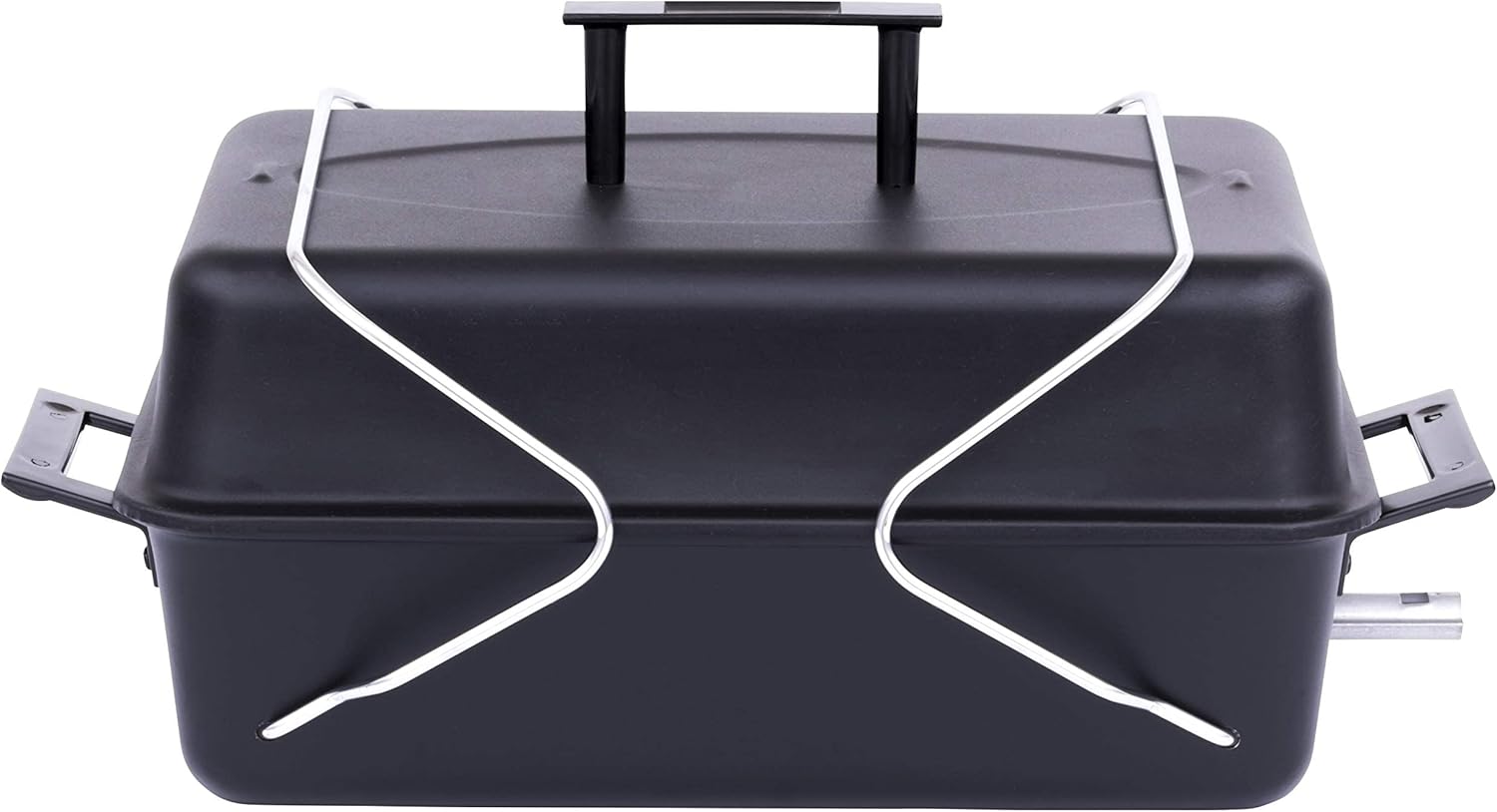
This is the entry point to the category and it has been around long enough that most people have cooked on one. A single burner under a lid, a small grate and a 1 lb cylinder screwed straight into the side is the whole design.
What it does well is being simple. There is no battery, no side burner and no cart to assemble, so it works the first time and keeps working. The lid means you can cook convectively rather than just searing over open flame, which is what separates it from a camp stove.
What it will not do is two zone cooking. One burner heats the entire grate to one temperature, so thicker cuts need patience and lid management rather than a cool side to move to.
The grease collection point is small, which is normal for a portable and worth remembering before you cook something fatty on it. An adapter hose is the upgrade to make if the grill ends up living on a balcony rather than travelling.
Bottom line: the simplest honest way to have a propane grill, and the one to take when space or weight decides the purchase.
- Burners: 1
- Format: portable tabletop with lid
- Model: 465133010
- Fuel: 1 lb disposable cylinder
- Alternative fuel: 20 lb tank with an adapter hose
- Cooking style: convective, lid down
Preheat with the lid down for around ten minutes, then cook with the lid closed as much as possible, because a single burner relies on trapped heat rather than a cool zone. For thicker cuts, sear first and then turn the burner low and let the lid finish the job. On a windy site, set the grill so the lid opens away from the wind.
Disconnect the cylinder before the grill goes back in a vehicle and let the unit cool fully first. Check the connection with soapy water whenever you fit a new cylinder. Empty the grease collection point after each cook rather than at the end of the trip, and keep the grate scraped so drippings do not build up under it.

Pros
- Porcelain enamel over the whole body, not just the grate
- 26,500 BTU across 418 square inches gives strong heat per square inch
- Two burners are enough for genuine two zone cooking
- Warming rack included
Cons
- Enamel chips are permanent and start rust wherever they appear
- Two burners limit how many zones you can hold at once
- No side burner or side tables of real size
The Feasto two burner takes the porcelain enamel idea further than most grills at this size by applying it across the body rather than only the cooking grate. That matters because the firebox is where grease and water sit together, and coated steel resists that combination far better than bare steel.
Output is good for the area. At 26,500 BTU across 418 square inches, this is around 63 BTU per square inch, which is at the modest end but paired with a smaller grate that heats through quickly.
Two burners is the minimum for cooking rather than just searing, and this grill uses them properly. One side hot and one side off is all most weeknight cooking needs, and the warming rack takes finished food out of the way.
The weakness of a fully enamelled grill is the same as its strength. Enamel protects steel completely until it chips, and once it chips there is no repairing it, so this is a grill to handle with plastic tools and a soft scraper.
Bottom line: a well protected compact cart for a small patio, as long as you treat the coating gently.
- Burners: 2
- Output: 26,500 BTU
- Grilling area: 418 square inches
- Body: all porcelain enamel
- Warming rack: yes
- Colour: black
- Fuel: standard 20 lb propane tank
Buy this if your patio is small, you cook for two to four most of the time, and you want a grill that resists corrosion without a stainless body. Skip it if you regularly feed six or more, or if you are hard on equipment, because enamel rewards careful handling and punishes a wire brush.
Use plastic or wooden tools on the enamel and scrape while it is still warm. Touch up nothing yourself, since there is no home repair for chipped enamel; instead keep the grill covered so any exposed steel stays dry. Empty the grease tray regularly and check the burner tubes for obstructions before the first cook of the season.

Pros
- Cast iron grates on a genuinely small cart
- Lockable wheels, so it moves and then stays put
- Removable oil tray makes cleanup straightforward
- Stainless body with a lid and a side shelf
Cons
- 16,000 BTU is modest, so preheating takes longer
- Two burners cap how many zones you can hold
- Cast iron needs drying and oiling after every wash
The COWSAR two burner is the compact cart in this list, sized for a small patio or a balcony where a three burner would not fit. It keeps the features that make a cart useful, a lid, a side shelf and wheels, in a much smaller footprint.
Cast iron grates on a grill this size are unusual and they change how it cooks. The grates hold heat when food lands, which compensates for the modest 16,000 BTU output and makes the sear better than the burner rating alone would suggest.
The removable oil tray is the other practical detail. Pulling a tray out and wiping it is a different experience from reaching under a firebox to unclip a cup, and it is the sort of thing that decides whether a grill gets cleaned or not.
The limitation is heat. At 16,000 BTU this grill takes longer to preheat and recovers more slowly after the lid comes up, so it suits patient cooking rather than back to back searing for a group.
Bottom line: the cart to choose when space is the binding constraint and you still want cast iron and wheels.
- Burners: 2
- Output: 16,000 BTU
- Grates: cast iron
- Body: stainless steel with lid
- Shelf: one side shelf
- Grease: removable oil tray
- Wheels: lockable
- Fuel: standard 20 lb propane tank
Give this grill a longer preheat than a larger cart, around fifteen minutes with the lid down, so the cast iron reaches temperature rather than just the air around it. Cook with the lid closed where possible, since a modest burner output relies on trapped heat. Lock the wheels before you start, because a light cart moves when you lean on it.
Dry the cast iron with the burners running briefly after washing, then oil it lightly before closing the lid. Empty and wipe the oil tray after every fatty cook rather than letting it fill. Check that the wheels are locked whenever the grill is lit, and keep the cart covered when it lives outdoors.
How to Choose a Propane Grill
Read the fuel section even if you skip the rest. Buying a cart grill when what you wanted was something for a campsite, or the reverse, is the mistake that gets returned most often here, and no feature list rescues you from it afterward.
Burner Count and What the BTU Figure Actually Tells You
Burner count is really zone count, and zones are what separate cooking from scorching. A single burner gives you one temperature across the whole surface, which is fine for burgers and awkward for anything thicker. Two burners give you a hot side and a side with the flame off, which is what lets you finish a chicken thigh without the outside going black. Three or more hold a searing zone, a resting zone and an off zone at once. The step from one burner to two changes far more than the step from three to four.
BTU measures fuel burned per hour, not heat delivered to food. A five burner rated at 68,000 BTU across 647 square inches is not running hotter than a three burner rated at 30,000 BTU across 429 square inches; it is putting a similar intensity across a much larger surface. The comparison that means something is BTU divided by primary grate area, and most competent gas grills land between roughly 75 and 110 BTU per square inch. Far below that band, the grill struggles to recover after you open the lid.
Side burners inflate the headline figure without adding a degree under the lid. A grill advertised at 42,000 BTU with a side burner may be putting something in the low thirties under the hood and the balance into a saucepan ring you use twice a year. Where a listing separates the main burner total from the side burner, use the main figure.
Cooking Area: Count the Main Grate, Not the Warming Rack
Advertised cooking area routinely folds the warming rack into the total, and a warming rack is not cooking area in any useful sense. It sits high in the dome where the air is cooler, it holds finished food and toasts buns, and it will not sear anything. A grill claiming six hundred square inches quite often has around four hundred and thirty on the primary grate and the rest overhead.
Translate the primary figure into food before you decide. Somewhere around two hundred square inches handles four burgers or a couple of steaks with room to move them. Four hundred and something suits most households, enough for a dozen burgers or a spatchcocked chicken with a cool zone still free. Above six hundred you are buying capacity for gatherings, and the rest of the year you heat grate you are not using.
Shape matters as much as area and never appears in the specification. A deep, narrow grate makes it hard to reach the back without leaning over open flame, while a wide, shallow one gives you a natural two zone split left to right. Lid clearance is the other silent constraint: a low dome will not close over a whole bird or a roast sitting on a rack.
Grate Material and What It Does to a Sear

Porcelain coated steel is the default on most grills here. It is light, food releases from it reasonably well when it is new, and it needs no seasoning. The failure mode is predictable: the coating chips where a metal spatula or a wire brush catches an edge, water reaches the steel underneath, and rust spreads from that chip. Handled gently it lasts years, attacked with a wire brush it flakes inside a season.
Cast iron, usually with a porcelain enamel skin, produces the dark defined bars people associate with a good steak. Its advantage is thermal mass: it holds temperature when cold food lands on it instead of dropping away, so the sear starts immediately. The costs are weight, a longer preheat, and rust if the enamel breaks and the grate is left wet. If sear marks are what you are chasing, that is the material to look for.
Stainless rod grates are the durability choice. There is no coating to chip, they tolerate a scraper, and they clean up more easily than either alternative. They hold less heat than cast iron, so marks are fainter, and thin stainless rod will bow over a hot burner. Look at rod diameter rather than the word stainless, because a thick rod grate and a thin one behave nothing alike.
Ignition, Lid and How Precisely You Can Hold a Temperature
Ignition is the part that fails first on a lot of gas grills. A push and turn piezo delivers a single spark per press and is the most common arrangement here; when it degrades you get clicks and no flame and end up reaching in with a lighter. A rotary spark generator throws a rapid series of sparks and is noticeably more reliable in wind. Battery powered electronic ignition is the most convenient until the battery compartment corrodes outdoors.
A built in lid thermometer is standard on almost everything now, and it is worth understanding what it reads. It measures dome air several inches above the food, which on most grills runs meaningfully hotter than the grate itself. Use it as a repeatable reference, learn the offset on your own grill, and reach for a probe when a specific internal temperature matters.
Independent control knobs are what make multiple burners worth having, and the useful question is how low each burner will go without going out. A burner that only holds a flame near the top of its range gives you a grill with one setting, which makes indirect cooking impossible. A burner that idles reliably is what allows low and slow work alongside searing.
Grease Path and How Long Cleanup Actually Takes
Every gas grill runs some version of the same system: angled metal tents over the burners catch drippings, vaporise part of them for flavour, and shed the rest down a sloped firebox to a collection point. A firebox with a proper slope and a single low exit drains itself. A flat bottomed one pools grease in the corners, and that pooled grease is what becomes a flare up later.
The collection point comes in two forms. Cart grills usually get a slide out tray under the firebox, which is the arrangement to prefer because you can pull it, line it with foil and slide it back without dismantling anything. Portable and compact grills often use a small cup hanging on a leg, and those cups are sized optimistically. They need emptying more often than the manual implies.
Check whether the firebox interior is coated or bare steel. A porcelain coated firebox wipes clean and resists the corrosion that grease and rain produce together. Bare steel stains, then pits, then eventually perforates at the lowest point, which is the most common way an otherwise working grill reaches the end of its life.
Fuel Source: 20 lb Tank or 1 lb Cylinder

Cart grills run on a standard 20 lb refillable tank, the same one sold through exchange cages everywhere. A full tank gives most three burner grills somewhere in the range of fifteen to twenty hours of cooking, which for a household grilling twice a week is close to a season. Either way you go, own two tanks so running out mid cook is an inconvenience rather than a ruined evening.
Portable grills are built around disposable 1 lb cylinders, which is what makes them work at a campsite with no other infrastructure. One cylinder runs a small grill for roughly an hour and a half at full output, so a weekend eats several. Most portables accept an adapter hose that lets them draw from a 20 lb tank instead, and that hose is worth having if the grill mostly lives on a balcony.
Look at where the tank actually sits. Some carts hold it on an internal shelf behind doors, which looks tidy but makes the hose route awkward; others hang it on an external bracket, which is easier to swap and to inspect. Either way the regulator and hose are consumables with a service life, they perish from ultraviolet light and cold, and a soapy water check at the start of each season takes two minutes.
| Grill type | Typical burners | Best at | Watch out for |
|---|---|---|---|
| Tabletop portable | 1 to 2 | Camping, tailgating, balconies, small decks | Small grease cup, disposable cylinders add up |
| Compact cart | 2 to 3 | Weeknight dinners on a small patio | Folding shelves flex under a loaded tray |
| Full cart | 4 to 5 | Crowds, indirect roasting, side burner work | Needs a permanent spot and a cover |
Why You Should Trust Us
We build these lists from published specification and from the pattern of what long term owners consistently report, rather than from marketing copy. For every grill here we looked at burner count, the main burner BTU total separately from any side burner, primary grate area with the warming rack excluded, grate and firebox material, ignition type, how drippings reach a collection point, and which fuel the grill is designed around. Where a maker publishes a combined cooking area figure, we say so rather than repeating the larger number.
We also set aside near identical listings that differ only in colour or bundled accessories, so each entry is a genuinely different grill rather than a variant of one already on the list. Owner feedback is read for patterns rather than individual opinions: one complaint about a chipped grate tells you little, while the same complaint across years of feedback tells you what that coating will do on yours.
Final Thoughts
Best overall is the Megamaster 3 Burner Gas Grill. Three independently controlled burners give you a proper hot zone and cool zone, the warming rack and built in thermometer are the two features you actually reach for, and the folding shelves mean it stores narrower than it cooks. It is the size that suits the way most households really grill, which is four to six portions on a weeknight rather than a party.
Best value is the Char-Broil Portable Convective 1-Burner Propane Gas Grill. It is the simplest expression of the idea in this list, it runs on a cylinder you can pick up anywhere, and for someone who wants a tailgate or balcony grill without owning a tank it does that one job without asking for space it has not earned.
For specific situations, the Bestfire 5 Burner Propane Gas Grill is the pick if you cook for a crowd and want a side burner, the Cuisinart Outdoor Gas Grill is the one to take camping when a single burner is not enough, the Electactic 4-Burner Gas Grill is the stainless option for a covered patio, and the COWSAR 2-Burner Propane BBQ Grill is the compact cart for a small yard. More outdoor picks sit in our article archive, and the full category index covers everything else.
Propane Grill FAQs
How many burners do I actually need on a propane grill?
Two is the number that changes how you cook, and three is the number most households settle on. One burner heats the whole surface to a single temperature, which works for burgers and fights you on anything thicker. Two lets you run one side hot and leave the other off, which is how you finish chicken, sausages or a thick chop without burning the outside. Three gives you a searing zone, a holding zone and an off zone at once. Four and five burners are about feeding more people rather than cooking better.
Is a higher BTU rating always better?
No, and comparing raw BTU between grills of different sizes is misleading. BTU measures fuel consumed per hour, not heat reaching food, so a large grill needs a large figure simply to warm all that extra metal. Divide the main burner total by primary grate area instead: most well matched gas grills fall between roughly 75 and 110 BTU per square inch. Also check whether the advertised total includes a side burner, because that portion never heats the grate at all.
Cast iron or porcelain coated steel grates?
Cast iron if you care about sear marks, porcelain coated steel if you care about weight and easy care. Cast iron holds heat, so grate temperature barely drops when cold food lands and the crust forms straight away, but it is heavy, slow to preheat and unforgiving about being left wet once the enamel chips. It wants the same habits as the cast iron pans in our home and kitchen section. Porcelain coated steel preheats faster and needs no seasoning, though the coating chips where a wire brush catches it.
How long does a 20 lb propane tank last?
Roughly fifteen to twenty hours of cooking on a typical three burner grill, less if you run every burner at full output and more if you cook mostly with two burners at a moderate setting. That works out to most of a season for a household grilling once or twice a week. There is no fuel gauge on a standard tank, so keep a spare and judge the level by pouring warm water down the side and feeling for the cool line.
How long should a propane grill last in 2026?
Five to ten years is realistic, and what fails is rarely the burners. Grates go first where the coating chips, then the heat tents above the burners thin out, then the firebox corrodes at its lowest point where grease and rainwater collect together. All three are slowed by the same two habits: emptying the grease tray before it overflows and keeping a fitted cover on between cooks. Burners and igniters are usually replaceable parts, so it is worth checking whether the maker still supplies them, and brand pages in our store directory are a good place to start.




Write Your Review
No reviews yet. Be the first to share your experience!