

A student trumpet has one job, and it is a narrow one: be easy enough to play that a beginner keeps picking it up, and solid enough to survive a school year of being carried between home and a band room. On paper the horns aimed at first year players look almost identical, because they all quote the same bore, the same bell diameter and the same 7C mouthpiece. What separates them shows up in the third month, when one instrument still has smooth valves and the other has a piston that hangs. We looked at 7 student trumpets from Jean Paul, Mendini by Cecilio, Eastar and more, sorted by valve quality, bore and leadpipe, what actually ships in the case, and whether the maker can repair the horn when something sticks.
Our top pick is the Jean Paul TR-330 Student Bb Trumpet for its play tested valves and the repair support behind it, which is what keeps a beginner instrument playable past the first year. Below we sort the field from complete first instrument kits through to a step up horn a second year player can grow into, and we flag which ones are worth the extra outlay only if the player has already stuck with it. For the rest of the practice room, our musical instruments section covers the adjacent gear.

Pros
- Play tested before shipping rather than sent straight from the line
- Stainless steel pistons that keep their action through a school year
- Named model with parts and repair support behind it
- Two piece yellow brass bell with a properly rolled rim
- Holds resale value when a student moves up
Cons
- No adjustable third valve ring, so smaller hands work harder on low D
- Semi hard case protects less than a fully moulded shell
- Gold lacquer shows wear at the left hand contact point
The TR-330 is the horn most band directors would recognise as a proper student trumpet rather than a starter kit. It is pitched in B flat, built around a two piece yellow brass bell, and fitted with stainless steel pistons, which is the combination that keeps a first instrument feeling the same in June as it did in September.
The detail that separates it from cheaper listings is the play test. Someone assembles the instrument, blows it and checks the valve action before it ships, which is why fewer of these arrive with a hanging third piston or a slide that will not move. For a beginner who cannot tell an instrument fault from their own mistake, that matters more than any specification on the page.
Being a named model also means it can be repaired. Valve guides, water key corks, springs and felts exist for it, and a local technician can order them by model number. An unbranded horn with the same photograph usually cannot be supported at all once something wears.
The limitations are honest ones. There is no adjustable third valve ring, so a younger player has to reach the third slide manually to correct low D and C sharp, and the case is semi hard rather than a full moulded shell. Both are the trade offs that keep it a student horn rather than a step up model.
Bottom line: the first trumpet to buy if the student is likely to stay with band past the first term, because it is the one that will still be playable and still be worth passing on.
- Key: B flat
- Bell: two piece yellow brass
- Valves: stainless steel pistons
- Finish: gold lacquer
- Mouthpiece: 7C included
- Case: semi hard with strap
- Extras: valve oil and cleaning cloth
Buy this for a student who has already started band or is about to, and who you expect to keep playing for at least a full school year. It suits a family that would rather buy once than replace a cheap horn mid term, and it suits a household with access to a repair shop, because this is a model a technician can actually get parts for.
Skip it if the student is only trying the instrument for a few weeks, where a complete starter kit makes more sense, and skip it if they are already in a second or third year, where a step up horn with a rose brass leadpipe gives them somewhere to grow.
Oil the pistons every few playing days and grease the main tuning slide and all three valve slides about once a month. A slide left dry for a term seizes, and freeing one becomes a repair shop job rather than a kitchen table one.
Give the whole horn a bath once or twice a term with warm soapy water and a cleaning snake, then dry it fully before it goes back in the case. Never store a wet instrument, and empty the water key after every session. Teach the student to hold the horn by the valve casing rather than the bell, since the bell rim takes every knock.

Pros
- Most complete first instrument package here
- Hard case protects the bell during the daily carry
- Cleaning kit and valve oil included from day one
- Gold lacquer over brass with a conventional student bore
Cons
- Accessory count includes gloves and a cloth, which do little for playing
- No adjustable third valve ring
- Parts support is thinner than the established student brands
The ETR-380 is the package answer to the beginner problem. Instead of buying a horn and then discovering it needs oil, a cleaning snake and a case that will survive a bus ride, everything arrives in one box and the student can play on the first evening.
The instrument itself is a conventional student build: B flat, gold lacquer over brass, a standard student bore that offers enough resistance for a young player to centre notes without running out of air. It behaves the way a first horn should, which is to say unremarkably, and that is the right target for this tier.
The hard case deserves the attention it gets. A student trumpet spends more time in transit than in a practice room, and a bell dent picked up on a school bus is the most common damage these instruments take. A moulded shell is the accessory in this kit that actually protects the investment.
What you give up is the depth of support behind the older student brands. Parts and repair paths are thinner, so a worn valve guide is harder to resolve than it would be on a named model from a maker with a service network. For a first year that may or may not continue, that is a reasonable trade.
Bottom line: the sensible first purchase when nobody yet knows whether the student will stay with the trumpet, because it covers everything week one needs.
- Key: B flat
- Model: ETR-380
- Finish: gold lacquer
- Mouthpiece: 7C included
- Case: hard case
- Included: cleaning kit, valve oil, gloves
- Intended level: beginner
This is the horn for a family equipping a beginner from nothing. If the student needs an instrument, a case, a mouthpiece and the maintenance basics before the first rehearsal, this covers all of it without a second order.
It is also a fair choice for a household testing whether the interest lasts. Skip it if the student is already committed and playing regularly, since a supported model with parts availability will last longer, and skip it if a teacher has specified a particular model.
Fit the 7C mouthpiece with a gentle twist and never tap or force it, since a stuck mouthpiece needs a puller to remove safely. Before the first note, oil each piston by unscrewing the top cap, lifting the piston part way, applying a few drops and reseating it so the valve guide clicks into place.
Warm up with long tones on middle C and G rather than chasing high notes, and empty the water key every few minutes. At the end of each session wipe the horn down with the cloth, drain it, and store it in the case with the mouthpiece removed.

Pros
- Complete set that covers first term needs
- Established beginner brand with a stated model designation
- Hard case included for the daily carry
- Conventional student bore that suits a developing embouchure
Cons
- Finish and fit vary more between units than at the supported student tier
- No adjustable third valve ring
- Valve action usually needs oiling out of the box before it feels right
Mendini by Cecilio has been the default budget band instrument brand for years, and the MTT-L is its plain B flat student trumpet. It is a conventional build with a gold lacquer finish and a standard student bore, sold as a set so a beginner has a case and the maintenance basics on day one.
Its strength is availability at scale. Where a school or a family needs several horns at once, this is the model that turns up most often, and having every student on the same instrument makes maintenance advice simpler for a teacher to give.
Consistency is the fair criticism. Units vary more than they do at the supported student tier, and it is worth checking the valve action carefully in the first week, oiling the pistons properly before deciding whether one is genuinely slow.
It has a model designation, which puts it ahead of anonymous listings when a part is needed later, though the parts path is not as direct as it is with the makers who supply technicians routinely.
Bottom line: a dependable low cost band room horn, and the practical pick when more than one instrument is being bought at the same time.
- Key: B flat
- Model: MTT-L
- Finish: gold lacquer
- Mouthpiece: 7C included
- Case: hard case
- Included: valve oil, cleaning cloth
- Intended level: beginner
This suits a school program or a family buying more than one instrument, where a single familiar model across several students keeps maintenance simple. It also suits a beginner whose teacher has no strong model preference and who needs the whole set in one purchase.
Skip it if you want the most consistent unit to unit build in this list, or if the student is heading into a second year and will soon want a wider bore and a rose brass leadpipe.
Check three things in the first week. Tip the horn and watch whether each piston drops under its own weight, pull and reseat the main tuning slide to confirm it moves freely, and press the water key to check the cork seals rather than leaking air.
If a valve feels slow, oil it properly before concluding anything is wrong, since factory assembly oil is often minimal. If it still hangs after oiling, that is a fault worth raising immediately rather than living with, because a beginner will assume the problem is their playing.

Pros
- Rose brass leadpipe gives a warmer attack than a yellow brass entry horn
- Adjustable third valve ring lets smaller hands correct low D and C sharp
- Wider bore opens the sound for a player with developed air support
- Play tested before shipping
- Genuine upgrade path from the same maker's student model
Cons
- Wider bore takes more air than a first year player usually has
- Costs more than a student horn for features a beginner cannot use yet
- Semi hard case rather than a full moulded shell
The TR-430 is the step up horn in this list, and the specification differences from a student model are real rather than cosmetic. A rose brass leadpipe, a 0.465 inch bore and an adjustable third valve ring are the three upgrades that a second or third year player will actually notice.
The rose brass leadpipe carries a higher copper content, and the usual description is a warmer, slightly softer attack compared with the bright directness of yellow brass. It is the first component the air meets, so it shapes the response before the bell has any say in it.
The wider bore is a double edged upgrade. It opens the sound and gives a developed player more room, but it also asks for more air, which is exactly what a beginner does not have. Given to a first year student, it makes the horn feel harder rather than better.
The adjustable third valve ring is the quietly practical feature. Low D and C sharp run sharp on every trumpet, and a ring that a smaller hand can reach is what lets a player correct them in real time rather than fighting the intonation.
Bottom line: the right horn for a player entering a second or third year, and the wrong one for a beginner who has not built air support yet.
- Key: B flat
- Model: TR-430
- Bore: 0.465 inches
- Leadpipe: rose brass
- Third valve: adjustable ring
- Mouthpiece: 7C included
- Case: semi hard with strap
This is for the student who has finished a year or two on a starter horn and is starting to fight the instrument rather than the music. If they are struggling with intonation on low D and C sharp, or want more colour in the sound than a small bore yellow brass horn gives, this is the natural next step.
Skip it for an outright beginner. The wider bore takes more air than a first year player has, and the extra outlay buys features that will sit unused until their embouchure and breath support catch up.
Time the upgrade by the player rather than the calendar. The signals are consistent tone across the register, comfort above the staff, and frustration with intonation that a tuning slide cannot fix. Before spending on an intermediate horn, consider whether lessons would move the student further.
When you do move up, keep the student horn if there is a younger sibling behind them, or sell it on. A named model retains value, which is one practical argument for staying inside a single maker's range from the first purchase.

Pros
- Complete kit with case, mouthpiece and cleaning gear
- Black finish stands out in a band room full of gold lacquer
- Standard student bore and conventional B flat build
- Cleaning kit included, which most beginners otherwise forget
Cons
- Dark finishes show scratches and wear more visibly than gold lacquer
- Carrying case is lighter duty than a fully moulded shell
- Limited parts support compared with the established student brands
The Eastrock set is a conventional B flat student trumpet with an unconventional finish. Mechanically it is what you would expect at this tier, with a standard student bore and a 7C mouthpiece, sold as a complete kit so nothing else is needed for a first lesson.
The black finish is the reason most people choose it. In a band room where every other horn is gold lacquer, that matters to some students, and motivation is not a trivial factor for a beginner. It is worth knowing that darker finishes show handling marks and scratches more clearly than lacquer does.
The kit contents are sensible. A carrying case, gloves and a cleaning kit cover the first term, though the case is lighter duty than a fully moulded shell and gives the bell rim less protection during a daily school carry.
As with most kit brand horns, the weak point is what happens after a fault. Parts and repair support are thinner than at the supported student tier, so a worn valve guide is more awkward to resolve.
Bottom line: a fair first horn where the finish is what gets a student to pick it up, provided you accept lighter case protection.
- Key: B flat
- Finish: black lacquer
- Mouthpiece: 7C included
- Case: carrying case
- Included: cleaning kit, gloves
- Intended level: beginner
- Bore: standard student
This suits a beginner who cares what the instrument looks like, which is a more useful buying factor than it sounds when the aim is to get a child to practise. It works for a first year student who needs a complete kit in one purchase.
Skip it if the horn will be carried on a school bus every day, where a moulded hard case is worth more than the finish, and skip it if you want the strongest parts availability in the long run.
Dark finishes mark more easily, so wipe the horn down after every session and keep the gloves for handling if the student is likely to leave fingerprints. Avoid abrasive polish entirely, since it cuts through a coloured lacquer far faster than it does through gold.
Oil the pistons every few playing days, grease the slides monthly, and drain the water key after each session. Store the instrument in its case rather than on a stand, because a lighter case offers less protection and a knocked bell rim is the damage that costs the most to put right.

Pros
- Straightforward B flat build with the expected 7C mouthpiece
- Case and gloves included in the set
- Widely available entry option for a first term
- Gold finish hides handling marks better than dark lacquer
Cons
- Valve action commonly needs oiling and settling before it feels smooth
- Accessory list is thinner than the fuller student kits here
- Parts and repair support are limited
The Glory set is an entry level B flat trumpet aimed squarely at the first term. It covers the basics, with the expected 7C mouthpiece and a case, and it is one of the lighter horns here, which matters for a younger player who has to hold the instrument up for a full rehearsal.
Expect to spend a little time on it out of the box. Pistons at this tier usually arrive with minimal assembly oil, and oiling them properly before the first serious session is the difference between valves that feel sticky and valves that feel normal.
The accessory list is thinner than the fuller kits in this list, so a cleaning snake and extra valve oil are worth adding early. Those two items decide whether a student horn stays in playable condition through a term.
Support after a fault is the usual limitation for this tier. There is no meaningful parts path, so the practical plan is to treat it as a horn for trying the instrument rather than one to keep for years.
Bottom line: a low commitment way to put a trumpet in a student's hands, best understood as a first term instrument rather than a long term one.
- Key: B flat
- Finish: gold
- Mouthpiece: 7C included
- Case: included
- Included: gloves
- Intended level: beginner and returning player
- Weight: light for the class
This is for a household that wants to find out whether a child will stay with the trumpet before committing further, and for an adult returning to the instrument casually after years away. Its light weight also helps a younger student who tires holding a horn up.
Skip it if the student is already in a school program with a director who expects a supported model, and skip it if you want an instrument that can be repaired and passed on rather than replaced.
Before the first session, unscrew each valve cap, lift the piston part way, apply valve oil down the piston, then lower it and turn gently until the guide seats and the cap threads without force. A piston that will not click into place is rotated, not broken.
Grease the main tuning slide and the three valve slides before first use as well, since factory grease is often sparse. Play long tones to start, empty the water key regularly, and wipe the horn down before it goes back in its case.

Pros
- Hard case included at the entry tier
- Full equipment set covers the first lesson
- Conventional B flat student specification
- 7C mouthpiece matches what band directors expect
Cons
- Least established parts and repair support in this list
- Valve feel is the most variable element unit to unit
- Cleaning cloth and gloves pad the accessory count
The Ktaxon set is the most basic complete package here, and its clearest advantage over similar listings is that a hard case is included rather than a soft bag. For an instrument that gets carried between home and school every day, that is the accessory that actually prevents damage.
The trumpet itself is a conventional B flat student build with the standard 7C mouthpiece. Nothing about the specification is unusual, which is appropriate at this level, and a beginner will find it plays the notes a first year part asks for.
Valve feel is the element that varies most in this tier, so check each piston in the first week by tipping the horn and watching whether it drops under its own weight. Oil them properly before drawing any conclusion, since assembly oil is usually minimal.
Longer term support is the weak point. There is little in the way of a parts path, so plan on this being a first horn to try the instrument on rather than one that gets repaired and handed down.
Bottom line: an inexpensive complete set whose hard case is the reason to prefer it over similar entry listings.
- Key: B flat
- Finish: lacquered brass
- Mouthpiece: 7C included
- Case: hard case
- Included: gloves, cleaning cloth
- Intended level: beginner
- Bore: standard student
This suits a family looking for the lowest commitment entry into band, where the student may or may not continue past a term and a hard case still matters because the horn travels daily.
Skip it if the student is already committed, if a teacher has specified a model, or if you want an instrument that a repair technician can source parts for in a year or two.
Inspect it as soon as it arrives. Check that all three pistons drop freely, that the main tuning slide and all three valve slides move, that the water key cork seals, and that the bell rim is straight and free of dents.
Faults at this tier are worth raising immediately rather than living with, because a beginner cannot separate an instrument problem from a technique problem, and a horn that fights back in the first month is the reason students give up.
How to Choose a Student Trumpet
Six things decide whether a beginner horn helps or hinders. Read the first two even if you skip the rest, because the key of the instrument and the behaviour of its valves are the two that make a student quit.
Bb Is the Only Key That Belongs in a Beginner Case
School band programs start trumpet players on a B flat instrument, and that is not a preference, it is how the parts are written. A B flat trumpet transposes, so the note a student reads on the page lines up with what the section around them is playing. A horn pitched in any other key leaves a beginner a full tone away from everybody else, with no way to fix it except transposing on sight, which is not a first year skill. Every instrument in this list is a B flat trumpet.
The confusion usually comes from three neighbours in the same search results. A C trumpet is an orchestral instrument, not a band one. A cornet is also pitched in B flat but is shorter, more conical, and used in brass bands rather than concert bands. A flugelhorn shares the fingering and none of the repertoire. All three are legitimate instruments and none of them is what a band director asked for on the supply list.
Watch for pocket trumpets and three quarter size listings marketed at children. A pocket trumpet has the same tubing length wound tighter, so it plays in B flat but with a cramped feel and a thinner sound, and it is a novelty rather than a school instrument. Trumpets are not sized like violins. A nine year old plays the same full size horn an adult plays, which is why weight and hand position matter more than any size label.
Valve Action Decides Whether Practice Actually Happens

A trumpet has three piston valves and almost nothing else that moves, so valve quality is most of the instrument. A good piston drops under its own weight when the horn is tipped and returns instantly under the spring. A poor one drags, hesitates at the top of its travel, or stops entirely halfway. A beginner cannot tell the difference between a sticking valve and their own mistake, so they conclude the notes are their fault and practise less.
Two details drive that behaviour. The first is the piston material and how tightly it is fitted to the casing, with monel and hardened stainless steel both used at this level. The second is the valve guide, the small key that stops the piston rotating in its casing. A moulded plastic guide is normal and fine when the piston sits square, but a guide that wears out lets the piston twist, the ports misalign, and the horn goes stuffy on notes that used to speak.
This is where a play tested claim carries real weight. It means someone assembled the instrument, blew it and checked the valves before it shipped rather than sending it straight from the production line. Instruments sold without that step are the ones that arrive with a slow third piston or a slide that will not budge.
Bore Size and Leadpipe Change How Hard You Blow
Bore is the internal diameter of the valve tubing, and at student level it sits in a narrow band around 0.459 to 0.465 inches. A smaller bore feels more resistant, which sounds like a drawback and is actually helpful for a beginner: it gives the air something to push against, so notes centre more easily and a young player runs out of breath less quickly. A larger bore opens up the sound and rewards a player who has already built some air support.
The leadpipe is the tube the mouthpiece drops into, and its material changes the response before the air ever reaches the bell. Yellow brass is the standard on entry level horns and gives a bright, direct sound. Rose brass has a higher copper content, and the usual description is a warmer, slightly softer attack. A rose brass leadpipe on a step up model is one of the few genuine specification upgrades between a first horn and a second one.
Bell construction is quoted constantly and understood rarely. A two piece bell is made from a rolled sheet seamed and then flared, which is normal at this price level. A one piece hand hammered bell is a professional feature, and any student listing claiming one deserves a second look. What matters far more on a first horn is that the bell rim is properly rolled over a wire, because that is the edge that takes every knock.
What Ships in the Case, and What Actually Matters
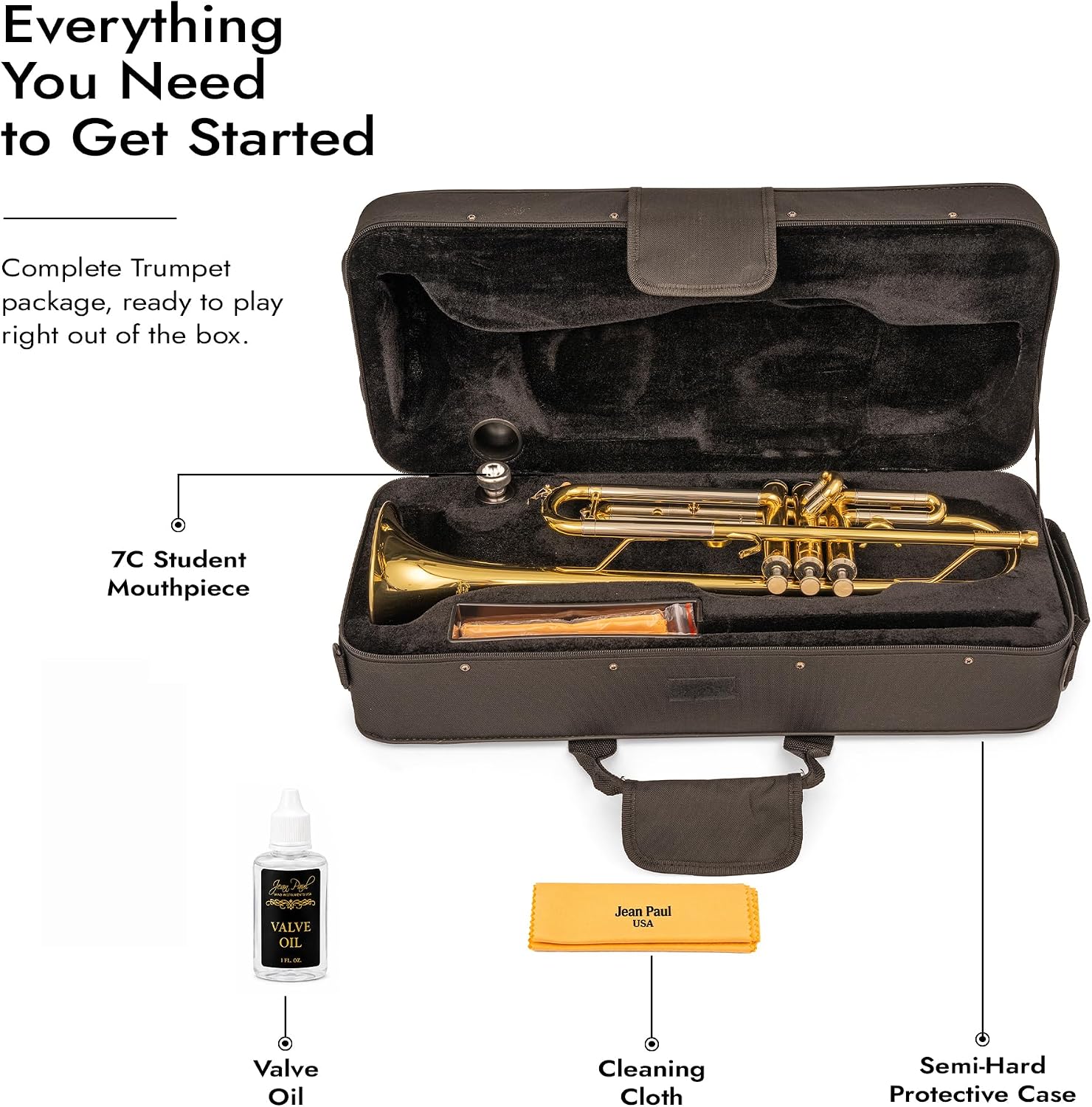
Nearly every student trumpet arrives as a kit, and the kits look more generous than they are. A 7C mouthpiece is the near universal starting size and the one most band directors expect, so its presence is a baseline rather than a bonus. Valve oil, slide grease and a polishing cloth are the other three items a player needs in week one. A cleaning snake matters within the first term, because the inside of a horn gets dirty faster than beginners expect.
The case is the accessory worth reading about, because a student instrument spends more time being carried than played. A moulded hard case protects the bell properly. A soft gig bag with thin padding does not, and a bell dent picked up on a bus is the most common damage a school horn takes. Backpack straps sound like marketing until you watch a small player carry a case, a rucksack and a music folder at the same time.
Gloves appear in most kits and are the least important item in the box, since they keep finger marks off lacquer and do nothing else. What the kits leave out is a music stand, a tuner and a practice mute, and the mute in particular buys goodwill in a house with neighbours.
Finish, Slides, and Surviving a School Year

Gold lacquer over yellow brass is the standard finish here and it does two jobs, sealing the metal against handling and giving the horn its colour. Lacquer wears at the contact points first, usually where the left hand wraps the valve casing, and worn lacquer is cosmetic rather than structural. Silver plate is the other option, brighter in sound by most descriptions, and it needs polishing to stay presentable.
Slides are where neglect shows. A trumpet has a main tuning slide and three valve slides, and all four need grease often enough that a student should learn to do it in the first month. A slide left dry for a term seizes, and freeing one is a repair shop job rather than a kitchen table one. Water keys, often called spit valves, wear out at the cork and are cheap to replace, but only if the maker sells the part.
Ergonomics matter more than the specification sheet suggests. An adjustable third valve ring or a third slide throw lets a smaller hand reach the correct correcting position for low D and C sharp, and it is one of the clearest dividing lines between a basic student horn and a step up model. Overall weight matters too, because a horn a child struggles to hold up steadily is a horn with a wobbly tone.
Repairs and Parts Are the Hidden Cost
Every brass instrument needs work eventually. A stuck slide, a dented bell rim, a worn valve guide and a leaking water key cork are all routine, all fixable, and all dependent on somebody being able to get the part. Established makers keep valve guides, water key corks, springs and felts available, and a local repair technician can order them. An unbranded listing usually cannot supply anything, which turns a small fault into a dead instrument.
This is the argument against the cheapest horn in any search result, and it is not about sound quality. A no name student trumpet often plays acceptably out of the box. The problem arrives six months later when a valve needs a guide and there is no model number, no parts list and no importer to ask.
Renting through a school program solves the same problem in a different way, because the rental fee usually includes maintenance. Buying makes more sense once a student has committed, and it makes far more sense if the horn holds some resale value. Instruments with a recognised model name sell on to the next family. Anonymous ones do not.
| Tier | What you typically get | Who it suits |
|---|---|---|
| Entry kit horn | Yellow brass bell, 7C mouthpiece, hard case, oil and cleaning kit | A first year player testing whether the instrument sticks |
| Supported student horn | Play tested valves, named model, parts and repair support | A student committed to a full school year or more |
| Step up intermediate | Rose brass leadpipe, adjustable third valve ring, larger bore | A second or third year player outgrowing a starter horn |
Why You Should Trust Us
We build these lists from published specification and from the pattern of what long term owners report, rather than from marketing copy. For each trumpet here we compared the stated key and bore, the leadpipe and bell material, the valve construction, whether the maker describes a pre shipping play test, what the case and accessory kit actually contains, and whether replacement parts and repair support exist for the model by name.
We set aside near identical listings that differ only in finish colour or bundle contents, so every entry here is a genuinely different instrument, and we left out unbranded horns sold without a model designation because they cannot be supported after a fault. Where a kit counts gloves and a cloth toward a headline accessory total, we say so rather than repeating the number. Owner feedback is read for repeated faults, especially sticking valves and seized slides, since those are the failures that end practice.
Final Thoughts
Best overall is the Jean Paul TR-330 Student Bb Trumpet. It is a named model with stainless steel valves, a two piece yellow brass bell and a described play test before shipping, and it sits behind a support network that can supply parts when something wears. For a first horn that has to last a school year and then be handed to a younger sibling, that combination matters more than any single specification on the page.
Best value is the Eastar ETR-380 Student Bb Trumpet Set. It is the most complete first instrument package here, arriving with a hard case, a 7C mouthpiece, gloves and a cleaning kit, so a beginner has everything needed for the first lesson in one box.
For specific needs, the Jean Paul TR-430 Intermediate Bb Trumpet is the step up pick for a player entering a second or third year, thanks to its rose brass leadpipe, wider bore and adjustable third valve ring. The Mendini by Cecilio MTT-L is the pick for a school program buying more than one horn at a time, and the Eastrock and Glory kits suit a cautious first purchase where a hard case matters most. More gear picks are indexed across our article archive, and beginner friendly instruments for younger children sit alongside our toys and games section.
Student Trumpet FAQs
What key should a beginner student trumpet be in?
B flat, without exception for school band. The parts written for concert band trumpet assume a transposing B flat instrument, so a student reading the same page as everyone else will play in tune with the section. C trumpets belong in orchestras, cornets belong in brass bands, and flugelhorns share the fingering but not the repertoire.
Is a 7C mouthpiece the right size to start on?
For most beginners, yes, and it is the size band directors assume. A 7C sits in the middle of the range, with a cup depth and rim diameter that suit an unformed embouchure without making high notes impossible or low notes thin. Some students move to a slightly larger 5C or a shallower 3C once a teacher hears them play, but that is a decision for month six rather than week one. Every trumpet on this list ships with a 7C.
How often does a student trumpet need cleaning?
Valves want oil every few playing days, slides want grease roughly monthly, and the whole instrument wants a full bath once or twice a term. The bath is the part people skip, and it is why horns go stuffy: condensation and food particles build a layer inside the tubing that narrows the bore. A cleaning snake and warm soapy water handle it at home.
Should a family rent or buy a first trumpet?
Rent if the student has not yet committed, because rental programs usually roll maintenance into the fee and swap the instrument if something fails. Buy once the student has finished a term and still wants to play, since ownership costs less over two or three years and the horn is always available for practice. Buying a named model rather than an anonymous one also protects resale, which makes the decision easier to reverse. Our musical instruments category tracks the options.
When is it time to upgrade from a student horn?
Usually in the second or third year, and the signal comes from the player rather than the calendar. When a student starts fighting intonation on low D and C sharp, wants more colour in the sound, or has outgrown the response of a small bore, an intermediate horn with a rose brass leadpipe and an adjustable third valve ring gives them somewhere to go. Before then, the upgrade that helps most is a lesson, not a new instrument.
Write Your Review
No reviews yet. Be the first to share your experience!