

The device that saves a refrigerator is not the one most people go looking for. A surge is a very short, very high voltage spike, and a plain surge protector clamps it well. What actually kills a compressor is the opposite problem: voltage that sags below normal for seconds or minutes, so the motor draws heavy current while barely turning, and a restart that happens the instant power returns, while refrigerant pressure in the system is still high. Neither of those is a spike, and no joule rating in the world addresses them. Our top pick is the Refrigmatic 2 in 1 Voltage and Surge Protector for combining high and low voltage cut out with a timed restart delay. This shortlist of 8 surge protector for refrigerator options from Eaton Tripp Lite, Belkin, Refrigmatic and more is judged on voltage thresholds and delay behaviour rather than on the number printed largest on the box.
Two products here are deliberate points of comparison rather than recommendations for a refrigerator. The Belkin single outlet unit and the Eaton Tripp Lite SPIKECUBE are excellent conventional surge protectors, and both are included so the difference is visible in one place: they clamp spikes, they have no voltage monitoring, and they have no restart delay. For the electronics they are built for, see our electronics guides.

Pros
- Protects against low voltage as well as high voltage
- Timed restart delay lets refrigerant pressure equalise
- Covers the two failure modes that actually destroy compressors
- Sized for refrigerators up to about 27 cubic feet
- Plugs directly into a grounded wall receptacle
Cons
- Body is bulky in a tight gap behind an appliance
- Larger refrigerators need the higher capacity version
The Refrigmatic takes the top spot because it addresses the failure modes a refrigerator actually suffers. It measures the incoming supply continuously and disconnects the appliance when voltage strays outside a safe window in either direction, which is the protection a plain surge strip cannot offer at any joule rating.
The second half of its job is the restart delay. When power returns, the compressor is held off for a few minutes so refrigerant pressures can equalise, which prevents the stalled, overheating start that a sudden reconnection forces on a motor that has just stopped.
Its limits are physical rather than functional. This is a chunky plug in block, and a tight gap between the appliance and the wall may not accommodate it comfortably, so measure before ordering. It is also sized for refrigerators up to around 27 cubic feet, which covers most domestic units but not the largest ones.
Bottom line: the most complete protection here and the default choice for a standard domestic refrigerator.
- Type: voltage and surge protector
- Voltage protection: high and low
- Restart delay: yes, timed
- Appliance size: refrigerators up to about 27 cubic feet
- Connection: direct plug in to grounded receptacle
- Display: incoming voltage readout
- Use: refrigerators and similar sealed motor appliances
Households on a supply that sags in hot weather or during storms, and anyone who has already replaced one compressor and does not want to do it again.
Owners of very large refrigerators should step up to the higher capacity version in the same range instead.
Plug it into the wall receptacle and the appliance into it, with no extension lead anywhere in the chain, since a long cord drops voltage before the protector can measure it.
Watch the voltage readout over a few evenings. A supply that sits well below normal at peak times is evidence worth showing an electrician rather than a quirk to ignore.

Pros
- Load ceiling of 1875 watts gives real headroom
- Three outlets cover more than one appliance
- Brownout and surge protection in one unit
- Delayed restart after power returns
- Compact enough for most appliance gaps
Cons
- Three outlets invite unsuitable loads being added later
- Shared protection means one fault disconnects everything on it
The three outlet BSEED unit is the one to choose when more than one appliance in the same corner deserves protection. The 1875 watt ceiling is generous at household voltage, and the essential behaviour is intact: it monitors supply voltage, disconnects outside a safe band, and holds off the restart when power comes back.
For a utility room with a refrigerator and a freezer, or a garage with two appliances on one wall, that combination is more practical than buying separate units for each.
The risk is behavioural rather than electrical. A spare outlet behind an appliance attracts a microwave or a space heater eventually, and those are loads in a different class that will erode the headroom you paid for. Remember also that protection is shared, so a voltage event disconnects everything plugged into it at once.
Bottom line: the right pick for two or three deliberately chosen appliances, provided nothing unplanned joins them.
- Type: voltage and surge protector
- Outlets: three protected
- Load rating: 1875 watts
- Supply: 120 volts
- Voltage protection: high and low
- Restart delay: yes
- Connection: direct plug in
Add up the running loads you intend to connect and leave room for starting current, which for motor appliances is several times the running figure.
If only one appliance needs protecting, the single outlet version in the same range is smaller and removes the temptation to add more.
Keep it out of standing damp in a garage or basement and pull the appliance forward once a year to clear dust from the unit and the receptacle.
Do not chain it to an extension lead. It should be the only thing between the appliance and the wall socket.

Pros
- Built for refrigerators of 27 cubic feet and above
- Surge budget of around 1005 joules
- High and low voltage protection with restart delay
- Suits large side by side and built in units
- Same proven protection approach as the standard model
Cons
- More capacity than a standard domestic refrigerator needs
- Physically larger in an already tight space
The Mega version exists for a specific reason: large refrigerators draw more, and the standard model in this range states a capacity limit of around 27 cubic feet. If your appliance is a big side by side, a built in, or a commercial style unit, this is the version that matches it.
The protection logic is the same as its smaller sibling, which is the point. Voltage monitoring in both directions, disconnection outside a safe window, and a timed hold before the compressor is allowed to start again, with a surge budget of around 1005 joules behind it.
For a normal domestic refrigerator this is more capacity than the job needs, and the body is larger in a gap that is often already tight. Buying up for the sake of a bigger number is not the reasoning here; match the unit to the appliance and no more.
Bottom line: the correct choice for large refrigerators and unnecessary for average ones.
- Type: voltage and surge protector
- Surge rating: about 1005 joules
- Appliance size: refrigerators 27 cubic feet and larger
- Voltage protection: high and low
- Restart delay: yes, timed
- Display: incoming voltage readout
- Connection: direct plug in
Owners of large side by side, built in, or commercial style refrigerators that exceed the capacity of the standard model in this range.
Anyone with an average domestic refrigerator is better served by the smaller version, which fits the space more easily.
Check your appliance capacity in cubic feet on its data plate before choosing between this and the standard model, since that is the figure the range is split on.
Measure the depth available behind the appliance too, because the larger body needs more room than a slim block.

Pros
- 1440 watt rating is ample for a domestic refrigerator
- Single outlet keeps the protector dedicated to one appliance
- High and low voltage cut out with delayed restart
- Compact body fits tighter gaps than larger units
- Straightforward plug in with nothing to configure
Cons
- One outlet only, so a second appliance needs its own unit
- Compact display is harder to read behind an appliance
This is the value pick because it delivers the two features that matter without paying for capacity nobody needs. Voltage monitoring in both directions and a delayed restart are present, the load ceiling of 1440 watts is twelve amps at household voltage, and a domestic refrigerator sits comfortably inside that.
Having a single outlet is a quiet advantage rather than a limitation. A protector with one socket stays dedicated to the appliance it was bought for, which is exactly the arrangement appliance manuals ask for.
The compromises are small. A second appliance needs its own unit or the three outlet version, and the compact display is harder to read once it is wedged behind a refrigerator, though that only matters when you are actively diagnosing a supply problem.
Bottom line: the sensible default for one refrigerator, with nothing important missing.
- Type: voltage and surge protector
- Outlets: one
- Load rating: 1440 watts
- Voltage protection: high and low
- Restart delay: yes
- Connection: direct plug in
- Use: refrigerators, freezers and similar appliances
Anyone protecting a single refrigerator or freezer who wants the voltage monitoring and restart delay without extra outlets or bulk.
Households with two appliances in the same spot should look at the three outlet version instead of buying two units.
Plug it directly into the wall socket, then the appliance into it. Nothing else should sit in that chain, since extension leads drop voltage before it can be measured.
Note the reading when the appliance first starts up so you have a baseline to compare against if you suspect the supply later.

Pros
- Two outlets protect a pair of appliances
- Time delay stated plainly on the listing
- Brownout and over voltage protection together
- One unit instead of two behind the same wall
- Simple plug in installation
Cons
- Both outlets share one protection circuit
- Two appliances on one unit consume the load headroom faster
The Ortis unit is a two outlet voltage protector that puts its time delay in the listing title, which is exactly the specification a refrigerator buyer should be checking for. Two sockets mean a refrigerator and a second appliance can be covered by one device rather than two.
Protection covers the range in both directions, so a sagging supply on a hot evening and an over voltage event are both grounds for disconnection, and the delay holds the appliances off until conditions have settled.
Two consequences of sharing. Both outlets sit behind one protection circuit, so a voltage event cuts both appliances at once, which is fine for a refrigerator and a freezer and less convenient if one of them is something you would rather keep running. Two appliances also consume load headroom faster, so check what you are connecting.
Bottom line: a tidy two appliance solution where a single delayed cut out covering both is acceptable.
- Type: voltage protector with surge protection
- Outlets: two
- Time delay: stated on the listing
- Protection: brownout and over voltage
- Connection: direct plug in
- Use: refrigerators and home appliances
- Circuit: shared across both outlets
Decide whether both appliances can tolerate being disconnected together, since they share one protection circuit and one delay.
Confirm the combined running load, and remember that motor appliances draw far more at the moment they start than while they run.
Mount or rest it where air can reach it rather than sandwiched against a hot condenser coil, since heat is what ages the components inside.
Check it after any major electrical event rather than assuming it survived, and clear dust from it annually.

Pros
- Designed around two specific motor appliances
- High and low voltage protection with delayed restart
- Covers a washing machine motor as well as a compressor
- One purchase for a laundry and kitchen pairing
- Strong customer rating history for the category
Cons
- Only worthwhile if both appliances are within reach of one socket
- Shared protection disconnects both appliances together
This combination unit is unusual in being designed around a specific pairing rather than a generic outlet count. A washing machine motor suffers from low voltage in much the same way a compressor does, so covering both appliances with one voltage protector is a coherent idea rather than a marketing convenience.
The protection itself is what the category demands: monitoring for both high and low supply voltage, disconnection outside a safe range, and a delay before reconnection so motors are not asked to start into an unsettled supply.
Its usefulness depends entirely on your layout. If the two appliances are on opposite sides of a house, the pairing is theoretical and two separate protectors are the practical answer. Both also share one protection circuit, so an event stops both machines at once, which is more disruptive mid wash than mid cooling cycle.
Bottom line: an efficient choice for a utility room where both appliances stand together, and pointless if they do not.
- Type: combination voltage and surge protector
- Intended appliances: refrigerator and washing machine
- Voltage protection: high and low
- Brownout protection: yes
- Restart delay: yes
- Connection: plug in
- Circuit: shared across the covered outlets
Utility rooms and garages where a refrigerator or freezer stands beside a washing machine on the same wall and one socket serves both.
Anyone with the two appliances in different rooms should buy two single outlet protectors instead.
Plug it straight into the wall receptacle rather than through an extension lead, and route the appliance cords so nothing pulls on the unit.
Expect a pause before either appliance restarts after an outage. That delay is the protection working, not a fault.

Pros
- Around 885 joules of surge absorption
- Single outlet keeps the adjacent socket usable
- Wall mountable, so it sits flat and tidy
- Long standing product with the deepest rating history here
- Excellent for televisions, routers and chargers
Cons
- No voltage monitoring, so brownouts pass straight through
- No restart delay, so power returns to the appliance instantly
The Belkin single outlet protector is included as the point of comparison, and on its own terms it is very good. A surge budget of around 885 joules, a flat wall mountable body, and one outlet that leaves the socket beside it usable make it a neat solution for electronics in a tight spot.
It also has by far the deepest rating history in this shortlist, which reflects years of doing its job in front of televisions, routers, consoles and chargers.
What it does not do is what a refrigerator needs. There is no voltage monitoring here, so a supply that sags to the mid nineties and stays there is passed through untouched, and there is no restart delay, so when power returns the outlet is live in that same instant. For a compressor those are the two events that matter, and this device notices neither.
Bottom line: buy it for electronics, and buy a voltage protector for the refrigerator.
- Type: surge protector only
- Surge rating: about 885 joules
- Outlets: one
- Mounting: wall mountable
- Voltage protection: none
- Restart delay: none
- Intended use: electronics and small devices
Televisions, routers, games consoles, computers and chargers, where a spike is the real threat and a circuit board is what needs guarding.
Not the right device for a refrigerator, because it has no voltage monitoring and no restart delay.
Compare joule ratings when shopping for electronics protection, since that budget is consumed over the life of the device and is the relevant specification there.
For any sealed motor appliance, ignore joules and look for stated voltage cut out thresholds and a timed restart delay instead.

Pros
- Diagnostic lights confirm protection is still present
- Very compact direct plug in block
- 600 joule rating suits small electronics
- Established brand in power protection
- Ideal for travel and for single devices
Cons
- No voltage protection, so brownouts reach the appliance
- No time delay, so a compressor restarts the instant power returns
The SPIKECUBE is the other deliberate comparison in this shortlist, and its best feature is one the whole category should copy: diagnostic lights that tell you whether protection is still present. Surge components wear out silently, so a device that reports its own health is genuinely more useful than one with a larger number on the label.
At 600 joules in a very compact plug in block, it suits a router, a charger, a single small device, or a bag for travelling.
For a refrigerator it is the wrong tool, and clearly so. There is no voltage monitoring, so sustained low voltage passes through untouched, and there is no delay, so a compressor that has just stopped is asked to restart the instant the supply returns, against refrigerant pressure that has not yet equalised. Those are the two mechanisms that damage compressors, and this device addresses neither.
Bottom line: a good compact protector for electronics, and not protection for a refrigerator.
- Type: surge protector only
- Surge rating: 600 joules
- Outlets: one
- Indicators: diagnostic LEDs
- Voltage protection: none
- Restart delay: none
- Format: compact direct plug in
Single small devices at home or on the road: routers, chargers, media players and similar electronics where a spike is the threat.
Not suitable as refrigerator protection, since it monitors nothing and delays nothing.
Check the diagnostic lights after any major electrical event. A protector can keep passing power long after its surge components are spent.
Treat it as a consumable part and replace it once the indicators say protection is no longer present.
How to Choose Protection for a Refrigerator
The criteria below are ordered by how much each one affects whether your compressor survives a bad night on the grid, starting with the failure mode most buyers have never heard of.
Brownouts Kill Compressors, Spikes Rarely Do
A refrigerator compressor is an electric motor sealed inside a steel shell with refrigerant around it. Like every induction motor it draws a large current at the moment it starts, several times its running current, and it relies on getting up to speed quickly so that current falls away. Supply voltage is what lets it do that.
When voltage sags, the motor cannot develop enough torque to accelerate, so it sits there drawing near stall current while turning slowly or not at all. That current becomes heat in the windings, the internal overload protector trips, and a few minutes later it tries again into the same weak supply. Repeat that cycle through a summer evening of low voltage and the winding insulation degrades until a start attempt shorts it.
This matters because a spike lasting microseconds is a completely different event, and it is the only one a conventional surge protector is designed for. Spikes damage circuit boards and electronics, which is why televisions and computers belong behind them. A sealed motor is comparatively tough against spikes and comparatively fragile against sustained low voltage, which is the reverse of what the shelf label suggests.
Voltage Protection Is the Feature to Insist On
A voltage protector does something a surge protector does not: it measures the supply continuously and disconnects the appliance when the voltage leaves a safe window. Household supply is nominally 120 volts, and these devices typically cut out somewhere in the region of the high nineties at the bottom and the low one hundred and thirties at the top, reconnecting only once the reading returns to a normal band.
Both directions matter. Low voltage is the compressor killer described above. High voltage is rarer but harder on everything, and it shows up when a utility neutral is lost, when a generator is poorly regulated, or during the messy minutes around a fault being cleared. A unit that watches both ends of the range covers the whole picture rather than half of it.
This is the feature that separates the two halves of this shortlist. The Refrigmatic, BSEED, Ortis and Two Electronic units are voltage protectors first and surge protectors second. The Belkin and Eaton Tripp Lite units are surge protectors only, so if the supply drops to ninety five volts and stays there, they will pass it straight through to the appliance without complaint, because that is not what they are built to notice.
The Time Delay Is the Other Half of the Job
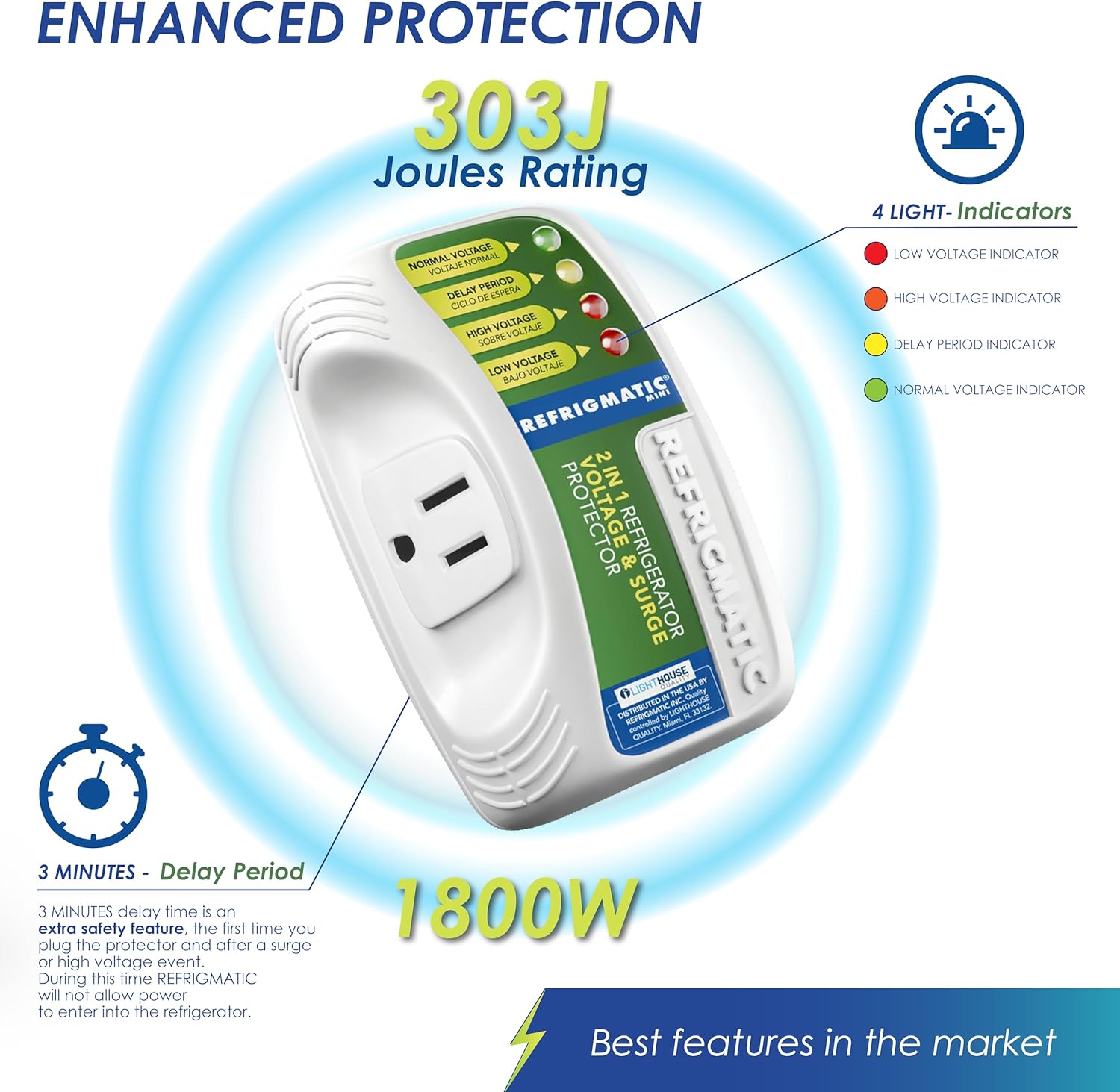
When a compressor stops, the refrigerant on its high side is still under pressure, and that pressure takes a few minutes to equalise through the system. Starting the motor again before that happens means asking it to push against a load it was never sized to overcome from a standstill, which produces exactly the stalled, overheating start described earlier.
This is why a delay of around three minutes appears on every serious refrigerator protector, and it is the single most useful thing these devices do. Utility equipment often restores power in bursts, cutting and reclosing within seconds while a fault is being cleared, and each of those events is a restart attempt the appliance never asked for. The protector absorbs all of them and lets the compressor back on once, calmly, when the supply has settled.
No conventional surge protector delays anything. Power returns and the outlet is live in the same instant, which is exactly the behaviour a refrigerator does not want. If you take one specification away from this guide, make it this: for a refrigerator, a timed restart delay is worth more than any joule figure on any package.
What a Joule Rating Actually Measures

Joule ratings describe how much surge energy a protector can absorb over its life before its internal components are used up. Inside most of these devices are metal oxide varistors, which shunt excess voltage to the neutral and ground conductors and give up a little of themselves each time they do it. A higher number means a bigger budget, not a stronger wall.
The figures here span a wide range, from a few hundred joules on the compact single outlet units to around a thousand on the Refrigmatic Mega. For sensitive electronics that budget is worth paying for, since a board damaged by a spike is a board replaced. For a sealed motor, the joule number is largely beside the point, because spikes are not the threat and a bigger budget does nothing about voltage sag.
Worth knowing too: varistors degrade silently. A protector can keep passing power perfectly for years after its surge components have been exhausted, so the device you bought for protection may now be a plain extension of the socket. That is why diagnostic indicators, covered further down, matter more than the headline rating.
Wattage and Outlet Count Have to Match the Load
These protectors carry a stated maximum load, and it is a real limit rather than a formality. The single outlet BSEED unit here is rated at 1440 watts, which at household voltage is twelve amps, and the three outlet version is rated at 1875 watts. A typical domestic refrigerator runs at a small fraction of either figure, so headroom is not usually the problem.
The problem is what else gets plugged in. The moment a three outlet protector is available behind an appliance, a microwave, a chest freezer or a space heater tends to appear on it, and those loads are in a different class entirely. Starting current also counts, since motor appliances briefly draw far more than their running rating and that is what trips the protector or shortens its life.
The safer arrangement is one protector serving one appliance, or at most one protector serving two appliances that were both chosen deliberately, as with the Two Electronic combination unit intended for a refrigerator and a washing machine. Multiple outlets are a convenience for cable management, not permission to consolidate the kitchen onto one socket.
Plug Into the Wall, Never Into an Extension Lead
Nearly every refrigerator manual asks for a dedicated grounded receptacle and asks you not to use an extension cord. The reason is voltage drop: a long, thin cord loses voltage under load, which means the appliance sees less than the wall does, and having just read what low voltage does to a compressor you can see why that instruction is not boilerplate.
A voltage protector is designed to sit between the wall and the appliance, which respects that rule, since it plugs directly into the receptacle and the appliance plugs into it. What it cannot fix is a bad chain further back, so a protector plugged into a coiled extension lead behind a cabinet gives you a device measuring a voltage that has already been degraded on its way there.
Watch the physical fit as well. Some of these units are chunky plug in blocks, and a deep one behind a refrigerator can stop the appliance sitting back against the wall or push it forward of the cabinet line. Measure the gap you have and prefer a slimmer body if that gap is tight, since forcing a fridge back onto a plug damages the plug.
Heat, Dust and Damp in the Space Behind the Fridge
The area behind a refrigerator is one of the least friendly spots in a house for a small electronic device. Condenser coils reject heat there, air circulation is poor, and dust collects heavily because nobody vacuums a space they cannot reach. Ambient temperature behind a working appliance runs meaningfully above room temperature.
That environment argues for a unit with a sealed, solid body rather than an open strip with a fabric mesh of ventilation slots, and it argues for pulling the appliance out once a year to clean the coils and the socket at the same time. A protector caked in dust runs hotter than its designers intended, and heat is what ages the components inside it.
Garages and basements add moisture to the list. Condensation on a cold floor, a nearby washing machine, or seasonal humidity all shorten the life of exposed contacts, and in those locations local wiring rules may also call for ground fault protection on the circuit. If your refrigerator lives in a garage rather than a kitchen, factor damp and cold into the choice rather than treating it as a kitchen installation.
Indicators, Displays and Knowing It Still Works
Because surge components wear out silently, an indicator that reports protection status is more useful than most buyers realise. The Eaton Tripp Lite unit here carries diagnostic lights for exactly that purpose, and the principle applies across the category: a light that confirms protection is present is the only way to know the device is still doing its job.
Voltage protectors often go further with a numeric display of the incoming supply, and that display turns a passive device into a diagnostic tool. Watching the reading sit at 112 volts through an evening tells you something concrete about your supply and about whether the problem is your appliance or your utility connection, and it is evidence you can put in front of an electrician.
A practical habit: after any significant electrical event, a nearby lightning strike, a transformer failure on your street, an extended outage, walk over and look at the indicator rather than assuming the device came through it. Protectors are consumable parts, and replacing one after it has absorbed a serious hit is far cheaper than replacing what it was guarding.
Warranties, Cover and What Nobody Pays For
Appliance warranties generally exclude damage caused by an improper power supply, which puts voltage related compressor failure in the awkward gap between what the manufacturer covers and what your household insurance considers a claim worth making. That gap is the commercial argument for these devices, and it is a fair one.
Some protectors advertise connected equipment cover of their own. Read the conditions before treating that as meaningful, because such policies typically require proof of purchase, an intact protector to return, evidence of the event, and correct installation, and they usually exclude damage from anything other than a surge. Keep receipts and photographs if you intend to rely on it.
The complementary measure worth knowing about is whole house surge protection installed at the electrical panel, which handles large events entering on the service conductors. It is an electrician’s job, and it protects everything in the building, but it still does not monitor voltage or delay a restart, so a refrigerator behind one benefits from a point of use voltage protector as well.
When a Plain Surge Protector Is the Right Answer

None of this makes conventional surge protectors bad products, and the two here are deservedly popular. The Belkin unit is a single outlet protector with a rating around 885 joules that can be wall mounted, and the Eaton Tripp Lite SPIKECUBE is a compact 600 joule block that plugs directly into a receptacle with diagnostic lights on the front. Both do their job well.
Their job is protecting electronics: televisions, routers, games consoles, computers, chargers, anything with a circuit board that a spike can damage in an instant. In those applications the joule rating is the right specification to compare, the absence of a restart delay is irrelevant, and a compact body that does not block the adjacent socket is genuinely valuable. Our portable charger picks cover another corner of the same shelf.
What they will not do is watch your supply voltage or hold a compressor off for three minutes, and no version of them will, because that is not the design. They sit in this shortlist to make the contrast concrete: if the appliance you are protecting is a sealed motor, buy the device that measures volts and counts minutes, and keep these for the equipment they were built for.
| Model | Type | Voltage protection | Restart delay |
|---|---|---|---|
| Refrigmatic 2 in 1 | Voltage and surge | High and low | Yes, timed |
| BSEED 3 outlet | Voltage and surge | High and low | Yes, timed |
| Refrigmatic Mega | Voltage and surge | High and low | Yes, timed |
| BSEED single outlet | Voltage and surge | High and low | Yes, timed |
| Ortis double outlet | Voltage and surge | High and low | Yes, stated on listing |
| Two Electronic combo | Voltage and surge | High and low | Yes, timed |
| Belkin single outlet | Surge only | None | None |
| Eaton Tripp Lite SPIKECUBE | Surge only | None | None |
Why You Should Trust Us
We lead with voltage thresholds and restart delay because those are the two mechanisms that address how refrigerators actually fail, and neither appears on the front of a package where joule ratings live. Every unit here is a current listing with enough accumulated customer feedback to show how these devices behave in real kitchens, garages and basements over years rather than weeks.
We do not accept payment for placement, and we would rather tell you that two popular products in this search result solve a different problem than quietly rank them for a job they cannot do. Where a device is a plain surge protector, we say so, because the distinction is the entire point of this guide.
Final Thoughts
The Refrigmatic 2 in 1 Voltage and Surge Protector is our best overall pick. It monitors for both high and low voltage, disconnects the appliance when the supply leaves a safe range, and holds the compressor off long enough for refrigerant pressures to settle before letting it start, which together cover the two failure modes that actually destroy refrigerators. It is rated for appliances up to around 27 cubic feet, and the Refrigmatic Mega covers larger units with a higher surge budget behind it.
The BSEED single outlet unit is our best value choice, delivering the same essential combination of voltage monitoring and delayed restart in a compact body rated at 1440 watts, which is ample for a domestic refrigerator. If you want two appliances covered, the Ortis double outlet unit and the Two Electronic combination are built for that, the latter specifically with a refrigerator and a washing machine in mind, and the BSEED three outlet version raises the load ceiling to 1875 watts.
Keep the Belkin and Eaton Tripp Lite units for what they are excellent at, which is protecting electronics from spikes. Plug your refrigerator straight into a grounded wall receptacle through its protector rather than through an extension lead, pull the appliance out once a year to clean the coils and the socket behind it, and check the indicator after any serious electrical event. More home and kitchen picks are in our latest guides.
Frequently Asked Questions
Does a refrigerator need a surge protector for refrigerator or a voltage protector?
A voltage protector, ideally one that also handles surges. Spikes lasting microseconds threaten circuit boards, while compressors are destroyed by sustained low voltage and by restarting against high refrigerant pressure. A device that measures the incoming supply, disconnects outside a safe window, and delays reconnection by a few minutes addresses both. A conventional surge protector does none of that.
What is a brownout and why is it worse than a spike?
A brownout is supply voltage sagging below normal for seconds or minutes, often during heavy demand or a nearby fault. A motor at low voltage cannot develop enough torque to accelerate, so it draws close to stall current, overheats, trips its overload, and tries again. Repeated over an evening, that cycle degrades winding insulation, which is how compressors fail electrically.
How long should the restart delay be?
Around three minutes is the usual figure and it is enough for most systems. The delay exists so refrigerant pressure can equalise before the compressor tries to start, and it also absorbs the rapid cut and reclose sequences utility equipment performs while clearing a fault. A shorter delay is better than none, and no delay at all is the weakness of a plain power strip.
Can I plug a refrigerator into a power strip in 2026?
Appliance manuals almost universally say no, and the reason is voltage drop rather than caution for its own sake. A long or thin cord loses voltage under load, so the compressor sees less than the wall provides, which is the condition that damages it. Plug the protector into the wall receptacle and the appliance into the protector, with nothing in between.
Will whole house surge protection cover my refrigerator?
Partly. A panel mounted device intercepts large surges arriving on the service conductors and protects everything in the building, which is worthwhile, but it does not monitor supply voltage and it does not delay a restart. Those two functions live at the point of use, so a refrigerator behind whole house protection still benefits from its own voltage protector. More picks are in our category directory.





Write Your Review
No reviews yet. Be the first to share your experience!