

A wired doorbell chime does not run on household current. It runs on low voltage supplied by a doorbell transformer, usually 16 volts at 10 volt amperes, and that transformer is a separate part already hidden somewhere in the house rather than a component inside the box you are about to buy. That single fact explains most of the one star reviews in this category: the chime arrives, gets wired to the same two wires as the old one, and then hums, strikes weakly, or does nothing. Our top pick is the Newhouse Hardware CHM1 for its true two note mechanical strike and the deepest reliability record here. This shortlist of 8 wired doorbell chime options from Heath Zenith, Broan-NuTone, Newhouse Hardware and more is judged on what actually decides whether a swap goes smoothly: transformer requirements, front and rear door wiring, and whether the cover hides the holes already in your wall.
Every model below is a low voltage wired unit that mounts on an interior wall and sounds when someone presses a button outside. Two products that dominate search results for this term were left off deliberately, because they are not this kind of device at all. The Ring Chime and the Blink Chime are wireless plug in speakers that repeat alerts from a camera or a video doorbell over your home network, and neither one connects to bell wire or to a transformer. If a camera at the door is what you are really after, start with our guide to doorbell cameras without a subscription instead. For the rest of the house, our tools and home improvement guides cover related jobs.

Pros
- True mechanical strike rather than a recorded tone
- Front and rear terminals distinguish the two doors
- Deepest customer rating history in this category
- Very few moving parts, so very little to fail
- Cover large enough to hide most existing screw holes
Cons
- Needs a transformer rated around 16 volts and 10 volt amperes
- No volume control, as no mechanical chime has one
The CHM1 takes the top spot because it does the one thing a wired chime is for without adding anything that can break. A solenoid throws a plunger, the plunger strikes flat metal bars, and the result is a real two note strike with real decay rather than a small speaker playing a recording of one.
The three terminal strip is the practical detail. Front, transformer and rear means one unit on one wall can tell you which door someone is standing at, two notes for the front and a single note for the back, with nothing to program and nothing to pair.
Its requirement is the requirement of the whole category: a doorbell transformer of roughly 16 volts at 10 volt amperes, which is a part already in most houses but not in this box. A transformer that is undersized, or shared with lighted buttons and a second chime, produces a weak strike or a hum, and that is a supply problem rather than a chime problem.
Bottom line: the most dependable choice here and the one to buy if you want the traditional sound and the fewest ways to fail.
- Type: mechanical wired chime
- Notes: two note front, single note rear
- Terminals: front, transformer, rear
- Power: low voltage doorbell transformer, not included
- Typical requirement: 16 volts at 10 volt amperes
- Finish: white cover
- Wiring: reuses existing bell wire
Measure the cover already on your wall before ordering. A new chime with a smaller footprint leaves screw holes and a paint outline on show, which turns a quick swap into patching and painting.
Check the transformer with a meter set to alternating volts first. A reading near sixteen means you are ready to fit this; a reading near ten means the transformer is the part to buy.
Photograph the old terminal strip and tape a label on each wire before you loosen anything. Bell wire conductors are often the same faded colour and become guesswork once they are loose in the wall.
If the chime hums instead of striking after fitting, do not assume a defect. Check the plunger moves freely and measure the supply voltage under load, since both symptoms point at supply rather than at the chime.

Pros
- Mechanical strike with two distinct melodies
- States compatibility with wired smart video doorbells
- Around 85 decibels, loud enough for a central hallway
- Front and rear operation from one unit
- Simple internals with little to go wrong
Cons
- Smart doorbell use adds a standing load on the transformer
- Plastic housing feels lighter than metal alternatives
This Heath Zenith unit is the pick for anyone pairing a wired video doorbell with a traditional chime. It is mechanical, so the sound is metal being struck, and the listing states compatibility with wired smart doorbells, which matters because those cameras are designed to run through an existing chime and transformer.
Two melodies cover the usual arrangement, a two note strike for the front and a single note for a rear button, and the quoted output of around 85 decibels is enough to carry through a normal hallway.
The caveat is electrical rather than mechanical. A video doorbell draws power continuously, so it sits on your transformer alongside the chime all day, and an undersized transformer will give you both a tired strike and an unreliable camera. The doorbell app will also ask whether your indoor chime is mechanical or digital, and this one is mechanical.
Bottom line: the sensible chime to keep when a wired video doorbell is going on the same circuit.
- Type: mechanical wired chime
- Melodies: two, ding dong and single ding
- Output: about 85 decibels
- Compatibility: stated for wired smart doorbells
- Housing: white plastic
- Power: low voltage doorbell transformer, not included
- Doors: front and rear
Households fitting or already running a wired video doorbell who want to keep a real mechanical chime indoors rather than relying on a phone alert.
Anyone with no camera plans is served just as well by a plain mechanical chime, since the compatibility statement is the main thing this adds.
Before pairing with a video doorbell, confirm the transformer has capacity for a continuous camera load plus the chime. This is the most common cause of a camera that reboots and a chime that buzzes.
When the doorbell app asks about chime type, answer mechanical. Choosing digital for a mechanical chime causes buzzing or half strikes.

Pros
- Cover size and style match many original builder chimes
- Plain finish disappears into a hallway wall
- Straightforward front and rear wiring
- Long established part from a familiar brand
- Nothing to configure or pair
Cons
- No tone options or volume control
- Transformer is not included, as with the whole category
The LA11WH is the like for like replacement. In a great many houses the original chime was a plain rectangular builder unit from this family, so the footprint, the screw spacing and the visual weight are all familiar, which is exactly what you want when the old cover has left a mark on the paint.
Operation is as plain as the cover. Bell wire in, front and rear terminals, and a strike when a button is pressed. There is no app, no tone list and no volume control, and for a device that has to be understood by everyone in the house, that is a feature.
The limits are the limits of plain hardware. If you want selectable melodies or a quieter setting you need an electronic chime, and as always the transformer is a separate part that has to be up to the job before any of this rings properly.
Bottom line: the safest choice when the priority is that the new chime looks like the old one and simply works.
- Type: wired builder grade chime
- Cover: white textured
- Doors: front and rear
- Power: low voltage doorbell transformer, not included
- Typical requirement: 16 volts at 10 volt amperes
- Setup: none, wired operation only
- Wiring: existing bell wire
Measure the old cover and compare before ordering. Matching or exceeding the previous footprint is what keeps the job to fifteen minutes instead of a repaint.
If you want tone choices or a volume control, look at an electronic unit instead, because this design has neither by definition.
Switch off the circuit feeding the doorbell transformer before working at the transformer end. The chime end is low voltage, but the transformer primary is not.
Keep the inside of the cover free of dust and check the plunger moves freely if the strike ever weakens.

Pros
- Two lighted pushbuttons supplied in the kit
- Covers a two door installation in one purchase
- Lighted buttons are easier to find after dark
- Builder grade sizing suits existing wall marks
- Familiar brand with long availability
Cons
- Lighted buttons draw current continuously, adding transformer load
- Transformer is still a separate purchase to verify
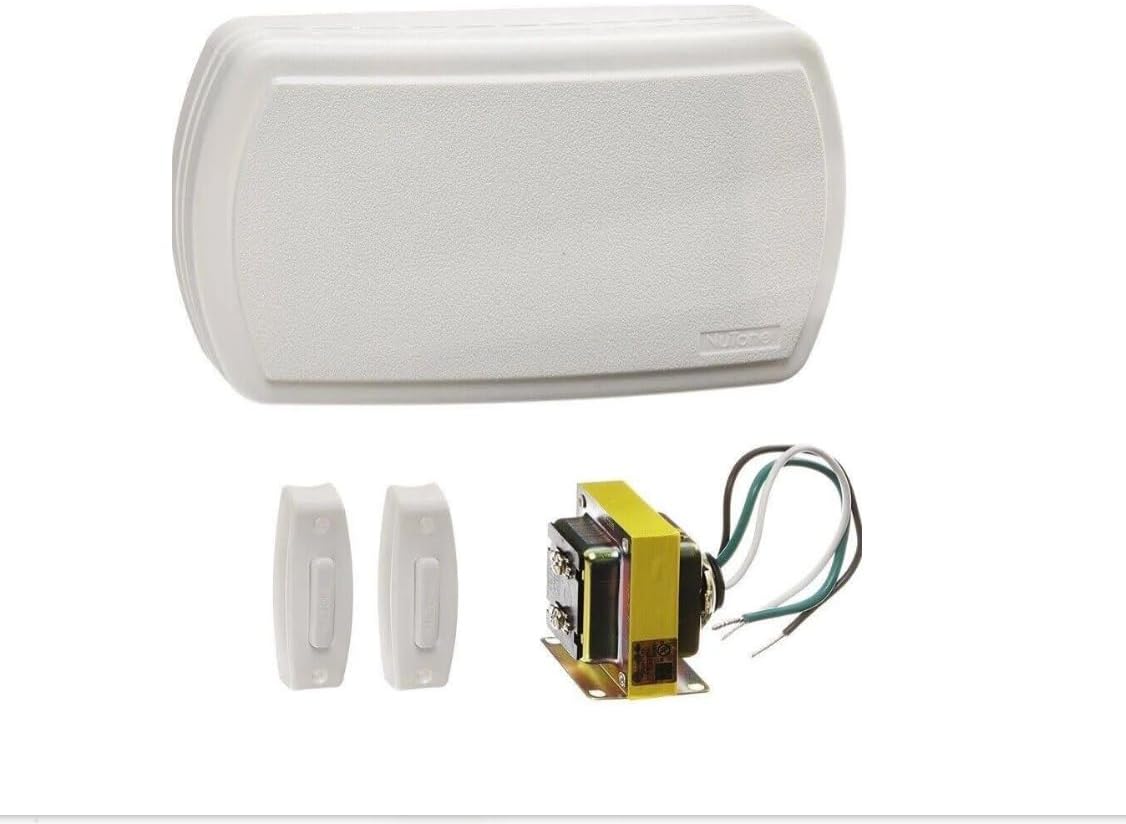
The BK125LWH kit approaches the category from the sensible end by including the parts that usually go wrong. Pushbuttons live outdoors in weather for decades, so their contacts corrode and their springs tire, and a kit that supplies two fresh lighted buttons alongside the chime replaces the most failure prone components at the same time.
For a house with a front and a back door that is the whole job in one box, and lighted buttons genuinely help visitors find the bell after dark rather than knocking.
There is a cost to those lamps that the packaging will not mention. A lighted button draws a small current every hour of every day, not only when pressed, so two of them plus the chime is a real load. On a transformer sized for one chime and one plain button, that is enough to turn a crisp strike into a tired one.
Bottom line: the best value in parts for a two door house, provided the transformer has headroom for the lighted buttons.
- Contents: indoor chime plus two lighted pushbuttons
- Type: wired builder chime kit
- Doors: front and rear
- Buttons: lighted, drawing continuous current
- Power: low voltage doorbell transformer, not included
- Finish: white
- Wiring: existing bell wire
Houses with two doors on the same doorbell system, especially where the existing buttons are old, sticky or no longer light.
A single door house with a healthy button gets less from this kit and can simply buy a chime.
Fit the buttons first and test each one by touching its two wires together at the wall, which confirms wiring and chime before the covers go back on.
Add the lighted button load to your transformer arithmetic. If the strike sounds weak once both buttons are lit, the transformer is the part to size up rather than the chime to return.

Pros
- Same family and wiring approach as the CHM1
- Plain white cover suits most hallways
- Front and rear door terminals
- No setup, pairing or app involved
- Reuses the bell wire already in the wall
Cons
- Shares the same transformer requirement as the rest of the range
- Fewer published details than the flagship model in the range
The CHM3D sits in the same range as our top pick and takes the same approach: low voltage in, a strike out, front and rear terminals so one unit covers two doors. If you like the way the CHM1 works but want a different cover on the wall, this is the alternative from the same maker.
Everything about fitting it is familiar. The bell wire in your wall is reused, the terminals are labelled, and there is nothing to pair or configure once the cover is back on.
Two things to be realistic about. It carries the same transformer expectation as the rest of the category, so an old undersized transformer will hold it back exactly as it would any other chime here. And the listing gives away less detail than the flagship, so if a specific note count or output figure matters to you, confirm it before ordering.
Bottom line: a plain alternative within a range that works, best chosen for the cover rather than for any added capability.
- Type: wired low voltage door chime
- Doors: front and rear terminals
- Cover: white
- Power: doorbell transformer, not included
- Typical requirement: 16 volts at 10 volt amperes
- Wiring: existing bell wire
- Range: same family as the CHM1
Compare the stated dimensions against the cover currently on your wall, since a smaller replacement exposes screw holes and old paint lines.
If you specifically want the traditional two note metal strike, the flagship model in this range documents it plainly and is the safer order.
Isolate the circuit feeding the transformer before touching the transformer itself. Work at the chime is low voltage, work at the transformer is not.
Keep the mechanism clear of dust and do not oil a plunger, since oil attracts grit and eventually stops the stroke.

Pros
- Depth of about one and a half inches suits tight hallways
- Two chime sounds available
- Modern flat cover instead of a builder rectangle
- Front and rear door use from one unit
- Sits close to the wall, so less likely to be knocked
Cons
- Slim covers can be smaller than the mark left by an old chime
- Flatter profile means no room for a large mechanical strike assembly
The SL 2735 is the shortlist answer to a specific problem, which is a hallway where a projecting chime gets knocked by shoulders and shopping bags. At a stated depth of roughly one and a half inches it sits far closer to the wall than a deep chime needs to, and the cover looks like current hardware rather than a nineteen eighties rectangle.
Two chime sounds cover the usual front and rear distinction, and the flat cover suits a modern entry or a stairwell wall where a bulky white box looks wrong.
The trade is physical. Depth is what a plunger needs to travel, so slim designs are inherently a different mechanism to a big mechanical strike, and if the authentic metal ding dong is the reason you are buying, check that before ordering. A slim cover may also be smaller than the outline the old chime left behind.
Bottom line: the pick when depth and looks decide the purchase, and worth confirming the sound first if tone is what you care about.
- Type: slim wired doorbell chime
- Sounds: two selectable chime sounds
- Depth: about one and a half inches
- Width: roughly nine inches
- Doors: front and rear
- Power: low voltage doorbell transformer, not included
- Finish: white
Narrow hallways, stairwell walls and modern entries where a deep chime projects into the traffic and looks out of place.
Anyone whose priority is the traditional two note metal strike should choose a mechanical unit instead.
Measure both the footprint and the depth you have available, then compare with the old cover so you know whether painting is part of the job.
If a specific tone matters, confirm which sounds this model produces before ordering rather than after fitting.

Pros
- Includes the 16 volt 10 volt ampere transformer
- Lighted pushbuttons supplied as well
- Removes the most common cause of a chime not ringing
- One purchase instead of three
- Correct transformer rating for the chime it powers
Cons
- Transformer still needs mounting and connecting to household wiring
- Lighted buttons consume some of the transformer capacity
The CKIT1 is the best value pick because it solves the problem this whole category creates. Nearly every wired chime is sold on the assumption that a suitable transformer is already in your house, and when it is not, or when it is an old low rated unit, the new chime hums or strikes weakly and gets returned as faulty.
This kit closes that gap by supplying a 16 volt 10 volt ampere transformer matched to the chime, plus lighted pushbuttons, which means one order instead of three trips and no guessing about ratings.
Two things remain your job. The transformer has to be mounted and connected to household wiring, which is a mains side task and the point at which some people call an electrician. And the lighted buttons draw a small continuous current, so they use part of the supplied capacity, which is fine for this kit as designed but worth remembering if you later add a second chime.
Bottom line: the right starting point for a house where the transformer is missing, unknown, or clearly too small.
- Contents: chime, transformer and lighted pushbuttons
- Transformer: 16 volts at 10 volt amperes
- Tone: two tone operation
- Buttons: lighted, continuous small draw
- Doors: front and rear capable
- Wiring: low voltage bell wire
- Mains work: transformer connection required
Mount the transformer where it can be reached again, typically on a junction box near the panel, and label it. A transformer nobody can find is a fault nobody can diagnose.
Connect the low voltage side to the chime terminals marked front, transformer and rear, then test each button by touching its wires together at the wall before fitting the covers.
Anyone fitting a doorbell where none existed, or replacing a system whose transformer is old, unknown or clearly underpowered.
If you already know your transformer measures around sixteen volts and carries the load, buying the chime alone is the cheaper route.

Pros
- States its 16 volt 10 volt ampere requirement openly
- Front and rear door inputs from one unit
- Works with existing buttons and transformer
- Compact indoor wall unit
- Clear labelling makes wiring straightforward
Cons
- Newer name with a shorter track record than the established brands
- Transformer is still not included
The Saillong unit earns its place partly on honesty. Its listing states the 16 volt 10 volt ampere requirement in the title rather than burying it, which is the single piece of information most buyers in this category need and almost never see before ordering.
Functionally it covers the standard arrangement: front and rear door inputs, indoor wall mounting, and compatibility with the button and transformer you already have, so it is a swap rather than a project.
The reservation is track record. This is a newer name beside Broan NuTone, Heath Zenith and Newhouse Hardware, and in a device that is expected to sit on a wall for a decade or two, accumulated evidence is worth something. Nothing in the design suggests a problem, there is simply less history behind it.
Bottom line: a clearly specified front and rear chime with less accumulated feedback than the established names.
- Type: wired indoor door chime
- Power requirement: 16 volts at 10 volt amperes
- Doors: front and rear inputs
- Compatibility: standard doorbell buttons and transformers
- Mounting: interior wall
- Transformer: not included
- Wiring: existing low voltage bell wire
Measure your transformer output before ordering. This listing tells you what it needs, so there is no excuse for finding out afterwards that the supply is a ten volt unit.
If long term reliability outweighs everything, the established brands here carry years more customer feedback for a similar job.
Land one transformer wire on the transformer terminal, the front button loop on front, and the rear button loop on rear. Two notes should sound for the front and one for the rear.
If only one door works, the fault is in that button loop rather than in the chime, since both share the same transformer feed.
How to Choose a Wired Doorbell Chime
The criteria below are ordered by how often they are the reason a doorbell replacement goes wrong, starting with the part that is not in the box.
The Transformer Decides Whether Anything Rings

A doorbell system has three parts, and the chime is only one of them. There is a button outside, a chime inside, and a transformer that steps household voltage down to something safe for thin bell wire. Almost every wired chime sold today expects 16 volts at 10 volt amperes, and that specification appears on the listing rather than in the marketing copy, which is why so many buyers never see it.
The transformer is usually bolted to a junction box and left where an electrician found it convenient: beside the main panel, in a basement joist bay, in the attic above the hallway, inside a closet ceiling, or occasionally behind the chime itself. Older houses often have a transformer rated at 10 volts and 5 volt amperes, which was adequate for a small mechanical chime in the nineteen seventies and is not adequate for a modern two note unit or for anything with a lighted button attached.
If you own a multimeter, this is a five minute check worth doing before you buy anything. Set it to alternating volts and touch the two transformer terminals, or the front and transformer terminals at the chime. A reading in the region of sixteen volts means you are ready. A reading around ten, or a reading that collapses when the button is pressed, means the transformer is the purchase you actually need, and swapping the chime alone will change nothing.
Volt Amperes Have to Cover Every Button and Every Chime
Voltage and volt amperes are different numbers and people confuse them constantly. Voltage has to match, and volt amperes describe how much current the transformer can deliver at that voltage. A 16 volt 10 volt ampere transformer is the common baseline, and it is sized for one chime and one button doing short bursts of work.
Loads add up faster than expected. A second button at the back door adds draw. A second chime in a basement or workshop adds more. Lighted pushbuttons are the quiet culprit, because the small lamp inside them draws current continuously, twenty four hours a day, not just while someone is pressing. Two lighted buttons and two chimes on a transformer sized for one of each produces exactly the symptom people describe as a defective chime: a strike that sounds tired, or a hum with no strike at all.
The fix is to size up rather than to keep swapping chimes. Doorbell transformers are made in larger ratings for precisely this reason, and a unit with more headroom costs little and cures a whole family of complaints. If you are adding a second chime or lighted buttons, plan the transformer at the same time rather than discovering the limit afterwards.
Mechanical or Electronic, and Why It Changes the Sound

A mechanical chime works the way it looks. Current energises a solenoid, the solenoid throws a plunger, and the plunger strikes a flat metal bar. Two bars struck in sequence give the familiar two note ding dong, and one bar struck once gives a single ding, which is how a single chime distinguishes the front door from the back. The sound is a real metal note with real decay, and there is nothing to program.
An electronic chime replaces the bars with a small speaker and a sound chip. That buys you selectable tones, sometimes a volume control, and a much slimmer body, since no space is needed for a hammer to travel. It also means the sound is a recording of a chime rather than a chime, which some people never notice and others dislike immediately in their own hallway.
Reliability tends to favour the mechanical design, because there is very little to fail: a coil, a spring, and a plunger. Electronics favour flexibility and fit. The Newhouse Hardware CHM1 and the Heath Zenith mechanical unit here are the traditionalists, while the slim Heath Zenith SL 2735 measures well under two inches deep, which is the sort of profile a hammer and bar assembly cannot reach.
Front Door, Back Door, and the Third Terminal
Look at the terminal strip in any of these chimes and you will usually find three screws marked front, transformer, and rear. That layout is what allows one chime on one wall to tell you which door someone is at, and it is worth understanding before you buy, because a chime with only two terminals cannot do it.
The wiring is straightforward. One transformer wire goes to the transformer terminal, the front button loop lands on front, and the back button loop lands on rear. Press the front button and the chime plays both notes. Press the back button and it plays one. Nothing is configured and nothing is learned, the distinction is purely which coil the current reaches.
Several units here advertise that capability explicitly. The Saillong model is described for front and rear door use and states its 16 volt 10 volt ampere requirement on the listing itself, which is unusually honest for the category. The Broan NuTone builder kit takes the same idea from the other end by supplying two lighted pushbuttons in the box, so a two door installation arrives as one purchase.
The Wire in Your Wall Is Probably Fine
Doorbell wire is thin, low voltage, two or three conductor cable, and it does not wear out the way a moving part does. If the old chime worked at any point, the wire almost certainly still works, which means replacing a chime is a swap rather than a rewiring job. This is the single biggest reason a wired chime remains worth buying rather than abandoning the system for a battery unit.
Before you unscrew anything, photograph the existing terminal strip and put a piece of tape on each wire with the terminal name written on it. The conductors are often the same colour or have faded to the same colour, and once they are loose in a wall cavity it becomes guesswork. Two minutes of labelling saves an afternoon of trial and error.
The exception is a house with no bell wire at all, or wire that has been cut off inside a wall during remodelling. In that situation the cost of the job is the fishing of new cable through finished walls, not the chime, and that is the point at which a wireless system genuinely becomes the cheaper answer. Everyone else is better served by keeping the infrastructure that is already there.
The Old Pushbutton Is the First Suspect
Buttons live outside in weather for decades. The contacts corrode, the spring loses tension, and water gets behind the plate, so a button is by far the most likely part of a doorbell system to have failed. It is also the cheapest to replace, which makes it the sensible thing to test before you blame anything else.
Testing takes a screwdriver. Remove the button from the wall, touch its two wires together briefly, and listen. If the chime sounds, the wiring and the chime are healthy and the button is the fault. If nothing happens, the problem is further back at the transformer or the chime, and you have just eliminated a whole branch of the diagnosis.
Lighted buttons need one extra thought. Because their lamp draws current all the time, a lighted button paired with an undersized transformer can leave too little in reserve for a clean strike. If you like the look of an illuminated button, count it as a load rather than as a cosmetic choice, and check that the transformer has room for it.
Cover Size, Depth, and the Holes Already in the Wall
An old chime leaves behind two things: mounting screw holes and, frequently, an unpainted rectangle where the previous cover sat. A new chime with a smaller footprint exposes both, which turns a fifteen minute swap into patching, sanding, and painting a hallway wall. Measure the old cover before ordering and prefer a unit at least as large.
Depth matters for a different reason. A mechanical chime needs internal clearance for the plunger to travel, so those units stand further off the wall, while electronic designs can be genuinely slim. In a narrow hallway where people brush past with bags, a projecting cover gets knocked, and the slim Heath Zenith unit here exists for exactly that situation.
There is also a middle path that suits older houses with proprietary covers. Chime mechanism assemblies are sold on their own, designed to replace the working parts behind a cover you want to keep, and some are made to fit common builder chime housings. Those replacement mechanisms are a separate product family and are not part of this shortlist, but they are worth knowing about if the cover on your wall matches the trim in the rest of the house.
Loudness, and Hearing It From the Far End of the House
Chime output is often quoted in decibels, with something in the region of 85 decibels being typical for this class. That is loud in the room it occupies and much less impressive two floors up with a washing machine running, which is the scenario most complaints about volume actually describe.
Placement does more than specification. A chime in a central hallway with hard surfaces carries through a house far better than one tucked into a carpeted corner or behind a door that is usually open. Before assuming a chime is too quiet, consider whether it is simply in the wrong place, since moving it a few feet is easier than replacing it.
Where a house is genuinely too large for one unit, the answer is a second chime wired in parallel rather than a louder one. That brings us back to volt amperes, because two chimes striking at once draw roughly twice the current. Note also that mechanical chimes have no volume control at all, so if you need the option of quieter, an electronic unit is the only route to it.
Smart Doorbell Compatibility Is a Separate Question
Many wired video doorbells are designed to use the existing chime and transformer, which is why listings in this category mention smart compatibility at all. The Heath Zenith mechanical unit here states that it works with that arrangement, and compatibility claims of that kind are worth reading closely rather than skimming, because they mean something specific.
The specifics come in two parts. First, a video doorbell draws power continuously, so it adds a standing load that your transformer has to carry alongside the chime, and an undersized transformer produces both a weak strike and an unreliable camera. Second, the doorbell app usually asks whether your indoor chime is mechanical or digital, and answering wrongly causes buzzing, half strikes, or silence, so it is worth knowing which one you own.
This is also the reason the Ring Chime and the Blink Chime are absent from the shortlist. Those are wireless speakers that plug into a wall socket and announce camera events over your network. They are useful products, they simply solve a different problem, and no amount of bell wire will connect one. If cameras are the goal, our subscription free doorbell camera guide is the better starting point.
What Failure Sounds Like, and What Is Actually Broken
Doorbell faults announce themselves in a small number of recognisable ways, and each one points at a different part. A hum or buzz with no strike usually means the solenoid is energised but cannot move, either because the plunger is stuck or because there is not enough voltage behind it. A weak or lazy strike points the same way, at supply rather than at the chime.
A chime that rings continuously means the circuit is closed somewhere it should be open, which is almost always a stuck button or a pinched wire, not a faulty chime. One note working and the other silent points at the front or rear terminal and its loop, since both coils share the same transformer feed. Total silence sends you back to the transformer test above.
Work in that order and the job stays cheap: button first because it is the likeliest and the least expensive, transformer second because it is the most commonly undersized, and chime last because it is the part with the fewest moving components. Buying a new chime to cure a fault that lives in the other two parts is the most common wasted purchase in this whole category.
| Model | Type | Doors | Notable |
|---|---|---|---|
| Newhouse Hardware CHM1 | Mechanical, two note | Front and rear | Deepest rating history here |
| Heath Zenith mechanical chime | Mechanical, two melody | Front and rear | Stated smart doorbell compatibility |
| Broan NuTone LA11WH | Builder grade chime | Front and rear | Textured cover, plain and quiet to fit |
| Broan NuTone BK125LWH kit | Builder chime kit | Two doors | Two lighted pushbuttons included |
| Newhouse Hardware CHM3D | Wired chime | Front and rear | Same range as the CHM1 |
| Heath Zenith SL 2735 | Slim wired chime | Front and rear | Well under two inches deep |
| Newhouse Hardware CKIT1 | Two tone chime kit | Two doors | 16V 10VA transformer in the box |
| Saillong wired chime | Wired chime | Front and rear | States 16V 10VA on the listing |
For other jobs where the hidden part costs more than the visible one, browse our home improvement picks.
Why You Should Trust Us
We lead with the transformer because it is the part that determines whether any of these chimes works, and it is the part every product page assumes you already have. Each unit here is a current listing with enough accumulated customer feedback to show what happens on real walls in real houses, which in this category means the difference between a clean two note strike and a hum.
We do not accept payment for placement, and we say plainly when a product in a search result belongs to a different category, as the Ring Chime and the Blink Chime do here. Where a chime needs a transformer you may not own, or a cover smaller than the mark on your wall, that belongs in the review rather than in the returns process.
Final Thoughts
The Newhouse Hardware CHM1 is our best overall pick. It is a true mechanical two note chime with front and rear terminals, the sound is metal rather than a recording, and it carries by far the deepest record of customer feedback in this shortlist, which for a device that has to survive twenty years on a wall is the specification that matters most.
The Newhouse Hardware CKIT1 is our best value choice, because it arrives as one purchase instead of three. The 16 volt 10 volt ampere transformer is in the box alongside lighted pushbuttons, which removes the exact failure this article opens with. If your house has no working transformer, or you never established what it is rated at, that kit is the safest way to start. For a slim profile in a narrow hallway, the Heath Zenith SL 2735 fits where a mechanical unit will not, and the Broan NuTone builder kit covers a two door installation with its buttons supplied.
Whatever you buy, do the sequence in the right order: test the button by shorting its wires, measure the transformer with a meter set to alternating volts, label the wires before you loosen them, and measure the old cover so the new one hides the holes. More projects around the house are in our latest guides.
Frequently Asked Questions
Does a wired doorbell chime need its own transformer?
It needs a doorbell transformer, and in almost every house one is already installed. Household current is far too high for bell wire, so a transformer steps it down, typically to 16 volts at 10 volt amperes. It is usually mounted near the electrical panel, in a basement joist bay, or in the attic. Chimes are generally sold without one because the assumption is that you are replacing an existing unit.
Can I reuse the doorbell wiring already in my walls in 2026?
Nearly always yes. Low voltage bell wire has no moving parts and does not wear out, so if the old chime ever worked, the cable is almost certainly fine. Photograph the terminal strip and label each conductor before disconnecting, since the wires are often indistinguishable once loose. Only a house with no bell wire at all, or wire cut off during remodelling, needs new cable run.
Why does my chime hum instead of ringing?
A hum means the coil is energised but the plunger is not completing its stroke. The two usual causes are a stuck or gummed plunger and insufficient voltage, which often traces back to a transformer that is too small for the number of chimes and lighted buttons attached to it. A chime that rings without stopping is the opposite fault, normally a stuck pushbutton holding the circuit closed.
Is a Ring Chime or Blink Chime the same as this?
No, and that is why neither appears in this shortlist. Both are wireless plug in speakers that repeat alerts from a camera or video doorbell over your home network. They do not connect to bell wire, they do not use a doorbell transformer, and they cannot be wired to a pushbutton at the door. They are accessories for a camera system rather than doorbell chimes.
Mechanical or electronic, which lasts longer?
Mechanical designs usually win on longevity because there is so little in them: a coil, a spring, a plunger, and a metal bar. Electronic chimes offer selectable tones, sometimes volume control, and much slimmer bodies, which is what you want in a tight hallway. Choose mechanical for the authentic strike and the simplest possible failure modes, electronic for fit and flexibility. More home picks are in our category directory.









Write Your Review
No reviews yet. Be the first to share your experience!