

The drawer of loose rechargeable cells is where good intentions go to die: AAs for the remotes, AAAs for the headphones, a pair of Ds for the lantern and a 9V for the smoke alarm, and a different charger for each. A universal battery charger is the answer, one unit with bays or sliding contacts that accept every common size, and the better ones treat each cell on its own channel, tell you the state of every slot on a screen, and stop when a cell is full. For October 2026 we pulled 8 of the highest rated options on Amazon from Energizer, EBL, Tenergy and more, then sorted them by how many sizes and how many cells each one really handles at once.
Our top pick is the Energizer Recharge Universal Charger for its ability to take AA, AAA, C, D and 9V NiMH cells in one compact body with automatic shutoff and a name that has been making rechargeable batteries for decades. Around it sit the smart LCD chargers from Tenergy and EBL that show per-slot status, a 14-bay unit for a house full of cells, a charger with a discharge and refresh function for reviving tired batteries, and USB-powered models you can run from a laptop or power bank. Every pick is rated at least 4.0 stars by real Amazon customers, and if the goal is charging phones rather than cells, our best portable chargers guide is the one you want.

Pros
- Charges AA, AAA, C, D and 9V NiMH cells in one unit
- Automatic shutoff and safety timer
- Compact body from an established battery brand
- Simple to use with clear indicator lights
Cons
- Indicator lights only, no per-slot screen
- Fewer bays than the big multi-bay smart chargers
- Wall powered, not USB
The Energizer Recharge Universal Charger is the straightforward answer to a drawer full of mixed rechargeable cells. It accepts AA, AAA, C, D and 9V NiMH batteries in one compact body, and it stops charging automatically when cells are full, with a safety timer as a backstop.
It does not have a screen; the indicator lights tell you charging or done and little more, and it does not offer the bay count of the big smart chargers. What it does offer is a brand that has made rechargeable batteries for decades and a design that is hard to use wrong, which for most households matters more than a bar graph.
Bottom line: the safe, simple universal charger for a home that wants one unit for every size.
- Sizes: AA, AAA, C, D, 9V
- Chemistry: NiMH rechargeable
- Shutoff: automatic with safety timer
- Display: indicator lights
- Power: wall adapter
Households that own cells in several sizes and want one dependable charger without learning a screen. Less suited to anyone charging a dozen cells at once.
Load cells by size following the slot markings, connect the 9V to its snap terminal, and let the lights change. Remove cells once done rather than leaving them on the charger for days.

Pros
- Per-slot LCD shows charging status
- Powered over micro USB or USB-C
- Dedicated 9V slot plus four cylindrical bays
- Independent channels
Cons
- Five bays fills quickly in a large household
- USB power means slower D cell charging on weak ports
- No discharge function
The Tenergy TN486U is the compact smart charger of the group. Four cylindrical bays plus a 9V slot handle AA, AAA, C, D and 9V, each slot has its own channel, and an LCD shows the state of every cell. It runs from micro USB or USB-C, so it works from a laptop, a phone brick or a power bank as well as the wall.
The trade-offs are the bay count, which is modest, and the fact that charging big D cells from a low-power USB port takes a while. For AA and AAA duty and for travel it is excellent.
Bottom line: the pick for people who want a screen and USB power in a small footprint.
- Sizes: AA, AAA, C, D, 9V
- Bays: 5, including one 9V slot
- Display: LCD per slot
- Power: micro USB or USB-C input
- Channels: independent
Travelers, small households and anyone who wants to power the charger from USB. Not for someone charging eight D cells at a time.
Use a proper USB adapter rather than a laptop port when charging C or D cells. Watch the LCD and pull the small cells as they finish.

Pros
- LCD readout for cell status
- Handles NiMH and NiCd in five sizes
- Automatic shutoff
- Wall powered for steady current
Cons
- Not USB powered
- Fewer bays than the 8 and 12 bay units
- Bulkier than the TN486U
The Tenergy Smart Universal Battery Charger is the wall-powered sibling of the TN486U, with an LCD readout and support for NiMH and NiCd cells in AA, AAA, C, D and 9V. Steady wall power suits regular C and D charging better than a USB port.
It is bulkier and not portable, and it does not have the bay count of the eight and twelve bay units, but as a household charger that shows you what each cell is doing, it does the job.
Bottom line: the wall-powered smart charger for a home that charges big cells often.
- Sizes: AA, AAA, C, D, 9V
- Chemistry: NiMH and NiCd
- Display: LCD
- Shutoff: automatic
- Power: wall adapter
Households with C and D cells in regular rotation that want a screen. Not for travel.
Set cells by size, check the LCD registers each one, and remove them when the display shows full. Keep it on a flat surface with airflow.
Pros
- Charger plus four 5000 mAh C cells in one box
- Accepts AA, AAA, C, D and 9V
- Automatic shutoff
- Good value for a household starting on rechargeables
Cons
- Indicator lights rather than a full LCD
- Bundled cells only useful if you need C size
- Wall powered
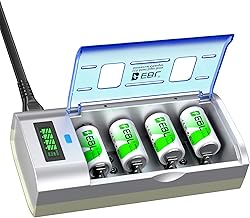
The EBL 906 is the value pick because it solves two problems at once: it is a universal smart charger for AA, AAA, C, D and 9V, and it ships with four 5000 mAh NiMH C cells, the size most people never get around to buying rechargeable.
The charger itself uses indicator lights rather than a full LCD, and it runs from the wall. If you do not need C cells, a bare charger is a fairer comparison; if you do, this bundle is hard to beat.
Bottom line: the box to buy when you are moving lanterns and radios off disposable C cells.
- Sizes: AA, AAA, C, D, 9V
- Included: 4 x 5000 mAh NiMH C batteries
- Display: indicator lights
- Shutoff: automatic
- Power: wall adapter
Households that need C cells and a charger in one purchase. Less compelling if you only use AA and AAA.
Charge the bundled C cells fully before first use, label them with a date, and rotate them through the lantern or radio in pairs so they age evenly.

Pros
- Twelve bays plus two 9V slots
- Handles AA, AAA, C and D
- LCD status display
- Independent channels
Cons
- Large footprint
- Wall powered only
- Newer listing with a smaller review base
The EBL 12+2 Bay is the charger for a house or workshop that has committed to rechargeables: twelve cylindrical bays that take AA, AAA, C and D, plus two dedicated 9V slots, with an LCD to track them and independent channels so odd counts are no problem.
It takes up real counter space and runs from the wall, and as one of the newer listings its review base is smaller than the older EBL units. But nothing else here charges fourteen cells at once.
Bottom line: the capacity pick, for people who count their rechargeable cells in dozens.
- Sizes: AA, AAA, C, D + 9V
- Bays: 12 cylindrical + 2 for 9V
- Chemistry: NiMH and NiCd
- Display: LCD
- Power: wall adapter
Large households, classrooms and workshops. Overkill for a couple of remotes.
Group cells by size and age in the bays, keep the unit on a hard surface with airflow, and use the LCD to pull finished cells early.

Pros
- Discharge function refreshes cells that have lost capacity
- Universal sizes including 9V
- LCD status display
- Rapid charging with smart termination
Cons
- Discharge cycles take hours
- Wall powered
- Newer listing with fewer reviews
The EBL Universal Smart Battery Charger with Discharge Function is built for the bag of old cells everyone owns. Besides charging C, D, AA, AAA and 9V NiMH and NiCd batteries with a per-slot LCD, it can fully discharge cells before recharging, which often restores capacity lost to repeated shallow top-ups.
The refresh cycle takes hours, so it is not something you run every time, and the unit is wall powered. As one of the newer EBL listings, its review base is still growing. But it is the only pick here with the feature, and for inherited or neglected batteries it earns its place.
Bottom line: the charger for reviving tired cells rather than replacing them.
- Sizes: AA, AAA, C, D, 9V
- Chemistry: NiMH and NiCd
- Function: charge, discharge and refresh
- Display: LCD
- Power: wall adapter
People with older rechargeable cells or devices that only sip power. Not necessary if all your cells are new.
Run the discharge cycle on cells that seem to die early, then charge fully. Do it every few months, not every charge, to avoid unnecessary wear.

Pros
- Eight independent bays
- LCD shows each cell
- Handles AA, AAA, C and D
- Good capacity for a family
Cons
- No 9V slot
- Wall powered
- Newer listing with a smaller review base
The EBL LCD 8 Bay Battery Charger is the middle ground between a compact five-bay unit and the fourteen-slot monster: eight independent bays for AA, AAA, C and D, each tracked on an LCD, in a body that still fits on a shelf.
It leaves out the 9V slot, so smoke alarm cells need another charger, and it runs from the wall. For a family with a normal spread of AA and AAA plus a few C and D, eight bays is the count that stops the backlog.
Bottom line: the family-sized smart charger, minus 9V.
- Sizes: AA, AAA, C, D
- Bays: 8, independent
- Chemistry: NiMH
- Display: LCD
- Power: wall adapter
Families with many AA and AAA cells and some C and D. Not for anyone who needs 9V charging.
Load any mix of sizes, confirm each slot registers on the LCD, and pull cells as they finish. Keep 9V cells for a separate charger.

Pros
- Eight bays with a smart LCD
- Handles AA, AAA, C and D
- NiMH and NiCd support
- Independent slots
Cons
- Smaller brand with a modest review base
- No 9V slot
- USB input needs a decent adapter for C and D cells
The CITYORK 8 Bay Universal Battery Charger offers the same basic recipe as the EBL LCD 8 Bay, eight independent bays for AA, AAA, C and D with a smart LCD, from a smaller brand, and it runs from a USB-C or micro USB input rather than a fixed wall brick. It supports both NiMH and NiCd cells.
Its review base is modest, it has no 9V slot, and big C and D cells want a proper USB adapter to charge at full speed, but as a second charger for a garage or a budget alternative for a family, it covers the essentials.
Bottom line: a budget eight-bay smart charger for the four cylindrical sizes.
- Sizes: AA, AAA, C, D 1.2V
- Bays: 8, independent
- Chemistry: NiMH and NiCd
- Display: smart LCD
- Power: USB-C or micro USB input
Budget buyers and second-charger locations. Not for 9V cells.
Match cell size to the slot markings, watch the LCD for a bad-cell warning, and recycle any cell that will not take a charge.
How to Choose the Right Universal Battery Charger
Which Sizes and Chemistries It Actually Charges

Universal is a loose word on a charger listing. Some units take AA and AAA only and call themselves universal because they handle two chemistries; the ones in this roundup were chosen because they accept the four common cylindrical sizes, AA, AAA, C and D, and most add a separate 9V slot. Read the size list on the listing rather than the headline, because the difference between AA/AAA and AA/AAA/C/D/9V is exactly the difference between charging half your house and all of it.
Chemistry matters as much. Nearly every charger here is built for nickel metal hydride, written NiMH, and most also handle the older nickel cadmium, NiCd. None of these is a lithium ion 18650 charger and none should be used with disposable alkaline cells, which are not designed to be recharged. If your household has both NiMH AA cells and 18650 flashlight cells, you need two chargers or one of the rarer multi-chemistry units; the products below are the NiMH and NiCd side of that question.
Independent Channels Versus Paired Slots
Older and cheaper chargers charge cells in pairs, which means a slot only works when its partner is filled and both cells stop when the first one is full, leaving the other undercharged. Independent channels give each slot its own circuit, so you can charge one AAA, two Cs and a D at the same time and each finishes on its own.
Every smart charger in this list, including the Tenergy TN486U, the EBL LCD 8 Bay and the CITYORK 8 Bay, advertises independent slots. It is the single most useful feature on a universal charger, because odd numbers of cells are the normal case, one AA for a remote, three AAAs for a torch, and a paired charger forces you to wait or to charge a cell that did not need it.
Bay Count and How Many Cells You Really Own
A four-bay charger sounds like plenty until the kids’ toys, the wireless mouse and the smoke alarms all run down in the same week. Count the cells in service in your home, then buy bays for roughly half of them so a full rotation takes two sessions rather than five. The Tenergy TN486U has five bays including a dedicated 9V slot; the EBL LCD 8 Bay and CITYORK have eight; the EBL 12+2 has twelve cylindrical bays plus two 9V slots for a household or a workshop that runs on rechargeables.
More bays means a wider body and usually a wall adapter rather than USB power, so bay count trades directly against desk space and portability. There is no wrong number, but there is a wrong match: a two-bay unit in a house with thirty cells guarantees the drawer of half-charged batteries you were trying to escape.
LCD Readouts, Indicator Lights and Knowing When a Cell Is Done
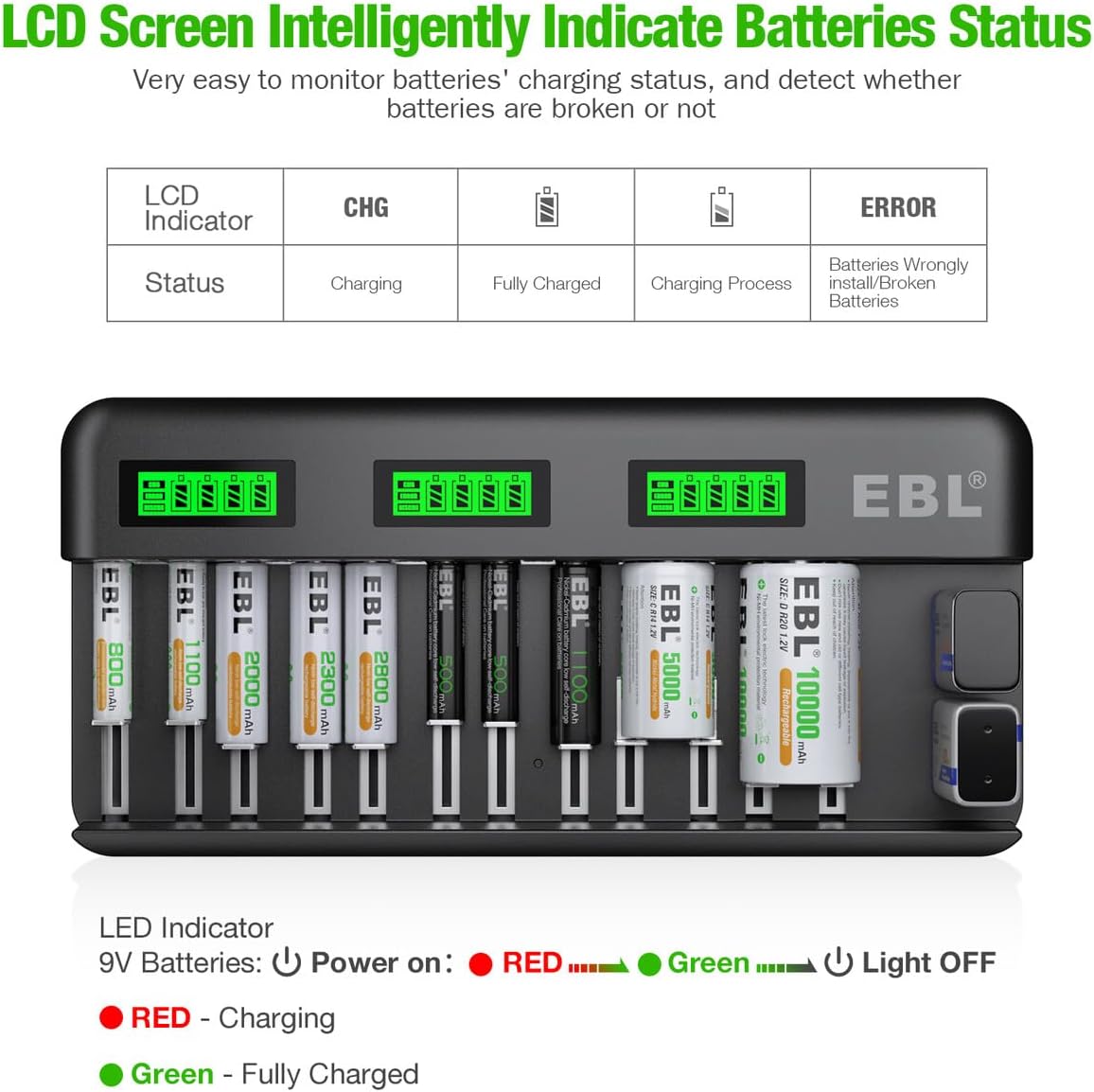
The cheapest chargers use a single LED per slot that turns from red to green. That tells you done or not done and nothing else. An LCD screen, which the Tenergy models, the EBL LCD 8 Bay, the EBL 12+2 and the CITYORK all carry, shows a bar graph or a percentage per slot, and often flags a bad cell that will not take a charge.
The practical value is triage. With a screen you can see that three of eight cells are nearly full and swap them out early, and you can spot the one cell that stays at zero and belongs in the recycling bin rather than back in the remote. On a plain LED charger those two situations look identical until you put the cell in a device and it dies in an hour.
| Charger | Sizes | Bays | Display | Power input |
|---|---|---|---|---|
| Energizer Recharge Universal | AA, AAA, C, D, 9V NiMH | Compact, mixed sizes | Indicator lights | Wall |
| Tenergy TN486U | AA, AAA, C, D, 9V | 5 with 9V slot | LCD per slot | Micro USB or USB-C |
| Tenergy Smart Universal | AA, AAA, C, D, 9V NiMH/NiCd | Multi-bay | LCD | Wall |
| EBL 906 with 4 C cells | AA, AAA, C, D, 9V | Multi-bay | Indicator lights | Wall |
| EBL 12+2 Bay | AA, AAA, C, D + 9V | 12 + 2 for 9V | LCD | Wall |
| EBL Universal with Discharge | AA, AAA, C, D, 9V NiMH/NiCd | Multi-bay | LCD | Wall |
| EBL LCD 8 Bay | AA, AAA, C, D | 8 independent | LCD | Wall |
| CITYORK 8 Bay | AA, AAA, C, D 1.2V | 8 independent | Smart LCD | USB-C or micro USB |
Automatic Shutoff, Trickle Charge and Overcharge Protection
NiMH cells are damaged by overcharging, so a charger that keeps pushing current after the cell is full shortens its life. Every pick here advertises automatic shutoff or a smart termination method that senses when the cell is full. The Energizer Recharge Universal, for example, lists an automatic shutoff and a safety timer as core features.
Some units then drop to a small trickle charge to hold the cell at full; others stop entirely. Both approaches are fine for daily use. What you should avoid is any charger sold without a shutoff claim at all, usually the very cheapest, because a forgotten set of cells left on it overnight comes out warm and permanently weakened. Overheat protection and reverse polarity protection are also worth seeing on the listing, especially if children will be loading the slots.
Discharge, Refresh and Reviving Tired Cells
NiMH batteries that have been topped up repeatedly without a full cycle can start to lose capacity, and a discharge function drains them fully before recharging, which often restores some of it. The EBL Universal Smart Battery Charger with Discharge Function is the pick here built around that feature, and it also handles C, D, AA, AAA and 9V.
It is not magic, and it will not revive a cell that has physically failed, but for a bag of five-year-old AAs it is the difference between throwing them out and getting another season from them. If your cells are new and you charge them from empty most of the time, you can skip the feature; if you inherit batteries or run devices that only sip power, it earns its place.
Power Input: Wall Adapter or USB

Big multi-bay chargers usually run from a dedicated AC adapter, which delivers the current needed to charge eight D cells at once. Smaller units increasingly run from USB, either micro USB or USB-C, which the Tenergy TN486U and the CITYORK 8 Bay support, so you can power the charger from a laptop, a phone brick or a power bank on the road.
USB power is convenient, but check the input rating: charging D cells from a low-wattage USB port takes a long time, and some USB chargers only reach full speed on a proper adapter. If you mostly charge AA and AAA and want the charger to travel, USB is the right pick; if you charge C and D regularly, a wall adapter and a bigger body are the honest answer. Our guide to the best solar power banks pairs well with a USB charger for anyone charging cells off grid.
Charging Speed and Why Faster Is Not Always Better
A charger that pushes more current fills a cell sooner but also runs it warmer, and heat is what wears NiMH cells out. Chargers described as rapid or high speed are fine for occasional use; for cells you want to last hundreds of cycles, a moderate rate and a smart shutoff matter more than shaving an hour off the wait.
D and C cells hold several times the capacity of an AA, so they will always take longer on the same charger. If a listing quotes a charge time, check which size it refers to. And notice that a charger with independent channels lets you pull the small cells early while the big ones finish, which is a bigger time saver than raw current.
Bundled Batteries and Whether They Are Worth Having
Several listings pair the charger with cells, and the EBL 906 in this roundup ships with four 5000 mAh C rechargeable batteries. That is a real value if you need C cells, which are the least common size to have on hand and the one people most often buy disposable. Check the capacity of bundled cells against what you would buy separately, and remember that a low-capacity bundled AAA is a worse deal than a bare charger.
If you already own good cells, buy the bare charger. If you are starting a household from scratch, a bundle that includes the sizes you actually use saves a second order and gets the cells matched to a charger that is known to treat them well.
Build, Slot Design and Living With It Every Week
Universal chargers use either sliding contacts that clamp cells of different lengths, or fixed bays with a spring at one end. Sliding contacts take more sizes in fewer bays but can be fiddly with a fat D cell; fixed bays are simpler and sturdier. Look at the photos for how a 9V connects, usually a separate snap terminal on the top or side, and check that the slots are labeled.
A charger lives on a counter or a shelf for years, so a screen you can read from across the room, feet that keep it from sliding, and a cable that reaches the outlet matter more than they sound. If it will sit near tools, our guide to power tool battery replacements covers the other kind of rechargeable in the garage.
Why You Should Trust Us
We built this shortlist from the highest rated universal battery chargers on Amazon, then read each listing, the specification sheet and the pattern of owner feedback, focusing on the details that matter for rechargeable cells: which sizes and chemistries are supported, whether slots are independent, how the charger signals a full or bad cell, and what protections it advertises. We do not claim to have run charging trials; the comparisons come from published specifications and real owner reports.
Ratings shown on the cards are pulled from Amazon and update over time. We do not print prices in the guide because they change constantly, and we do not accept payment for placement. Where a charger is sold with and without bundled cells, we linked one representative version.
Final Thoughts
The best overall pick is the Energizer Recharge Universal Charger. It accepts AA, AAA, C, D and 9V NiMH cells in one compact body, shuts off automatically, and comes from a brand that has made rechargeable batteries long enough to trust with them; for a household that just wants one charger to cover everything, it is the safe choice.
The best value is the EBL 906 Smart Charger bundled with four 5000 mAh C rechargeable batteries, because it delivers the universal charger and the size people most often lack in one box. If you want a screen and USB power, the Tenergy TN486U is the compact smart pick; if you run a house or workshop on rechargeables, the EBL 12+2 Bay is the one with room; and if you have a bag of tired cells, the EBL Universal with discharge function is built to give them another season. Whichever you choose, keep it to NiMH and NiCd cells, and if you want to check what those old batteries are really holding, our guide to the best digital multimeters covers the tool for it.
Frequently Asked Questions About Universal Battery Chargers
What is the best universal battery charger in 2026?
For most households the Energizer Recharge Universal Charger is the best all-round universal battery charger, because it takes AA, AAA, C, D and 9V NiMH cells in one unit with automatic shutoff. If you want a per-slot display and USB power, the Tenergy TN486U is the compact smart alternative.
Can a universal battery charger charge alkaline batteries?
No. The chargers here are built for NiMH and NiCd rechargeable cells. Disposable alkaline batteries are not designed to be recharged and should not be placed in these units.
Do I need independent charging channels?
Yes, if you ever charge odd numbers of cells, which is most of the time. Independent slots let each cell finish on its own; paired slots only work in twos and stop both cells when the first is full.
How long does a universal battery charger take to charge D batteries?
Longer than AA or AAA, because D cells hold several times the capacity. Charge time depends on the charger current and the cell capacity, so check which size a listing quotes. A charger with independent slots lets you remove the small cells early while the D cells finish.
Will a universal charger charge 18650 lithium cells?
The chargers in this roundup are NiMH and NiCd chargers and are not built for 18650 lithium ion cells, which need a lithium-specific charger. If you own both types, plan on two chargers or a dedicated multi-chemistry unit. For general electronics guides, see our electronics section.






Write Your Review
No reviews yet. Be the first to share your experience!