

A fly trap without the right bait is a plastic bag hanging in the wind. What actually pulls house flies, blow flies and fruit flies out of the air is the lure inside, and the differences between lures decide whether a trap fills up in a weekend or hangs empty for a month. Shopping for fly trap bait therefore means asking two questions at once: what kind of fly you have, and whether you want a disposable trap that comes pre-baited, a reusable trap you refill, or a bait product on its own. For October 2026 we gathered 6 of the highest rated options on Amazon from TERRO, Starbar, RESCUE!, then sorted them by lure type and by where each one belongs: kitchen counter, patio, trash area or barn.
Our top pick is the RESCUE! Outdoor Disposable Fly Trap for its water-activated attractant that draws in the common nuisance flies, its sealed bag design that keeps the catch and the smell contained, and the fact that you hang it, add water and walk away. Below it you will find a reusable outdoor trap from TERRO, RESCUE! reusable jars, the Starbar attractant refill that keeps those jars working, a food-based fruit fly trap for the kitchen, and a scatter bait for farm and stable use where a hanging trap cannot keep up. Every pick is rated at least 4.0 stars by real Amazon customers, and our patio, lawn and garden guides cover the rest of the outdoor pest kit.

Pros
- Arrives pre-baited and activates with water
- Sealed bag contains the catch and the smell
- Draws the common nuisance flies around patios, trash and farms
- No emptying or cleaning
Cons
- Single use, so ongoing cost on a busy site
- Smells strongly once active, hang it away from seating
- Outdoor only
The RESCUE! Outdoor Disposable Fly Trap is the category default for a reason: the attractant is sealed inside the bag, you cut the top, add water and hang it, and filth flies enter through the top and drown. When it is full, the whole bag goes in the trash still sealed, so you never handle the catch.
The lure targets house flies, blow flies and the other nuisance species around patios, trash enclosures, kennels and barns, and RESCUE! describes it as working without insecticide. The bag is sized to hold a large catch, which on a busy site it will reach in a couple of weeks.
The costs are that it is single use, so a summer of heavy fly pressure means several bags, and that an active bag smells like what it imitates. Hang it well away from doors and seating and it does its job quietly.
Bottom line: the easiest baited trap to own, and the right first purchase for a patio or trash area.
- Type: disposable hanging bag trap
- Bait: pre-loaded attractant, water activated
- Target: house flies, blow flies and other filth flies
- Use: outdoor only
- Disposal: seal and discard whole bag
Cut along the marked line, add water to the fill line, hang at chest to head height about twenty feet from the area you want to protect, in some sun and out of strong wind. Replace when two thirds full or when the water is gone.
Homeowners with one patio, deck or trash enclosure who want no handling. Less economical for a farm with constant fly pressure, where reusable jars and refills win.

Pros
- Reusable jar lowers the cost over a season
- Baffled lid keeps flies in
- Bait included to start
- Works with brand-agnostic attractant refills
Cons
- Must be emptied and rinsed, which is unpleasant
- Smells strongly when full
- Outdoor only
The TERRO Fly Magnet is the reusable answer: a rigid jar with a baffled lid, an included attractant to mix with water, and a design that lets flies in and not out. When it fills, you empty it, rinse it and add fresh bait, so the ongoing cost is packets rather than whole traps.
It is aimed at house flies, barn flies and bottle flies, and TERRO describes it as poison-free. Because it takes standard attractant refills, it pairs naturally with the Starbar packets in this roundup.
The downside is the emptying: a full jar smells and has to be handled with gloves and a hose. On a farm or a big yard that is a fair trade; on a small patio the disposable bag is easier.
Bottom line: the reusable jar for anyone running traps all season.
- Type: reusable jar trap with baffled lid
- Bait: attractant included, refillable
- Target: house flies, barn flies, bottle flies
- Use: outdoor
- Maintenance: empty, rinse, refill
Mix the attractant with water in the jar per the packet, hang or set it away from seating and doors, and check weekly. Empty away from the house wearing gloves, rinse and recharge with a fresh packet.
Larger properties, kennels and barns where a trap runs all season. Not for people who cannot face emptying a jar of flies.

Pros
- Keeps any reusable jar trap working for a fraction of the cost of new traps
- Packets are pre-measured
- Works with common reusable trap designs
- Multi-pack lasts a season
Cons
- Useless without a jar trap
- Strong smell once mixed
- Packets must be stored sealed and dry
The Starbar Fly Trap Attractant Refill is the pure bait product in this roundup: eight pre-measured packets that you dissolve in water inside a reusable jar trap. It is what makes a jar trap economical, because after the jar is bought, each recharge is one packet.
It is designed for reusable traps in general rather than one brand, so it pairs with the TERRO Fly Magnet or the RESCUE! reusable jars here. Like every filth fly attractant it smells strongly once mixed, and it does nothing on its own without a trap to hold the flies.
Bottom line: the value pick for anyone already running jar traps, and the reason to choose jars over disposable bags on a large site.
- Type: attractant refill packets
- Pack: 8 packets, 30 g each
- Use: reusable outdoor fly traps
- Application: dissolve in water inside the trap
Empty and rinse the trap, add one packet and water to the trap's fill line, replace the lid and hang. Recharge when the catch covers the liquid or the lure has been out for the period on the packet. Store unopened packets sealed and dry.
Owners of reusable jar traps on farms, kennels and large yards. Not for someone with only disposable bag traps.

Pros
- Three jars cover several problem spots at once
- Reusable, refill with attractant
- Same lure family as the disposable bag
- Rigid jars hang or stand
Cons
- Emptying and rinsing three jars is a chore
- Strong smell when full
- Outdoor only
The RESCUE! Outdoor Reusable Fly Trap three-pack is the choice for a property with more than one fly hotspot: a trash enclosure, a run and a compost corner, for instance. Each jar comes with attractant, catches the same filth flies as the disposable bag, and is emptied, rinsed and refilled rather than thrown away.
Spreading three traps around a large yard intercepts flies from several directions, and refills keep the running cost low. The price is the maintenance: three full jars to empty in high season.
Bottom line: the multi-site reusable kit for big yards and small farms.
- Type: reusable jar traps
- Pack: 3 traps with attractant
- Target: filth flies
- Use: outdoor
- Maintenance: empty, rinse, refill
Place the three jars between fly sources and the areas you use, well apart and away from doors. Recharge with RESCUE! or compatible attractant packets when the catch covers the liquid.
Large properties with several fly sources. Not for a single small patio.

Pros
- The one indoor pick: mild food-based lure
- Sits on a counter or by a fruit bowl
- Four-pack covers several rooms
- Long stated lure supply
Cons
- Fruit flies only, does nothing for house flies
- Small capacity per trap
- Lure eventually needs replacing
The TERRO Fruit Fly Trap is the only pick here that belongs indoors, because it targets a different fly with a different lure. Fruit flies go for fermenting sugars, so the trap uses a food-based lure inside an apple-shaped housing that sits on a counter, next to the fruit bowl or by the trash can, and the four-pack covers a kitchen and a couple of other rooms.
It does nothing for house flies, and it holds far fewer insects than an outdoor bag, but that is the point: it is discreet, it does not smell like a barn and it targets the cloud over the bananas.
Bottom line: the kitchen fruit fly answer to sit alongside an outdoor trap, not instead of one.
- Type: indoor fruit fly trap
- Lure: food-based
- Pack: 4 traps
- Placement: counters, fruit bowls, trash cans
- Target: fruit flies
Add the lure per the instructions, set the trap next to where fruit flies gather, and remove overripe fruit and rinse recycling to cut the source. Replace the lure when it stops attracting.
Anyone with a fruit fly problem indoors. Not a house fly product.

Pros
- Handles heavy fly pressure that traps cannot keep up with
- Ready to use, scatter or use in bait stations
- Sized for barns, stables and poultry houses
- Established farm-use product
Cons
- Contains an insecticide, so strict label placement and storage rules
- Not for residential patios where pets or children can reach it
- Not a trap, so no visible catch
Starbar QuikStrike is in this roundup because the phrase fly bait covers it, but it is a different class of product from the traps: a granular bait with an insecticide that kills flies which feed on it, scattered on the ground or set out in bait stations at outdoor sites such as barns, stables, kennels and poultry houses.
It exists for the situations where hanging traps cannot keep up with the fly population, and used as the label directs it does that job. The label is not optional: placement away from children, pets and livestock, use only at listed sites, and proper storage and disposal.
Bottom line: the agricultural-strength option for farm and animal sites, and the wrong product for a suburban deck.
- Type: insecticide scatter bait
- Size: 3 lb
- Use: outdoor agricultural and animal sites per label
- Application: scatter or bait stations as directed
Read the full label before use. Apply only at listed sites, keep out of reach of children, pets and livestock, use bait stations where directed, wear gloves, and store locked and dry. Dispose of containers per label instructions.
Farms, stables and commercial animal sites with heavy fly pressure. Not for homeowners with a patio problem, who should use the traps.
How to Choose the Right Fly Trap Bait
Know Which Fly You Are Fighting Before You Buy a Lure

Fly lures are not universal. The attractants in outdoor bag and jar traps from RESCUE! and TERRO are formulated for filth flies: house flies, blow flies, bottle flies and similar species that breed in trash, manure and rotting organic matter and swarm patios and barns. Those lures smell like the things such flies breed in, which is exactly why they work outdoors and why nobody wants them indoors.
Fruit flies are a different animal. They are drawn to fermenting fruit and sugars, not decay, so a filth fly bag does nothing for the cloud over the fruit bowl. The TERRO Fruit Fly Trap uses a food-based lure for that reason and is the only pick here meant for a kitchen counter. If you have both problems, you need both types; there is no single bait that covers the whole list.
Pre-Baited Disposable Traps: Hang, Add Water, Throw Away
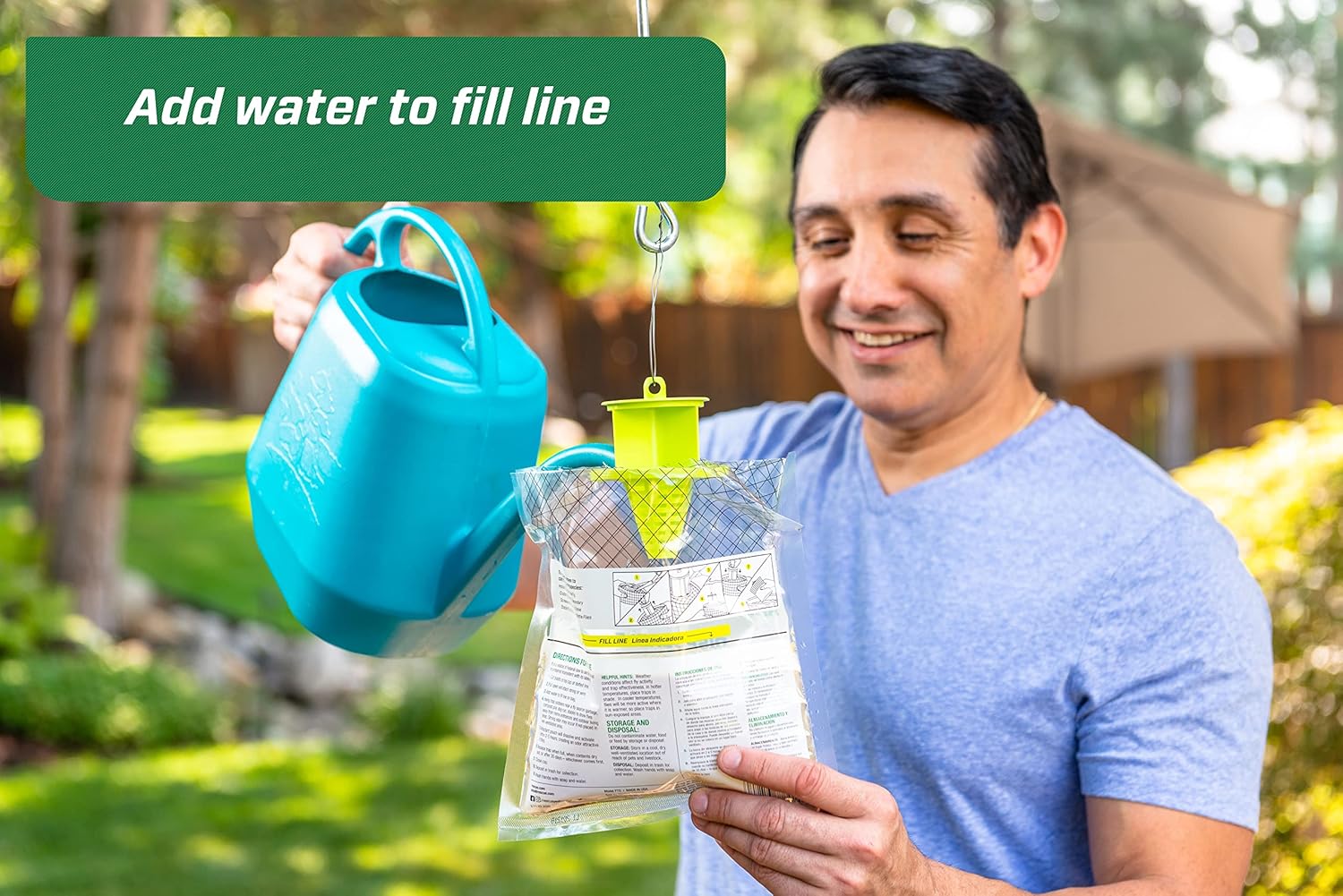
The disposable bag trap is the simplest form of the category. The RESCUE! Outdoor Disposable Fly Trap arrives with the attractant already sealed inside; you cut the top, add water to activate the lure, and hang it. Flies enter through the top, drop into the liquid and cannot leave. When the bag is full or the lure is spent, the whole thing goes in the trash unopened.
The appeal is zero handling. The trade-off is that you buy a new bag every time, and a bag that fills fast on a busy patio can need replacing every couple of weeks in peak season. For a single patio or a trash enclosure it is the least fuss; for a barn or a large yard, a reusable jar with bulk refills works out cheaper over a summer.
Reusable Jar Traps and the Refill Economics

A reusable trap like the TERRO Fly Magnet or the RESCUE! Outdoor Reusable Fly Trap is a rigid jar with a baffled lid: you mix the attractant with water inside, flies enter and cannot find the way out, and when it fills you empty it, rinse it and add a fresh charge of bait. The jar costs more once, and then each refill is a small packet.
This is where a bait-only product earns its place. The Starbar Fly Trap Attractant Refill is sold as packets sized for reusable traps, and it works in the brand-agnostic way most jar traps expect: dissolve, add water, hang. If you run several traps around a stable or a large property, buying refills in quantity and reusing the jars is the sensible route; if you have one patio and a low tolerance for emptying a jar of dead flies, the disposable bag is worth its higher per-use cost.
Scatter Baits Are Not Traps, and That Matters
Starbar QuikStrike is a different product class. It is a granular fly bait containing an insecticide, scattered on the ground or set out in bait stations in areas where flies congregate, and it kills flies that feed on it rather than catching them. It is sold for outdoor use around barns, kennels, poultry houses and similar sites, and it is the answer when hanging traps cannot keep up with a large fly population.
Because it is a pesticide rather than a lure in a bag, it comes with label directions that must be followed: placement out of reach of children, pets and livestock, use only in listed sites, and disposal rules. It belongs on a farm or a commercial property, not on a suburban deck where a dog can reach it. Read the label before you buy, and if your problem is a patio, stick to the traps.
| Product | Type | Where it belongs | Refill or replace |
|---|---|---|---|
| RESCUE! Outdoor Disposable Fly Trap | Pre-baited bag, water activated | Patio, yard, trash area, farm | Replace whole bag |
| TERRO Fly Magnet Trap | Reusable jar with bait | Yard, barn, kennel | Refill with attractant |
| Starbar Fly Trap Attractant Refill | Bait packets for reusable traps | Any reusable jar trap | Buy packets in bulk |
| RESCUE! Outdoor Reusable Fly Trap, 3 pack | Reusable jars with attractant | Large yard, several sites | Refill with attractant |
| TERRO Fruit Fly Trap, 4 pack | Food-based lure, indoor | Kitchen counter, fruit bowl | Replace lure or trap |
| Starbar QuikStrike Fly Bait | Insecticide scatter bait | Barns, stables, poultry houses | Reapply per label |
Indoor Versus Outdoor: Why Most Baited Traps Belong Outside
The lures that work on filth flies are formulated to smell like decay, and once activated with water they smell exactly like it. That is why every bag and jar trap here is sold for outdoor use, and why the manufacturers tell you to hang them away from doors, seating and windows: they draw flies toward themselves, so a trap by the back door pulls flies to the back door.
The one indoor product in this roundup is the fruit fly trap, whose food-based lure is mild and whose apple-shaped housing is designed to sit on a counter. If you want to knock down house flies inside without a smelly bait, that is the domain of sticky traps and swatters, which are outside the scope of this guide. Do not bring an outdoor bag trap indoors to solve a kitchen problem.
Placement: Distance, Height, Sun and Wind
Where you hang the trap matters more than which brand you hang. The manufacturers of the outdoor bags and jars generally recommend placing them a good distance from the area you want to protect, roughly twenty feet or more where space allows, between the fly source and the people, so the lure intercepts flies on the way in. Hang at chest to head height, in a spot with some sun to keep the attractant active, and out of strong wind that blows the scent away.
Near the source works too: beside the trash enclosure, downwind of the compost bin, along the fence line of a run or paddock. Wherever it goes, keep it off the dining table side of the yard. If flies still crowd the patio, move the trap further out rather than adding a second one closer in.
Capacity, Fill Time and How Often You Replace
The bag traps publish capacity in the tens of thousands of flies, and on a busy site they reach it faster than the lure expires. Reusable jars hold less per fill but reset in minutes. In practice the replacement rhythm is set by two things: how many flies your site produces, and how long you can tolerate a full trap hanging in view.
Plan on checking a bag weekly in high season and swapping it when it is roughly two thirds full or the water has evaporated. Refill jars when the catch covers the liquid or the attractant has been in the sun for the period stated on the packet. Buying a multi-pack of bags or a box of refill packets at the start of summer avoids the gap where an empty trap sits doing nothing.
Handling, Smell and Disposal
Every outdoor filth fly bait smells bad by design, and it smells worse when the trap is full. Disposable bags win here because they are sealed and go straight in the trash. Reusable jars have to be opened, emptied and rinsed, which is a job for gloves and a garden hose away from the house.
The fruit fly trap and the attractant packets are the least unpleasant to handle: the lure is contained, and there is nothing to empty on the counter. Store unused bags and packets sealed and dry, and keep the scatter bait locked away exactly as its label demands. If a trap tears or leaks, treat the spill as you would spilled compost tea: rinse thoroughly and keep it off soft furnishings.
Non-Toxic Lures Versus Insecticide Baits
The bag and jar traps here rely on attractant and drowning rather than poison; RESCUE! and TERRO both describe their trap lures as containing no insecticide, which is why they are acceptable around gardens, patios and pets when hung out of reach. That is the choice for most homeowners.
Scatter baits like Starbar QuikStrike do their job with an active ingredient and are the choice for high-pressure agricultural sites where trapping alone fails. Neither approach is wrong, but they are not interchangeable: do not treat a scatter bait as a slower trap or a trap as a gentler bait. Match the product class to the site, and follow the label on the pesticide without shortcuts.
Reduce the Source, or the Trap Never Catches Up
Traps and baits manage flies; they do not stop them breeding. A trap next to an open compost pile or an uncovered trash can is emptying the ocean with a bucket. Lidded bins, covered compost, prompt cleanup of pet waste and a rinse of the trash enclosure will cut the population more than a second trap will.
Timing helps too. Hang traps at the start of the warm season, before flies build up, rather than after the patio is already unusable, and take them down and dispose of them at the end. If pests beyond flies are the problem, our guides to the best ant killers for the yard and the best outdoor compost bins cover the neighboring jobs.
Why You Should Trust Us
We built this shortlist from the highest rated fly traps and fly bait products on Amazon, then read the listings, the label directions and the pattern of owner feedback for each, focusing on the things that decide whether a trap works: lure type, indoor or outdoor design, disposable versus refillable and, for the scatter bait, the label restrictions. We do not claim to have run field trials; the comparisons come from published product information and real owner reports.
Ratings shown on the cards are pulled from Amazon and update over time. We do not print prices because they change, and we do not accept payment for placement. Where a product is sold in several pack sizes, we linked one representative size.
Final Thoughts
The best overall pick is the RESCUE! Outdoor Disposable Fly Trap. It arrives pre-baited, activates with water, catches the filth flies that ruin patios and trash areas, and goes in the bin sealed when it is full. For most homeowners with one problem area, that is the entire solution.
The best value is the Starbar Fly Trap Attractant Refill, because a box of packets keeps any reusable jar trap working all season for less than a stream of disposable bags. Pair it with the TERRO Fly Magnet or the RESCUE! reusable three-pack for a barn or a large yard, keep the TERRO Fruit Fly Trap for the kitchen counter, and reserve Starbar QuikStrike for agricultural sites where trapping cannot keep up and the label can be followed to the letter. For the biting insects that traps ignore, our guide to the best non-DEET insect repellents is the next read.
Frequently Asked Questions About Fly Trap Bait
What is the best fly trap bait for outdoor flies in 2026?
For house flies, blow flies and other filth flies around a patio or trash area, a pre-baited bag like the RESCUE! Outdoor Disposable Fly Trap is the easiest choice, and attractant refill packets from Starbar keep reusable jar traps working through the season.
Can I use outdoor fly trap bait indoors?
No. Outdoor filth fly lures smell like decay once activated and are designed to draw flies toward the trap, which is the last thing you want in a kitchen. Indoors, use a food-based fruit fly trap for fruit flies, and keep the bag and jar traps outside and away from doors.
How far from the patio should a baited fly trap hang?
The trap makers generally recommend a good distance from the area you want to protect, roughly twenty feet or more where space allows, between the fly source and the people, at chest to head height, in some sun and out of strong wind.
Is fly trap bait poisonous to pets?
The bag and jar trap lures from RESCUE! and TERRO are described as containing no insecticide and work by attracting and drowning flies, so they are used around yards when hung out of reach. Scatter baits like Starbar QuikStrike do contain an insecticide and must be placed and stored exactly as the label directs, away from pets and children.
How often should I replace or refill a fly trap?
Check bags weekly in high season and replace when roughly two thirds full or when the water has evaporated. Refill jars when the catch covers the liquid or the attractant has been out for the period stated on the packet. Cutting off the breeding source, with lidded bins and covered compost, matters as much as the trap; our guide to the best pest control sprays covers the wider yard.

Write Your Review
No reviews yet. Be the first to share your experience!