

A plant in a pot lives in a closed system. Every watering that runs out of the drainage holes carries dissolved nutrients with it, and there is no soil web underneath to put them back, which is why a container plant that looked fine in May is pale and stalled by July. Choosing a fertilizer for pot plants is really a choice about how nutrients get back into that pot and how often: coated granules that release for months, a water-soluble powder you mix every couple of weeks, a liquid you dilute, or a spike you push into the soil and forget. For October 2026 we gathered 9 of the highest rated options on Amazon from Miracle-Gro, FoxFarm, MARPHYL and more, then sorted them by release type and by what kind of plant each one is built to feed.
Our top pick is the Osmocote Smart-Release Plant Food Plus for its coated granules that release nutrients for months, feed indoor and outdoor containers alike, and remove the weekly mixing chore that causes most potted plants to be underfed. Below it sit the water-soluble and liquid classics, a granular shake-on feed, two liquid organics from FoxFarm and MARPHYL, and the spikes for people who will never remember a schedule. Every pick is rated at least 4.0 stars by real Amazon customers, and if you are building out a balcony or patio garden, our patio, lawn and garden guides cover the planters, sprayers and soil that go with it.
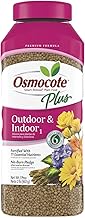
Pros
- Coated granules release nutrients for months from a single application
- Works in indoor and outdoor containers alike
- Removes the weekly mixing chore that leads to underfed pots
- Balanced formula suits most plants
Cons
- Slower to correct a visibly starving plant than a soluble feed
- Granules on the surface can wash out of small pots
- Release rate rises with heat, so hot-climate pots may run through it faster
Osmocote Smart-Release Plant Food Plus is the granule that container nurseries lean on, and it is the top pick here for the same reason: it solves the core problem of pots, which is that nutrients leach out faster than people remember to replace them. Each granule holds soluble fertilizer inside a resin coating that lets nutrients diffuse out over months as the mix stays warm and moist.
You mix it into the potting mix at planting or scratch it into the surface, and the pot is fed until the coating is spent. It is sold for both indoor and outdoor use, so one bag handles a windowsill and a patio.
The limits are the flip side of the design: it will not rescue a starving plant this week the way a soluble feed can, surface granules can wash out of very small pots, and release speeds up in heat. Pair it with an occasional soluble top-up in peak season and it covers almost everything.
Bottom line: the most forgiving fertilizer for pot plants, and the one to buy if you know your schedule will slip.
- Format: coated slow-release granules
- Use: indoor and outdoor containers and beds
- Package: 2 lb
- Feeding: continuous release over months per label
- Application: mix into soil or top-dress
Measure by the scoop and rate on the label for the pot diameter, work it into the top inch or two of mix, then water normally. Note the date on a plant tag; when the label period ends, reapply. In very hot weather, watch for pale growth and add a light soluble feed if needed.
Anyone with more than a couple of pots, travelers, and people who have killed plants by forgetting to feed them. Less ideal as the only feed for heavy fruiting vegetables in midsummer, which want a soluble boost.

Pros
- Fast, visible results on hungry plants
- A tub makes many gallons of feed
- Balanced all-purpose formula for mixed containers
- Full control over strength and timing
Cons
- Needs a one to two week schedule in season
- Leaches out quickly, so it must be repeated
- Frequent high-strength use builds up salts faster than slow-release
Miracle-Gro Water Soluble All Purpose Plant Food is the powder most people picture when they think of feeding plants, and for pots it is the fast lever. A scoop dissolves in the watering can, the nutrients are available immediately, and a pale plant greens up within days.
The 3 pound tub makes many gallons of feed, which is why it is the value pick, and the balanced formula suits mixed planters, most houseplants and vegetables in containers when used at the label rate.
Its weakness in pots is the same as its strength: it is entirely soluble, so it leaches out with watering and has to be repeated on a schedule, usually every one to two weeks in season, and frequent strong doses build up salts. Flush the pot every few weeks and it behaves.
Bottom line: the top-up feed every container gardener should own, and the whole answer for people who enjoy a weekly routine.
- Format: water-soluble powder
- Use: all purpose, indoor and outdoor plants
- Package: 3 lb
- Feeding: every 1 to 2 weeks in the growing season per label
- Application: dissolve in water, apply at watering
Use the enclosed scoop and the container rate, not the garden rate. Water the plant first if the mix is dry, then apply the feed solution. Skip a feeding every month or so and water plain until it runs from the drainage holes to flush salts.
People who enjoy a weekly routine, anyone with a plant that needs correcting fast, and mixed patio planters in peak season. Less suited to travelers or the forgetful.

Pros
- Formulated and dosed for indoor plants
- Can be applied directly to soil or in water
- Gentle enough for feeding at most waterings
- Small bottle stores easily
Cons
- Not sized for a large outdoor collection
- Easy to overuse if you also apply a granular product
- Liquid measuring adds a step
Miracle-Gro Indoor Plant Food is the liquid built for the slower pace of houseplants, which is where outdoor-strength products cause the most damage. It can be applied directly to the soil in measured pumps or diluted into water, and the label dosing assumes a plant in lower light growing modestly.
That makes it the easy answer for a windowsill of foliage plants: feed lightly and often, watch new growth, and pause in winter. It is not economical for a big patio garden, and it should not be combined with a granular feed in the same pot without cutting the dose.
Bottom line: the gentle everyday feed for houseplants that are alive but not thriving.
- Format: liquid, direct application or diluted
- Use: indoor houseplants including foliage and flowering plants, herbs
- Feeding: light and regular per label
- Application: pump onto soil or mix into water
Water first if the mix is dry, then apply the label dose. Feed during active growth and stop or halve the dose in winter. Do not stack it on top of spikes or granules in the same pot.
Houseplant owners with a handful of pots who want a simple, gentle routine. Not the product for outdoor vegetables or large planters.

Pros
- Shake straight from the jug, no mixing
- Feeds for months per label
- Suits both containers and beds
- Large jug covers many planters
Cons
- Not coated like Osmocote, so release is less even
- Granules must be worked in and watered
- Overkill for a couple of small houseplants
Miracle-Gro Shake and Feed All Purpose sits between the water-soluble powder and the coated granules. You shake it from the jug onto the soil surface, work it in and water, and the label says it feeds for months. It is sold for both containers and beds, and the 4.5 pound jug covers a lot of planters.
Compared with Osmocote, its granules are not resin coated in the same way, so release depends more on watering and temperature and is less even, but it is simple, widely available and covers a big patio garden economically.
Bottom line: the easy granular baseline for outdoor planters and raised beds, best paired with a soluble top-up in peak season.
- Format: granular, shake-on
- Use: in-ground and container plants, indoor and outdoor
- Package: 4.5 lb
- Feeding: months per label
- Application: sprinkle, work in, water
Use the shaker lid and the container rate on the label, keep granules an inch or two from stems, mix into the top layer of soil and water well. Reapply when the label period ends.
Gardeners with many outdoor pots and beds who want one jug for everything. Not for a small indoor collection.

Pros
- 6-4-4 formula built for leafy growth
- Concentrate goes a long way at label dilution
- Fast nutrient uptake
- Pairs with Big Bloom for stage-based feeding
Cons
- Not the right formula once flowering starts
- Must be measured and diluted
- Concentrated liquid can burn if overdosed
FoxFarm Grow Big is a 6-4-4 liquid concentrate, nitrogen-forward for the leafy vegetative stage of a plant's life. Diluted into water at the label rate, it drives lush growth in houseplants and in container vegetables and herbs early in the season.
It is deliberately not an all-season product. Once a tomato or a flowering annual starts to bloom, continuing a nitrogen-heavy feed gives you foliage at the expense of flowers and fruit, which is where FoxFarm's Big Bloom takes over. Used as a pair, they let you feed by stage rather than by calendar.
Bottom line: the early-season liquid for pots you want to fill out fast, best followed by a bloom formula.
- Format: liquid concentrate
- N-P-K: 6-4-4
- Use: houseplants and container plants, vegetative stage
- Application: dilute into water per label
Shake, measure into a watering can at the label rate, apply to moist soil. Use during active leafy growth, then switch to a bloom formula when flowers appear. Flush the pot every few weeks.
Container vegetable growers and houseplant owners who want to feed by growth stage. Not for someone who wants one product all year.

Pros
- Organic bloom formula for flowering and fruiting pots
- Gentle, low risk of root burn
- Made from earthworm castings and bat guano
- Pairs with Grow Big for a full season
Cons
- Low analysis, so it is not a complete high-strength feed
- Organic liquids can smell
- Needs regular application to keep pace with pots
FoxFarm Big Bloom is the organic bloom half of the FoxFarm pair, a liquid built around earthworm castings and bat guano to support flowering and fruiting. In a pot it is the feed to switch to when a tomato, pepper or flowering annual starts to bloom.
Because it is a low-analysis organic, it is gentle and very hard to overdo, which suits small containers, and it relies less on hitting an exact dose than a synthetic. The trade-offs are that it needs regular application to keep up with leaching, and like most organic liquids it has an odor.
Bottom line: the gentle bloom-stage feed for containers, and the natural partner to Grow Big.
- Format: organic liquid concentrate
- Use: flowering and fruiting plants in containers and beds
- Key ingredients: earthworm castings, bat guano
- Application: dilute into water per label
Begin when flower buds form, dilute at the label rate and apply at watering. It can be used more often than a synthetic because it is gentle. Store away from heat and expect a natural smell.
Organic container growers and anyone growing tomatoes, peppers or flowering annuals in pots. Not a stand-alone feed for heavy leafy growth early in the season.

Pros
- Organic all-purpose formula for a wide range of plants
- Marine phytoplankton base adds micronutrients
- Gentle enough for houseplants
- Works as a soil enhancer as well as a feed
Cons
- Noticeable ocean smell
- Lower analysis than synthetics, so results are steadier rather than fast
- Must be diluted and applied regularly
MARPHYL All-Purpose Plant Food is the organic all-rounder in this roundup, a liquid made from marine phytoplankton that works as both a fertilizer and a soil enhancer for flowers, vegetables and houseplants indoors and out.
Its appeal in pots is breadth and gentleness: it delivers a wide range of nutrients and organic compounds at low strength, so it suits regular feeding without the salt build-up that strong synthetics cause. The trade-offs are a distinct sea smell and results that arrive steadily rather than overnight.
Bottom line: the one-bottle organic choice for a mixed collection, for people who prefer gentle regular feeding.
- Format: organic liquid concentrate
- Base: marine phytoplankton
- Use: all purpose, indoor and outdoor, flowers, vegetables, houseplants
- Application: dilute into water per label
Shake well, dilute at the label rate and apply at watering during active growth. Use it outdoors or in a ventilated room if the smell bothers you. It can be combined with a slow-release granule at reduced rates.
Organic gardeners with a mixed collection of pots. Not for people who want the fastest possible green-up.

Pros
- No measuring, mixing or schedule
- Continuous feeding as you water
- Suits small to medium houseplant pots
- Two-pack lasts a long time
Cons
- Feeds a small zone around each spike
- No control over dose once inserted
- Less suited to large outdoor planters
Miracle-Gro Indoor Plant Food Spikes are the least-effort feed in this roundup: push a spike into the soil near the edge of the pot and it dissolves slowly with each watering. There is no measuring, no mixing and no schedule to keep beyond replacing spikes every couple of months per label.
The trade-off is control and distribution. Each spike feeds a zone around itself, so a big planter needs several and still feeds unevenly, and you cannot reduce the dose once it is in. In small to medium houseplant pots with roots filling the container, that hardly matters.
Bottom line: the answer for houseplant owners who will not keep a schedule, and a poor fit for large outdoor pots.
- Format: fertilizer spikes
- Use: indoor flowering and foliage houseplants
- Package: 48 spikes, 2-pack
- Feeding: replace per label, roughly every couple of months
Insert spikes near the pot rim, not against the stem, using the number the label gives for the pot size. Water as normal. Mark the date and replace on schedule; remove old spikes if you switch to a liquid feed.
Busy or forgetful houseplant owners and beginners. Not for large patio planters or vegetables.

Pros
- No measuring or mixing
- Instant feeding for containers
- Indoor and outdoor use
- Good for a few pots
Cons
- Highest cost per feeding of the group
- Bottle empties quickly on a large collection
- Adds plastic compared with a concentrate
Miracle-Gro Pour and Feed removes the last excuse for not feeding a pot: you pour the stated amount straight onto the soil, no measuring, no watering can. It is sold for indoor and outdoor containers and feeds immediately.
The convenience has a cost. Per feeding it is the most expensive format here, and a 32 ounce bottle disappears fast on a big collection. For two or three houseplants or a single patio pot, that trade is worth it; for a balcony full of planters, buy a concentrate or granules.
Bottom line: the simplest possible feed for a small number of pots.
- Format: ready-to-use liquid
- Use: indoor and outdoor container plants
- Package: 32 fl oz
- Application: pour directly onto soil per label
Water first if the soil is dry, then pour the label amount around the base of the plant. Feed during active growth on the label schedule and pause in winter.
People with a few pots who want zero preparation. Not economical for a large collection.
How to Choose the Right Fertilizer For Pot Plants
Why Pots Need Feeding More Than Beds Do
In the ground, roots reach into a large volume of soil that holds nutrients on clay and organic matter and is constantly topped up by decomposing material. In a pot, the root zone is a few quarts of potting mix, most of it peat or coir and bark, which holds very little in reserve. Every thorough watering flushes soluble nutrients out through the drainage holes, and the plant is fully dependent on what you add.
That changes the buying question. Bed fertilizers can be applied once a season and largely forgotten. Container fertilizers have to keep pace with leaching, which means either something slow and continuous like a coated granule, or something fast and frequent like a soluble powder or liquid on a schedule. The products in this guide are chosen because they solve that problem one way or the other, and the rest of the guide is about matching the method to your habits and your plants.
Slow-Release Granules Versus Water-Soluble Powders
Coated slow-release granules, which is what the Osmocote Smart-Release Plant Food Plus is, hold soluble fertilizer inside a resin shell that lets nutrients diffuse out over months as the soil warms and stays moist. You mix them into the potting mix at planting or scratch them into the surface, and the pot is fed until the coating is spent. It is the closest thing to a set-and-forget answer, and it is why Osmocote shows up in commercial container nurseries.
Water-soluble powders like Miracle-Gro Water Soluble All Purpose dissolve in the watering can and deliver nutrients immediately, then are gone as soon as they leach out. They give you complete control over strength and timing, they show results within days on a hungry plant, and they require you to remember the schedule, usually every one to two weeks in the growing season. Many container gardeners use both: granules as the baseline, soluble feed as the top-up during heavy flowering or fruiting.
Liquids, Concentrates and Ready-to-Use Bottles
Liquid concentrates split the difference. Miracle-Gro Indoor Plant Food, FoxFarm Grow Big, FoxFarm Big Bloom and MARPHYL All-Purpose are all measured into water at a stated dilution and applied at watering time. They are convenient for houseplants because you can feed at low strength every time you water instead of hitting the plant with a bigger dose every two weeks, which is gentler on roots in small pots.
Ready-to-use bottles such as Miracle-Gro Pour and Feed skip the measuring entirely: you pour a set amount straight onto the soil. That convenience costs more per feeding and adds plastic, but for a couple of houseplants or a single patio pot it removes the last excuse for not feeding. Check whether a liquid is a complete fertilizer or a supplement; the two FoxFarm bottles here are complete formulas designed for different growth stages, and a kelp or vitamin tonic is not a substitute for either.
Spikes: The Least Work and the Least Control
Fertilizer spikes, represented here by the Miracle-Gro Indoor Plant Food Spikes, are compressed sticks you push into the soil near the pot edge, where they dissolve slowly with each watering. They are genuinely the easiest option and suit people who travel or forget schedules.
The trade-off is distribution and control. A spike releases nutrients in a small zone around itself, so roots on the far side of a large pot get less, and you cannot dial back the dose once it is in. They work best in small to medium houseplant pots with roots that fill the container, and less well in a big patio planter where a granular product spread through the mix feeds evenly.
| Product | Format | Best suited to | How often |
|---|---|---|---|
| Osmocote Smart-Release Plus | Coated slow-release granules | Indoor and outdoor containers, set and forget | Once per label period, months |
| Miracle-Gro Water Soluble All Purpose | Powder mixed in water | Mixed containers, fast results | Every 1 to 2 weeks in season |
| Miracle-Gro Indoor Plant Food | Liquid concentrate | Houseplants, gentle feeding | At watering, low strength |
| Miracle-Gro Shake and Feed All Purpose | Granular shake-on | Outdoor planters and beds | Every few months |
| FoxFarm Grow Big | Liquid concentrate, 6-4-4 | Leafy vegetative growth | With watering in season |
| FoxFarm Big Bloom | Organic liquid bloom formula | Flowering and fruiting pots | With watering in season |
| MARPHYL All-Purpose | Organic marine phytoplankton liquid | Flowers, vegetables, houseplants | Per label dilution |
| Miracle-Gro Indoor Plant Food Spikes | Spikes | Small houseplant pots, no schedule | Every couple of months |
| Miracle-Gro Pour and Feed | Ready-to-use liquid | A few pots, no measuring | Per label |
Reading the N-P-K Numbers Without a Chemistry Degree

The three numbers on every fertilizer label are the percentages by weight of nitrogen, phosphorus (as phosphate) and potassium (as potash). Nitrogen drives leafy growth, phosphorus supports roots and flowering, potassium supports overall vigor and fruit quality. A balanced all-purpose formula, which is what the Miracle-Gro all-purpose products and Osmocote Plus are built as, suits most foliage plants and mixed containers.
The two FoxFarm liquids show why the ratio matters. Grow Big is a 6-4-4 formula, nitrogen-forward for the leafy vegetative phase. Big Bloom is a low-analysis organic bloom formula built around earthworm castings and bat guano to support flowering and fruiting. Feeding a tomato in a pot with a nitrogen-heavy formula all summer gives you a beautiful bush and few tomatoes; switching to a bloom formula when flowers appear is the fix. Match the numbers to the stage, not just to the plant.
Synthetic or Organic, and What Each Does in a Pot

Synthetic fertilizers, like the Miracle-Gro range and Osmocote, deliver nutrients in forms roots can take up immediately, and their strength is precise and repeatable. In a pot, where you are the only source of nutrition, that predictability is a real advantage.
Organic liquids like FoxFarm Big Bloom and MARPHYL All-Purpose, which is built on marine phytoplankton, deliver a broader mix of nutrients and organic compounds but rely partly on soil biology to make them available, and a sterile potting mix has less of that biology than garden soil. In practice organics work well in containers when applied regularly and at the label rate, and they are less likely to burn roots if you overdo it. Many container growers run an organic base with a synthetic top-up, or the reverse; neither camp is wrong for a pot.
Salt Build-Up, Leaching and Why the White Crust Matters
Every soluble fertilizer is a salt, and in a pot the salts that the plant does not use accumulate in the mix and on the rim as a white crust. Enough of it and roots struggle to take up water, and leaf tips brown. This is the hidden cost of feeding pots, and it is worse with frequent high-strength soluble feeds than with slow-release granules or dilute liquids.
The remedy is simple and it should be part of the routine: every few weeks, water the pot thoroughly until it runs freely out of the bottom for a minute or two, which flushes accumulated salts, then resume feeding. Products that recommend feeding at every watering, such as the indoor liquid formulas, are designed to be used at low strength precisely so that this build-up stays manageable.
Indoor Houseplants Versus Outdoor Containers

Houseplants grow more slowly, in lower light, in pots that stay indoors year round, and they need less food than an outdoor planter full of annuals in full sun. Formulas sold specifically for indoor use, like the Miracle-Gro Indoor Plant Food liquid and the spikes, are typically gentler and are dosed for that slower pace. Overfeeding a snake plant with an outdoor-strength product is the more common mistake.
Outdoor containers, especially vegetables and heavy-flowering annuals, run through nutrients quickly in warm weather. Osmocote and the Shake and Feed granules are built for that pace, and the label rates for outdoor use are higher. If a product is sold for both, read the two schedules separately rather than splitting the difference. And in either setting, do not feed a plant that is bone dry; water first, then feed, to avoid root burn.
Feeding Schedule, Season and Dormancy
Most container fertilizers, whatever the format, are dosed for the active growing season, roughly spring through early autumn for outdoor pots and whenever the plant is putting out new growth indoors. Feeding a dormant plant in winter mostly adds salts. Slow-release granules handle this on their own because release slows as soil temperature drops; soluble and liquid feeds have to be paused by you.
Write the schedule down or set a reminder, because irregular feeding is the reason most people conclude a fertilizer did not work. If you know you will not keep a two-week rhythm, choose the granules or the spikes; if you enjoy tending plants weekly, the soluble and liquid feeds give you more control and faster feedback.
Package Size, Cost Per Feeding and Storage
A 3 pound tub of water-soluble powder makes many gallons of feed and lasts a small collection for a season or more; a quart of concentrate goes a long way at label dilution; a 2 pound bag of slow-release granules feeds several containers for a full season. Compare products on the number of feedings or pots per package rather than on the sticker, because the formats are not comparable by weight.
Store dry products sealed and dry; soluble powders cake if they absorb moisture. Liquids should be kept from freezing and out of the sun. Organic liquids can have a noticeable odor, MARPHYL and Big Bloom included, which is normal but worth knowing before you keep them under the kitchen sink. If a whole vegetable patch rather than a pot is the goal, our guide to the best compost for a vegetable garden is the better starting point.
Why You Should Trust Us
We built this shortlist from the highest rated container and houseplant fertilizers on Amazon, then read the labels, the guaranteed analysis and the owner feedback for each one, focusing on what matters in a pot: release type, N-P-K ratio, indoor or outdoor dosing and how forgiving the product is of an imperfect schedule. We do not claim to have grown trials with every product; the comparisons come from published label information and the pattern of real owner reports.
Ratings on the cards are pulled from Amazon and update over time. We do not print prices in the guide because they change constantly, and we do not accept payment for placement. Where a product is sold in several sizes, we linked one representative size.
Final Thoughts
The best overall pick is the Osmocote Smart-Release Plant Food Plus. Coated granules that feed for months solve the core problem of containers, nutrients leaching away faster than most people remember to replace them, and it works in indoor and outdoor pots alike, so one bag covers the whole collection.
The best value is Miracle-Gro Water Soluble All Purpose Plant Food: a tub makes many gallons of feed, results show within days, and it is the right top-up during heavy flowering or fruiting. For houseplants, the Miracle-Gro Indoor Plant Food liquid or the spikes are gentler and easier; for tomatoes and flowering annuals in pots, the FoxFarm pair, Grow Big early and Big Bloom once flowers appear, is the stage-by-stage approach; and MARPHYL is the organic all-rounder. Whatever you choose, flush the pot every few weeks and feed only when the plant is growing. If the collection is indoors, our guide to the best indoor plants pairs well with this one.
Frequently Asked Questions About Fertilizer for Pot Plants
What is the best fertilizer for pot plants in 2026?
For most people a coated slow-release granule like Osmocote is the best all-round fertilizer for pot plants, because it feeds for months and does not depend on a schedule. Add a water-soluble or liquid feed during heavy flowering or fruiting if the plant is hungry.
How often should I fertilize potted plants?
It depends on the format. Slow-release granules go on once per label period, often several months. Water-soluble powders are typically every one to two weeks in the growing season. Indoor liquids can be used at low strength at most waterings. Stop or slow feeding when the plant is dormant.
Can I use garden fertilizer for pot plants?
Often yes, but read the container rate on the label, which is usually lower, and be aware that pots leach nutrients faster and build up salts sooner. Products sold for indoor use are dosed for slower-growing houseplants.
Why do my potted plants have a white crust on the soil?
That is accumulated fertilizer salt. Water the pot thoroughly until it runs freely from the drainage holes for a minute or two to flush it, then resume feeding, ideally at a lower strength or with a slower-release product.
Is organic or synthetic fertilizer for pot plants better?
Both work in containers. Synthetics are precise and fast; organics like FoxFarm Big Bloom and MARPHYL are gentler and broader but rely partly on soil biology. Many growers combine them. If you grow food in containers, our guide to the best outdoor compost bins covers the other half of a healthy potting mix.



Write Your Review
No reviews yet. Be the first to share your experience!