

A Faraday pouch is one of the few security products you can verify yourself in ten seconds, and almost nobody does. Put a phone inside, seal it, and call the phone. If it rings, the pouch is not blocking anything and your keys are no safer than they were in a drawer. That single test matters more than any specification on the listing, because construction quality in this category varies enormously and nothing about the outside tells you which one you have. We compared 7 key fob signal blocker options on construction, closure design, size and how easily each can be checked.
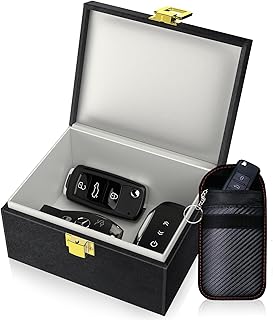
Our top pick is the Samfolk Faraday Box with Faraday Bags, because a box by the door solves the problem at home where most keys actually sit. For related vehicle security, our guide to automotive accessories covers other equipment.
Pros
- Box replaces the bowl keys already land in
- No closure to fasten, so protection is automatic
- Rigid construction outlasts folded pouches
- Includes bags for carrying keys out
Cons
- Takes up counter or shelf space
- Still needs verifying with a phone test on arrival
The strongest argument for a box is behavioural rather than technical. Keys land in the same place every evening, usually near the front door, which is both the most convenient spot and the most exposed one. A box occupies that spot and requires nothing extra from the person dropping keys into it.
Rigid construction also solves the durability problem that quietly defeats pouches. A pouch folded twice a day develops cracks in its metallic lining along the fold lines, and it looks identical while doing nothing. A box is not repeatedly flexed.
The included bags cover the other half of the problem, keys away from home. What it does not do is exempt you from testing: put a phone inside, close the lid, and ring it before trusting anything in this category.
Bottom line: the format most likely to be used consistently, which matters more than any specification.
- Type: Faraday box with pouches
- Placement: hallway or entry table
- Closure: lid, no folding
- Included: box plus bags
- Blocks: key fob and contactless card signals
- Verification: phone test recommended
Put the box where keys already land rather than somewhere tidier, since the habit is what makes it work.
Test on arrival by placing a phone inside, closing the lid and calling it. Silence means it is blocking.
Retest every few months, particularly the pouches, since folded linings fatigue over time with no visible sign.
Keep the lid fully closed rather than resting, as a gap defeats the shielding entirely.

Pros
- Very large volume of customer feedback to draw on
- Compact enough for a pocket or bag
- Blocks contactless card signals as well
- Straightforward fold over closure
Cons
- Folded closure must be done properly every time
- Lining fatigues with repeated folding
This is the volume seller of the pouch format, and the large pool of buyer feedback is genuinely useful in a category where quality is invisible from the outside.
As a carry pouch it does what it should: small enough for a pocket, blocks contactless cards alongside the fob, and simple to use.
The two limits are inherent to the format rather than to this product. A fold over closure has to be folded properly, and a hurried single fold leaves a gap that defeats the whole thing. And the lining cracks along fold lines over months of daily use, which is why retesting matters more than the initial purchase decision.
Bottom line: a sound everyday carry pouch, provided you close it properly and retest it periodically.
- Type: Faraday pouch
- Closure: fold over
- Blocks: key fob and RFID card signals
- Size: pocket sized
- Best use: carrying keys away from home
- Verification: phone test recommended
Fold the closure fully rather than once, and test the pouch the way you actually close it in a hurry rather than carefully.
Measure your fob first, since a pouch that will not close comfortably leaves a gap at the opening.
Retest with a phone call every few months. A cracked lining looks exactly like a working one.
Avoid cramming keys and a phone in together unless you intend the phone to lose signal.

Pros
- Two pouches covers a second driver or spare keys
- Established seller with substantial feedback
- Compact carry size
- Blocks card signals alongside fobs
Cons
- Fold over closures need care each time
- Same lining fatigue as any pouch
Most households have more than one set of car keys, and a spare set left unprotected undoes the protection on the primary set entirely. A two pack addresses that at little extra cost.
The pouches themselves are conventional in the useful sense: compact, simple and blocking contactless cards as well as fobs.
Everything said about pouches generally applies here. Fold the closure fully, test it on arrival, and retest periodically because the lining ages invisibly. Where a household keeps a spare set in a drawer for months, that set is the one most likely to be protected by a pouch nobody has checked in years.
Bottom line: the sensible buy when there is more than one set of keys in the house.
- Type: Faraday pouches
- Quantity: 2
- Closure: fold over
- Blocks: fob and RFID card signals
- Best use: two drivers or spare keys
- Verification: phone test recommended
Households with two drivers, or anyone who keeps a spare set of keys somewhere at home.
Less relevant for a single driver with one set.
Test both pouches, not just the one you will use daily, since spare key protection is the easiest to forget about.
Store the spare set away from the front door as well, since location matters alongside shielding.

Pros
- Simple, well established design
- Named brand rather than a generic listing
- Compact for pocket carry
- Blocks card signals as well as fobs
Cons
- Single pouch, so spares need a second purchase
- Fold closure requires consistent use
A named brand carries some weight in a category dominated by generic listings, mainly because there is an identifiable seller behind consistency between units.
The pouch itself is conventional: pocket sized, fold over closure, blocking contactless cards alongside the fob.
There is nothing unusual to report and that is arguably the point. It does the job a Faraday pouch should do, it needs the same verification as anything else here, and the lining will age the same way. Buy it, test it, retest it.
Bottom line: a dependable single pouch with a name attached.
- Type: Faraday pouch
- Quantity: 1
- Closure: fold over
- Blocks: fob and RFID card signals
- Size: everyday carry
- Verification: phone test recommended
Single drivers wanting one reliable pouch from an identifiable brand.
Less economical where several sets of keys need covering.
Check the internal dimensions against your fob, since larger modern fobs do not fit every pouch comfortably.
Run the phone test on arrival rather than assuming a brand name guarantees performance.
Pros
- Covers home and away in one purchase
- Box protects without needing a habit
- Two pouches included for carrying
- Lower cost than premium bundles
Cons
- Generic listing with limited brand information
- Verification is essential rather than optional
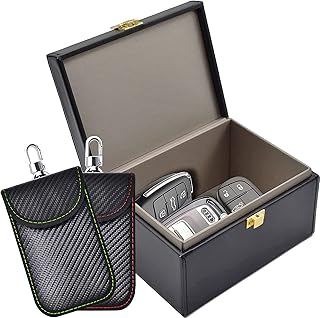
The bundle approach is sound: a box for where keys live and pouches for when they leave, which is how most households actually use their keys.
At a lower price than premium sets, it makes the box format accessible, and the box is the part that protects most consistently because it demands nothing of the user beyond dropping keys in.
The caution is that this is a generic listing without much brand accountability behind it, which raises rather than lowers the importance of testing. Place a phone inside the box, close it, ring the phone, and repeat for each pouch. If any of them rings, that item is not doing its job.
Bottom line: a practical low cost bundle, on the condition that you verify each piece.
- Type: Faraday box with 2 pouches
- Placement: hallway plus carry
- Closure: lid and fold over
- Blocks: fob and RFID card signals
- Cost: lower than premium bundles
- Verification: test every piece
Test the box and each pouch separately, since they are different constructions and can fail independently.
Retest every few months, particularly the pouches, which fatigue with folding.
Households wanting both formats without paying premium prices, and who are willing to verify what they receive.
Less reassuring for buyers who want a named brand behind the product.

Pros
- Fire and water resistance protects documents too
- Two pouches per pack
- Heavier construction than basic pouches
- Blocks fob and card signals
Cons
- Fire resistance is unrelated to signal blocking, do not conflate them
- Bulkier than a plain carry pouch
These combine two unrelated protections in one product, and it is worth separating them mentally. Signal blocking stops a relay attack; fire and water resistance protects contents from a house fire or a flood. Neither improves the other.
Where that combination is genuinely useful is a drawer holding passports, deeds and a spare set of keys, since one pouch covers several risks in a place things are stored long term.
For daily carry they are bulkier than a plain pouch, and the heavier construction is doing work that a pocket does not require. Treat these as storage rather than as an everyday key pouch, and test the signal blocking exactly as you would any other product here.
Bottom line: a storage pouch with a useful second function, not the best choice for a pocket.
- Type: Faraday pouches with fire and water resistance
- Quantity: 2
- Blocks: fob and RFID card signals
- Additional: fire and water resistant materials
- Best use: document and spare key storage
- Verification: phone test recommended
Do not assume fire resistance implies better signal blocking. They are separate properties and each needs its own check.
Read the manufacturer's temperature and duration ratings for the fire resistance claim rather than treating it as absolute.
Anyone storing documents and spare keys together who wants one pouch covering several risks.
Not the pick for slim everyday carry.
Pros
- Inexpensive route to covering two sets of keys
- Compact carry format
- Blocks card signals as well
- Simple with nothing to go wrong
Cons
- Basic construction, verification matters more
- Fold closure and lining fatigue as with all pouches
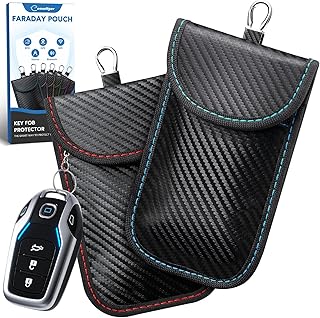
At the budget end of the category, a two pack makes covering both a main and a spare set inexpensive, which is worth something given that an unprotected spare undermines a protected primary.
Construction is basic and the design is conventional, with a fold over closure and a compact carry size.
Basic construction is exactly why testing is not optional here. A pouch that fails a phone call is not a cheap pouch, it is not a pouch at all. Test both on arrival, close them fully in use, and retest periodically as the lining ages.
Bottom line: fine as budget coverage for two sets, provided you actually verify them.
- Type: Faraday pouches
- Quantity: 2
- Closure: fold over
- Blocks: fob and RFID card signals
- Construction: basic
- Verification: test both on arrival
Budget conscious buyers covering a main set and a spare, who will run the verification test.
Less suitable for anyone who wants to buy and forget.
Test each pouch separately with a phone call before relying on either.
Replace rather than repair once a pouch fails a test, since a cracked lining cannot be fixed.
How to Choose a Key Fob Signal Blocker
What the Pouch Is Actually Protecting Against
Keyless entry works by the car and the fob holding a short conversation over radio whenever they are close enough. The car is listening, the fob answers, and the doors unlock without anything being pressed.
The weakness is distance. If that conversation can be carried further than the manufacturer intended, a car parked on a driveway can be persuaded that a fob sitting on a hall table is right beside it. This is widely known as a relay attack, and it explains why cars are taken from driveways without a window being broken.
A Faraday pouch works by putting a conductive layer between the fob and the outside world so that no conversation can happen at all. It is a physical solution to a radio problem, and when the pouch is intact it is genuinely effective. The whole question is whether yours is intact.
The Phone Test Is the Only Verification You Have

There is no indicator light on a Faraday pouch and no way to see whether the lining is doing its job. The practical substitute is a phone. Place it inside, close the pouch properly, and ring it from another phone. Silence means the pouch is blocking; a ring means it is not.
Do this the day it arrives rather than assuming, because manufacturing quality varies and a poorly sealed seam is invisible from the outside. It costs nothing and it is the difference between owning a security product and owning a small bag.
One caveat on the test: phone signals and key fob signals sit on different frequencies, so a pouch that blocks a phone is a good sign rather than a guarantee for every band. It remains by far the best check available to an ordinary owner, and a pouch that fails it fails outright.
Pouch or Box: Where the Keys Actually Live
Most keys spend most of their time in one place at home, usually a hook or a bowl near the front door, and that is also where they are most exposed to someone standing outside with a relay device.
A box addresses that directly. It sits where the bowl sat, keys go in as a matter of habit, and there is no zip to fasten or flap to fold. Habits that require no extra steps are the ones that survive, which is why a box protects more consistently than a pouch that has to be remembered every evening.
Pouches earn their place away from home, in a pocket, a bag or a hotel room. Many buyers end up with both for that reason, and several products here bundle a box with bags on exactly that logic.
Layers, Seams and the Closure

Blocking performance comes from a continuous conductive layer with no gaps, so the weak points are wherever the material is interrupted. Seams and the opening are the two places a pouch fails.
Double layered pouches provide redundancy, which matters as the material ages. The closure design matters just as much: a fold over flap needs folding properly every time, and a partial fold leaves a gap that defeats the whole product. Designs that fold twice and then fasten are more forgiving of a hurried user than a single flap.
When you run the phone test, test it the way you will actually use it, closed quickly with one hand rather than carefully sealed. That tells you what the pouch does in practice rather than in ideal conditions.
Wear: These Do Not Last Forever
The conductive lining is a thin metallic layer inside a fabric shell, and repeated folding fatigues it. Over months of daily opening and closing, cracks develop along the fold lines, and the pouch gradually stops blocking while looking exactly as it did on day one.
This is the most important thing to understand about the category. A pouch is a consumable, not a permanent fixture, and one bought three years ago and folded daily should not be assumed to work.
Retest every few months with the same phone call. It takes ten seconds and it is the only way to notice a failure that has no other symptom. Boxes generally outlast pouches simply because rigid construction is not repeatedly flexed.
Does Your Car Even Need One
Not every vehicle is exposed. A car that uses a traditional key, or one where the fob must be pressed to unlock, is not vulnerable to this particular attack because there is no continuous conversation to relay.
Manufacturers have also responded. Some fobs go to sleep after a period without motion, so a key resting on a table overnight stops transmitting entirely, and newer systems using ultra wideband technology can measure distance precisely enough that a relayed signal is rejected. If your car has either, the risk is substantially reduced.
Check your handbook or ask the dealer before assuming you need protection, and equally before assuming you do not. Given what these cost against what a car costs, many owners reasonably choose to use one regardless.
Size, and What Else Goes In

Measure before ordering. Modern fobs vary widely in size, and some are large enough that a compact pouch will not close properly, which reintroduces the gap problem at the closure.
Think about what shares the pouch too. Two fobs for the same car in one pouch is fine and convenient. A phone in with the keys is a different decision, since the phone loses signal entirely, misses calls and can drain its battery searching for a network.
Larger bags exist for phones and tablets and serve different purposes, from privacy to preventing a device being tracked. For keys, a pouch just large enough to close comfortably is the right size.
Beyond Keys: Cards and Devices
The same principle covers contactless cards, which is why some products in this category advertise RFID protection alongside key blocking. Card fraud by proximity reading is a much smaller problem than car theft in practice, but the protection comes free with the same material.
Phone sized Faraday bags are a separate product with separate uses, and they cut the device off completely, which is the point rather than a side effect. Anyone buying one should understand the phone will be uncontactable while inside.
Some pouches add fire and water resistance, which addresses a different risk entirely. Useful for documents, irrelevant to signal blocking, and worth not confusing with the security function.
Habits That Do More Than the Pouch
A pouch is one layer and works best alongside a few free measures. Keys kept away from the front door and away from windows are harder to reach with a relay device, since these attacks depend on getting close enough to the fob.
Where a vehicle allows it, turning off keyless entry in the settings removes the vulnerability outright, and many cars have that option buried in a menu. A visible steering lock is an old fashioned answer that still deters, because it takes time and attracts attention.
None of this replaces the pouch and none of it costs anything. Combined, they make a driveway a considerably less attractive proposition than any single measure does alone.
What Happens to the Fob Battery Inside
A question that comes up often and has a genuinely useful answer: does keeping a fob in a shielded pouch help or hurt its battery.
The answer depends on how the fob behaves. Many keyless fobs are effectively listening all the time, waking briefly and repeatedly to check whether their car is nearby. Inside a shielded pouch, some fobs simply hear nothing and settle, which draws less power than constantly answering. Others behave the opposite way, interpreting the silence as being out of range and searching harder, which drains the cell faster than leaving the key on a table would.
There is no universal rule because the behaviour is set by the manufacturer, and the practical effect is small either way. What is worth knowing is that if your fob battery starts needing replacement noticeably more often after you begin using a pouch, that is a plausible cause rather than a coincidence, and switching to a rigid box for overnight storage sometimes changes the pattern.
Newer fobs that sleep after a period without motion sidestep the question entirely. They stop transmitting on their own when left still, which is both better for the battery and a reduction in exposure, and it is one of the reasons to check what your particular car does before assuming any of this applies to you.
| Product | Type | Contents | Best For |
|---|---|---|---|
| Samfolk Faraday Box with Bags | Box plus pouches | Box and bags | Keys kept by the front door |
| Faraday Pouch for Car Keys | Pouch | Single pouch | Carrying keys away from home |
| TICONN Faraday Bags, 2 Pack | Pouch | 2 pouches | Two drivers or two sets of keys |
| Wisdompro Faraday Bag | Pouch | Single pouch | A straightforward everyday pouch |
| Faraday Box and 2 Bags | Box plus pouches | Box and bags | Home and travel in one purchase |
| Military Grade Faraday Bags | Pouch | 2 pouches | Added fire and water resistance |
| Faraday Pouch, 2 Pack | Pouch | 2 pouches | Keeping a spare in a bag |
For more vehicle related decisions, our automotive guides cover tools and accessories, and the full library sits at our article index.
Why You Should Trust Us
We organised this list around verification rather than around claims, because every product in the category makes the same promise and none of them can be checked by looking at it. The phone test is the practical answer available to any owner, and a guide that does not mention it is leaving out the only useful tool a buyer has.
We then separated boxes from pouches, since where keys live at home is the decision that determines whether protection is used consistently. Real customer ratings informed the shortlist, with attention to repeated reports of pouches failing a signal check, and near identical listings of the same product were counted once.
Final Thoughts
For most households the Samfolk Faraday Box with Faraday Bags is the sensible purchase. Keys spend their nights near the front door, a box replaces the bowl they already land in, and protection that requires no extra step is protection that actually happens.
For carrying keys out, the standalone pouches cover it, and buying a two pack means a second set of keys or a second driver is covered too. If documents matter as much as keys, the fire and water resistant bags handle a different risk in the same product.
Whichever you choose, run the phone test the day it arrives and again every few months, because the lining cracks with folding and gives no warning when it stops working. Browse more of our category guides for the rest of the garage.
Frequently Asked Questions
What is the best key fob signal blocker in 2026?
The Samfolk Faraday Box with Faraday Bags is our overall pick for 2026, because a box by the door protects keys where they actually sit without requiring a habit. For carrying keys out, a double layered pouch is the right format.
How do I know if my Faraday pouch works?
Put a phone inside, close it the way you normally would, and ring the phone. If it rings, the pouch is not blocking. Repeat every few months, because the metallic lining cracks along fold lines over time and gives no other sign that it has stopped working.
Does my car actually need one?
Only cars with keyless entry, where the fob and car communicate continuously, are exposed to a relay attack. Cars with traditional keys are not, and newer fobs that sleep when still or systems using ultra wideband distance measurement substantially reduce the risk. Check your handbook.
Can I put my phone in the same pouch?
You can, and the phone will lose signal completely, miss calls and may drain its battery searching for a network. For keys, choose a pouch just large enough to close comfortably around the fobs. Our automotive guides cover other in car accessories.
What else reduces the risk besides a pouch?
Keeping keys away from the front door and windows makes them harder to reach with a relay device. Some cars allow keyless entry to be switched off in the settings, which removes the vulnerability entirely, and a visible steering lock still deters because it costs time and draws attention.

Write Your Review
No reviews yet. Be the first to share your experience!