

Every compact refrigerator in this category is sold as a mini fridge with a freezer, and that single phrase covers two products that behave nothing alike. One has a proper second door with its own seal and its own compartment. The other has a small metal box inside the main cabinet with a flap in front of it. Both are legally freezers. Only one of them will still have your food frozen a week later.
Our top pick is the EUHOMY Mini Fridge with Freezer, 3.2 Cu.Ft two door model, because the separate freezer door is the difference between storing frozen food and storing ice for a few days. Below are 8 compact refrigerators from Midea, Frigidaire, EUHOMY and more, sorted by how the freezer is actually built. Our appliance guides cover full size options, and this list reflects what is available in October 2026.

Pros
- Separate freezer door holds a proper frozen temperature
- Opening the fridge does not warm the freezer section
- 3.2 cubic feet is enough for a week of food for one person
- Suits bedroom, dorm, office and apartment use
Cons
- Freezer compartment takes a share of the quoted capacity
- Manual defrosting still required
The reason this unit leads the list is structural. It has two doors, and the freezer sits behind its own seal instead of inside the fridge cabinet. That single difference decides whether frozen food stays frozen through a term or slowly softens every time somebody reaches in for a drink.
At 3.2 cubic feet the fridge section still has usable room once the freezer takes its share. That is the practical minimum for storing real meals rather than snacks, and it is why this size dominates the category.
Expect to defrost it manually, as with almost everything at this size, and expect the compressor to cycle audibly if it lives in a bedroom. Neither is a fault, both are the cost of a compact refrigerator.
Bottom line: buy this if the freezer needs to actually freeze.
- Capacity: 3.2 cubic feet total
- Configuration: two door with separate freezer
- Defrost: manual
- Placement: bedroom, dorm, office, apartment
- Shelving: adjustable interior shelves
Best for students and renters who cook and need real frozen storage, and for a second fridge in a home office or garage.
Less suited to anyone who only needs cold drinks, where a smaller single door unit saves space and money.
Check your housing capacity limit before ordering. Student accommodation frequently caps compact refrigerators near four cubic feet and this class sits close to that line.
Leave the manufacturer specified clearance at the back and sides. Enclosing a compact fridge makes it run longer and louder and shortens its life.

Pros
- Energy Star certification matters when it runs year round
- Long established model with a broad track record
- 3.1 cubic feet suits a single occupant
- Designed specifically for dorm use
Cons
- Two door layout takes some cabinet space for the freezer
- Manual defrost like most units at this size
This is the safe default in the category and it has been for years. The capacity is right for one person, the footprint fits a dorm room, and the Energy Star certification is a genuine consideration rather than a sticker, because a fridge in student accommodation runs continuously for months at a time.
The freezer here sits behind its own door and takes 0.9 of the 3.1 cubic feet, which is what lets it hold a proper frozen temperature instead of warming every time you open the fridge.
What it lacks in features it makes up for in predictability. This is a well understood machine with a long history, which is worth something in a category where many listings appear and disappear within a season.
Bottom line: the sensible low risk choice for a first fridge.
- Capacity: 3.1 cubic feet
- Certification: Energy Star
- Freezer: separate freezer door, 0.9 cubic feet of the 3.1 total
- Defrost: manual
- Intended use: dorm rooms and small spaces
Best for students, for a first compact fridge, and for anyone who wants a model with a long record rather than the newest listing.
Less suited to anyone who wants the largest possible fridge section, since the sealed freezer takes real space from the cabinet.
Let it stand upright for several hours before switching it on if it has been transported lying down, so the compressor oil settles back where it belongs.
Set the thermostat to the middle rather than the coldest setting. Compact fridges arrive set colder than needed, which builds frost faster and uses more electricity for no benefit.

Pros
- Runs quietly enough for a bedroom
- Includes a usable freezer shelf
- Adjustable thermostat for precise cooling
- Compact footprint fits almost anywhere
- Reversible door for flexible placement
Cons
- Freezer shelf only reaches a soft freeze
- Manual defrost needed on the freezer
The Upstreman 3.2 Cu.Ft. mini fridge is a single-door compact refrigerator aimed at anyone who needs cold storage in a small space without the noise or bulk of a full unit. It suits students, renters, and anyone adding a fridge to a bedroom or home office.
Its strongest quality is the balance it strikes. The compressor cools quickly and holds temperature steadily, yet stays quiet enough to sit near a bed. An adjustable thermostat lets you dial in the cold, and the small freezer shelf handles ice, frozen snacks, and cold packs.
The main limitation is the freezer itself. Like most single-door minis, its freezer only reaches a soft freeze and needs occasional manual defrosting, so it is not the place for long-term frozen storage. Interior space is modest, which is the trade-off for the slim footprint.
Bottom line: for a versatile mini fridge that fits nearly anywhere and stays quiet, the Upstreman 3.2 is the most well-rounded choice on this list and our pick for best overall.
- Capacity: 3.2 cubic feet
- Type: single-door compact with freezer shelf
- Cooling: compressor
- Thermostat: adjustable mechanical dial
- Door: reversible swing
- Defrost: manual freezer defrost
- Best placement: dorm, bedroom, office
This mini fridge fits students in a dorm, renters in a studio, and anyone who wants a second fridge for drinks and snacks in a bedroom or office. It is ideal for one person or a couple keeping a modest amount of food and beverages cold. If you need to store large amounts of frozen food or feed a family, step up to an apartment-size model instead.
Set the fridge on a level surface with a few inches of clearance behind and above it so the compressor can vent heat. Keep it out of direct sunlight and away from radiators or ovens, which force it to work harder. Use the reversible door feature to hinge it so it opens away from the nearest wall, and let it stand upright for a few hours after moving before you plug it in.

Pros
- Smallest footprint here, fits under a desk
- Low noise operation for bedrooms
- Adjustable thermostat
- Energy saving at a size that runs constantly
Cons
- Freezer section only really fits ice trays
- Too small for storing meals
At 1.7 cubic feet this is a different product from the rest of the list rather than a smaller version of it. It is a drinks and lunch fridge, and the freezer section is sized for ice trays and a couple of frozen items.
Understood that way it is very good at its job. It slides under a desk, it runs quietly enough to share a bedroom, and the adjustable thermostat lets you keep it at a sensible temperature rather than the factory default.
Where people go wrong is buying this size and expecting to store food for the week. If cooking is part of the plan, the 3.2 cubic foot units are the correct place to look. If the fridge exists so you do not have to walk to a shared kitchen for a cold drink, this is the right size and the right footprint.
Bottom line: the pick when space is the binding constraint.
- Capacity: 1.7 cubic feet
- Freezer: small compartment
- Noise: low noise operation
- Thermostat: adjustable
- Placement: under desks, dorm rooms, offices
Best for dorm desks, small offices and bedrooms where floor space is the limiting factor and the fridge holds drinks and snacks.
Not appropriate for anyone who intends to store frozen meals or cook regularly from the fridge.
Measure the alcove or desk gap including the clearance the manufacturer requires around the back and sides, not just the cabinet dimensions.
If you are choosing between this and a 3.2 cubic foot unit, the question is whether you cook. Drinks and lunches fit here, meals do not.

Pros
- Two door layout with a separate freezer section
- Retro styling designed to be on show
- Side mounted bottle opener gets used daily
- Suits offices, bars and shared rooms
Cons
- Styling costs some interior efficiency
- Manual defrost as with the rest of the class
This is the unit for a room where the fridge will be seen. Retro styled compact refrigerators exist because in a studio, a games room or an office the appliance is furniture, and the plain white box option looks like storage.
Underneath the styling it is a two door machine, which is the important part. The freezer has its own door and its own seal, so it holds a lower temperature than an internal ice box and does not warm up every time somebody takes a drink.
The bottle opener on the side is the detail people mention most, and it is genuinely useful in the rooms this fridge ends up in. What you give up compared with a plain rectangular cabinet is a little interior efficiency, since curved retro shells do not use their volume as cleanly.
Bottom line: two door performance in a package designed to be looked at.
- Configuration: two door with separate freezer
- Style: retro shell with colour options
- Extra: side mounted bottle opener
- Defrost: manual
- Placement: office, bar, bedroom, games room
Best for rooms where the fridge is on display, for home offices and for shared spaces where the appearance matters as much as the capacity.
Less suited to anyone who wants the maximum usable interior for the external footprint.
Clean the exterior with a soft damp cloth rather than an abrasive. Coloured retro finishes scuff and the marks are far more visible than on a white cabinet.
Defrost before ice reaches the point where the freezer door will not close fully. A door held slightly open by frost lets warm air in continuously and the build up accelerates from there.

Pros
- Full 3.2 cubic feet in a simpler single door layout
- Adjustable thermostat for temperature control
- More usable fridge space than a two door of the same size
- Straightforward design with fewer seals to fail
Cons
- Internal freezer box will not hold food frozen long term
- Frost builds faster than in a sealed compartment
The trade this fridge makes is worth understanding rather than dismissing. By using an internal freezer box instead of a second door, it gives you more usable refrigerator volume for the same external size, because there is no second set of walls and seals eating into the cabinet.
If your actual need is cold storage with occasional ice, that is the better deal. Drinks, leftovers, lunch supplies and condiments all fit more comfortably here than in a two door unit of the same nominal capacity.
What you lose is real freezing. An internal box behind a plastic flap is exposed to room air every time the door opens, so it will keep ice cubes and firm ice cream and it is not the place for meat you intend to keep for weeks. Frost also builds faster for the same reason.
Bottom line: more fridge, less freezer, and a fair swap if you know which one you need.
- Capacity: 3.2 cubic feet
- Configuration: single door with internal freezer box
- Thermostat: adjustable
- Defrost: manual
- Placement: office, bedroom, small kitchen
Best for people who want maximum fridge space in a compact footprint and only need occasional freezing.
Not the choice if frozen meals are part of the plan, where a two door model is the only sensible option.
Keep the freezer flap closed properly. On internal box designs, a flap left ajar by an overfilled ice tray is the fastest way to build frost through the whole compartment.
Defrost before the box loses half its space to ice. It is easier to melt a thin layer than to clear a compartment that has frozen solid around the tray.

Pros
- Glass shelves are easier to clean than wire racks
- Glass supports spills instead of letting them run down
- 3.2 cubic feet in a single door layout
- Familiar brand with wide availability
Cons
- Internal freezer section rather than a separate door
- Glass shelves add weight and can be cold to handle
Shelving is an underrated part of a compact fridge and it is the reason to look at this one. Wire racks let a spilled carton run through every level and then pool at the bottom, which in a small cabinet means emptying the whole thing to clean up. Glass shelves contain the spill where it happens.
They also wipe clean rather than needing to be scrubbed between wires, which matters in a fridge that lives in a dorm room and gets cleaned rarely.
The freezer is an internal section rather than a separately doored compartment, so the same caveat as the other single door units applies: good for ice and short term storage, not for keeping food frozen over weeks. Glass shelves also add a little weight, which is worth knowing if you are carrying the fridge up stairs.
Bottom line: the easiest unit here to keep clean.
- Capacity: 3.2 cubic feet
- Shelving: glass
- Configuration: single door with internal freezer
- Defrost: manual
- Placement: home, dorm, office
Best for shared rooms and student housing where spills happen and cleaning needs to be quick, and for anyone who has fought with wire shelving before.
Not the pick for long term frozen storage.
Let glass shelves reach room temperature before washing them in warm water. Taking a cold glass shelf straight to hot water risks cracking it.
Do not stand on the door or use it as a shelf support when loading. Compact fridge doors carry their own bins and the hinges are not built for downward load.

Pros
- Two door layout with a separate top freezer
- Coloured finish suits rooms where the fridge is visible
- 3.2 cubic feet in a familiar layout
- Top freezer arrangement mirrors a full size fridge
Cons
- Freezer takes a visible share of the total capacity
- Manual defrost required
This is the compact fridge that behaves most like a full size one, with a top freezer behind its own door and a fridge section below. For anyone who wants a small appliance that works the way they expect a fridge to work, that familiarity counts.
Because the freezer has its own door, it holds temperature properly and is not disturbed every time the fridge is opened. That puts it in the same functional group as the other two door units here rather than with the internal box designs.
The coloured contemporary finish is the differentiator against plainer models. In a studio or a bedroom where the fridge cannot be hidden, having it match the room is a reasonable thing to pay for. As with everything in this class, budget some time a few times a year for defrosting.
Bottom line: a proper two door layout in a finish designed to be seen.
- Capacity: 3.2 cubic feet
- Configuration: two door with top freezer
- Finish: contemporary colour
- Defrost: manual
- Placement: bedroom, office, studio
Best for people who want a miniature version of a normal fridge layout, and for rooms where a coloured finish beats plain white.
Less suited to anyone maximising fridge volume, since the separate freezer takes real space from the cabinet.
Compare against the other two door models here on styling and shelf layout rather than on freezer capability, since all of them share the sealed compartment advantage.
Check the door swing against your room before ordering, and confirm your housing rules if this is going into student accommodation.
How to Choose a Mini Fridge With Freezer For Dorm
Six things separate these machines, and the first one changes what the rest of them mean. Read that one before you compare anything else.
Two Doors or One: What “With Freezer” Really Means

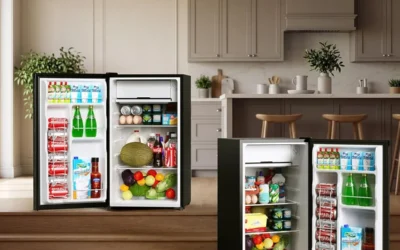
A true two door compact refrigerator, like the EUHOMY two door model, the Midea 3.1, the Frigidaire retro unit and the Frigidaire contemporary top freezer, gives the freezer its own insulated door and its own space. Opening the fridge to get a drink does not dump warm air into the frozen section, and the compartment can hold a temperature low enough to keep food frozen properly over weeks.
A single door model with an internal freezer box, which describes the Igloo, the single door EUHOMY and the smaller Upstreman unit, works differently. The freezer box sits inside the main cabinet, usually behind a plastic flap rather than a sealed door. Every time you open the fridge, that box is exposed to room temperature air. It will make ice cubes and it will keep ice cream firm for a while, and it is not where you should store meat you intend to eat next month.
Neither design is wrong. The internal box is fine for a drinks fridge in an office or a bedroom where the freezer is a convenience rather than a store. The moment you plan to freeze actual meals, the second door stops being a luxury and becomes the whole point of the purchase.
Cubic Feet and Why the Number Flatters

Capacity is quoted as total volume, which includes the freezer compartment, the door bins and the space taken by shelving. A 3.2 cubic foot fridge does not give you 3.2 cubic feet of usable fridge, and on a two door model a meaningful share of that figure sits behind the freezer door.
Shelf layout matters more than the headline number. Fixed shelves that cannot be moved or removed decide what you can store, and the most common complaint in this category is that a two litre bottle or a tall carton will not stand upright anywhere in the cabinet. Models with glass shelves, like the Igloo, are easier to clean than wire and often sit on adjustable supports, which is worth checking before you buy.
The 1.7 cubic foot units, such as the smaller Upstreman, are a genuinely different category rather than simply a smaller version. At that size the fridge holds drinks, lunch items and condiments, and the freezer section is small enough that ice trays are most of what fits. That is exactly right for a dorm room desk and wrong for anyone planning to cook.
Dorm Rules, Outlets, and Limits Nobody Reads
If this fridge is going into student accommodation, check the housing rules before you check the reviews. Many institutions cap the capacity of a permitted refrigerator, and the cap frequently lands somewhere around four cubic feet, which is exactly where the larger units in this class sit. A fridge that exceeds the limit can be refused at move in.
The second rule that catches people is the ban on extension leads and multi way adapters for appliances. Compressors draw a surge of current when they start, and that surge is why housing rules single them out. In practice this means the fridge has to reach a wall outlet on its own cord, which is a real constraint on where it can sit in a small room.
Energy certification is worth a look in the same breath. The Midea unit is Energy Star certified, which matters more than it sounds in a room where the electricity is included in a fixed housing fee and the fridge runs continuously for a whole academic year.
Noise, and What a Compressor Sounds Like at Night

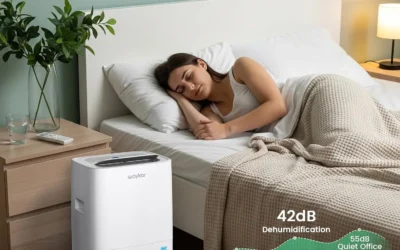
Compact refrigerators use a compressor that cycles on and off rather than running constantly. In a kitchen nobody notices. In a bedroom or a dorm room, the moment the compressor kicks in at two in the morning is the moment people start reading the noise specification they skipped.
Both Upstreman models make low noise operation an explicit feature, which is a reasonable thing to prioritise when the fridge is a few feet from a pillow. Beyond the specification, placement does much of the work. A fridge standing on a hard floor against a hollow wall transmits vibration into the room, while a small mat underneath and a few centimetres of clearance behind it cuts the resonance noticeably.
Also expect sounds that are not faults. Gurgling as refrigerant moves, occasional ticking from the thermostat and a click as the compressor stops are all normal. A rattle that appears after a few weeks is usually something touching the back panel rather than a failing machine.
Defrosting: Manual, and More Often Than You Think
Almost nothing in this size class is frost free. That is a running cost in time rather than money: ice builds up in the freezer section, gradually eats the usable space, and eventually has to be melted out. On single door models with an internal freezer box the build up is faster, because humid room air enters every time the door opens and condenses on the coldest surface it finds.
Plan on defrosting a few times a year, more if the fridge lives somewhere humid or gets opened constantly. The process is simple, switch it off, empty it, let the ice melt into a tray and towel, and it takes a few hours. Never chip ice off with a knife or a screwdriver: puncturing the evaporator ends the life of the appliance instantly and is not repairable at this price point.
An adjustable thermostat, which both Upstreman units and several others here provide, helps in a smaller way. Running the fridge colder than necessary accelerates frost build up as well as electricity use, and most compact fridges arrive set colder than they need to be.
Door Swing, Clearance, and Where It Will Actually Fit
A reversible door, offered on the Upstreman models among others, decides whether the fridge works in the corner you have available. In a narrow dorm room or a small office, a door that opens the wrong way means either standing in a doorway to reach the shelves or putting the fridge somewhere less convenient.
Clearance is the other half of the same question. Compact refrigerators shed heat through coils at the back and sides, and pushing one tight into an alcove or under a desk with no gap makes it work harder, run louder and last less long. Manufacturers usually specify a few centimetres on each side and more at the back. Measure the alcove including that clearance, not just the cabinet.
Finally, think about the top surface. In a small room it will become a shelf whatever the manual says, so a flat top with a lip is more useful than a curved one. The retro style Frigidaire adds a side mounted bottle opener, which is the kind of small touch that gets used daily in the room this fridge is designed for.
| Model | Capacity | Freezer type | Stands out for |
|---|---|---|---|
| EUHOMY 2 Door | 3.2 cu ft | Separate freezer door | True two door layout |
| Midea 3.1 | 3.1 cu ft | Separate freezer door | Energy Star certified |
| Upstreman BR321 | 3.2 cu ft | Freezer compartment | Low noise, reversible door |
| Upstreman FR17 | 1.7 cu ft | Freezer compartment | Smallest footprint here |
| Frigidaire EFR840 Retro | Compact 2 door | Separate freezer door | Retro styling, bottle opener |
| EUHOMY Single Door | 3.2 cu ft | Internal freezer box | Adjustable thermostat |
| Igloo 3.2 | 3.2 cu ft | Internal freezer box | Glass shelves |
| Frigidaire Contemporary | 3.2 cu ft | Top freezer, separate door | Two door in a colour finish |
Read the freezer type column first. It is the specification that determines whether this appliance can do the job you are buying it for. More comparisons are in our article archive.
Why You Should Trust Us
We build these lists from manufacturer specifications and verified buyer reports, and we pay attention to the differences that listings blur. In this category the blurred difference is the freezer itself, since a sealed second door and an internal ice box are described with the same words and sold at overlapping prices.
We also filtered for category accuracy. Searches for compact fridges with freezers return beverage coolers with glass doors that have no freezer at all, and those are excluded here regardless of how well they are rated, because a fridge without a freezer cannot answer the question this page is about. Where a model uses an internal box rather than a second door, we say so in the table rather than letting the marketing phrase stand.
Final Thoughts
The EUHOMY Mini Fridge with Freezer in the 3.2 cubic foot two door layout is our best overall. The separate freezer door is what makes frozen storage reliable rather than approximate, and at this capacity there is still enough fridge space left for a week of food for one person.
The Midea 3.1 Cu.ft Mini Fridge with Freezer is the best value pick. It is Energy Star certified, which matters in a room where it will run without interruption for months, and it has the broadest track record of any unit here.
Choose by room after that. A fridge sitting next to a bed should be one of the low noise Upstreman units, and the 1.7 cubic foot version is the one that fits under a desk. If the room is shared and the fridge will be seen, the retro Frigidaire and the contemporary coloured model are the two designed to be looked at. If you mainly want cold drinks and lunch storage with occasional ice, the single door Igloo and EUHOMY units do that job for less space. Check your housing capacity limit before ordering any of them. Our appliances section covers larger options.
Frequently Asked Questions
Can a mini fridge with freezer for dorm actually keep food frozen?
A two door model with a sealed freezer compartment can, because the freezer keeps its own temperature and is not exposed every time you open the fridge. A single door model with an internal freezer box is better thought of as an ice maker and short term store. It will keep ice cubes and firm up ice cream, but it is not the place for food you plan to keep for weeks.
What size mini fridge is allowed in a dorm in 2026?
It varies by institution and is often capped somewhere near four cubic feet, which is close to the top of this class. Check your housing agreement before ordering, and check the rule on extension leads at the same time, since many places require appliances to be plugged directly into a wall outlet.
Do these need defrosting?
Almost all of them, yes. Frost free technology is rare at this size, so expect to defrost a few times a year, more often on single door models where humid air reaches the freezer box constantly. Switch it off and let the ice melt rather than chipping at it, because puncturing the cooling surface ends the appliance.
How loud is a compact fridge in a bedroom?
Loud enough to notice when the compressor cycles on at night, which is why several models here advertise low noise operation. Placement helps as much as the specification: leave clearance behind the unit, avoid standing it against a hollow partition wall, and put something under it to stop vibration transferring into a hard floor.
Can I put a mini fridge under a desk or in a cupboard?
Only with the clearance the manufacturer specifies. These fridges shed heat from the back and sides, so an enclosed space makes the compressor run longer, louder and hotter, which shortens its life. Measure the gap you need as well as the cabinet itself. More appliance guides are in our article archive.

Write Your Review
No reviews yet. Be the first to share your experience!