

A spotting scope sits between binoculars and a telescope, and it exists for two jobs: reading bullet holes at 200 yards without walking down range, and identifying a bird across a marsh that binoculars can only turn into a smudge. Our shortlist covers 7 models from Celestron, Vortex, Bushnell and more, sorted by the specifications that decide how much of the advertised magnification you will actually be able to use.
Our top pick is the Gosky Flagship DiamondEdge 20-60×80 for pairing a large 80 mm objective with waterproof sealing, which is the combination that keeps a scope usable in early morning light and bad weather. One point before you read on: if you arrived here searching for a specific premium brand, the section on marketplace availability below explains why the results you saw were mostly monoculars. This list is current for October 2026.

Pros
- 80 mm objective gathers light well at dawn and dusk
- Waterproof body resists internal fogging
- 20-60x range covers birding and target work
- Largest rating history among these scopes
Cons
- Top of the zoom range is limited by heat shimmer, not the optics
- Bundled tripod is the weak point of the package
The DiamondEdge earns the top spot on a combination rather than on any single number. An 80 mm objective is the size at which a scope stays genuinely usable in the first and last hour of daylight, which is when wildlife moves and when range lighting is at its worst.
Waterproof sealing is the other half of it. Internal fogging is the failure that ends a scope's useful life, because condensation behind the lenses cannot be wiped away, and it happens when a cold instrument meets humid air rather than in dramatic weather. A sealed body removes that risk from ordinary use.
The 20-60x zoom is honest for what it is. Expect to spend most of your time between 20x and 40x, because heat shimmer rising off ground or a warm barrel magnifies at the same rate as the target. That is physics rather than a criticism of this scope, and it applies equally to instruments costing ten times as much.
Bottom line: the most complete package here, and the scope we would hand to someone buying their first serious optic.
- Magnification: 20-60x
- Objective: 80 mm
- Eyepiece: angled
- Weather sealing: waterproof
- Tripod: included
- Intended use: bird watching, target shooting
Birders and range shooters who want one scope that works in poor light and survives damp mornings.
Less suited to anyone who needs an ultra-compact instrument to carry on foot all day.
Use the lens caps between sessions and clean the objective with a blower before any cloth touches it, since grit dragged across coatings is what causes permanent damage.
Let the scope acclimatise to outside temperature before use in cold weather to reduce surface condensation.

Pros
- Angled eyepiece at an entry price
- Tripod included in the box
- Fully multi-coated optics at this price
- Foldable eyecup suits glasses wearers
Cons
- 70 mm objective is dim at the top of the zoom
- Bundled tripod struggles in wind
The SV28 is the scope to buy when you are not yet sure how much you will use one. It gives you the two things that matter most for comfort, an angled eyepiece and a tripod, at a price that makes the decision easy.
Be realistic about the zoom. A 70 mm objective at 75x produces an exit pupil under 1 mm, which is dim and intolerant of any head movement, so the practical top of the range is well below the printed figure. At 25x to 40x, where you will actually work, the image is perfectly serviceable.
The bundled tripod is adequate on a bench in still air and unhappy in wind. Treat it as a starting point rather than a permanent solution, and put the first upgrade budget into legs rather than into glass.
Bottom line: the sensible entry point, chosen on price and on the angled eyepiece rather than on the headline magnification.
- Model: SV28
- Magnification: 25-75x
- Objective: 70 mm
- Field of view: 64 ft at 25x, 43 ft at 75x, per 1000 yards
- Weight: 910 g
- Optics: FMC fully multi-coated
- Eyecup: foldable, for use with or without glasses
- Eyepiece: angled
- Tripod: included
Choose this as a first scope or as a second one for a truck or a range bag. Upgrade the tripod before the optics.
If you expect to observe mostly at dawn and dusk, an 80 mm objective will serve you better.
Keep the eyepiece capped when not in use; the small rear lens collects dust faster than the objective and is harder to clean safely.
Do not overtighten the tripod mount thread, which is the most commonly stripped part on budget scopes.

Pros
- 80 mm objective for low light work
- Angled eyepiece suits long viewing sessions
- Optics manufacturer with deep telescope heritage
- Long-running design with a settled reputation
Cons
- Tripod is not stated as included
- Design is older than most rivals here
Celestron came to spotting scopes from telescopes, and the Ultima shows it. This is a long-running design rather than a recent arrival, which in optics is usually a point in favour: a scope that has stayed in the catalogue for years has survived the scrutiny of people who look through glass for a living.
The specification is the classic wildlife combination. An 80 mm objective delivers a 4 mm exit pupil at 20x, bright enough for comfortable extended viewing, and the angled eyepiece keeps your neck out of trouble when you are watching a nest or a distant ridge for an hour.
Note that a tripod is not listed as included, so budget for one. Given the Ultima's weight and the magnification on offer, a light travel tripod will not be enough; this scope wants proper legs.
Bottom line: the heritage pick, best for patient wildlife observation rather than for quick target checks.
- Magnification: 20-60x
- Objective: 80 mm
- Eyepiece: angled
- Tripod: not stated in listing
- Intended use: wildlife and nature viewing
Birders and nature watchers who stay in one place for long periods and already own or intend to buy a solid tripod.
Less suited to buyers who want everything in one box.
Support the scope by the tube rather than the eyepiece when mounting, since eyepiece housings are not designed to carry the instrument's weight.
Store with caps fitted in a dry place rather than a cold garage, where repeated temperature swings encourage condensation.

Pros
- Nitrogen purged, waterproof, fogproof and shockproof
- Highest rating average among these scopes
- 80 mm objective for low light performance
- Twist-up eyecup and extendable sunshade included
Cons
- Silver coated K9 prism rather than a BAK4 design
- Modest rating volume compared with the leaders
Athlon is a sport optics specialist rather than a general outdoor brand, and the Talos is its accessible spotting scope. It carries the highest rating average of any scope on this list, which given the demanding audience for target optics is worth noting even though the number of ratings is modest.
The sealing specification is the strongest here. The body is nitrogen purged and rated waterproof, fogproof and shockproof, which addresses the failure that actually ends a scope's life: condensation forming behind lenses where no cloth can reach. Athlon backs that with a rotating tripod ring, a twist-up eyecup for glasses wearers and an extendable sunshade to keep flare off the objective.
One honest note on the glass. Athlon specifies a silver coated K9 prism rather than the BAK4 design enthusiasts usually look for, alongside fully multi-coated lenses. Silver coating raises reflectivity and the lenses are properly coated, so this is a considered engineering choice rather than a corner cut, but it is a difference worth knowing before you compare specification sheets.
Bottom line: the best-sealed scope here, and the enthusiast pick on ratings and weatherproofing.
- Series: Talos
- Magnification: 20-60x
- Objective: 80 mm
- Eyepiece: angled, twist-up eyecup
- Prism: silver coated K9
- Lenses: fully multi-coated
- Sealing: nitrogen purged, waterproof, fogproof, shockproof
- Extras: rotating ring, extendable sunshade, tabletop tripod and case
Range work and load development, where you are checking groups repeatedly and want consistent glass at moderate magnification.
Also capable for hunting, provided you pair it with a tripod that suits the terrain.
Keep the objective capped between strings at a range; unburnt powder residue in the air settles on coatings and is abrasive when wiped.
Clean with a blower and a proper lens cloth, never a shirt.

Pros
- 85 mm objective, the largest here
- Full size tripod included rather than a tabletop model
- 20-60x range suits birding and target work
- Complete package out of the box
Cons
- Larger objective means more weight to carry
- Newer listing with less accumulated feedback
The Falcon is the light gathering champion of this group. At 85 mm its objective is 5 mm wider than the common 80 mm standard, which sounds marginal and is not: light gathering scales with area, so that step is worth roughly a tenth more light reaching your eye at any given magnification.
More significant for most buyers is what comes in the box. A full size tripod rather than a tabletop one means the package is genuinely usable from the moment it arrives, which is rarer than it should be in this price bracket where bundled legs are usually an afterthought.
The cost is bulk. An 85 mm scope plus a full size tripod is a two-hand carry and not something you will hike far with. If your observation happens from a car, a hide, or a fixed position, that hardly matters.
Bottom line: the complete-package pick, and the one to choose when light gathering matters more than portability.
- Series: Falcon
- Magnification: 20-60x
- Objective: 85 mm
- Tripod: full size, included
- Intended use: birding and general observation
Buyers who observe from a fixed position and want everything needed in one purchase.
Not the choice for anyone carrying their optics any distance on foot.
Carry the scope and tripod separately rather than as one assembled unit; the mount thread takes the strain badly when the whole thing swings from a shoulder.
Keep caps on in transit, as an exposed 85 mm objective is a large target for knocks.

Pros
- Long-established outdoor optics brand
- Solid rating average
- Trophy line has a settled reputation among hunters
- Simple proposition
Cons
- Listing publishes almost no specification
- Cannot compare objective or magnification from the listing alone
Bushnell has been making outdoor optics for a very long time, and the Trophy line is a familiar name to hunters. That heritage is the honest case for this scope, because the listing itself gives very little else to work with.
Neither magnification range nor objective diameter appears in the listing text, which makes direct comparison with the rest of this list impossible. For a category where those two numbers determine nearly everything about how an instrument performs, that is a real gap rather than a quibble.
The rating average is solid, which suggests buyers are content with what arrived. If you value a familiar name with accessible service and warranty support over a detailed specification sheet, this is a reasonable choice; if you want to calculate exit pupil before buying, look at the Gosky or Celestron instead.
Bottom line: a brand-led pick, and one where you should confirm the exact model specification with the seller before ordering.
- Series: Trophy Xtreme
- Type: spotting scope
- Magnification: not stated in listing
- Objective: not stated in listing
- Tripod: not stated in listing
Ask the seller for the exact magnification and objective before ordering, since the Trophy Xtreme name covers more than one configuration.
Choose a fully specified rival if you want to compare optical performance on paper.
Standard optics care applies: blower first, lens cloth second, caps on in storage.
Register the product if the manufacturer offers a warranty scheme, since brand support is the main reason to buy here.

Pros
- MRAD ranging reticle allows distance estimation
- Pocket sized with a utility clip
- Adjustable eyecup suits glasses wearers
- Excellent rating average
Cons
- It is a monocular, not a spotting scope
- 8x is far below spotting scope magnification
This entry needs its label read first: the Solo R/T is a monocular, not a spotting scope. It is on this list because searches for this brand's spotting scopes overwhelmingly return its monoculars and mounts instead, and pretending otherwise would leave readers wondering what happened to the results they saw.
Judged as what it is, it is very good. The R/T designation refers to a ranging and tactical reticle marked in milliradians, which lets you estimate distance to an object of known size instead of guessing. That is a genuine field capability at a fraction of the cost of a laser rangefinder.
At 8x36 it occupies the same optical territory as one half of a pair of binoculars, so it will not read bullet holes at 200 yards or resolve a distant warbler. What it will do is live in a jacket pocket permanently, which is a different and often more useful kind of value.
Bottom line: an excellent pocket monocular and a poor substitute for a spotting scope, listed here honestly as both.
- Type: monocular
- Magnification: 8x
- Objective: 36 mm
- Reticle: MRAD based ranging reticle
- Features: utility clip, adjustable eyecup, multi-coated lenses
To range with the reticle, you need the target's approximate height. Divide that height in metres by the number of milliradians it spans, then multiply by 1000 to get distance in metres.
Brace against a post or your own shoulder when ranging; small hand movements translate directly into reticle error.
Hikers, hunters, and shooters who want an always-present optic with a ranging capability in a pocket.
Not a substitute for a spotting scope if your goal is reading targets or identifying distant birds.
How to Choose a Spotting Scope
Spotting scopes are sold on magnification, and magnification is the least useful number on the box. What determines whether you can read a target or identify a bird is how much light reaches your eye, how well the glass controls colour, and whether the air between you and the subject is steady enough to support the zoom you paid for.
The Magnification You Can Actually Use
Almost every scope here tops out at 60x or 75x, and on most days you will never get there. The limiting factor is the atmosphere. Heat rising off ground, tarmac, or a rifle barrel creates shimmer that magnifies along with the image, so at 60x on a warm afternoon a target can boil into an unreadable ripple while at 30x it stays sharp. Shooters call it mirage and birders call it heat haze; it is the same problem.
Treat the top of the zoom range as a reserve for cold, still mornings and expect to work between 20x and 40x for most of the day. This is also why a scope with excellent glass at 30x beats a scope with mediocre glass at 60x, no matter what the two boxes claim.
Objective Diameter and Exit Pupil
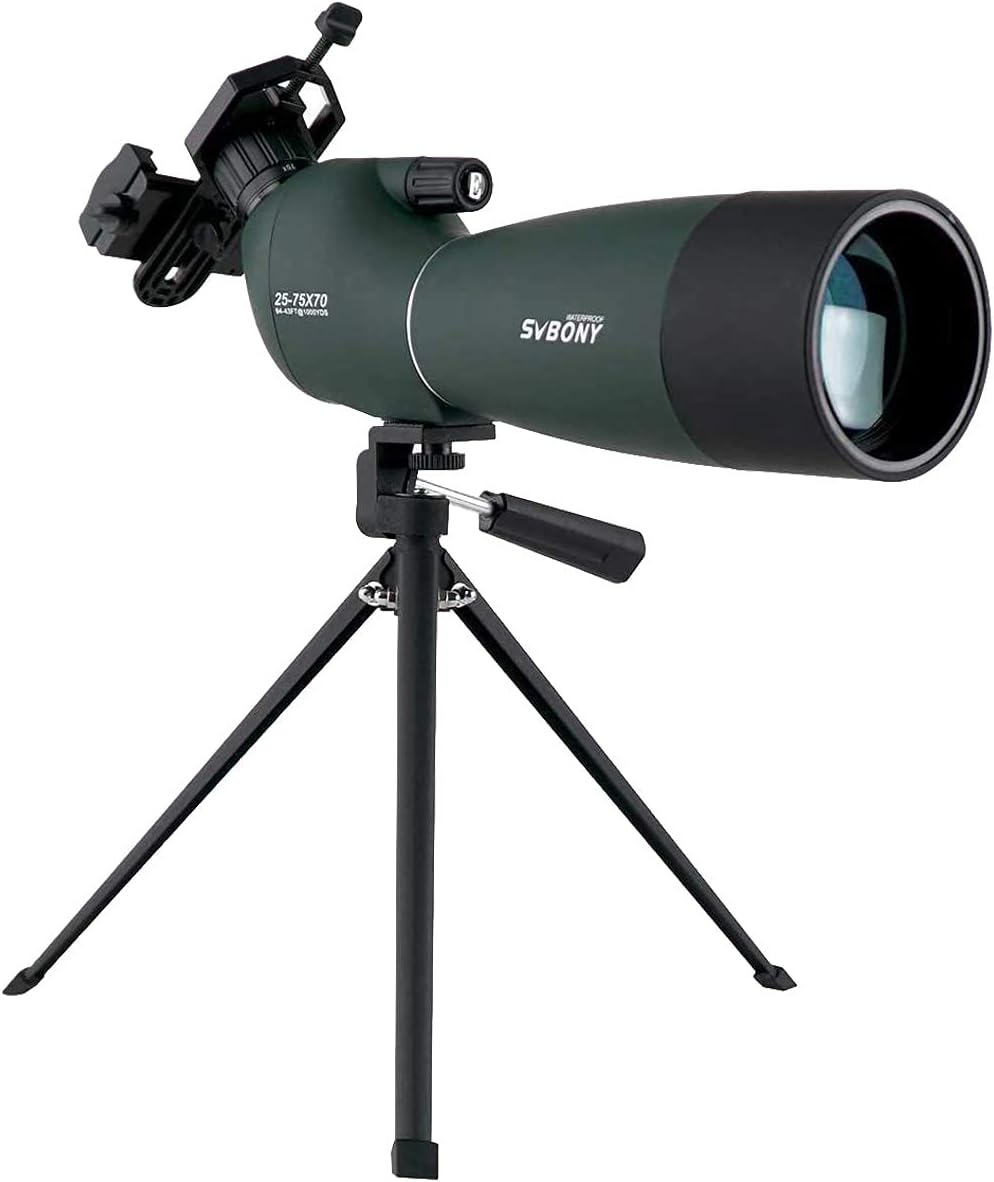
The objective is the front lens, and its diameter in millimetres is the second number in a designation such as 20-60×80. Bigger gathers more light, which matters at dawn and dusk when wildlife moves and when range lighting is poor. The list here runs from 70 mm on the SVBONY SV28 to 85 mm on the Gosky Falcon.
Exit pupil is the calculation nobody does and everybody should. Divide the objective diameter by the magnification and you get the width of the light beam leaving the eyepiece in millimetres. An 80 mm scope at 20x gives a 4 mm exit pupil, comfortably bright and easy to hold your eye behind. The same scope at 60x gives 1.33 mm, which is dim and unforgiving of any head movement. That single sum explains why high magnification feels harder to use, not just shakier.
Angled Versus Straight Eyepieces
An angled eyepiece, used on the SVBONY SV28 and the Celestron Ultima, puts the eyepiece at roughly 45 degrees to the tube. It is more comfortable for extended sessions because you look down into it rather than craning behind it, it lets a group of different heights share one scope without resetting the tripod, and it is much easier to use on birds high in a tree.
Straight eyepieces win when you need to find the target fast, because where the tube points is where you look. Shooters watching a specific bench and hunters glassing a hillside from a truck window usually prefer straight. Neither is better in general; pick the one that matches how you sit.
Glass, Coatings, and Weather Sealing

Two terms are worth knowing. Prism glass type affects how evenly light reaches the edge of the field, and fully multi-coated optics carry anti-reflective coatings on every air-to-glass surface rather than only the outer ones. Worth noting that manufacturers in this bracket use several prism types: the Athlon Talos specifies a silver coated K9 prism, while the SVBONY advertises FMC multi-coating. Fully multi-coated is the term to insist on, because single-layer coating visibly reduces contrast.
Weather sealing is the specification that decides how long the scope lasts. A waterproof, nitrogen or argon purged body will not fog internally when you carry it from a cold truck into humid air, and internal fogging is not something you can wipe away. The Gosky Flagship DiamondEdge is explicitly waterproof, which is a large part of why it leads this list, and the Athlon Talos goes further with a nitrogen purged body rated waterproof, fogproof and shockproof.
Eye Relief, Field of View, and Finding Things
Eye relief is the distance you can hold your eye behind the eyepiece and still see the whole image. If you wear glasses, this is the specification that decides whether the scope is comfortable or infuriating, because spectacle lenses push your eye further back. Look for adjustable or twist-down eyecups, which let glasses wearers get close enough without pressing lenses against the rubber. The Vortex monocular on this list has an adjustable eyecup for exactly this reason, and most full size scopes offer the same.
Field of view shrinks as magnification rises. The SVBONY SV28 publishes the numbers: 64 feet at 1000 yards at 25x, narrowing to 43 feet at 75x. That is a third of the width gone for tripling the magnification, and it is why finding your subject at the top of the zoom is so frustrating and why experienced users do it in two steps.
The technique is simple and worth adopting from day one. Zoom out to the widest setting, locate the subject in the large field of view, centre it carefully, and only then zoom in. Trying to find a bird or a target at 60x is like searching a room through a drinking straw, and it is the single most common reason people conclude a scope is faulty when it is working perfectly.
Why Searching for a Premium Brand Here Returns Monoculars

This is worth explaining because it surprises a lot of people. Search Amazon for a well-known American optics brand and a spotting scope, and what comes back is mostly that brand’s compact monoculars, tripod adapters, and window mounts rather than its actual spotting scopes. The Vortex Solo 8×36 on this list is a good example: an excellent little monocular with a ranging reticle, and not a spotting scope at all.
The reason is distribution. Several premium optics manufacturers sell their scope lines primarily through authorised dealers and specialist retailers rather than through general online marketplaces, and their accessories circulate far more widely than the scopes themselves. If your heart is set on a particular premium line, a specialist optics dealer is the place to look. If you want a working scope today, the models on this list are what the marketplace actually stocks, and at these magnifications they will do the job.
Tripods, Mounts, and Digiscoping
A spotting scope without a solid tripod is a paperweight. At 40x, a heartbeat is visible in the image, so handheld use is not merely inconvenient, it is impossible. Several scopes here ship with a tripod, and honesty requires noting that bundled tripods are usually the weakest part of the package. The SVBONY SV28 and both Gosky models include one, which is fine for a bench rest at a range and marginal in wind.
Digiscoping, holding a phone camera to the eyepiece, works better than it has any right to and is the cheapest way to record what you saw. A dedicated phone adapter costs little and removes the awkward one-handed balancing act. If you would rather use a proper camera, our guide to travel tripods for mirrorless cameras covers supports that suit both jobs.
| Pick | Magnification | Objective | Eyepiece | Tripod included |
|---|---|---|---|---|
| Gosky Flagship DiamondEdge | 20-60x | 80 mm | Angled | Yes |
| SVBONY SV28 | 25-75x | 70 mm | Angled | Yes |
| Celestron Ultima | 20-60x | 80 mm | Angled | Not stated |
| Athlon Optics Talos | 20-60x | 80 mm | Angled | Yes, tabletop |
| Gosky Falcon | 20-60x | 85 mm | Not stated | Yes, full size |
| Bushnell Trophy Xtreme | Not stated | Not stated | Not stated | Not stated |
| Vortex Solo R/T | 8x | 36 mm | Monocular | No |
For the rest of the field kit that tends to travel with a scope, our sports and outdoors section covers stands, tents, and packs.
Why You Should Trust Us
Every model here was checked against its live listing for magnification range, objective diameter, eyepiece angle, weather sealing, and whether a tripod is included. Where a manufacturer does not publish a figure, the table above says so instead of guessing, and one product on this list is included precisely because it is not what its search term implies, which we have labelled rather than quietly dropped.
We have not set these scopes up on a range with a resolution chart, and we make no claim to have done so. What we can do is explain which published numbers predict real performance, which ones are limited by physics and weather rather than by build quality, and where the marketplace itself distorts what buyers find. More of our outdoor buying guides are in the articles section.
Final Thoughts
The Gosky Flagship DiamondEdge 20-60×80 is our best overall pick. An 80 mm objective gathers enough light to stay useful at dawn and dusk, the 20-60x range covers both target work and birding, and the waterproof body means a damp morning will not put condensation somewhere you cannot reach. It also carries the largest body of customer feedback here by a wide margin.
For best value, the SVBONY SV28 25-75×70 is the obvious choice. The 70 mm objective is smaller, so the top of that 75x range is dim in anything but bright light, but as a first scope with an angled eyepiece and a bundled tripod it is difficult to beat on price.
Beyond those, pick by use. The Celestron Ultima for a well-established angled 80 mm design, the Athlon Talos for buyers who want a specialist optics brand at a moderate price, the Gosky Falcon when you want the largest objective on this list and a full size tripod in the box, and the Bushnell Trophy Xtreme if brand familiarity matters more than a detailed specification sheet. The Vortex Solo R/T is here as the compact you can pocket, with a ranging reticle, and it is a monocular rather than a spotting scope. If you are setting up to watch from a fixed position, our guide to deer stands covers the other half of that setup.
Frequently Asked Questions
What magnification do I need to see bullet holes at 100 yards?
For .22 calibre holes in paper at 100 yards, most shooters find they need somewhere between 20x and 40x with decent glass, and larger calibres are easier. Pushing to 60x usually makes things worse rather than better, because heat shimmer off the ground magnifies at the same rate as the target.
Is an angled or straight spotting scope better?
Angled is more comfortable for long sessions, easier to share between people of different heights, and far better for anything above the horizon. Straight is faster to aim, because the scope points where you look, which suits shooters watching one fixed spot and anyone glassing from a vehicle window.
Do I need to buy a separate tripod?
Usually yes, eventually. Bundled tripods are adequate on a bench in still conditions and struggle in wind, which is exactly when you want stability. Budget for a separate tripod as the first upgrade rather than the last, since no amount of glass quality survives a shaking image.
Why can I not find certain premium brands of spotting scope online in 2026?
Several premium optics manufacturers distribute their scope lines mainly through authorised dealers and specialist retailers rather than general marketplaces, while their accessories and smaller monoculars circulate everywhere. That is why a search for a big-name spotting scope often returns that brand’s monoculars and mounts instead. Specialist optics dealers are the place to look for those specific lines.
Can I take photos through a spotting scope?
Yes, and the technique is called digiscoping. Holding a phone camera to the eyepiece works surprisingly well, and an inexpensive phone adapter holds the alignment steady so you are not balancing two objects at once. Expect soft edges and vignetting at high magnification, which is normal rather than a fault. More gear guides are collected in our category index.

Write Your Review
No reviews yet. Be the first to share your experience!