

Sport-specific eyewear is one of the few upgrades that pays off the first time you use it. A pair of ordinary fashion frames slides down your nose on the second mile, fogs at every stoplight, and leaves you squinting into water glare. That is the gap performance sunglasses are built to close. Our shortlist covers 9 pairs from DUCO, RIVBOS, ATTCL and more, all of them polarized, all of them chosen because real buyers keep coming back with high ratings after months of running, riding, casting, and driving.
Our top pick is the goodr OG Polarized for its grip coating that keeps the frame locked in place through sweat and hard efforts, which is the single failure point that ruins most cheap sport shades. Below that we have picked pairs by discipline rather than by price alone, because the right lens for open water is not the right lens for a shaded bike path. If you want more gear for the same activities, our sports and outdoors coverage runs through the rest of the kit. Prices and availability shift constantly, so this list is refreshed for September 2026.

Pros
- Grip coating holds through heavy sweat
- Medium fit suits a wide range of face sizes
- Non-reflective lens option hides fingerprints
- Restrained styling works off the trail
Cons
- Single frame size only, no wide or narrow option
- Coating can pick up lint from a pocket
The goodr OG is the pair most people in this category should start with, because it targets the one failure that makes buyers give up on sport eyewear entirely. Instead of gluing rubber pads to the nose bridge and temple tips, goodr applies a grip coating to the whole frame. There is no separate pad to peel loose, and the hold improves rather than degrades as sweat builds up.
Optically it is a straightforward polarized lens with UV400 protection. The OG is offered in a non-reflective finish, which is a deliberate choice rather than a cost saving: a mirror coating shows every fingerprint and every dried salt spot, and on a pair you wear daily that becomes tiresome. Colours stay natural through the tint, so it works for road running, gym sessions, and driving without feeling like specialist equipment.
The medium fit designation is worth reading literally. goodr sizes this frame for the middle of the range rather than trying to cover everyone, so buyers with unusually narrow or wide faces should check the lens width before ordering. Within that range the frame sits close enough to the cheekbones to block light from underneath without pressing.
Bottom line: if you want one pair that stays put during hard effort and does not look like race gear at the coffee shop afterwards, this is the pick, and the rating volume behind it reflects that.
- Lens: polarized, UV400
- Finish: non-reflective or mirrored, depending on colourway
- Fit: medium
- Frame: polycarbonate with grip coating
- Intended use: running, gym, everyday wear
Runners, gym users, and anyone who has previously abandoned a pair of sport shades because they slid down the nose. Also a sound choice for a first pair, since the styling does not commit you to one sport.
Less suited to buyers at the extremes of face width, and to cyclists who want the maximum wrap coverage a shield frame provides.
Rinse with fresh water before wiping, then dry with the supplied pouch. The grip coating attracts lint, so store the glasses in a case rather than loose in a jacket pocket.
Do not leave them on a car dashboard. Sustained heat can distort any polycarbonate frame, and the coating is no exception.

Pros
- Metal alloy frame at a low price point
- Anti-slip nose and temple pads
- Wrap shape blocks peripheral glare
- Enormous rating history to draw on
Cons
- Alloy bends permanently rather than flexing back
- Wrap fit can sit wide on narrow faces
The 8177 is the pair that built DUCO's reputation, and its appeal is easy to explain: an aluminum-magnesium alloy frame at a price where nearly everything else is bare injection-moulded plastic. Alloy resists corrosion better than plain metal, holds its shape through years of being tossed into a centre console, and gives the glasses a density in the hand that plastic frames never have.
The lens is polarized and wrapped, which is the combination that matters for driving into low sun and for fishing off a bank. Anti-slip material at the nose bridge and behind the ears handles the grip problem in the conventional way. It works, though the pads are a wear item in a way that an all-frame coating is not.
The trade-off with alloy is that it does not spring back. A TR90 frame can be folded almost flat and recover; sit on the 8177 and it stays bent until you take it to an optician to be tweaked. Treat that as the price of the rigidity rather than a defect.
Bottom line: the value pick of this list by a wide margin, and the pair to buy in pairs so there is always one in the car.
- Model: 8177
- Frame: aluminum-magnesium alloy
- Lens: polarized with UV protection
- Shape: wrap-around
- Grip: anti-slip nose and temple pads
- Intended use: driving, fishing, hiking
Choose the 8177 if you want metal-frame feel without a designer price, and if your activities are steady rather than high impact. Driving, hiking, and bank fishing all suit it.
Choose a thermoplastic frame instead if the glasses will live in a jersey pocket or a gym bag where they will be crushed.
Alloy tolerates salt spray better than steel but still benefits from a freshwater rinse. Check the hinge screws twice a season and tighten them; metal frames loosen at the hinge long before anything else fails.
Store in a hard case. The frame will not scratch easily but the lens will.

Pros
- Published 0.9 oz weight is genuinely light for metal
- Al-Mg alloy resists corrosion
- Slim temples reduce pressure over long rounds
- Anti-slip frame design
Cons
- Slim alloy temples are easy to bend
- Narrow arms offer less side coverage than a shield
Weight is the whole argument for the ATTCL. At a published 0.9 ounces it undercuts most plastic sport frames while still using aluminum-magnesium alloy, achieved by keeping the temple arms very slim rather than by thinning the lens.
That matters more than it sounds. Over a four-hour round of golf or a full day on the water, the thing you notice about eyewear is not optics but pressure: the weight bearing on the bridge of the nose and the clamping force behind the ears. A frame this light largely removes that from the equation.
The lenses are polarized with UV400 coverage, which is what you want for reading a green or spotting fish. The compromise sits in those same slim temples. They bend more easily than a thicker alloy arm, and they cover less at the sides than a wrap shield, so windblown grit has an easier path in.
Bottom line: the pick for long, low-intensity days outdoors where comfort compounds hour by hour.
- Published weight: 0.9 oz
- Frame: aluminum-magnesium metal
- Lens: polarized, UV400
- Design: lightweight wrap with anti-slip frame
- Intended use: golf, fishing, driving, running
Best suited to endurance-length, low-contact activity: a full round of golf, a day of casting, a long drive. Weight advantages show up over hours, not minutes.
For contact sports or mountain biking, a flexible thermoplastic frame is the safer choice.
Handle the temples with two hands when putting the glasses on and taking them off; one-handed removal is what bends slim metal arms over time.
Rinse after saltwater exposure and dry with a microfibre cloth rather than clothing.
Pros
- TR90 flexes hard and returns to shape
- Light enough to forget during effort
- Polarized UV400 lens
- Survives being crushed in a bag
Cons
- Plastic frame feels less premium than alloy
- Fit is tuned for sport rather than everyday wear
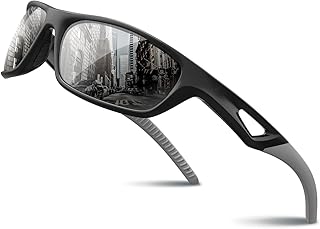
TR90 is the material that dominates serious cycling and running eyewear, and the RB831 is a clean example of why. You can flex the frame far past the point where watching it becomes uncomfortable and it returns to shape. For anyone who stuffs glasses into a jersey pocket or the bottom of a gym bag, that property is worth more than any optical claim.
The lens is polarized with UV400 protection, and the frame carries enough wrap to keep wind and road grit out of the corners of your eyes at speed. Weight is low enough that the glasses disappear during effort, which is the real test.
What you give up is the feel of metal. Next to the DUCO or ATTCL the RB831 reads as sport equipment rather than eyewear, and it looks like it off the bike. That is a fair trade for a frame that will outlive several alloy pairs in the same conditions.
Bottom line: the durability pick, and the one to choose if your glasses lead a rough life.
- Model: RB831
- Frame: TR90 thermoplastic
- Lens: polarized, UV400
- Coverage: sport wrap
- Intended use: cycling, baseball, running, driving
Cycling and baseball are the natural fits, where a ball or a fall can put load on the frame and flex recovery matters. Running works equally well.
Less appropriate as a dress pair, since the shape is unmistakably athletic.
Set the frame high on the bridge so the top rim sits just under your helmet line; a low-sitting frame puts the rim straight through your sightline when you are down on the drops.
Rinse road salt and grit off before wiping to avoid scratching the lens.

Pros
- Wrap curvature blocks peripheral glare
- Polarized UV400 lens
- Covers several sports without specialising
- Strong rating volume for the price
Cons
- Grip depends on fit rather than pads
- Aggressive shape does not suit every face
The BEACOOL sits in the busiest part of this market: a polarized wrap sold for multiple sports at once. What separates it from the noise is the shape. The curvature is pronounced enough that the lens follows the line of the cheekbone, which blocks the low-angle light that flat-fronted frames let in underneath.
Grip comes from that same curvature rather than from rubber inserts, which is a design choice with two sides. Nothing peels off over time, but the hold depends entirely on the frame matching your face. Buyers whose temples are narrower than the frame assumes will find it moves.
Lens performance is conventional and competent: polarized, UV400, tuned to cut glare rather than to lift contrast dramatically. For a general-purpose second pair kept in a bag, that is the correct choice.
Bottom line: a solid multi-sport wrap, best bought when you already know that wrap shapes fit your face.
- Lens: polarized, UV400
- Shape: sport wrap
- Fit: unisex
- Intended use: running, baseball, golf, cycling, fishing, driving
Buyers who move between sports and want one pair that is adequate at all of them rather than excellent at one.
Not the right pick if wrap frames have historically sat off your cheekbones, since there is no pad system to compensate.
Clean with the supplied pouch after rinsing. Wrap lenses collect more dust along the lower edge than flat lenses, so check that edge before wiping.
Keep them out of a hot car; heat is the main enemy of any moulded sport frame.

Pros
- Light on the face for long wear
- Polarized with UV protection
- Shape works off the course as well as on
- Very large base of customer ratings
Cons
- Less wrap coverage than a dedicated cycling shield
- No specialised grip system
KALIYADI has taken the opposite approach to the shield-shaped pairs on this list. The frame is lighter and flatter, closer to a lifestyle silhouette, and the result is a pair you can wear into a restaurant after a round of golf without looking like you forgot to change.
That decision has optical consequences worth knowing. Flatter fronts distort less at the edges of your vision, which some buyers prefer, but they also let more low-angle light in from the sides. On open water at the end of the day you will notice the difference against a full wrap.
The lens itself is polarized with UV protection, which handles the glare that matters most for driving and fishing. Weight is low enough that the frame is comfortable across hours.
Bottom line: the crossover pick, for buyers who want polarized performance without committing to a sport look.
- Lens: polarized with UV protection
- Frame: lightweight, moderate wrap
- Fit: unisex
- Intended use: driving, fishing, golf, everyday wear
Golfers, drivers, and anglers who want one pair that crosses over into ordinary use. Also a good pick for buyers who dislike the distortion of high-wrap lenses.
Runners and cyclists are better served by the grip-focused or shield-shaped options here.
Decide first whether you want sport coverage or crossover styling. This pair is firmly in the second camp and should be judged on that basis.
If you need one pair for both, accept slightly less side coverage in exchange for wearability.

Pros
- PuriVex treatment sheds water and salt
- Wrap design blocks glare off the water
- Case and pouch included
- Built by a fishing-focused brand
Cons
- Styling is clearly angling-oriented
- Coating still needs a freshwater rinse to stay effective
Saltwater destroys eyewear faster than any other environment. Spray dries into a hard film, and the moment someone wipes that film with a shirt hem it becomes an abrasive that puts permanent haze across the lens. The Skidaway is the one pair here that addresses the problem at the lens rather than in the instruction leaflet.
KastKing calls the treatment PuriVex, and its job is to make droplets bead and roll off instead of drying flat. It does not make the glasses maintenance free, but it buys you the time to reach fresh water before salt sets.
Everything else is what you would expect from a brand that sells mostly to anglers: a wrap design that blocks glare bouncing off the surface, polarized lenses that let you see through it rather than around it, and a case plus pouch in the box rather than as an upsell.
Bottom line: the specialist pick for saltwater, and still a competent all-rounder on land.
- Model: Skidaway
- Lens treatment: PuriVex water and salt repellent
- Lens: polarized with UV protection
- Design: wrap
- Included: case and pouch
- Intended use: fishing, driving, cycling, running
Rinse with fresh water at the end of every saltwater session, before the spray dries. The repellent treatment slows salt down, it does not remove the need for a rinse.
Dry with the supplied pouch. Never wipe a salted lens dry with clothing.
Anglers, especially anyone fishing salt from a boat or a jetty, and boaters generally.
Buyers who want a discreet pair for town will find the styling too committed to the water.

Pros
- Inner clip frame accepts prescription lenses
- Unobstructed shield view for riding
- Polarized UV400 lens
- Far cheaper than dedicated prescription sport eyewear
Cons
- Two lens surfaces can fog in humid conditions
- Glazing the insert is an extra cost and errand
Riders who need correction usually face an unpleasant choice: pay several times the price of ordinary sport shades for true prescription eyewear, or ride in contacts. The ROCKBROS offers a third route by shipping with an inner clip frame that sits behind the tinted shield and can be glazed by a local optician.
It works, with caveats that are worth stating plainly. Two lens surfaces mean two surfaces that can fog, and in humid or stop-start conditions that is noticeable. The insert also sits closer to the eye than the shield, so the optical geometry is not identical to purpose-built prescription sport lenses.
As a shield it is conventional and effective: a wide unobstructed field of view, polarized anti-glare treatment, UV400 coverage, and low enough weight to forget on a long ride. For anyone whose alternative was riding with blurred distance vision, the compromise is easy to accept.
Bottom line: the pick for nearsighted cyclists, chosen for the insert rather than for the lens.
- Lens: polarized, anti-glare, UV400
- Insert: inner myopia clip frame for prescription lenses
- Design: sport shield with unobstructed view
- Intended use: cycling, running, driving, hiking
Take the clip frame to an optician along with your current prescription and ask for the thinnest practical lens; weight sits far forward on an insert and a thick lens is felt on the nose.
On humid days, lift the shield slightly at stops to let air move between the two surfaces.
Nearsighted riders and runners who do not want to train in contacts.
Riders with normal vision gain nothing from the insert and should pick a simpler shield.

Pros
- Polarized UV400 lens at a low price
- Wrap coverage for wind and side glare
- Light enough for extended wear
- Broad use case coverage
Cons
- No standout feature over similar wraps
- Grip relies on frame fit alone
The FAGUMA is the honest baseline of this list. It is a polarized sport wrap with UV400 protection, sized for a range of faces, aimed at cycling, driving, and fishing, and it does not claim anything beyond that.
There is a real place for a pair like this. Sport eyewear gets lost, sat on, and left on café tables, and there is a strong argument for owning a competent pair you will not mourn. The polarization does the job that matters on wet roads and open water, and the wrap keeps wind out at speed.
What it lacks is a differentiator. There is no grip coating, no repellent lens treatment, no prescription insert. Against the goodr on sweat management or the KastKing on salt, it comes second on each specific axis while costing less than either.
Bottom line: the spare pair, and a sensible first purchase for someone who is not yet sure which sport they will use them for most.
- Lens: polarized, UV400
- Frame: lightweight sport wrap
- Fit: unisex
- Intended use: cycling, driving, fishing
Buy this as a second or spare pair, or as a first pair while you work out which activity you actually need eyewear for.
If you already know your sport, one of the specialised picks above will serve you better.
Rinse before wiping and use the pouch rather than a shirt. Without a repellent coating, dried salt is more abrasive on this lens than on the Skidaway.
Keep them out of direct heat when stored.
How to Choose Performance Sunglasses
Nearly every pair in this category advertises the same three things: polarized lenses, UV400 protection, and a lightweight frame. Those claims are close to meaningless as a way of separating one pair from another, because they are true of almost everything on the shelf. The differences that actually matter show up in frame material, how the frame behaves when you sweat, how much of your field of view is covered, and whether the lens tint suits the light you spend your time in.
Polarization Versus Plain Dark Lenses
A dark lens reduces overall brightness. A polarized lens does something different: it filters out light waves that have been bounced off a flat surface, which is the light responsible for the hard white sheet you see on water, wet asphalt, and car hoods. For anglers this is not a comfort feature, it is the difference between seeing structure under the surface and seeing your own reflection. Drivers get the same benefit on rain-slicked roads.
There is one place polarization works against you. Polarized lenses can dim or blotch out LCD screens viewed at certain angles, which affects cycling computers, boat electronics, and phone screens held in landscape. Riders who constantly check a head unit sometimes prefer a non-polarized tint for that reason. Everyone else gains far more than they lose.
Frame Material: Metal Alloy Versus TR90 and Nylon

Two material families dominate this list. Aluminum-magnesium alloy frames, used by the DUCO 8177 and the ATTCL, feel rigid and premium, resist corrosion better than plain metal, and hold their shape over years of being tossed into a center console. They are also unforgiving: an alloy frame bends rather than flexes, so a hard sit-on will leave it permanently out of true.
TR90, the thermoplastic used in the RIVBOS RB831, takes the opposite approach. It flexes far past what feels comfortable to watch and springs back, which is why it dominates cycling and running frames. It also weighs less. The ATTCL is the outlier that gets both, with a published weight of 0.9 ounces despite the metal frame, achieved by keeping the temple arms very slim.
Grip: the Failure Point Nobody Advertises
Ratings in this category tend to fall apart over one complaint: the glasses slide. Sweat is the enemy, and it collects exactly where the nose pads and temple tips sit. Three strategies show up among our picks. The goodr OG uses a grip coating applied to the whole frame rather than rubber inserts, which means there is no separate pad to peel off and lose. DUCO and ATTCL use anti-slip pads at the nose and behind the ear. The wrap-around shapes from BEACOOL, FAGUMA, and KALIYADI rely partly on frame curvature hugging the temples.
If you run or ride in heat, treat grip as the first filter and everything else as secondary. A pair that slips is a pair you stop wearing, no matter how good the optics are.
Coverage and Wrap Angle

Wrap describes how far the lens curves back toward your temples. High wrap blocks peripheral glare and windblown grit, which matters at speed on a bike or in an open boat. It also introduces mild optical distortion at the edges, which some people notice as a swimming sensation when they first put the glasses on and most stop noticing within a day. Flatter fronts, closer to a lifestyle shape, distort less and look less aggressive off the field.
Coverage also depends on face size. Frames marketed as medium fit, like the goodr OG, deliberately target the middle of the range rather than the extremes. Buyers with narrow or very wide faces should read the listed lens width and temple length rather than trusting the photos, since a wrap frame that is too wide will sit off your cheekbones and let light in underneath.
Options for Glasses Wearers
This is the detail most roundups skip. The ROCKBROS pair on our list ships with an inner clip frame designed to take prescription lenses, so a nearsighted rider can have a local optician glaze the insert and clip it behind the tinted shield. It is not as clean as true prescription sport eyewear, and it adds a second surface that can fog in humid conditions, but it costs a fraction of the alternative.
The other route is fit-over frames worn on top of your regular glasses, or simply switching to contacts for training. Anyone who has tried to jam standard sport wraps over prescription frames already knows that path does not work; the temple arms collide.
Lens Tint and the Light You Actually Train In

Tint colour is not decoration. A grey lens is neutral, dimming everything evenly, which makes it the safe default for bright open conditions and for anyone who wants colours to look natural. Brown and copper tints lift contrast by cutting some of the blue end of the spectrum, which helps a golfer read the break of a green and helps an angler pick out a shadow on the bottom. Yellow and rose tints do the same trick more aggressively and are meant for flat, overcast light rather than full sun.
Mirrored coatings sit on top of whichever base tint the lens uses and knock down a further slice of light, which is why they suit snow, open water, and high altitude. They also mark easily; fingerprints and salt show on a mirror finish in a way they never do on a plain lens. The goodr OG is offered in a non-reflective version specifically for people who would rather not deal with that, and it is a reasonable default if you own one pair and wear it everywhere.
The practical takeaway is that a single pair cannot cover dawn trail runs and midday water equally well. If you only buy one, a polarized grey or brown lens in the middle of the darkness range is the compromise that fails least often.
Salt, Water, and Coatings
Saltwater is brutal on eyewear. Spray dries into a film that scratches the lens the moment you wipe it with a shirt, and salt creeps into hinges. The KastKing Skidaway addresses this directly with a water and salt repellent lens treatment the company calls PuriVex, which lets droplets bead and roll instead of drying flat. Whether or not a coating is on the lens, the habit that saves eyewear is the same: rinse with fresh water before wiping, and wipe with the pouch rather than the hem of your shirt.
| Pick | Frame material | Strongest use case | Notable feature |
|---|---|---|---|
| goodr OG | Polycarbonate with grip coating | Running and gym | No-slip coating, medium fit |
| DUCO 8177 | Al-Mg alloy | Driving and hiking | Anti-slip pads, wrap shape |
| ATTCL | Al-Mg alloy | Golf and fishing | Published 0.9 oz weight |
| RIVBOS RB831 | TR90 thermoplastic | Cycling and baseball | High-flex frame |
| KastKing Skidaway | Polycarbonate wrap | Saltwater fishing | PuriVex water and salt repellent |
| ROCKBROS | Sport shield | Cycling for glasses wearers | Inner prescription clip frame |
If your sport puts you on snow rather than pavement, the trade-offs change completely and goggles beat sunglasses; our guides to magnetic ski goggles and anti-fog snowboard goggles cover that side.
Why You Should Trust Us
We build these lists from what is verifiable rather than from marketing copy. Every pair here was checked against its live Amazon listing for frame material, published weight where the manufacturer states one, lens treatment, and fit designation, and anything a brand claims without support was left out of our write-ups. We also read the pattern of customer ratings over time, since eyewear complaints cluster around durability and slippage, both of which only surface after weeks of use.
We did not put these glasses through a laboratory optical bench, and we say so plainly. What we can do is filter out the listings that fall apart under scrutiny, group the survivors by the activity they were designed for, and flag the trade-offs that the product pages leave unsaid. Our full library of buying guides lives in the articles section.
Final Thoughts
The goodr OG Polarized is our best overall pick because it solves the problem that actually drives people to abandon sport eyewear. The grip coating holds through sweat, the medium fit suits the widest range of faces, and the non-reflective lens keeps the look restrained enough to wear off the trail. It is the pair we would hand to someone who wants one option and no further research.
For best value, the DUCO 8177 is hard to argue with. An aluminum-magnesium frame, anti-slip pads, and a genuinely wrap-around shape at a price where most competitors ship bare plastic explains the enormous volume of ratings it has accumulated. Buy two and keep one in the car.
Beyond those two, match the pair to the discipline. The KastKing Skidaway for anyone who fishes salt, the RIVBOS RB831 for cyclists who want a frame that survives being sat on, the ROCKBROS for riders who need a prescription insert, and the ATTCL for golfers who want the lightest thing on their face during a four-hour round. If swimming is your sport instead, our guide to competition swim goggles is the right starting point.
Frequently Asked Questions
Are polarized performance sunglasses worth the extra cost in 2026?
For anything involving water, snow, or wet roads, yes. Polarization removes the reflected glare that a plain tint only dims, and the price gap at this end of the market is now small enough that nearly every credible sport pair includes it. The exception is riders who constantly read an LCD cycling computer, since polarized lenses can darken those screens at certain viewing angles.
What does UV400 actually mean?
UV400 means the lens blocks light at wavelengths up to 400 nanometers, which covers both UVA and UVB. It is a protection rating, not a quality rating, and it says nothing about optical clarity, impact resistance, or how the frame is built. Treat it as a minimum requirement rather than a selling point.
How do I stop sport sunglasses from sliding down my nose?
Start with a frame designed for it rather than trying to fix one that is not. Grip coatings applied across the whole frame, like the one on the goodr OG, resist sweat better than rubber pads that can peel away. Failing that, a thin retainer strap costs very little and solves the problem outright for high-intensity efforts.
Can I wear these over prescription glasses?
Generally no. Wrap-around sport frames have temple arms that collide with the arms of your regular glasses. Look instead for a pair with an inner clip frame that an optician can glaze, such as the ROCKBROS on this list, or use contacts during training. Dedicated fit-over frames exist but sacrifice most of the sport fit.
How should I clean and store them?
Rinse with fresh water first, especially after saltwater exposure, then dry with the microfiber pouch rather than a shirt hem, which traps grit and puts fine scratches across the lens. Store in a hard case in the bag rather than loose in a car, since heat can distort thermoplastic frames left on a dashboard. More gear-care guides are collected in our category index.
Write Your Review
No reviews yet. Be the first to share your experience!