

A single burst pipe or a slow leak behind a washing machine can dump hundreds of gallons of water into a home before anyone notices. A smart water shut off valve closes that gap by watching flow in real time and cutting the water supply automatically the moment something looks wrong, whether that is a full-home flow monitor tied into the main line or a compact leak sensor kit you install yourself in an afternoon. Our top pick is the Moen Flo Smart Water Shutoff Valve for its combination of whole-home flow monitoring, wide insurance-partner recognition, and the largest base of verified owner ratings in this roundup.
The category has grown well beyond a single style of valve. Some kits bolt a small motor onto the lever of a ball valve you already own, closing it within seconds of a leak sensor tripping. Others replace a section of pipe outright with a valve that also tracks flow rate, pressure, and daily water usage the way a utility meter would. Below we cover 9 of the best smart water shut off valve options for October 2026, from budget-friendly DIY kits to app-connected systems built for a full renovation, so you can match the right style of protection to your plumbing, your budget, and how much of the install you want to handle yourself. For more ways to protect a home from water damage, see our guide to automatic water shut off valves.

Pros
- Monitors flow, pressure and temperature on the whole house, not just one appliance
- Runs a daily automatic health check that can surface drips as small as a drop per minute
- Shutoff logic runs on the device, so the valve still closes when the router is down
- Mature app with usage history, away mode and Alexa or Google voice control
Cons
- Inline installation on a pressurized main line realistically calls for a licensed plumber
- Needs a power outlet within reach of the valve and has no built-in battery backup
- Some analytics and the extended warranty sit behind an optional subscription
The Moen Flo is the closest thing this category has to a complete answer. It is an inline 3/4 inch valve with a flow meter and a pressure sensor built into the same body, mounted on the main line after the meter so it sees every drop entering the house. Because it watches the water itself rather than waiting for a puddle, it catches the failures that matter most: a supply line weeping inside a wall, a toilet flapper running all night, an irrigation zone that never shut off.
What sets it apart in daily use is the automatic health check. Once a day the unit closes briefly and watches whether pressure holds, which is how it flags a leak measured in drops per minute long before anything shows on a ceiling. The app turns that into plain language alerts and a usage history you can actually read, and the away mode keeps it from overreacting when you fill a pool or run a sprinkler for an hour.
The honest drawbacks are practical rather than technical. It cuts into a pressurized main, which most homeowners should hand to a plumber, and it needs an outlet nearby with no battery to fall back on during an outage. A subscription unlocks deeper analytics and a longer warranty, though the core protection works without paying anything extra.
Bottom line: if you want one device guarding the entire house and you are willing to pay for a proper installation, this is the unit we would put on our own main line.
- Pipe size: 3/4 inch, inline on the main supply
- Coverage: whole home
- Detection: flow rate, pressure and temperature monitoring
- Power: AC outlet, no built-in battery backup
- Connectivity: 2.4 GHz Wi-Fi, no hub required
- Voice: Alexa and Google Assistant
- Override: manual lever on the valve body
- Model: 900-001
Owners of a single family home with a finished basement, a second floor bathroom, or any pipe run they cannot see. It is also the natural pick for anyone who travels often, since the usage history and away mode make an empty house easy to watch remotely.
It is a poor fit for renters, for anyone unwilling to modify the main line, and for homes where the main shutoff sits in a crawlspace with no power nearby.
The valve mounts horizontally or vertically on the main line downstream of the meter and any pressure reducing valve, with the arrow following the direction of flow. Leave clear access to the manual lever and plan for a grounded outlet within cord reach.
Shut the house off at the street before cutting, and expect the plumber to add a short section of pipe to make up the length the valve body takes. On copper, press fittings speed the job up considerably.

Pros
- Clamps onto an existing ball valve lever, so there is no pipe cutting or plumber needed
- Bundle includes 3 leak sensors and a hub for broad leak coverage right out of the box
- Long-range LoRa signal keeps the valve connected from a basement or garage to a phone anywhere in the house
- Works with Alexa, Google Assistant, and IFTTT for automation routines
- Backed by one of the largest verified review counts among DIY shutoff kits
Cons
- Requires the YoLink Hub to function, which is one more device to set up beyond the valve itself
- The clamp-on operator is built for standard quarter-turn ball valves, not gate or globe valves
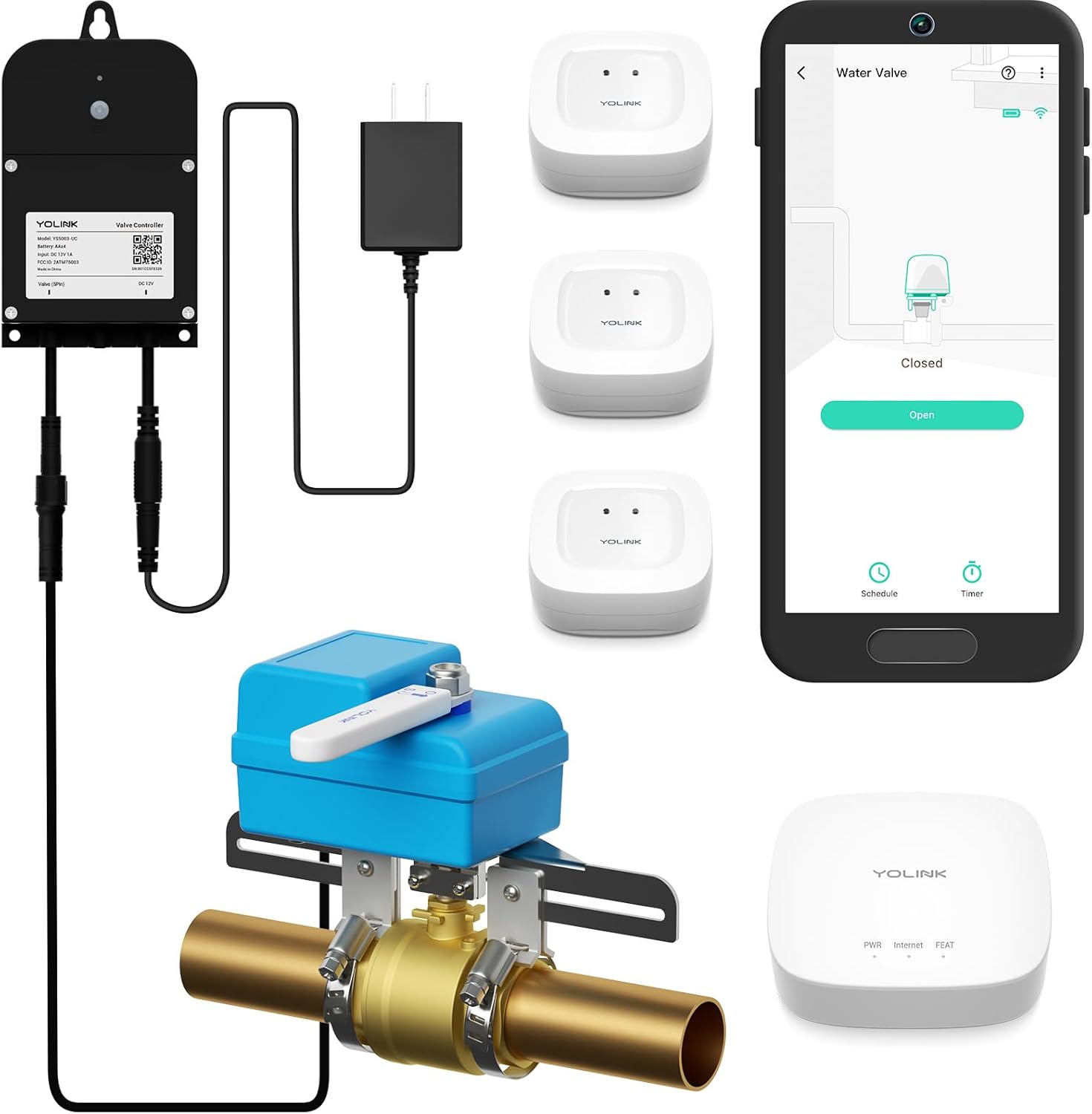
The YoLink DIY Automatic Water Leak Detection & Shut-Off Starter Kit is built around a simple idea: instead of replacing a section of pipe, a motorized EVO Valve Operator clamps directly onto the handle of an existing quarter-turn ball valve and turns it closed automatically when a connected leak sensor gets wet. That approach makes it one of the more approachable whole-home kits to install, since it avoids any plumbing work beyond mounting a bracket.
The kit ships with three battery-powered leak sensors, a wireless valve controller, and a YoLink Hub that bridges the sensors and valve to a home Wi-Fi network over YoLink's proprietary long-range radio. That radio link is a real advantage over plain Wi-Fi leak sensors, since it keeps a strong connection from a basement or crawl space where router signal is often weak.
Owners consistently point to easy setup and reliable alerts as the strongest parts of the system, and with close to 500 verified ratings at a 4.7 average, it has one of the deeper review bases of any DIY kit in this category. The main tradeoff is that everything routes through the YoLink Hub, so a hub failure or extended internet outage limits remote functionality, though the valve itself continues to respond to local sensor triggers.
Bottom line: for a homeowner who wants whole-home leak protection without hiring a plumber, this is one of the most complete DIY kits available, combining a clamp-on valve operator with a real sensor bundle in a single purchase.
- Valve type: clamp-on motorized operator for existing ball valves
- Included: EVO Valve Operator, wireless valve controller, 3 leak sensors, YoLink Hub
- Connectivity: YoLink LoRa network to hub, hub connects to home Wi-Fi
- Smart home support: Alexa, Google Assistant, IFTTT
- Power: battery-operated valve operator and sensors
Installation starts with mounting the EVO Valve Operator onto the lever of an existing ball valve using the included bracket, then pairing it with the YoLink Hub through the YoLink app. From there, the three leak sensors get placed near common risk points such as a water heater, washing machine, or under a sink, and each one is linked to trigger the valve automatically.
Once configured, the system runs in the background: a wet sensor sends a signal to the hub, the hub triggers the valve to close, and a push notification goes out to the app. Manual shutoff and reopening from the app is also available for travel or vacation use.
This kit fits homeowners who want whole-home leak coverage but would rather avoid hiring a plumber for a full valve replacement. It is also a good match for anyone already comfortable with basic smart home apps, since setup runs entirely through the YoLink app rather than requiring an installer visit.

Pros
- No pipe cutting at all, the robot drives your existing shutoff handle
- High torque handles stiff round handle gate valves as well as lever ball valves
- Battery powered with LoRa range that covers a whole property
- Three leak sensors in the box cover the usual trouble spots on day one
- Leaves no permanent modification, so it moves with you
Cons
- Only works if the existing valve still turns freely, a seized valve must be replaced first
- Needs physical clearance around the valve for the robot body
- Closing takes noticeably longer than a purpose built motorized valve
The Bulldog kit exists for the very large group of people who want automatic shutoff and absolutely do not want anyone cutting their main line. Instead of replacing the valve, the robot clamps around the one already on the wall and turns the handle with a motor. Nothing is soldered, nothing is opened, and when you move out the whole thing comes off with a wrench.
Torque is the reason this model exists rather than the lighter operators. Older homes often have round handle gate valves that take several full turns and a fair amount of force, and the Bulldog is built for that job as well as for quarter turn ball valves. The included hub and three sensors mean the kit is useful straight out of the box: put a sensor under the water heater, one behind the washer, one under the kitchen sink, and any of them can command the valve directly over LoRa without touching the cloud.
Its limits follow from the approach. If your shutoff valve is corroded stiff, the robot cannot fix that and you need a plumber to replace the valve first, which somewhat defeats the point. Clearance around the pipe has to be checked with a tape measure, and mechanically turning a multi turn handle is slower than a purpose built motorized ball valve.
Bottom line: the right answer for renters and for anyone who wants whole-home protection without a permanent plumbing change, as long as your existing valve is in good working order.
- Type: clamp on valve robot, no plumbing
- Valve compatibility: ball and gate valves, larger sizes supported
- Coverage: whole home, wherever your main valve sits
- Detection: three included water leak sensors
- Power: battery
- Connectivity: LoRa to included hub
- Offline: device to device automatic shutoff
Before ordering, turn your main shutoff by hand to confirm it moves without a fight, then measure the clearance around the handle in every direction. A valve tight against a foundation wall may not accept the robot body.
Mount the unit so the handle travel is unobstructed, then run a manual open and close from the app to confirm the robot reaches both end stops.
Exercise the valve a few times a year so the handle does not stiffen up, since the robot can only move what a hand could move. Keep the sensors off carpet and directly on hard floor at the lowest point of the room.
Check batteries in both the robot and the sensors on a schedule, and confirm the hub is online after any router change.

Pros
- NSF certification adds an extra layer of confidence for a valve carrying drinking water
- 3/4-inch stainless steel ball valve resists corrosion better than lower-grade metal valves
- Rated for 10+ years of battery life on the motorized controller
- Long-range LoRa (D2D) connection triggers the valve directly from leak sensors without waiting on the internet
- Includes a physical remote fob for quick manual shutoff
Cons
- Requires the YoLink Hub for app control and remote alerts
- Fewer included leak sensors than the brand's larger bundle kits
The NSF Certified YoLink X3 kit replaces a section of 3/4-inch pipe with a full stainless steel ball valve rather than clamping onto an existing one, which makes it a step up in durability from the clamp-on kits in this list. The NSF certification specifically covers the valve's suitability for potable water lines, which matters for buyers who want documentation beyond a manufacturer's own claims.
Where this model stands out is its D2D (device-to-device) leak sensor triggering, which lets a connected leak sensor close the valve directly through YoLink's LoRa network without a round trip through the internet or a cloud server. That local-first design means the valve can still respond to a leak even during a broadband outage, as long as the hub and sensors keep power.
The kit includes a small remote fob for manual open and close from arm's length, which is a convenient backup if a phone is not handy. Battery life is rated at over 10 years on the motorized controller, which is longer than most competing valves in this price range.
Bottom line: this is a solid choice for anyone who wants a full valve replacement with genuine third-party water-safety certification and a battery that will not need attention again for the better part of a decade.
- Valve type: 3/4-inch NSF certified stainless steel ball valve, full replacement
- Battery life: rated 10+ years on lithium cell
- Connectivity: YoLink LoRa (D2D) network, hub required for app and remote alerts
- Included: valve controller, remote fob, leak sensors
- Smart home support: Alexa, IFTTT, Home Assistant
This kit is best suited to homeowners doing a planned plumbing upgrade rather than a quick retrofit, since installing a full replacement valve on 3/4-inch pipe typically calls for basic plumbing skills or a professional install. It is also a strong fit for anyone who specifically wants NSF-certified hardware on a potable water line, or who wants a valve they will not need to think about again for a decade thanks to the long battery rating.
NSF certification means the valve's wetted materials have been evaluated for use on potable water lines, which is worth confirming on any valve that sits directly in a home's drinking water supply. Because the controller runs on a long-life lithium battery rather than line power, check the app periodically for low-battery alerts so the valve stays responsive during an actual leak event.

Pros
- Ultrasonic sensing resolves flow as small as 0.01 gallons per minute
- One product covers both 3/4 inch and 1 inch main lines
- Detailed usage reports make a hidden drip easy to spot week over week
- Temperature alarm gives early warning of a freeze risk in the line
Cons
- Newer name in this category with a shorter track record than the established brands
- Requires an outlet at the valve and cutting into the main line
- App polish and notification wording still trail the bigger ecosystems
The Frizzlife LP365 is a whole-home valve aimed squarely at people who want the data as much as the protection. Its ultrasonic sensor has no impeller in the water path, which means it can resolve very small flows, and the listing claims sensitivity down to 0.01 gallons per minute. In practical terms that is the difference between noticing a running toilet and noticing a pinhole in a copper elbow.
Day to day it behaves like a smart meter with teeth. The app shows what the house used by hour and by day, raises an alarm when flow stays continuous past your threshold, and closes the valve automatically when the pattern crosses the line you set. A temperature reading on the same body is a genuinely useful extra in a cold climate, since a main line drifting toward freezing is worth knowing about before it splits.
Where it asks for patience is maturity. Frizzlife is far better known for water filtration than for leak hardware, and the app language and notification logic are less refined than the long established competition. The physical install is the usual story for an inline valve: cut the main, make your joints, find an outlet.
Bottom line: the strongest choice on this list for a data-minded owner who wants fine grained flow visibility along with automatic shutoff, provided you are comfortable with a younger product line.
- Pipe size: 3/4 inch and 1 inch versions
- Coverage: whole home, inline on the main
- Detection: ultrasonic flow sensing from 0.01 GPM
- Extras: real time temperature monitoring
- Power: AC outlet
- Connectivity: 2.4 GHz Wi-Fi app control
- Reporting: 24/7 usage logs
Choose the size that matches your existing main rather than the one you wish you had, and confirm the fitting style before ordering. A 1 inch main paired with a 3/4 inch valve creates a restriction you will feel at every shower upstairs.
If your household routinely runs long draws such as filling a hot tub, set the continuous flow threshold generously on day one to avoid nuisance closures while you learn the pattern of your own house.
Keep the valve accessible rather than boxing it in behind drywall, and label the manual override so anyone in the house can open the water by hand. Check the app for offline warnings after a router change or a power outage.
In an unheated basement, insulate the pipe around the unit. Electronics on the line do not stop a freeze, they only report the temperature dropping.

Pros
- Clamps onto an existing ball valve up to 1.5 inches, so no plumbing or pipe cutting is needed
- Z-Wave Plus connectivity slots directly into an existing SmartThings, Hubitat, or other Z-Wave hub
- Straightforward physical install that most owners describe as a short job
- Larger valve size range than several competing clamp-on actuators
Cons
- Requires an existing Z-Wave smart home controller, it will not work standalone
- No leak sensors are included, so sensors must be sourced separately for automatic triggering
The EcoNet Controls Bulldog Valve Robot takes a similar physical approach to the YoLink clamp-on kits, mounting a small robotic arm onto the lever of an existing ball valve, but it runs on the Z-Wave Plus protocol instead of a proprietary hub. That makes it a natural fit for anyone who already has a Z-Wave-based smart home controller like SmartThings or Hubitat, since the valve becomes just another device in an existing automation setup rather than a new app and ecosystem to manage.
It is rated for valves up to 1.5 inches, which is a wider range than several competing clamp-on actuators and makes it a workable option for larger main lines as well as standard 3/4-inch supply valves. Installation does not require cutting into any plumbing; the bracket and robotic arm mount over the existing valve handle.
Unlike the bundled YoLink kits, this product ships as the valve controller alone, with no leak sensors included, so it depends on separate Z-Wave leak sensors already in a smart home setup, or purchased alongside it, to trigger automatically. For someone building out a Z-Wave leak-detection system piece by piece, that separation can actually be an advantage, since it avoids paying for sensors that duplicate ones already installed.
Bottom line: a well-reviewed, protocol-specific pick for households already invested in Z-Wave smart home hardware who want their water shutoff to live in the same ecosystem as their other automations.
- Valve type: clamp-on robotic actuator for existing ball valves
- Valve size range: up to 1.5 inches
- Connectivity: Z-Wave Plus, requires a compatible smart home controller
- Included: valve robot and mounting bracket, no leak sensors included
- Installation: no plumbing or pipe cutting required
This valve is best suited to households that already run a Z-Wave smart home hub and want their water shutoff integrated into the same automations as their locks, lights, and sensors, rather than a separate app. It is less practical for someone starting from scratch with no smart home hardware, since a Z-Wave controller and separate leak sensors both need to be purchased alongside it.
Before buying, confirm which Z-Wave controller brand and firmware version are already in use, since device inclusion steps vary between platforms like SmartThings and Hubitat. Also measure the ball valve's handle length and confirm it is a standard quarter-turn lever, since the clamp bracket is designed around that style of handle rather than a wheel-style shutoff.

Pros
- Costs a fraction of a whole-home system while covering a top source of water damage
- No app, no hub and no account, it simply closes the valve and sounds an alarm
- Threaded NPT connections keep the install within reach of basic hand tools
- Audible and visual alarm gets attention even if nobody is looking at a phone
- Long track record with a large base of owner reviews
Cons
- Protects one appliance only, a leak elsewhere in the house is unaffected
- Needs an outlet nearby and depends on that power for new detections
- No remote notification, so a leak while you are away is handled silently
Water heaters fail in two ways: slowly, staining the floor around the pan, and suddenly, when the tank lets go. The FloodStop kit is aimed at both. A motorized valve threads onto the 3/4 inch supply, a sensor sits in the drain pan, and when that sensor sees water the valve closes and the alarm goes off. There is no app, no hub and no account, which is precisely why many owners choose it.
The value argument is hard to beat. For a small fraction of what a whole-home smart valve plus installation costs, you cover the single appliance most likely to soak a finished basement. Because the connections are threaded NPT rather than cut and soldered, a homeowner comfortable with a pipe wrench and thread sealant can usually do the work in an afternoon.
What you give up is reach and reporting. It watches one appliance, so a pinhole in a wall upstairs is entirely outside its world, and it will never send you a message. If the power is out when a leak starts, the unit cannot act until power returns. Treat it as a focused insurance policy rather than a house wide system.
Bottom line: the best money per unit of protection on this list, and the easiest recommendation for anyone with a water heater sitting above living space.
- Connection: 3/4 inch NPT male by female
- Coverage: single appliance, typically a water heater
- Detection: pan or floor probe sensor
- Alarm: audible and visual at the control unit
- Power: AC adapter
- Connectivity: none, fully local
- Control: manual open and close at the unit
Close the manual stop above the heater, relieve the pressure at a nearby faucet, then thread the valve into the cold inlet with the flow arrow pointing toward the tank. Use thread sealant rated for potable water on the male threads.
Set the sensor at the lowest point of the drain pan, not on the pan rim, and route the cable so nothing pulls it out during service.
Cycle the valve manually once or twice a year so the motor and seat stay free, and wipe the sensor probes if they have collected mineral scale. Confirm the alarm still sounds after any long power outage.
Keep in mind that a closed valve stops new water but does not empty the tank. A failed heater can still release its full volume onto the floor, which is why the drain pan and a working drain line still matter.

Pros
- 1/2 inch NPT sizing matches laundry boxes and smaller appliance lines
- Sensor plus alarm plus valve in one affordable package
- Works without any app, hub or network connection
- Simple threaded install with common hand tools
Cons
- Ratings are solid but the review history is shorter than the established kits
- Single appliance coverage only
- Outlet powered, so a blackout pauses new detections
The E-SDS kit covers the same idea as the FloodStop unit but in the 1/2 inch size that many laundry boxes, utility sinks and smaller heaters actually use. A motorized valve threads into the supply, a probe sits on the floor at the low point, and water on that probe closes the valve and triggers an alarm. There is no app and no radio, which keeps setup down to plumbing and a power cord.
For a laundry pair, this is the leak that most often ruins a floor. A supply hose that lets go while nobody is home can push water for hours, and a valve that closes within seconds of the first puddle changes the outcome completely. Because the kit is inexpensive, it is easy to justify one on the washer and another on a second appliance.
The reservations are about maturity and scope. E-SDS has a shorter review history than the long established names here, so there is less long term feedback to lean on, and like every local kit it does nothing about a leak on another line and cannot message you while you are away. It also depends on its outlet, so a power cut pauses protection until the electricity returns.
Bottom line: a sensible, low cost way to guard a laundry connection or a small heater, especially as a second layer alongside a whole-home valve.
- Connection: 1/2 inch NPT
- Coverage: single appliance line
- Detection: floor probe sensor
- Alarm: audible at the controller
- Power: AC adapter
- Connectivity: none required
- Typical uses: laundry, water heater, utility sink
Anyone with a washer on an upper floor or a small heater in a closet who wants automatic shutoff without joining an app ecosystem. It also works well as an inexpensive second layer in a house that already has a smart valve on the main.
Skip it if you need remote alerts or coverage for pipes inside walls.
Confirm your line is genuinely 1/2 inch before ordering, since laundry boxes and heater inlets are not always the size they appear. Shut the water at the manual stop, drain the pressure, then thread the valve in with potable rated sealant.
Place the probe flat on the floor at the lowest point, and keep the controller and its cord above any likely water level.

Pros
- One of the lowest-priced ways to add automatic shutoff to a valve you already own
- No hub required, connects directly over WiFi and Bluetooth
- Works with Alexa and the Tuya Smart / Smart Life app for scheduling and remote control
- Can be paired with separate water or gas leak detectors for a basic automated shutoff routine
Cons
- The ball valve itself is sold separately, so this only works if a compatible lever valve is already installed
- As a generic listing without a defined brand, warranty and support may be more limited than name-brand kits
This motorized valve actuator takes the clamp-on concept to its simplest and cheapest form: it is sold as a controller only, meant to attach to a ball valve with a lever handle that the buyer already has installed. There is no bundled hub, no bundled leak sensors, and no name-brand warranty program behind it, which keeps the price well below almost everything else in this roundup.
Setup runs through the Tuya Smart or Smart Life app, which is a common white-label platform used by a wide range of budget smart home hardware, and the actuator connects directly over WiFi and Bluetooth without needing a separate hub. It also works with Alexa for voice control and can be scheduled or triggered by pairing it with separate water or gas leak detectors sold on the same platform.
Because this is a generic, unbranded listing, buyers should treat it as a functional budget option rather than a long-term investment on par with the branded kits above. It is a reasonable way to add basic automatic shutoff to a valve that is already accessible, but it comes without the sensor bundles, NSF certification, or long-term brand support that the YoLink and Moen options offer.
Bottom line: a practical low-cost pick for anyone who already has a compatible ball valve and just wants a straightforward way to close it remotely or on a leak trigger, without paying for a full kit.
- Valve type: clamp-on actuator, valve sold separately
- Connectivity: WiFi and Bluetooth, no hub required
- App: Tuya Smart / Smart Life
- Smart home support: Alexa
- Compatible accessories: separate water and gas leak detectors
Since this actuator only works with a compatible lever-handle ball valve, confirm the valve's size and handle length before ordering, as an oversized or unusually shaped lever may not seat correctly in the bracket. Because there is no bundled leak sensor, pair it with at least one separate detector near a high-risk fixture to get real automatic shutoff rather than manual app control alone.
This is the right pick for a buyer who already has a working, accessible ball valve and simply wants to automate it as cheaply as possible. Anyone who does not yet have a compatible valve installed, or who wants a bundled sensor kit and a defined brand with clearer support, will likely be better served by one of the branded kits elsewhere in this guide.
How to Choose the Right Smart Water Shut Off Valve
Not every home needs the same kind of protection. A rental apartment with one washing machine hose has very different requirements than a house with a finished basement and a main line that feeds the whole property. Homeowners who travel often have different priorities than someone who is mainly worried about a specific appliance like a water heater or dishwasher. The criteria below cover the questions that matter most when comparing a smart water shut off valve for your specific plumbing setup, and they are roughly in the order we weighed them when ranking the products above.
Valve Type: Retrofit Actuator vs. Full Valve Replacement

Some systems clamp a motorized actuator onto the lever of a ball valve you already own, so there is no cutting, soldering, or drain-down of the line. Others ship as a complete valve assembly meant to replace a section of pipe outright, which usually calls for a plumber or at least real sweating/threading skill. If you already have an accessible quarter-turn ball valve on your main line, a clamp-on actuator is the faster and cheaper route. If your existing shutoff is old, corroded, or hard to reach, a full valve replacement is the more reliable long-term fix.
Pipe size matters here too. Most residential mains run 3/4-inch or 1-inch, and a valve rated for the wrong diameter simply will not fit without an adapter. Double-check the pipe size at your shutoff point before ordering, since returns on plumbing hardware can be a hassle once a valve has already been mounted in place.
Leak Detection: Flow-Based vs. Point Sensors
Whole-home systems typically watch the rate and pattern of water flow through the main line and shut off automatically when they detect a signature that looks like a burst pipe or a fixture left running, catching leaks anywhere in the house without needing a sensor at every fixture. Point sensors, by contrast, are small pucks placed directly under a water heater, washing machine, or sink; they trigger the valve the instant they get wet, which is very precise but only protects the spots where a sensor is physically sitting.
Many of the kits in this list combine both approaches: a motorized valve on the main line plus two or three point sensors in the highest-risk areas. That hybrid setup tends to catch more leak scenarios than either method alone, and it is worth prioritizing if your budget allows for it.
Connectivity: Wi-Fi, Hub-Based, and Hub-Free Systems

Wi-Fi valves connect straight to a home router and need no extra hardware, which keeps setup simple but also means the valve depends on router uptime and signal strength. Hub-based systems use a proprietary low-power radio (commonly LoRa or Z-Wave) between the valve and a small hub plugged in near the router; the tradeoff is one more device to manage, but signal range and reliability from a basement or garage is usually much better than plain Wi-Fi.
If you already run a Z-Wave or Zigbee smart home hub such as SmartThings or Hubitat, a valve built for that ecosystem will slot into existing automations instead of adding a second app to check. If you have no smart home hub at all, a Wi-Fi-only or self-contained hub kit is the simpler starting point.
Battery Life and Backup Power
A shutoff valve is only useful during an emergency, so it needs to keep working even when the power flickers. Look at whether the valve runs on line power with a battery backup, or on long-life lithium cells rated for several years. Systems that only work while plugged in are a real liability during a storm-related power outage, which is exactly when a burst pipe is more likely.
App Alerts and Smart Home Integration
Push notifications to a phone are the baseline; the more useful systems also support Alexa, Google Assistant, or IFTTT so a leak alert can trigger other actions, like turning off a smart plug feeding a sump pump or flashing smart lights. If you travel often or manage a second property, prioritize a system with reliable remote shutoff from the app rather than one that only alerts locally.
Total Cost, Including What Comes in the Box
Sticker price alone can be misleading in this category. A bare valve controller with no sensors or hub can look cheap next to a bundled kit, but once you add a hub and two or three leak sensors separately, the total often ends up close to or higher than the bundled option. When comparing prices, check whether the hub, mounting hardware, and any leak sensors are included, or whether they are sold as add-ons that get purchased later.
It is also worth thinking about ongoing costs. Most of the systems in this guide have no subscription fee for basic app alerts, but a few premium monitoring platforms charge for extended data history or professional monitoring. If a subscription-free system covers what you need, there is little reason to pay for a recurring plan.
| Product | Valve Type | Connectivity | Best For |
|---|---|---|---|
| Moen Flo | Full valve replacement | Wi-Fi | Whole-home monitoring |
| YoLink DIY EVO Kit | Clamp-on actuator | LoRa hub | DIY installation |
| YoLink Bulldog Kit | Clamp-on actuator | LoRa hub | Sensor bundle |
| YoLink NSF X3 | Full valve replacement | LoRa hub | Long-range reliability |
| Frizzlife LP365 | Add-on monitor + valve | Wi-Fi | Flow and pressure data |
| EcoNet Bulldog Robot | Clamp-on actuator | Z-Wave hub | Existing Z-Wave homes |
| FloodStop | Appliance-specific kit | Standalone | Water heater protection |
| E-SDS | Compact valve kit | Standalone | Budget under $100 |
| Generic Motorized Actuator | Clamp-on actuator | Wi-Fi/Bluetooth | Cheapest retrofit |
For related plumbing upgrades, our roundup of main line drain cleaners covers another common cause of basement water damage: backed-up drains rather than burst pipes.
Why You Should Trust Us
We built this list by comparing verified customer ratings, review volume, and published specifications for every product, and we cross-check brand and installation claims against manufacturer listings and product documentation before publishing. Where a listing lacked a clear brand name, we researched the manufacturer directly rather than guess, and where we could not confirm one, we left the brand out of the writeup instead of inventing one. We prioritize systems with a real track record of owner reviews over newly listed products with little feedback, and we update this guide as new valves and kits reach the market.
Because a smart water shut off valve is a piece of safety hardware, we also weigh how a product handles failure states: whether it fails open or closed if the battery dies, whether it keeps working without an internet connection, and whether the manufacturer publishes clear installation instructions rather than leaving buyers to figure it out from a video. Products that were vague on these points, or that had a pattern of complaints about false shutoffs, ranked lower even when their star rating looked competitive on paper.
We do not accept payment from brands to influence rankings. When you buy through a link on this page, we may earn a commission at no extra cost to you, which helps support the research that goes into guides like this one.
Final Thoughts
For most homes, the Moen Flo Smart Water Shutoff Valve remains the strongest overall pick: it monitors the entire main line, integrates with insurance discount programs at several major carriers, and has the deepest base of verified owner reviews of anything in this comparison. If a full valve replacement is more than you want to take on right now, the YoLink DIY Automatic Water Leak Detection & Shut-Off Starter Kit is a strong middle ground, since its EVO Valve Operator clamps onto an existing ball valve and ships with three leak sensors and a hub in one box, so a single afternoon of DIY work covers most of a house.
Buyers who just want a low-cost way to add automatic shutoff without a big investment should look at the E-SDS Automatic Water Shutoff Valve Kit, which pairs a compact valve with a leak sensor and audible alarm for well under $100. It will not replace the flow-based monitoring of a whole-home system, but it covers the most common failure point in a home, a washing machine or sink supply line, at a price that is easy to justify even on a tight budget.
If your main concern is a specific appliance rather than the whole house, the FloodStop kit built for water heaters is worth a closer look, since it is designed around the exact failure mode of a leaking or ruptured tank rather than general-purpose leak detection. And if you already run a Z-Wave smart home hub, the EcoNet Bulldog Valve Robot slots into an existing setup instead of adding a second app and a second ecosystem to manage. Whichever option fits your plumbing and budget, pairing it with our guide to instant hot water heaters is a useful next step if a water heater swap is also on the to-do list. Browse more tools and home improvement picks or head back to our full articles library for additional buying guides.
FAQs
What is a smart water shut off valve and how does it work?
A smart water shut off valve is a motorized valve installed on a home’s water supply line that monitors flow or leak sensors and closes automatically when it detects a leak, a burst pipe, or unusual water usage. Most models pair with a smartphone app so the valve can also be closed manually from anywhere, and many send a push notification the moment a leak is detected.
Do I need a plumber to install a smart shutoff valve?
It depends on the type. Clamp-on actuators that attach to an existing ball valve lever are usually a DIY-friendly job with basic tools. Full valve replacements that require cutting into copper or PEX pipe are generally a job for a licensed plumber unless you already have soldering or push-fit plumbing experience.
Will a smart water shutoff valve work during a power outage?
Most of the kits in this guide run on long-life lithium batteries or include a battery backup, so they continue to monitor and shut off water even if household power goes out. It is worth confirming battery backup specifically before buying if you live somewhere with frequent outages.
Can a smart shutoff valve lower my homeowners insurance premium?
Several major insurance carriers offer discounts for verified smart leak-detection and automatic shutoff systems, though the exact discount and list of approved devices varies by carrier and state. Check with your insurance provider before buying if a discount is a deciding factor, since not every smart water shut off valve on the market qualifies. Our guide to automatic water shut off valves covers some additional insurance-partner models.
What is the best smart water shut off valve for 2026 if I rent instead of own?
Renters should lean toward point-sensor kits and clamp-on actuators that do not require permanent modification to the plumbing, since these can typically be removed and taken along at the end of a lease. A standalone kit with a leak sensor and alarm is often the most practical starting point for an apartment or rented house.




Write Your Review
No reviews yet. Be the first to share your experience!