

Composting outdoors turns kitchen scraps and yard waste into free, nutrient-rich soil instead of trash-bag filler, but not every bin makes the job easy. Some tumblers seize up when they’re full, some stationary bins let rodents in through the seams, and some “compost bins” turn out to be little more than a plastic trash can with a lid. We compared 7 outdoor compost bin options built specifically for backyard use, weighing capacity, airflow, pest resistance, and how much effort each design actually takes to turn. Our top pick is the FCMP Outdoor 37-Gallon Dual Chamber Tumbling Composter for its elevated, rodent-resistant frame and dual chambers that let you cure one batch while filling the next. Below is the full rundown of every model we shortlisted, plus a buying guide to help you match a bin to your yard.

Pros
- Elevated stand keeps pests and rodents out of the compost
- Dual chambers let you start a new batch while the first cures
- 8-sided drum tumbles compost quickly with minimal effort
- Sturdy steel frame holds up to years of outdoor use
- Built-in vent holes help regulate moisture and airflow
Cons
- Assembly takes real time and a second pair of hands helps
- 37-gallon capacity is modest for large yards or big households
The FCMP Outdoor 37-Gallon Dual Chamber Tumbling Composter is built around a simple idea: give each batch of compost its own space so you're never stuck choosing between adding fresh scraps and letting a finished batch cure undisturbed. The 8-sided drum sits on a raised steel frame, well above ground level, which does double duty as both a rodent deterrent and a way to keep the compost out of standing water after heavy rain.
Loading is straightforward through the sliding doors on each chamber, and the drum spins easily on its axle even when both sides are close to full. Owners consistently point to the pest resistance as the standout feature since the elevated, fully enclosed design makes it far harder for rats or raccoons to get inside compared to an open bin at ground level.
The main downside is assembly. The bin ships as a kit of steel panels, bolts, and the plastic drum, and putting it together correctly takes real time, with several owners recommending a second person to hold pieces steady during the process. Once assembled, though, it's a low-maintenance piece of equipment that just needs an occasional turn.
Bottom line: for anyone who wants a genuinely pest-resistant outdoor composter that supports back-to-back batches, this is the most complete option in our lineup and worth the one-time assembly effort.
- Total capacity: 37 gallons (two chambers)
- Frame: powder-coated steel, elevated stand
- Drum: 8-sided BPA-free plastic
- Access: sliding doors per chamber
- Ventilation: molded vent holes
- Assembly required: yes
Plan for roughly an hour of assembly and keep the included hardware organized before starting, since the panels and bolts look similar. Working on a flat, level surface makes it much easier to line up the frame before attaching the drum. A second person to hold the frame steady while you tighten bolts speeds things up considerably.
Once assembled, pick a permanent spot before filling the drum. The unit is far easier to move empty than full, and relocating a loaded tumbler is not something most owners want to repeat.
Check the drum's latch and door seals periodically to make sure they're closing fully, since a gap is the most common way pests get in. Avoid adding meat, dairy, or oily foods, which can attract animals and slow decomposition even in an enclosed tumbler.
In freezing climates, decomposition slows down significantly over winter. Continuing to add material in smaller batches and giving the drum an occasional spin keeps the pile from stalling out completely until temperatures warm back up.

Pros
- Recognizable, trusted lawn-and-garden brand
- Twin sliding doors make loading and unloading simple
- Dual chambers support continuous composting
- Tumbling design speeds up decomposition
- Compact footprint fits smaller yards
Cons
- Smaller per-chamber capacity than single large bins
- Plastic panels can feel less rugged after years of sun exposure
Miracle-Gro's compost tumbler splits its 37-gallon total capacity into two 18.5-gallon chambers, aimed at gardeners who want the staggered-batch benefit of a dual-chamber system without stepping up to a bulkier frame. Each chamber has its own sliding door, so loading fresh scraps into one side doesn't disturb the curing batch in the other.
The crank mechanism turns smoothly even when both chambers hold a full load, and the compact frame footprint makes it a reasonable fit for smaller patios or side yards where a larger tumbler wouldn't comfortably sit. Being a well-known garden brand name also gives some buyers extra confidence in build quality and customer support.
The tradeoff for the smaller frame is capacity. With only 18.5 gallons per chamber, households generating a lot of yard waste will fill it quickly and need to either compost in smaller, more frequent batches or supplement with a larger stationary bin for overflow.
Bottom line: a solid, brand-name dual-chamber tumbler for smaller households or anyone composting mostly kitchen scraps rather than large volumes of yard waste.
- Total capacity: 37 gallons (2 x 18.5-gallon chambers)
- Doors: sliding door per chamber
- Turning mechanism: hand crank
- Frame: raised stand
- Assembly required: yes
This tumbler fits households with a modest amount of kitchen scraps and light yard trimmings rather than someone managing a large vegetable garden or a yard full of mature trees. It also suits anyone who wants a recognizable garden brand behind the purchase and values a compact footprint over maximum capacity.
Fill one chamber with a mix of food scraps and dry browns like shredded paper or leaves, then give the crank several turns every few days to keep the material aerated. Once that chamber is roughly full, switch to loading the second chamber and let the first cure undisturbed until it's ready to use.
Pros
- Large 43-gallon dual-chamber capacity
- Sliding doors make loading and unloading easy
- Raised stand keeps the compost off the ground
- Ventilation slats promote consistent airflow
- Competitively priced for the capacity offered
Cons
- Turning crank can feel stiff when the drum is full
- Some owners note the latch needs occasional tightening
The VIVOSUN Outdoor Tumbling Composter offers 43 gallons of total capacity split across two chambers, giving it more room than most tumblers in this price range. The drum sits on a raised frame with ventilation slats built into the panels, which helps keep airflow consistent even when both chambers are loaded close to capacity.
Sliding doors on each side make it easy to add fresh material without disturbing whatever is curing on the other side, and the dual-chamber layout lets a household keep composting continuously rather than waiting on a single batch. Buyers frequently point to the price-to-capacity ratio as the main reason they chose this model over pricier competitors.
The crank does get noticeably harder to turn once a chamber is packed full, which is a common tradeoff with larger-capacity tumblers, and a few owners mention needing to periodically retighten the door latch to keep it sealed properly.
Bottom line: a strong value pick for anyone who wants more capacity than a typical single-chamber tumbler without paying a premium price.
- Total capacity: 43 gallons (two chambers)
- Frame: raised stand with ventilation slats
- Access: sliding door per chamber
- Turning mechanism: hand crank
- Assembly required: yes
This tumbler suits gardeners who want more capacity than a compact tumbler but aren't ready to move up to a large stationary bin. It's a reasonable middle-ground pick for a household generating a steady but not extreme volume of kitchen and yard waste.
Check the door latch every few weeks and re-tighten if it feels loose, since a gap in the seal is the easiest way for pests or excess rain to get in. If the crank becomes hard to turn, it usually means the pile is too wet or too full; adding dry browns like shredded cardboard helps loosen it back up.

Pros
- Huge 246-gallon capacity for a fraction of tumbler prices
- Expandable ring design fits almost any yard
- Tool-free assembly takes just a few minutes
- Made in the USA from recycled plastic
- Open bottom lets worms and soil organisms in naturally
Cons
- No tumbling mechanism, so turning compost means shoveling by hand
- Mesh panel offers less rodent protection than an enclosed bin
The Geobin Compost Bin takes a completely different approach from the tumblers in this roundup. Instead of an enclosed, rotating drum, it's a flexible ring of recycled plastic panels that locks together into a freestanding bin, and it expands to hold up to 246 gallons, roughly five to six times the capacity of most tumblers here.
Assembly is genuinely tool-free: the interlocking panels click together in a matter of minutes, and the diameter can be adjusted to fit the available space or expanded further as your pile grows. The open bottom lets the bin sit directly on soil, so worms, beneficial bacteria, and other organisms can reach the pile from underneath, which many home composters consider a plus for finished compost quality.
The obvious tradeoff is effort. There's no crank or tumbling mechanism, so mixing the pile means opening the bin or reaching in with a pitchfork or aerator tool. The mesh-style panel also offers less protection against determined rodents than a fully enclosed tumbler, so it's better suited to yard waste and food scraps that are buried under a layer of browns.
Bottom line: for sheer composting volume per dollar, nothing else in this roundup comes close, making it our pick for best value.
- Capacity: up to 246 gallons, expandable
- Material: recycled plastic panels
- Assembly: tool-free, interlocking design
- Bottom: open, sits directly on ground
- Made in the USA
Unroll the panel and connect the interlocking edges into a ring on a flat patch of bare soil or grass, adjusting the diameter to the footprint you want. No bolts, screws, or tools are needed, and the whole process typically takes just a few minutes. The ring can be expanded later simply by adding more length if your composting needs grow.
This bin is the clear choice for gardeners composting large volumes of fall leaves, grass clippings, or garden trimmings who don't want to pay tumbler prices for that much capacity. It's a better fit for yard waste than for households that only need to compost small daily amounts of kitchen scraps.

Pros
- 65-gallon capacity handles a season's worth of scraps
- Four sliding doors give access at every stage of decomposition
- Vent holes built into the panels for airflow
- Lightweight panels are easy to move or relocate
- Lift-off lid keeps rain and pests out
Cons
- Stationary design means turning compost requires a pitchfork or aerator tool
- Black plastic can get hot in direct summer sun
The Redmon Outdoor Compost Bin is a straightforward, stationary design built around access rather than mechanics. Instead of a single opening, it has four sliding doors positioned around the bin, so you can add fresh material near the top while pulling finished, fully broken-down compost from lower doors without disturbing the rest of the pile.
At 65 gallons, it holds noticeably more than most tumblers in this roundup while costing less, which makes it a practical choice for households with a bigger garden or yard. The lightweight plastic panels mean the empty bin is easy to reposition if you decide on a better spot later, and the lift-off lid does a good job keeping heavy rain and curious animals out.
Because there's no crank or rotating drum, mixing the pile means reaching in with a pitchfork or compost aerator tool periodically, which is more physical effort than spinning a tumbler but far less than turning an open pile with no structure at all. In direct summer sun, the black plastic panels can get noticeably warm, which some owners actually see as a plus for speeding up decomposition.
Bottom line: a practical, higher-capacity stationary bin for gardeners who don't mind manual turning in exchange for more volume at a lower price than a comparable tumbler.
- Capacity: 65 gallons
- Access: 4 sliding doors
- Lid: lift-off design
- Ventilation: molded vent holes
- Material: lightweight plastic panels
Add fresh scraps and yard waste through the top opening, layering greens like food scraps with browns like dry leaves or shredded paper. Use the lower doors to check on and remove finished compost once it's dark and crumbly, and turn the pile every week or two with a pitchfork to keep it aerated and speed up decomposition.
Keep the lid fully seated after each use to block rain and discourage pests, and avoid adding meat, dairy, or oily food waste that can attract animals to a stationary bin. If the panels start to warp in extreme heat, moving the bin to a spot with afternoon shade can help extend its lifespan.

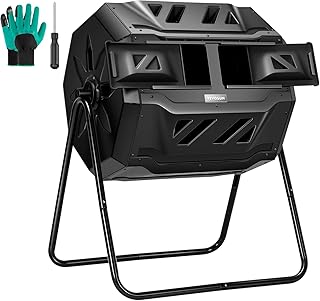
Pros
- Dual chambers let you stagger batches
- Sliding doors on both sides for easy loading
- Steel frame keeps the tumbler stable while rotating
- Ships with a pair of gardening gloves included
- Wallet-friendly price for a dual-chamber tumbler
Cons
- Instructions are thin, so first assembly takes patience
- Drum seams have been known to loosen after heavy use
The F2C Compost Bin Outdoor gives budget-conscious gardeners a dual-chamber tumbler without the price tag of some competing brands. At 43 gallons total, split across two chambers with sliding doors, it offers the same staggered-batch convenience as pricier tumblers, letting you fill one side while the other cures.
The steel frame keeps the drum stable while it's being turned, and the BPA-free plastic construction is a reassuring detail for anyone composting food scraps that will eventually feed a vegetable garden. It also ships with a bundled pair of gardening gloves, a small but useful extra for handling yard debris.
The included instructions are on the thin side, so first-time assembly takes more trial and error than some other tumblers in this roundup, and a handful of owners report the drum's seams loosening after extended heavy use. Neither issue is a dealbreaker at this price point, but they're worth knowing going in.
Bottom line: a genuinely capable dual-chamber tumbler for gardeners who want the format without paying a premium, as long as you're prepared for a slightly rougher assembly process.
- Total capacity: 43 gallons (two chambers)
- Frame: steel
- Drum: BPA-free plastic
- Access: sliding doors per chamber
- Includes: gardening gloves
- Assembly required: yes
This tumbler is a good fit for budget-focused gardeners who still want the continuous-batch benefit of two chambers rather than settling for a single-chamber tumbler. It suits small to medium yards where 43 gallons of total capacity is enough to keep up with regular kitchen and yard waste.
If assembly instructions are a sticking point for you, set aside extra time and expect to reference online videos or reviews rather than relying solely on the printed guide. Once assembled, periodically check the drum seams for gaps, especially after the bin has been in heavy use for a full season.

Pros
- 50-gallon single chamber holds a large volume of material
- Raised stand and sturdy frame built for years of outdoor exposure
- Recycled-plastic construction is durable and low maintenance
- Simple crank mechanism turns easily even when full
- Made in the USA
Cons
- Single chamber means no fresh batch until the current one finishes curing
- Premium price compared to bins with similar capacity
The Good Ideas Compost Wizard Jr. Tumbler takes a single-chamber approach but compensates with a generous 50-gallon capacity, more than most single-chamber tumblers in its class. It's built from recycled plastic on a raised steel-reinforced frame, designed to hold up to years of sun and rain without cracking or rusting out.
The crank mechanism turns smoothly even when the drum is close to full, which some competing single-chamber tumblers struggle with at capacity. Being made in the USA and backed by a long track record in the home composting market gives it a reputation for durability that shows up repeatedly in long-term owner feedback.
The single-chamber design is the main tradeoff: unlike the dual-chamber tumblers in this roundup, you can't start a fresh batch until the current one finishes curing, which means either pausing on adding new scraps or supplementing with a second bin. It also costs more than some bins with comparable capacity, reflecting the sturdier build.
Bottom line: a durable, well-built single-chamber option for gardeners who value long-term reliability over the staggered-batch convenience of a dual-chamber design.
- Capacity: 50 gallons, single chamber
- Material: recycled plastic
- Frame: raised, steel-reinforced stand
- Turning mechanism: hand crank
- Made in the USA
Assembly follows a similar process to other tumblers in this roundup: attach the frame first on a flat surface, then mount the drum and secure the axle. Because the single drum is larger than some dual-chamber models, having a second person help lift it onto the frame makes the process considerably easier.
Fill the chamber gradually with a mix of greens and browns rather than dumping in a large amount at once, and give the crank several full turns every few days to keep the pile aerated. Once the chamber is full, it's best to let that batch finish curing before adding significant new material, since there's no second chamber to separate fresh scraps from finished compost.
Outdoor Compost Bin Buying Guide
Before you buy, it helps to know what separates a genuine outdoor compost bin from a repurposed trash can. Amazon search results for “compost bin” mix in kitchen countertop caddies, plain plastic garbage cans, and even compost additives, none of which are built for months of sun, rain, and active decomposition outside. The criteria below cover the features that actually affect how fast your compost breaks down, how much manual work the bin asks of you, and how long it will hold up sitting in a corner of the yard.
Tumbler vs. Stationary Bin
Tumbling composters sit on a raised frame and rotate on an axle, so mixing the pile is as simple as spinning a crank a few times. That agitation speeds up decomposition and keeps material from compacting into a soggy clump. The tradeoff is capacity: most tumblers top out around 40 to 50 gallons because a full drum gets heavy to turn.
Stationary bins skip the moving parts entirely. You load scraps from the top or through side doors and turn the pile by hand with a pitchfork or aerator tool. They tend to hold far more material for the price, which matters if you’re composting fall leaves or a big vegetable garden’s worth of trimmings, not just kitchen scraps.
Neither style is objectively better. A tumbler suits someone who wants finished compost in weeks with minimal manual labor. A stationary bin suits someone who wants maximum volume and doesn’t mind an occasional turn with a fork. Some gardeners end up running both: a tumbler for fast-turning kitchen scraps and a larger stationary bin for slower-composting yard waste like fallen leaves and pruned branches.
Capacity and Chamber Count

Match capacity to how much waste your household actually generates. A family that composts daily food scraps and a modest garden bed is usually well served by a 35 to 50 gallon bin. A household with a large lawn, mature trees, or a big vegetable garden will fill a small bin within a week and should look at 65 gallons or more.
Dual-chamber tumblers solve a common composting problem: if you only have one bin, you either have to stop adding fresh scraps while a batch cures, or you keep adding and the pile never finishes. A second chamber lets you fill one side while the other cures undisturbed, so you always have a batch either actively cooking or ready to use.
Pest and Rodent Resistance

Food scraps left in an open pile or a loose bin attract rats, raccoons, and flies fast. Enclosed tumblers with latching doors are the most secure option because the compost never sits exposed at ground level. Elevated stands add another layer of protection since most rodents can’t easily climb a smooth metal or plastic leg.
Stationary wire or mesh bins offer the least pest protection by design, since airflow openings can also let small animals through. That’s an acceptable tradeoff for yard waste like leaves and grass clippings, but if you’re composting food scraps in an area with wildlife, an enclosed tumbler or a bin with a tight lid is the safer choice.
Airflow, Drainage, and Moisture Control
Compost needs oxygen to break down aerobically instead of turning into a smelly, slimy mess. Look for vent holes or slats built into the bin’s walls, not just a lid you crack open occasionally. Good bins also let excess moisture drain out the bottom or through mesh panels, since a compost pile that’s too wet stalls out just as easily as one that’s too dry.
Assembly and Footprint

Tumblers generally arrive as a box of panels, bolts, and a drum that need to be assembled, and some models take considerably longer than others. Stationary wire bins are usually the fastest to set up since many just unfold or lock into a ring shape. Before buying, measure the space where the bin will actually sit, including clearance to walk around a tumbler and turn its crank, plus room to wheel a wheelbarrow up to a stationary bin’s access doors when it’s time to harvest finished compost.
Materials and Weather Durability
An outdoor compost bin lives outside year-round, so the materials matter more than they would for an indoor container. UV-stabilized plastic resists the cracking and fading that ordinary plastic develops after a summer or two in direct sun. Steel frames and hardware should be galvanized or otherwise coated, since bare steel rusts quickly once it’s exposed to a season of rain and humidity, especially around bolts and hinge points that see repeated movement.
Wire and mesh bins hold up differently: the metal itself resists weather well, but thinner gauge wire can bend or sag under the weight of a full pile of wet leaves. Thicker, welded wire or heavier-gauge mesh keeps its shape better over multiple seasons, which is worth checking in product photos and reviews before choosing a lightweight, budget option.
Price Versus Capacity
Price scales with mechanism more than with raw volume. A tumbler’s moving parts, drum, and frame add cost per gallon of capacity compared to a stationary bin, which is essentially a static enclosure. If your priority is composting the largest volume of yard waste for the least money, a stationary or expandable bin will almost always beat a tumbler on a per-gallon basis. If your priority is speed and low physical effort, the extra cost of a tumbler buys back the labor of manually turning a large pile with a fork.
| Bin Type | Typical Capacity | Effort to Turn | Best For |
|---|---|---|---|
| Elevated dual-chamber tumbler | 35-45 gallons | Low (crank turn) | Continuous composting, pest control |
| Single-chamber tumbler | 18-50 gallons | Low (crank turn) | Smaller yards, faster batches |
| Stationary multi-door bin | 60-70 gallons | Moderate (manual turn) | Larger volume at lower cost |
| Expandable wire/mesh bin | 150+ gallons | Higher (manual turn) | Yard waste, leaves, big gardens |
For more backyard equipment picks, see our guide to the best lawn mowers or browse everything in our patio, lawn, and garden category.
Why You Should Trust Us
Our team builds these roundups by comparing verified customer ratings, review volume, and product specifications across every listing in the category, then filtering out variants, off-topic listings, and bins that don’t hold up to real backyard use. We read through detailed buyer feedback for recurring themes like durability, pest resistance, and ease of turning before a bin makes our final shortlist.
We also cross-check that every product is genuinely built for outdoor composting rather than a repackaged trash can or an indoor kitchen caddy, since Amazon search results for compost bins frequently mix the two. Any listing that turned out to be a countertop caddy, a plain garbage can, or a compost additive rather than an actual outdoor bin was removed from consideration, even when it had strong ratings, because it wouldn’t answer what someone searching for outdoor compost bin is actually trying to buy.
We don’t accept payment from brands to influence rankings, and pricing, availability, and specifications can change after publication, so we recommend double-checking the current listing before you buy. Our picks are updated periodically as new models are released and older ones are discontinued.
Final Thoughts
If you want the least amount of manual effort for the fastest results, the FCMP Outdoor 37-Gallon Dual Chamber Tumbling Composter is our best overall pick. Its elevated frame keeps rodents out, and running two chambers means you’re never stuck waiting on a single batch to finish before adding fresh scraps.
If budget and capacity matter more than speed, the Geobin Compost Bin is the smarter buy. It holds roughly six times the volume of most tumblers for a fraction of the price, and the expandable ring assembles in minutes without tools. It just requires turning the pile by hand instead of spinning a crank.
For a household that wants staggered batches without stepping up to a large frame, the Miracle-Gro Dual Chamber Compost Tumbler is worth a look, since its twin sliding doors make loading and unloading straightforward for anyone new to composting. Anyone composting a full yard’s worth of leaves each fall should consider the higher-capacity Redmon Outdoor Compost Bin or the VIVOSUN Outdoor Tumbling Composter, both of which handle heavier seasonal volume than a compact tumbler can.
If you’re outfitting a garden shed and want a dual-chamber tumbler that ships with a couple of extras thrown in, the F2C Compost Bin Outdoor is a solid budget-friendly pick, and gardeners who prefer a heavier-duty single-chamber tumbler with a longer track record should look at the Good Ideas Compost Wizard Jr. Whichever style fits your yard, see our best indoor composters guide if you also want a countertop option for daily kitchen scraps, or browse our best pruning saws for more yard maintenance gear.
FAQs
What is the best outdoor compost bin for a small backyard?
A single-chamber or compact dual-chamber tumbler is usually the best fit for small backyards, since it holds a useful volume of scraps without taking up much ground space. Look for a model with a raised stand so you don’t need extra clearance around the base.
How long does it take to make compost in an outdoor bin?
Tumbling composters that are turned regularly and kept at a good moisture balance can produce usable compost in as little as four to eight weeks. Stationary bins that are turned less often typically take two to six months, depending on the mix of greens and browns and how often the pile is aerated. Chopping scraps into smaller pieces before adding them, and keeping a roughly even balance of nitrogen-rich greens like food scraps and carbon-rich browns like dry leaves or cardboard, both speed up the process regardless of which bin style you use.
Do outdoor compost bins attract pests?
Enclosed tumblers with latching doors rarely attract pests because scraps are never exposed at ground level. Open or mesh-style bins carry more risk, so it helps to bury fresh food waste under a layer of browns like dry leaves or shredded paper and avoid adding meat, dairy, or oily foods.
Can I compost year-round in 2026?
Yes, though decomposition slows significantly in cold weather. An insulated or dark-colored bin placed in a sunny spot retains more heat through winter, and adding material in smaller, more frequent batches helps keep the pile active even during colder months.
What’s the difference between a compost bin and a compost tumbler?
A compost tumbler is enclosed and mounted on a frame so it can be rotated to mix the contents, which speeds up decomposition with minimal manual effort. A compost bin is typically stationary, often larger and less expensive, and requires manually turning the pile with a tool. Both are valid ways to compost outdoors; see our full categories for more backyard gear comparisons.
Where should I put an outdoor compost bin?
A spot with partial sun helps keep the pile warm enough to stay active without drying out completely, and placing the bin on bare soil or grass rather than concrete lets excess moisture drain and allows beneficial insects and microbes to reach the pile from below. Keep the bin within an easy walk of the kitchen door so adding daily scraps doesn’t feel like a chore, but away from windows if you’re worried about occasional odor during hot weather.


Write Your Review
No reviews yet. Be the first to share your experience!