

Mirrorless cameras have become the default choice for photographers moving up from a smartphone or retiring an aging DSLR. Dropping the mirror and optical viewfinder lets manufacturers build lighter bodies, faster autofocus systems, and video specs that used to be reserved for dedicated camcorders. For September 2026, we set DSLRs and point-and-shoots aside to focus purely on today’s mirrorless cameras, comparing sensor formats, lens mounts, autofocus systems, and video capabilities across 9 current models from Sony, Panasonic, OM System and more. Our top pick is the Canon EOS R8 for its full-frame image quality, flagship-level autofocus, and body weight that stays well under a pound.
For a wider look at cameras that also covers DSLRs and compacts, see our camera buying guide. If you already know you want an interchangeable-lens body with an electronic viewfinder, the picks below narrow that decision down to sensor format, lens system, and how each camera handles autofocus and video.

Pros
- Full-frame image quality in a body that weighs well under a pound
- Dual Pixel CMOS AF II tracks people, animals, and vehicles reliably
- Oversampled 4K video up to 60p with no recording crop
- Vari-angle touchscreen makes low-angle shots and vlogging easier
Cons
- No in-body image stabilization, so a stabilized lens matters more for handheld video
- Single SD card slot offers no in-camera backup for important shoots
The Canon EOS R8 puts a full-frame sensor and Canon's newest autofocus technology into one of the lightest full-frame bodies on the market, aimed at photographers who want a step up from APS-C without hauling around a heavier professional body.
Its Dual Pixel CMOS AF II system carries over from Canon's more expensive R6 Mark II, recognizing and tracking people, animals, and vehicles across the frame with very little hunting, and its burst shooting can reach 40fps in electronic shutter mode for fast-moving subjects.
Video shooters get oversampled 4K footage up to 60 frames per second with no additional crop, which is unusual at this size and body weight, plus a vari-angle touchscreen that flips out for selfie angles and vlogging.
The tradeoffs are a lack of in-body stabilization and only one SD card slot, both trims Canon made to keep the body small and the price approachable relative to its full-frame competitors.
Bottom line: for photographers who want full-frame image quality and serious autofocus without the size and weight of a professional body, the EOS R8 is the most well-rounded pick on this list.
- 24.2MP full-frame CMOS sensor
- DIGIC X image processor
- Dual Pixel CMOS AF II with subject detection
- 4K60p video oversampled from 6K, no crop
- Vari-angle 3-inch touchscreen
- Up to 40fps electronic shutter burst
- RF lens mount
The EOS R8 suits photographers upgrading from an APS-C mirrorless or DSLR who want full-frame quality without stepping up to a heavier professional body, as well as hybrid shooters who split time between stills and video.
It is less suited to photographers who need dual card slots for professional backup or in-body stabilization for handheld low-light video, both of which are better served by the EOS R6 Mark II.
Subject-detection autofocus covers people, animals, and vehicles in a single mode, switching automatically between them as the scene changes rather than requiring a manual mode change.
Video is oversampled from a 6K capture down to 4K60p, which keeps footage sharp even without upscaling in post, and the vari-angle screen makes it easier to monitor framing while shooting handheld or from odd angles.

Pros
- 33MP sensor balances resolution with strong low-light performance
- 5-axis in-body stabilization steadies handheld photos and video
- 759-point hybrid autofocus with reliable eye tracking for people and animals
- Dual card slots, including CFexpress Type A, for overflow or backup recording
Cons
- Menu system still takes time to learn for first-time Sony users
- A full kit with native E-mount lenses adds up quickly in cost
The Sony Alpha 7 IV sits in the middle of Sony's full-frame lineup, built for photographers and videographers who do not want to choose between resolution, autofocus speed, and video quality.
Its 33MP sensor is a meaningful step up in detail from the 24MP sensors common at this tier, without sacrificing the low-light performance full-frame shooters expect, and its 759-point hybrid autofocus system tracks eyes for both people and animals with very few missed shots.
In-body stabilization rated for several stops of correction helps with both handheld stills in dim light and smoother handheld video, and dual card slots, one of them CFexpress Type A, give working photographers a real backup option in the field.
The learning curve is steeper than on more basic bodies, since Sony's menu system packs in a lot of customization, and building out a full kit with Sony's native E-mount glass is a real investment over time.
Bottom line: the Alpha 7 IV is the pick for anyone who needs one full-frame body to reliably handle stills, video, and fast-moving subjects without compromise.
- 33MP full-frame BSI CMOS sensor
- 5-axis in-body image stabilization
- 759-point hybrid phase-detect autofocus
- 4K UHD video up to 60p (Super 35 crop) / 30p full-frame
- Dual card slots (CFexpress Type A and SD)
- Vari-angle 3-inch touchscreen
- Sony E-mount lens compatibility
Sony's E-mount has been open to third-party lens makers for well over a decade, so the Alpha 7 IV can draw from one of the deepest full-frame lens catalogs available, spanning budget primes to professional-grade zooms.
That maturity means used and third-party glass is easy to find at a range of price points, which helps offset the cost of the body itself over time.
The Alpha 7 IV fits photographers and hybrid shooters who need a single body to cover portraits, events, and video work without switching cameras between tasks.
It is overkill for casual shooters who mainly want simple point-and-shoot style results, who would likely be better served by a simpler APS-C body.

Pros
- Up to 40fps electronic shutter burst for fast-moving subjects
- In-body stabilization rated for several stops of shake correction
- 6K-oversampled 4K video up to 60p in 10-bit
- Subject-detection autofocus covers people, animals, and vehicles in one mode
Cons
- Buffer can fill quickly at the fastest burst rates with large raw files
- No dedicated headphone jack without an accessory grip
The Canon EOS R6 Mark II is built for shooters who prioritize speed, autofocus sophistication, and durability over outright resolution, making it a natural fit for events, sports, and family photography where moments happen fast.
Its burst shooting reaches 40fps in electronic shutter mode, backed by subject-detection autofocus that recognizes people, animals, and vehicles automatically, so photographers rarely need to switch modes mid-shoot.
Video is oversampled from a 6K capture down to 4K60p in 10-bit color, giving editors more flexibility in post-production than the 8-bit footage common on entry-level bodies, and in-body stabilization smooths out handheld footage without a gimbal.
A weather-sealed magnesium-alloy body and dual UHS-II SD card slots round out a design clearly aimed at photographers who shoot outdoors and need a reliable backup while working.
Bottom line: the R6 Mark II is the choice for photographers who need consistently fast autofocus and high frame rates across both stills and video, with the build quality to back it up.
- 24.2MP full-frame CMOS sensor
- DIGIC X image processor
- In-body image stabilization
- Up to 40fps electronic / 12fps mechanical burst
- 4K60p 10-bit video oversampled from 6K
- Dual UHS-II SD card slots
- Weather-sealed magnesium-alloy body
Subject-detection autofocus switches automatically between people, animals, and vehicles, keeping focus locked through erratic movement better than older contrast-based systems.
10-bit 4K60p video oversampled from 6K gives more room to grade footage in post than the 8-bit files common on cheaper bodies, while in-body stabilization helps handheld clips stay steady.
Choose the R6 Mark II over the lighter EOS R8 if dual card slots, weather sealing, or in-body stabilization matter for the way you shoot, since those are the main features Canon held back from the smaller body.
It is a better fit for action, sports, and outdoor photography than for shooters who mainly want the lightest possible full-frame kit to travel with.

Pros
- 32.5MP APS-C sensor adds effective reach for wildlife and sports without cropping
- Up to 30fps electronic shutter keeps up with fast action
- In-body stabilization helps with non-stabilized telephoto lenses
- Weather-sealed body holds up to outdoor shooting conditions
Cons
- The RF-S lens lineup built for APS-C is still smaller than Canon's full-frame RF lineup
- Buffer depth drops off quickly in the fastest raw burst mode
The Canon EOS R7 is built for photographers who need extra telephoto reach and fast burst shooting more than they need a full-frame sensor, which makes it a natural pick for wildlife, birding, and sports.
Its 32.5MP APS-C sensor effectively extends the reach of any telephoto lens compared to a full-frame body, and burst rates up to 30fps in electronic shutter mode make it easier to capture a decisive moment in fast action.
In-body stabilization helps steady shots with lighter, non-stabilized telephoto lenses, while a weather-sealed body means it can handle the outdoor conditions wildlife and sports photography often involve.
The main compromise is lens selection: Canon's RF-S lineup built specifically for APS-C bodies is still growing, though RF-S bodies can also mount full-frame RF lenses with an automatic crop.
Bottom line: for photographers who prioritize reach and speed over full-frame image quality, the EOS R7 is the strongest APS-C option in Canon's current mirrorless lineup.
- 32.5MP APS-C CMOS sensor
- DIGIC X image processor
- Up to 30fps electronic shutter / 15fps mechanical
- In-body image stabilization
- Dual UHS-II SD card slots
- 4K60p video oversampled from 7K
- Weather-sealed body
The EOS R7 is built for wildlife, birding, and sports photographers who value telephoto reach and fast burst rates more than full-frame image quality.
It is a less natural fit for portrait or landscape photographers who would benefit more from a full-frame sensor's shallower depth of field and cleaner low-light files.
Dual control dials let photographers adjust aperture and shutter speed independently without digging into menus, which matters when subjects move unpredictably.
Weather sealing and a durable body construction make the R7 comfortable to use in the outdoor conditions that wildlife and sports photography often involve.

Pros
- 5-axis stabilization rated for several stops keeps handheld shots sharp
- Weather-sealed magnesium-alloy body suited to outdoor use
- Large, bright electronic viewfinder is easy to compose with in daylight
- Dual SD card slots, both UHS-II rated
Cons
- Contrast-detect autofocus can hunt more than phase-detect systems in low light
- Micro Four Thirds sensor gathers less light than APS-C or full-frame in dim scenes
The Panasonic LUMIX G9 was designed as a stills-and-video hybrid for photographers who want a rugged, weather-sealed body without the size and weight of a full-frame system.
Its Micro Four Thirds sensor pairs with 5-axis Dual I.S. stabilization rated for several stops of correction, which makes handheld shooting with long telephoto lenses far more practical than the lens size alone would suggest.
Burst shooting reaches 60fps with focus locked on the first frame, or 20fps with continuous autofocus tracking, and video shooters get 4K60p footage from a body that was built with video as a real priority rather than an afterthought.
The tradeoff is autofocus technology: the G9 relies on contrast-detect focusing rather than the phase-detect and AI-driven subject tracking found on the Canon and Sony bodies on this list, so it can be slower to lock onto fast, erratic subjects.
Bottom line: the G9 is a strong pick for photographers who want a small, weather-sealed system with excellent stabilization and video specs, and who are willing to trade some autofocus sophistication for a more compact overall kit.
- 20.3MP Micro Four Thirds Live MOS sensor, no anti-aliasing filter
- 5-axis Dual I.S. 2 image stabilization
- Up to 60fps burst (single AF) / 20fps (continuous AF)
- 4K60p video
- Dual SD UHS-II card slots
- 3.68-million-dot electronic viewfinder
- Weather-sealed magnesium-alloy body
Micro Four Thirds is one of the most mature small-sensor mounts available, and the G9 draws from a combined lens catalog built by Panasonic, Olympus, and OM System over more than a decade.
That means smaller, lighter telephoto lenses than an APS-C or full-frame system would need to cover the same focal length, which matters for anyone who wants long reach without a heavy kit.
4K60p recording, combined with the G9's stabilization system, makes handheld video noticeably steadier than on bodies without in-body stabilization.
A high-resolution handheld multi-shot mode also lets photographers capture extra detail for landscape or product work without a tripod, a feature not common at this price point.

Pros
- Among the most affordable ways into Canon's RF mirrorless system
- Simple controls make it approachable for first-time camera buyers
- Compact, lightweight body even with the kit lens attached
- Built-in Wi-Fi and Bluetooth make sharing photos to a phone straightforward
Cons
- Fixed LCD screen does not tilt, flip, or respond to touch
- 4K video is limited and more heavily cropped than on Canon's higher-tier bodies
The Canon EOS R100 is built to be the least intimidating and least expensive way into Canon's mirrorless system, aimed squarely at first-time buyers moving up from a smartphone.
It pairs a 24.1MP APS-C sensor with Dual Pixel autofocus for reliably sharp stills, and its simplified control layout keeps the learning curve short for anyone who has never used an interchangeable-lens camera before.
Built-in Wi-Fi and Bluetooth make it easy to move photos to a phone for quick sharing, and the compact body with the included RF-S 18-45mm kit lens stays light enough for everyday carry.
The tradeoffs that keep the price down are real: the rear screen is fixed rather than tilting or touch-enabled, and 4K video is limited and cropped compared to Canon's more expensive bodies.
Bottom line: as an entry point into a real interchangeable-lens system rather than a fixed-lens compact, the EOS R100 is the easiest and most affordable option on this list.
- 24.1MP APS-C CMOS sensor
- DIGIC 8 image processor
- Dual Pixel autofocus for stills
- RF-S 18-45mm kit lens included
- Fixed 3-inch LCD screen (no touch or tilt)
- Built-in Wi-Fi and Bluetooth
- RF lens mount (RF-S native, RF-compatible)
The R100 is aimed at first-time interchangeable-lens camera buyers who want noticeably better image quality than a smartphone without a steep learning curve or a high price.
It is not the right choice for anyone who shoots video regularly or wants a flip-out touchscreen for vlogging, both of which are better covered by other bodies on this list.
Choose the R100 if the goal is simply owning a real mirrorless camera with interchangeable lenses at the lowest possible entry cost, with room to add RF-S or RF lenses later.
Consider stepping up to the EOS R7 or R8 instead if faster autofocus, better video, or a touchscreen are priorities from day one.

Pros
- Fast 11fps burst shooting still holds up for casual action shots
- 179-point hybrid autofocus locks on quickly for a budget body
- Compact, light body pairs well with small E-mount prime lenses
- A long-running platform means used lenses and accessories are easy to find
Cons
- No 4K video, tops out at 1080p
- No in-body stabilization or touchscreen
The Sony Alpha a6000 has stayed in production for years because its core formula, a fast hybrid autofocus system in a small, affordable APS-C body, still holds up for stills-focused shooters on a tight budget.
Its 179-point hybrid autofocus system locks on quickly for a camera at this price, and 11fps burst shooting is fast enough for casual sports or pet photography, even without the AI-driven subject tracking found on newer bodies.
The compact body pairs especially well with small Sony E-mount prime lenses, keeping the whole kit light enough to carry all day, and a tilting LCD screen helps with waist-level or overhead shots.
Its age shows in a few places: there is no 4K video, no in-body stabilization, and no touchscreen, all features that have become standard on newer mirrorless bodies.
Bottom line: for photographers who mainly shoot stills and want the lowest-cost entry into Sony's E-mount system, the a6000 remains a capable, no-frills choice.
- 24.3MP APS-C Exmor CMOS sensor
- Bionz X image processor
- 179-point hybrid phase-detect autofocus
- Up to 11fps continuous burst
- 1080p video (no 4K)
- Tilting LCD screen (no touch)
- Built-in Wi-Fi
Sony's E-mount has been around long enough that the a6000 can draw on one of the largest and most affordable used lens markets of any mirrorless system.
That makes it an economical way to build out a small kit of primes and zooms over time, even on a limited budget.
The a6000 suits stills-focused beginners and anyone who wants a compact, capable APS-C body without paying for video features they will not use.
Shooters who plan to record video regularly should look elsewhere on this list, since the lack of 4K and in-body stabilization is a real limitation for that use case.
Pros
- Subject-detection autofocus covers people, animals, birds, and vehicles
- Compact APS-C body is easy to carry for travel and everyday shooting
- Vari-angle touchscreen works well for both stills and vlogging
- Two-lens kit covers wide-angle through short telephoto right out of the box
Cons
- Single SD card slot with no in-camera backup option
- No in-body image stabilization, so lens choice matters more for handheld video
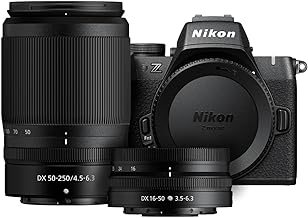
The Nikon Z50 II updates Nikon's compact APS-C mirrorless body with a much newer processor, bringing subject-detection autofocus that recognizes people, animals, birds, and vehicles to a body small enough for everyday carry.
That autofocus upgrade is the headline change over the original Z50, letting the camera track moving subjects with far less manual intervention than older Nikon APS-C bodies required.
The kit tested here bundles two lenses covering a wide-angle to short telephoto range, giving new owners a usable kit for travel, portraits, and casual wildlife shots without buying additional glass right away.
A vari-angle touchscreen supports both stills composition at odd angles and vlogging-style video, though the body sticks with a single SD card slot and skips in-body stabilization to stay compact and affordable.
Bottom line: the Z50 II is a strong entry point into Nikon's Z-mount system for travelers and everyday shooters who want modern autofocus without a large body or a steep price.
- 20.9MP APS-C CMOS sensor
- EXPEED-generation image processor with subject-detection autofocus
- Up to 11fps burst shooting
- 4K UHD video up to 60p (cropped)
- Vari-angle touchscreen
- Single SD (UHS-I) card slot
- Two-lens kit included (wide-angle and telephoto zoom)
Subject-detection autofocus automatically recognizes and tracks people, animals, birds, and vehicles, a meaningful step up from the autofocus in Nikon's earlier compact APS-C bodies.
4K video is available up to 60p with a sensor crop, which is worth checking against your framing needs if video is a priority alongside stills.
The Z50 II fits travelers and everyday shooters who want a small, light body with modern autofocus and a two-lens kit ready to go without additional purchases.
Photographers who need dual card slots or in-body stabilization for professional or low-light handheld work should look at a higher-tier body instead.

Pros
- 5-axis in-body stabilization helps handheld shots in low light
- Compact, retro-styled body is easy to carry all day
- Flip-down selfie screen suits vlogging and self-portraits
- Micro Four Thirds lenses are smaller and lighter than APS-C or full-frame equivalents
Cons
- Contrast-detect autofocus is slower to lock onto moving subjects than hybrid systems
- Smaller sensor gathers less light in dim scenes than APS-C or full-frame bodies
The OM System Olympus E-M10 Mark IV is built around a simple idea: make a mirrorless camera small and light enough that people actually carry it, without giving up in-body stabilization or a real lens system.
Its 5-axis stabilization noticeably helps handheld shots in dim restaurants, museums, and evening streets, areas where a smaller Micro Four Thirds sensor would otherwise be at a disadvantage against APS-C or full-frame bodies.
A flip-down touchscreen makes it easy to frame selfies or vlogging shots, and the retro-styled body keeps physical dials for exposure compensation and shooting mode within easy reach.
Autofocus relies on a contrast-detect system rather than the phase-detect and AI subject tracking found on newer Canon, Sony, and Nikon bodies, so it can be slower locking onto subjects that move unpredictably.
Bottom line: for travel and everyday photography where a small, light kit matters more than the fastest autofocus, the E-M10 Mark IV remains an easy camera to recommend.
- 20MP Micro Four Thirds sensor
- 5-axis in-body image stabilization
- Flip-down 3-inch touchscreen
- 4K30p video
- Built-in Wi-Fi and Bluetooth
- 121-point contrast-detect autofocus
- Compact, lightweight body
The retro-inspired body keeps physical dials for common settings within reach, and its small size and light weight make it easy to carry all day without a dedicated camera bag.
It is not weather-sealed to the same degree as the Panasonic LUMIX G9, so it suits everyday and travel use more than harsh outdoor conditions.
Micro Four Thirds lenses from OM System, Olympus, and Panasonic are consistently smaller and lighter than APS-C or full-frame equivalents covering the same focal length, which keeps the whole kit compact.
That smaller mount also means telephoto lenses are lighter and less expensive than full-frame options with similar effective reach.
Mirrorless Cameras Buying Guide
Unlike a broad camera roundup that has to weigh DSLRs, compacts, and mirrorless bodies against each other, shopping for mirrorless cameras specifically means every option already shares the same basic design: no mirror, no optical viewfinder, and a lens mount built for a smaller, lighter body. That still leaves a lot of ground to cover. The six factors below are what separated our picks from the rest of the field.
Sensor Size and Image Quality
Sensor format is the single biggest factor in how a mirrorless camera performs, and it touches everything from low-light noise to how much a lens costs. Full-frame sensors, like the ones in the Canon EOS R8, Canon EOS R6 Mark II, and Sony Alpha 7 IV, gather the most light and produce the cleanest files in dim rooms or at night, which is why they dominate the higher end of this list. APS-C sensors, used in the Canon EOS R7, Canon EOS R100, Sony Alpha a6000, and Nikon Z50 II, are smaller and more affordable while still delivering sharp, detailed images in good light, and the crop factor works in a shooter’s favor when photographing distant wildlife or sports. Micro Four Thirds, found in the Panasonic LUMIX G9 and OM System E-M10 Mark IV, is smaller still, which shrinks both the camera and its lenses considerably.
None of these formats is objectively “best.” A full-frame body makes the most sense for low-light work, shallow depth of field, and maximum resolution. An APS-C camera is the sensible middle ground for most everyday shooting and for anyone who wants extra reach without paying for a long, heavy full-frame telephoto lens. Micro Four Thirds rewards photographers who prioritize a small, light kit they’ll actually carry every day over the last bit of image quality.
Lens Mount and Ecosystem

A camera body is only half the purchase. Canon’s RF mount (and the APS-C RF-S variant used by the EOS R7 and EOS R100) has grown quickly but still trails Sony’s E-mount, which has been open to third-party lens makers for over a decade and now covers nearly every focal length and price point. Nikon’s Z-mount, used by the Z50 II, is newer for APS-C bodies but shares full-frame Z glass through an adapter. Micro Four Thirds is the most mature small-sensor mount around, with the Panasonic LUMIX G9 and OM System E-M10 Mark IV both drawing from a combined catalog built by Olympus, OM System, and Panasonic over more than a decade.
Before buying a body, check what lenses actually exist for that mount in the focal lengths you shoot most. A wide selection of affordable primes and zooms matters more day to day than a spec sheet, especially for anyone planning to build out a kit over several years rather than buying everything at once.
It is also worth checking whether a mount uses a full APS-C variant or shares hardware with its full-frame sibling. Canon’s RF-S lenses only cover the smaller APS-C sensor but can still mount on a full-frame RF body with an automatic crop, which gives owners of the EOS R7 or EOS R100 a path to full-frame glass down the road without switching systems entirely.
Autofocus Speed and Subject Tracking

Autofocus is where mirrorless cameras pulled decisively ahead of DSLRs, and it is also where the gap between models on this list is widest. The Canon EOS R8, Canon EOS R6 Mark II, and Nikon Z50 II all use recent processors with subject-detection autofocus that recognizes people, animals, and vehicles and keeps a focus point locked on them as they move through the frame. The Canon EOS R7 pushes that same technology to fast burst rates aimed squarely at wildlife and sports. Older or more basic designs, like the Sony Alpha a6000’s phase-detect system or the Panasonic LUMIX G9 and OM System E-M10 Mark IV’s contrast-detect systems, still lock focus reliably on stationary or slow-moving subjects but ask more of the shooter when tracking something fast and erratic.
Anyone photographing kids, pets, or sports should weigh autofocus sophistication as heavily as sensor size. A camera that nails focus on a moving subject nine times out of ten is more useful in practice than one with a slightly larger sensor and a focus system that requires more manual intervention.
Electronic Viewfinder and Handling
Every camera here replaces the optical viewfinder of a DSLR with an electronic one, which shows a live preview of exposure, white balance, and depth of field before the shutter fires. Higher-resolution EVFs, like the one on the Panasonic LUMIX G9, make manual focusing and reviewing fine detail easier in bright daylight. Compact bodies such as the Canon EOS R100, Sony Alpha a6000, and OM System E-M10 Mark IV trade some viewfinder size and grip depth for a lighter kit that’s easier to carry all day, while larger grips on the Canon EOS R6 Mark II and Sony Alpha 7 IV suit shooters using bigger telephoto or zoom lenses.
Video Capabilities
Nearly every mirrorless camera on the market now shoots respectable video, but the details vary widely. Oversampled 4K, where the sensor captures more resolution than the final video file and downscales it for extra sharpness, is available on the Canon EOS R8, Canon EOS R6 Mark II, and Canon EOS R7, all rated up to 4K60p. The Sony Alpha 7 IV records 4K60p with an additional sensor crop, while the Nikon Z50 II offers 4K up to 60p with a similar tradeoff. The Panasonic LUMIX G9 was built with video as a priority from the start and still holds up well for 4K60p footage. Budget-oriented bodies like the Canon EOS R100 and Sony Alpha a6000 are the exceptions, with more limited or, in the case of the a6000, no 4K recording at all.
In-Body Stabilization and Build Quality

In-body image stabilization (IBIS) shifts the sensor itself to counteract handshake, which steadies both photos and video without relying on a stabilized lens. The Sony Alpha 7 IV, Canon EOS R6 Mark II, Canon EOS R7, Panasonic LUMIX G9, and OM System E-M10 Mark IV all include it, each rated for several stops of correction. The Canon EOS R8, Canon EOS R100, Sony Alpha a6000, and Nikon Z50 II skip IBIS to keep the body smaller and lighter, which means a stabilized lens or a steadier hand matters more for handheld shots at slower shutter speeds. Weather sealing is another build-quality factor worth checking: the Canon EOS R6 Mark II, Canon EOS R7, and Panasonic LUMIX G9 are sealed against dust and light moisture, which matters for anyone shooting outdoors regularly rather than keeping a camera in a bag most of the time.
| Sensor Format | Strengths | Tradeoffs |
|---|---|---|
| Full-Frame (Canon EOS R8, EOS R6 Mark II, Sony Alpha 7 IV) | Best low-light performance, shallow depth of field, highest overall image quality | Larger, heavier lenses; pricier glass |
| APS-C (Canon EOS R7, EOS R100, Sony a6000, Nikon Z50 II) | Smaller and lighter kit, extra effective reach with telephoto lenses | Somewhat noisier files in very low light than full-frame |
| Micro Four Thirds (Panasonic LUMIX G9, OM System E-M10 Mark IV) | Smallest, lightest bodies and lenses; huge compact telephoto reach | Smallest sensor of the three, more noise in dim scenes |
For more buying guides across every category we cover, browse our full electronics picks or head back to the articles hub.
Why You Should Trust Us
We built this list by comparing publicly available specifications, real owner ratings, and review volume for each camera, then narrowing the field down to models that are genuinely mirrorless, in current production, and distinct enough from one another to serve different kinds of buyers. We deliberately excluded DSLRs, fixed-lens compacts, and cameras that are just a different color or lens bundle of a model we’d already covered, so every entry on this list represents its own sensor format, price tier, or use case rather than padding the count with duplicates.
We also cross-checked autofocus, video, and stabilization claims against each manufacturer’s own published specifications rather than repeating marketing copy at face value, and we update this guide as new bodies launch or older ones get discontinued.
Our editorial team covers consumer electronics year-round, and the picks here reflect the same standard we hold every guide on this site to: no filler entries, no unpaid placements, and no camera included just to round out a number. If a category does not have enough genuinely distinct mirrorless models to fill out a longer list, we would rather publish a shorter, more useful one.
Final Thoughts
For most photographers moving into mirrorless for the first time or upgrading from an older DSLR, the Canon EOS R8 is our Best Overall pick. It pairs a full-frame sensor with the same autofocus system found in Canon’s higher-end bodies, all in a body light enough to carry all day, and its oversampled 4K60p video means it can double as a capable video camera without an external recorder.
Anyone who wants a real mirrorless system without committing to full-frame prices should look at the Canon EOS R100, our Best Value pick. It trades some speed and video sophistication for one of the lowest entry points into an interchangeable-lens mirrorless kit, complete with a lens included. Shooters who photograph fast wildlife or sports should skip straight to the Canon EOS R7 for its high burst rate and extra APS-C reach, while anyone building a small, light travel kit will get more day-to-day enjoyment out of the OM System E-M10 Mark IV or the Panasonic LUMIX G9’s more video-focused Micro Four Thirds body. For a broader comparison that includes DSLRs and compacts alongside mirrorless bodies, our camera buying guide is the better starting point.
FAQs
What makes mirrorless cameras different from a DSLR?
A mirrorless camera removes the mirror and optical viewfinder mechanism found in a DSLR, showing a live digital preview through an electronic viewfinder or the rear screen instead. That simpler design lets manufacturers build lighter bodies, and it also allows faster, more sophisticated autofocus systems that track moving subjects across the entire frame rather than a limited set of focus points.
Do I need a full-frame sensor for mirrorless cameras in 2026?
Not necessarily. Full-frame sensors deliver the cleanest low-light performance and the shallowest depth of field, but APS-C and Micro Four Thirds bodies on this list produce excellent results for everyday photography, travel, and even wildlife, often at a lower cost and in a smaller kit. Choose sensor size based on what and where you shoot most, not just the biggest spec on paper.
Can these mirrorless cameras shoot good video as well as photos?
Most of the cameras on this list handle 4K video well, particularly the Canon EOS R8, Canon EOS R6 Mark II, and Sony Alpha 7 IV, all of which oversample or otherwise process 4K footage for extra sharpness. Budget-focused models like the Canon EOS R100 and Sony Alpha a6000 are more limited on the video side, so anyone who shoots video as often as stills should weigh that when choosing between our picks.
Is in-body stabilization worth prioritizing?
In-body stabilization helps most with handheld video, low-light stills, and using older or non-stabilized lenses. If you mostly shoot in good light with a tripod or a stabilized lens already in hand, a camera without IBIS, like the Canon EOS R8 or Nikon Z50 II, will not hold you back. If you shoot handheld in mixed lighting often, prioritize one of the stabilized bodies on this list.
Where can I compare mirrorless cameras against DSLRs and compact cameras?
Our category pages break down every type of camera we cover, and our dedicated camera buying guide compares mirrorless models against DSLRs and fixed-lens compacts side by side if you have not fully committed to a mirrorless system yet.



Write Your Review
No reviews yet. Be the first to share your experience!