

Establishing flat baselines, checking foundation forms, and setting true elevations across an active building site can challenge any crew when manual optical instruments or standard bubble vials fall short. When excavating trenches, pouring commercial slabs, or terracing large properties, an out-of-level reading creates structural settling risks, improper water drainage, and expensive rework that eats through project margins. Equipping your crew with a dependable self leveling rotary laser eliminates guesswork by projecting a continuous three hundred sixty degree reference plane across hundreds of feet in every direction. For our comprehensive analysis, we compared 7 self leveling rotary laser options from SpectraPrecision, Johnson, Topcon for October 2026 to find the most capable layout equipment on the market today.
Whether you manage heavy civil grading projects or residential framing jobs, having an accurate beam transmitter keeps your entire crew aligned from the initial dig to the final inspection. Our team regularly investigates rugged equipment for our tools and home improvement catalog to highlight gear that withstands harsh site conditions. Our top pick is the Topcon RL-H5A Self-Leveling Construction Laser for its exceptional 800-meter operating range and reliable electronic self-leveling performance.

Pros
- Massive 800-meter operating diameter
- Rugged IP66 water and dust protection
- Precise electronic self-leveling to ±10 arc seconds
- Up to 100 hours of runtime on D cell batteries
Cons
- Grade matching requires manual adjustment without digital entry
- Excessive reach and size for simple indoor leveling tasks
The Topcon RL-H5A is an industrial-grade horizontal rotary laser designed for general construction, flatwork, and excavation grading. Engineered to handle expansive exterior jobs, it caters directly to general contractors, earthmovers, and concrete crews who require consistent accuracy over long distances.
Its standout capability is an 800-meter working diameter paired with an accuracy rating of ±10 arc seconds. Powered by electronic self-leveling motors that activate with a single button push, the instrument also features an IP66 weather rating, ensuring it remains fully operational through sudden downpours and blowing dust.
While the tool delivers exceptional outdoor performance, its slope capabilities require manual leveling rather than motorized dual-axis grade entries. Tradespeople working exclusively on interior alignment, such as cabinetry installers or finish carpenters, will find its exterior-focused feature set and receiver setup excessive for simple room leveling.
Bottom line: The Topcon RL-H5A offers best-in-class exterior reliability, long battery life, and rapid automatic leveling, making it a dependable choice for demanding outdoor job sites.
- Working Range: 800 meters (2,626 feet) diameter
- Leveling Accuracy: ±10 arc seconds
- Self-Leveling Range: ±5 degrees
- Environmental Rating: IP66
- Laser Output: Class 2, 0.9mW
- Battery Life: Up to 100 hours (D cells) or 60 hours (rechargeable)
- Dimensions: 18 inches L x 16 inches W
- Housing Material: Plastic
- Topcon RL-H5A rotary laser
- LS-80L laser receiver
- Laser receiver holder
- User manual
This rotary laser is engineered primarily for earthwork contractors, concrete flatwork specialists, and excavation crews working on open job sites. Its 800-meter operating reach and fast electronic self-leveling make setting footings, grading foundations, and checking drainage runoffs efficient over vast project areas.
It is less suited for homeowners or interior craftspeople tackling small-room remodeling. Trades focusing solely on indoor jobs like tiling, drywalling, or trim installation will be better served by a compact multi-line interior laser.

Pros
- Expansive 2000-foot working diameter
- Rugged IP66 dust and washdown resistance
- Complete kit with tripod, grade rod, and detector
- Versatile 90-degree split beam layout capability
Cons
- Lacks slope and grade matching functionality
- Heavy total kit weight at over 37 pounds
- Uses alkaline batteries rather than a rechargeable lithium pack
The Johnson Level & Tool 99-027K is a heavy-duty rotary laser system engineered for commercial contractors, excavators, and landscapers. Designed to establish level references across vast distances, it comes complete with the foundational tools needed for solo operation right out of the box.
The standout feature of this setup is its expansive 2000-foot working diameter paired with an IP66-rated housing. This ingress protection ensures the laser mechanism survives severe jobsite dust and direct water exposure, while the included detector and 13-foot grade rod make setting elevations straightforward across large work areas.
Users needing complex slope matching or dual-axis grade calculation should look elsewhere, as this unit focuses strictly on flat horizontal and vertical alignment. Additionally, the entire system weighs over 37 pounds in its hard-shell case, requiring some effort to haul across jobsites.
Bottom line: If your daily tasks require rugged durability and extensive outdoor coverage without the need for sloped grading calculations, this turnkey rotary kit delivers outstanding utility and reliable layout precision.
- Working Diameter: 2000 feet
- Housing Protection: IP66 dustproof and washdown rated
- Laser Classification: Class IIIa (up to 5mW output)
- Beam Type: Red horizontal and 90-degree vertical split beam
- Total System Weight: 37.2 pounds
- Primary Material: Metal construction
- Warranty: 3-year limited warranty
- Power Source: Four C alkaline batteries for laser, 9V for detector
- Johnson 99-027K self-leveling rotary laser
- Heavy-duty contractor tripod
- 13-foot grade rod
- Laser detector with mounting clamp and 9V battery
- Four C alkaline batteries
- Magnetic laser target
- Tinted laser glasses
- Hard-shell contractor carrying case
- Instruction manual
This rotary laser kit is built specifically for exterior construction professionals, concrete flatwork contractors, and excavation teams managing expansive outdoor sites. The 2000-foot working range ensures ample coverage for large commercial pads, parking structures, and residential foundations.
Solo operators will appreciate the included laser detector and grade rod, which allow one person to check elevations and grade benchmarks across a jobsite without requiring an assistant at the tripod station.
Homeowners or interior renovators doing simple indoor framing will likely find the heavy-duty kit oversized for small rooms, making it best reserved for serious outdoor and ground-level projects.

Pros
- Turnkey kit with tripod, grade rod, detector, and hard case
- Impressive 800-foot working range covers expansive outdoor yards
- Locking compensator safeguards internal assembly during transit
- Dual power convenience with rechargeable NiMH pack and 6V charger
Cons
- Vertical plane requires manual leveling rather than self-leveling
- Full system kit is relatively heavy to carry at 34.3 pounds
The Johnson 99-026K Self-Leveling Rotary Laser System provides a comprehensive layout solution for residential contractors, deck builders, and serious property owners. Designed primarily for exterior grading, concrete footings, and interior ceiling installations, it gives you the essential tools needed for one-person leveling operations.
Its standout capability is an expansive 800-foot working diameter when paired with the included detector. Adjustable rotation speeds between 200 and 600 RPM let you balance laser brightness and battery efficiency, while visual and audible out-of-level alarms prevent costly measurement mistakes on active jobsites.
While it self-levels horizontally, vertical alignment requires manual adjustment using the built-in illuminated vial. Crews that require fully automatic dual-axis leveling or need an ultralight setup may find the 34.3-pound total kit weight cumbersome to move across multiple work areas.
Bottom line: For residential foundation work, grading, and interior build-outs, this turnkey kit delivers reliable precision, rugged transport protection, and every critical accessory right out of the box.
- Working Range: Up to 800-foot diameter with detector
- Leveling Type: Horizontal self-leveling, manual vertical leveling
- Rotational Speeds: Variable 200 to 600 RPM
- Laser Classification: Class IIIa, maximum output 5mW or less
- Power Source: NiMH rechargeable battery pack with 6V charger
- Kit Dimensions: 14.5 inches long by 50 inches wide
- Total Weight: 34.3 pounds
- Materials: Metal and heavy-duty plastic construction
- Warranty: 3-year limited manufacturer warranty
- Johnson 99-026K rotary laser level
- Full-size aluminum contractor tripod
- 13-foot grade rod
- Laser detector with mounting clamp and 9V battery
- Rechargeable NiMH battery pack and 6V wall charger
- Drop ceiling and wall mounting bracket
- Magnetic target and tinted laser enhancement glasses
- Rugged hard-shell carrying case
This rotary laser system is built for general contractors, deck builders, landscapers, and ambitious homeowners handling outdoor grading and excavation. Packing the tripod, rod, and detector together makes it an effortless all-in-one purchase for solo layout work.
Commercial framers who frequently perform plumb-line work may prefer a system that self-levels in both the horizontal and vertical planes automatically. However, for flatwork, septic tank digging, footings, and acoustic ceiling installation, this package offers dependable precision and great utility.

Pros
- Expansive 1,650-foot diameter range
- Rugged IP66 drop-resistant housing
- Complete all-in-one kit with tripod and rod
- Long-term 5-year manufacturer warranty
Cons
- Total kit weight is relatively heavy at 32 pounds
- Red beam requires digital receiver for outdoor visibility
- Grade rod is marked in tenths rather than inches
The Spectra Precision LL300N-1 is a heavy-duty rotary laser kit engineered for professional grading, site preparation, and concrete foundation work. Offering a complete field setup in a single package, it targets commercial contractors, concrete crews, and excavators who demand dependable one-person elevation control across wide working areas.
Its primary strength lies in its durability and jobsite resilience. Protected by a metal sunshade and an IP66 weather rating, the rotary unit can withstand direct drops of up to 3 feet onto concrete and tripod tip-overs up to 5 feet. The 1,650-foot diameter range, paired with 3/32-inch leveling accuracy and the HL450 digital receiver, allows operators to take accurate long-range measurements quickly using simple one-button automatic leveling.
However, the complete kit is fairly bulky to transport across large jobsites, weighing 32 pounds inside its all-in-one carrying case. Additionally, the included GR151 grade rod is calibrated in tenths of a foot, which may require an adjustment period for workers who routinely work with standard fractional inches.
Bottom line: The Spectra Precision LL300N-1 provides an exceptionally tough, accurate leveling solution with an expansive working range and an all-in-one kit design that makes it a premier pick for commercial builders.
- Operating Range: 1,650 feet (500 meters) diameter
- Leveling Accuracy: 3/32 inch
- Leveling Type: Automatic self-leveling red beam
- Housing Material: Aluminum with metal sunshade
- Durability Rating: IP66 water and dust protection
- Drop Rating: 3 feet to concrete, 5 feet tripod tip-over
- Dimensions: 8.3 inches long by 7.1 inches wide
- Total Weight: 32 pounds
- Manufacturer Warranty: 5 years
- Spectra Precision LL300N rotary laser level
- HL450 digital readout receiver with C45 clamp
- Q104025 aluminum construction tripod
- GR151 15-foot grade rod (tenths)
- 4 D-cell alkaline batteries
- Multi-language operating manual
- Hard-shelled all-in-one carrying case
This kit is tailored for general contractors, foundation crews, and excavation operators who need reliable, one-person elevation control. The expansive 1,650-foot working diameter easily accommodates large commercial building pads and roadway projects.
It is also a great fit for crews working in harsh outdoor environments. Thanks to the IP66 water and dust seal along with heavy-duty drop protection, the equipment can handle rain, dust, and unexpected jobsite mishaps without downtime.
Homeowners or casual DIYers handling small interior remodeling projects should likely pass on this system, as compact interior cross-line lasers are lighter and better matched for indoor layout tasks.

Pros
- Dual-axis horizontal and vertical self-leveling
- Programmable 5-degree dual-slope capability
- Complete kit includes grade rod, tripod, and detector
- Visual and audible out-of-level security alerts
- Flexible dual-power battery compatibility
Cons
- Total kit weight of 35.3 pounds requires extra effort to transport
- Outdoor sighting requires using the detector due to red beam visibility
- Alkaline backup batteries are not included in the package
The Johnson Level & Tool 99-028K is an electronic rotary laser system engineered for demanding outdoor site preparation and indoor layout tasks. Built for flatwork contractors, excavators, and commercial framing crews, it effortlessly handles grade checks, vertical post alignment, footings, and track installations.
Its primary strength lies in its dual-axis electronic self-leveling coupled with a programmable dual-slope mode. Users can set slopes up to 5 degrees without manual math, while visual flashes and audible sirens sound immediately if the unit shifts out of level, saving crews from expensive grading mistakes.
Because this full kit includes a metal tripod, 13-foot grade rod, detector, and hard case, the entire setup weighs 35.3 pounds, making it bulky for quick single-person jobs. In addition, the red laser beam requires relying on the included detector for outdoor daylight tasks where the line cannot be seen with the naked eye.
Bottom line: The Johnson 99-028K is a dependable, professional-grade rotary laser kit that takes the complexity out of slope work and delivers turnkey precision on the jobsite.
- Brand: Johnson
- Model Number: 99028K
- Laser Classification: Class IIIa, maximum power output 5mW or less
- Leveling Mechanism: Electronic horizontal and vertical self-leveling
- Slope Range: Up to 5-degree programmable dual slope
- Material: Metal
- Total Weight: 35.3 pounds
- Dimensions: 50 inches L x 14.69 inches W
- Warranty: 3-Year Limited Manufacturer Warranty
- Johnson 99-028K Electronic Dual Slope Rotary Laser
- Rechargeable NiMH battery pack and 6.4V charger
- Alkaline battery compartment (alkaline batteries not included)
- Laser detector with mounting clamp and 9V battery
- Remote control and batteries
- Contractor tripod
- 13-foot grade rod
- Magnetic target and tinted glasses
- Hard-shell contractor carrying case
The system features a Class IIIa laser operating at 5mW or lower output. Avoid looking directly into the laser aperture during operation, and use the included tinted glasses to spot the beam indoors rather than as protective safety eyewear.
Always transport and store the unit inside its hard-shell carrying case to protect internal electronics and leveling sensors from jobsite drops and vehicle vibration. Keep the glass beam enclosure free of dirt, oil, and dust by wiping it with a clean, soft cloth.
If storing the system for long periods during the off-season, remove the NiMH battery pack and any alkaline cells from the compartments to avoid corrosion and extend component life.
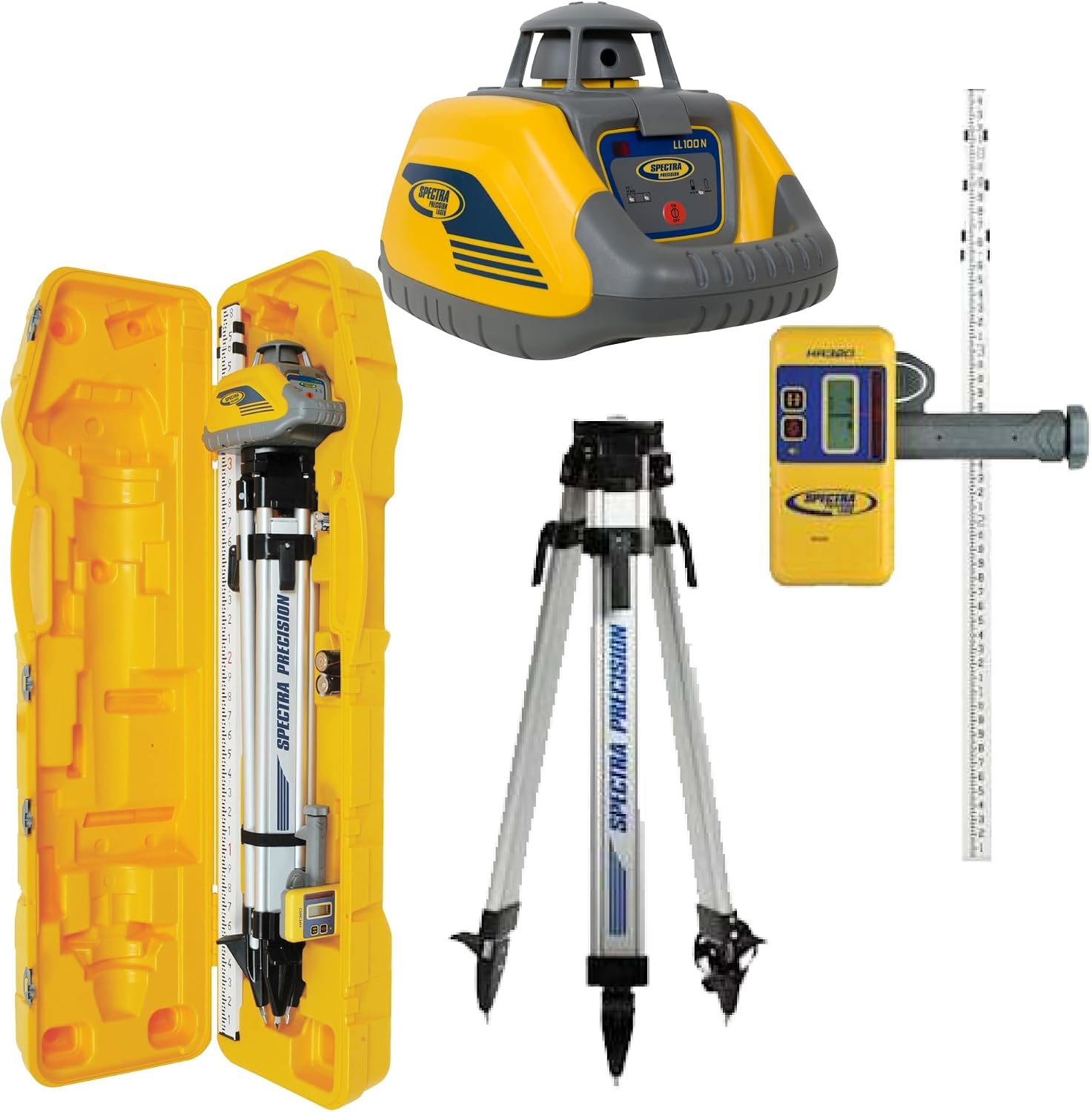
Pros
- Complete all-in-one kit packed in a single portable case
- Height of Instrument alert prevents accidental misreadings
- Durable housing withstands concrete drops and tip-overs
- Simple one-button automatic self-leveling operation
Cons
- Grade rod is calibrated in inches rather than engineering tenths
- Remote control is not included in the standard kit
The Spectra Precision LL100N-2 is a fully automatic rotary laser kit engineered for residential builders, concrete contractors, and excavation teams. Packed into a single hard-shell case, it provides everything a single operator needs to establish accurate elevations and grade lines across the work area.
Its straightforward one-button interface delivers fast automatic self-leveling with minimal setup time. The system covers up to a 1,000-foot diameter when paired with the included HR320 receiver. Additionally, a built-in Height of Instrument alert halts the laser if the unit is knocked or jarred, protecting your project from inaccurate measurements.
While the rugged metal housing withstands direct drops onto concrete, this bundle features a 15-foot grade rod marked in inches, which may not suit surveyors who require engineering tenths. Furthermore, users who prefer remote adjustments must purchase a compatible remote control separately.
Bottom line: The Spectra Precision LL100N-2 provides an all-in-one elevation control solution that pairs jobsite durability with straightforward one-person operation for reliable daily performance.
- Brand: Spectra Precision
- Model Number: LL100N-2
- Material: Metal
- Item Weight: 15 pounds
- Working Range: Up to 1,000-foot diameter (570-foot radius with receiver)
- Measurement Units: Inches, feet
- Operation Mode: Automatic self-leveling
- Warranty: 3 Year Limited Warranty
- Spectra Precision LL100 laser transmitter
- HR320 digital laser receiver
- C59 rod clamp
- 15-foot telescopic aluminum grade rod in inches
- Adjustable tripod
- Rigid system carrying case
- Alkaline batteries and user instructions
This rotary laser kit is tailored for general contractors, landscapers, and residential excavation crews seeking a complete leveling solution straight out of the box. Its one-person operation makes checking elevations, leveling footers, and setting concrete forms efficient without requiring an extra crew member.
It also suits small commercial builders working on patios, septic systems, swimming pools, and foundations where straightforward setup and dependable drop protection are essential.

Pros
- Complete all-in-one kit with tripod, grade rod, and detector
- Locking compensator protects internal components during transport
- Audible and visual alerts flag out-of-level conditions
- Adjustable rotational speeds for distinct jobsite environments
Cons
- Vertical alignment requires manual leveling adjustments
- Heavier total kit weight at over 18 pounds
The Johnson Level & Tool 40-6517 is a comprehensive rotary laser system built for small construction sites, residential remodeling, and DIY land leveling projects. It provides a full toolkit designed to assist with foundational groundwork, patio grading, acoustic drop-ceiling layout, and wall framing.
When used horizontally, the unit automatically self-levels and alerts operators with audible and visual indicators if it gets knocked out of calibration. Variable rotational speeds of 200, 400, and 600 RPM allow users to balance visual beam tracking indoors against rapid receiver acquisition outdoors, while a built-in transport lock protects the delicate internal pendulum.
While the horizontal axis levels automatically, setting up vertical alignments requires manual adjustments using an illuminated vial. Contractors who routinely need automated dual-axis self-leveling for extensive plumbing and squaring jobs might find the manual vertical operation slower than dedicated electronic dual-slope models.
Bottom line: The Johnson Level & Tool 40-6517 is a dependable, turnkey rotary package that gives builders, landscapers, and drywall installers everything needed to establish flat and reliable elevations right out of the case.
- Laser Classification: Class IIIa, maximum output 5mW or less
- Leveling Type: Automatic horizontal self-leveling, manual vertical leveling
- Rotational Speeds: 200, 400, and 600 RPM
- Item Dimensions: 4.96 inches L x 6.69 inches W
- Total Weight: 8.62 kg
- Primary Materials: Metal, Wood
- Warranty: 3-year limited manufacturer warranty
- Johnson Level & Tool 40-6517 rotary laser
- Elevating tripod
- 8-foot grade rod
- Laser detector with mounting clamp
- Wall and ceiling mount bracket
- Tinted laser enhancement glasses and magnetic target
- Hard-shell carrying case and alkaline batteries
This rotary laser kit is tailored for general contractors, deck builders, landscapers, and residential remodelers who need a full grade-setting setup without sourcing extra accessories separately. The included grade rod and detector make it suitable for single-person site grading and foundation checks.
Drywallers and ceiling installers will benefit from the included wall and ceiling bracket for overhead grid alignment. However, commercial crews requiring automated vertical plumbing or programmable dual-slope grading will prefer an advanced electronic dual-axis laser.
How to Choose the Best Self Leveling Rotary Lasers: Buying Guide
Working Range and Operational Diameter

Evaluating the operational diameter of a rotary laser is vital because jobsite requirements vary drastically between tight residential foundations and expansive commercial developments. Working diameter refers to the full circular coverage area generated by the rotating transmitter head, which is double the operational radius from the central tripod. If you oversee large commercial earthmoving or multi-acre pad grading, investing in extensive range capability ensures you do not waste valuable daylight repositioning your tripod setup. For immense projects, the Topcon RL-H5A Self-Leveling Construction Laser delivers an impressive 800-meter working diameter, translating to 2,626 feet of reliable radial coverage. Similarly, the Johnson Level & Tool 99-027K Self-Leveling Rotary provides a substantial 2000-foot working diameter, making it an excellent platform for large-scale grading where broad area coverage is paramount.
At distances beyond one hundred feet outdoors, natural daylight overpowers visible red laser lines, making digital laser receivers essential for grade detection. When transmitting signals across several hundred yards, atmospheric phenomena can distort line-of-sight clarity. As Johnson Level’s guide to rotary lasers points out, you will not be able to see the beam outside, so the receiver beeps to indicate a connection with the laser. Units such as the Spectra Precision LL300N-1 Rotary Laser Level Kit pair a 1650-foot working range with an HL450 digital receiver to ensure rapid signal capture through heat shimmer and bright sun. For more confined building plots, an instrument like the Johnson Level & Tool 99-026K Self-Leveling delivers an 800-foot working diameter that easily handles residential concrete framing, utility line trenching, and backyard patio grading.
Choosing an excessive range adds unnecessary cost if your routine tasks consist of indoor layout or single-family foundation forming, but underestimating range forces frequent repositioning. Every time a crew moves a tripod to extend coverage, cumulative benchmark transfer errors can sneak into elevation readings. When combining an exterior laser setup with manual bench checks using heavy duty contractor tape measures, maintaining an uninterrupted line of sight from a single central benchmark maintains structural consistency across your entire jobsite. Plan your primary site perimeter before selecting a laser system to ensure its rated reception diameter comfortably exceeds your furthest property boundary by at least twenty percent.
Self-Leveling Mechanisms and Elevation Accuracy

The mechanical leveling mechanism inside a rotary laser dictates how rapidly the transmitter stabilizes and how reliably it recovers when disturbed by vibration. High-end professional instruments rely on motorized electronic leveling systems that utilize internal tilt sensors to actuate precision leveling stepper motors automatically. For example, the Topcon RL-H5A Self-Leveling Construction Laser features electronic self-leveling accurate to plus or minus 10 arc seconds, operating within a plus or minus 5-degree self-leveling range to automatically correct itself if the housing is jostled. On the other hand, traditional entry-level tools often utilize wire-hung magnetic pendulum compensators, such as the mechanism found in the Johnson Level & Tool 99-026K Self-Leveling, which uses a locking compensator to safeguard internal pendulums during transit while offering horizontal self-leveling and manual vertical alignment.
Accuracy ratings on construction grade lasers are typically expressed in fractions of an inch over one hundred feet or in angular arc seconds. Because accuracy is stated per unit of distance, a tiny variance at thirty feet grows into a real discrepancy at several hundred feet. To mitigate catastrophic grade errors, modern tools feature Height of Instrument alerts that automatically halt beam rotation if the tripod settles in soft mud or gets struck by an excavator bucket. The Spectra Precision LL100N-2 Laser Level Kit integrates this alert mechanism, stopping rotation instantly to avoid broadcasting erroneous elevation benchmarks. Similarly, the Johnson Level & Tool 40-6517 Self-Leveling Rotary incorporates visual and audible alarms that siren if the instrument gets knocked outside its operating envelope.
Investing in rapid automatic leveling minimizes crew downtime during morning setups. With electronic self-leveling systems, operators can mount the unit, press a single power button, and begin shooting elevations within seconds without manual thumb-screw adjustments. In concrete flatwork where mix curing clocks are ticking, instant stabilization prevents pour delays and guarantees slab flatness across wide screed passes. For general contractors who transition between excavation, subgrade compacting, and finished carpentry, choosing an instrument with automatic motorized leveling provides dependable repeatability that manual bubble vial systems cannot match.
Slope Grading and Dual-Axis Drainage Layout

While standard horizontal leveling is essential for flat slabs, many exterior earthwork projects demand controlled slopes to facilitate proper water runoff away from structures. Rotary lasers generally fall into three grading categories: strictly horizontal transmitters, manual slope units, and fully programmable electronic dual-slope systems. If your daily operations involve complex parking lots, agricultural drainage, or ADA compliant access ramps, a dual-slope model is an invaluable asset. The Johnson Level & Tool 99-028K Electronic represents the advanced tier of this technology, offering a programmable 5-degree dual-slope mode that calculates grade percentages digitally, removing complex mathematical formulas from field operations.
For contractors who only tackle occasional drainage swales or driveways, a laser with manual slope capability provides sufficient flexibility without the premium cost of motorized dual-grade hardware. The Topcon RL-H5A Self-Leveling Construction Laser provides intuitive manual slope matching that allows the operator to tilt the beam along an axis while maintaining stability. Conversely, if your scope centers entirely on level footings, flat slabs, or subgrade leveling, the Johnson Level & Tool 99-027K Self-Leveling Rotary intentionally omits slope features to provide straightforward, error-free leveling without unnecessary settings. Uniform slope gradients help manage stormwater runoff, which makes accurate slope control valuable on any site.
Beyond horizontal grading, certain rotary units can be flipped onto their side mount to execute vertical plumb alignment. Instruments like the Johnson Level & Tool 99-028K Electronic self-level in both horizontal and vertical planes, allowing excavators to align perimeter fencing, verify foundation footing squareness, and layout drywall tracks. When running vertical slopes or horizontal elevations, always establish fixed physical grade stakes at opposite ends of your trench or pad to verify that the laser detector agrees with pre-engineered site plans before pouring concrete or burying drainage pipe.
| Product | Model Number | Operation Mode | Material Type |
|---|---|---|---|
| Topcon RL-H5A Self-Leveling Construction Laser | RL-H5A | Automatic | Plastic |
| Johnson Level & Tool 99-027K Self-Leveling Rotary | 99027K | Manual | Metal |
| Spectra Precision LL300N-1 Rotary Laser Level Kit | LL300N-1 | Automatic | Aluminum |
| Johnson Level & Tool 99-028K Electronic | 99028K | Automatic | Metal |
| Spectra Precision LL100N-2 Laser Level Kit | LL100N-2 | Automatic | Metal |
Housing Durability and Environmental Ingress Protection
Construction jobsites subject leveling instruments to abrasive silica dust, sudden downpours, concrete splatter, and vibrations from nearby heavy machinery. When comparing rotary laser specifications, the International Ingress Protection rating provides a reliable benchmark of environmental resistance. An IP66 rating indicates that the instrument housing is totally dust-tight and sealed against high-pressure water jets from any direction. Both the Topcon RL-H5A Self-Leveling Construction Laser and the Johnson Level & Tool 99-027K Self-Leveling Rotary feature IP66 construction, allowing crews to continue grading operations through sudden rainstorms or wash down mud encrusted housings at the end of the shift without damaging sensitive optical lenses.
Accidental tripod tip-overs remain the leading cause of internal calibration damage on commercial job sites. Because wind gusts or backing equipment can knock over a grading station, structural roll cages and protective housing materials are critical considerations. The Spectra Precision LL300N-1 Rotary Laser Level Kit incorporates a rugged design with a metal sunshade and hard hat rotary protection, shielding the glass lighthouse and rotary prism from direct impact during drops. OSHA’s construction rule for lasers requires that only qualified and trained employees install, adjust, and operate laser equipment, that areas where lasers are used be posted with standard laser warning placards, and that workers exposed to direct or reflected laser light above 5 milliwatts be given anti-laser eye protection. Lightweight options like the Spectra Precision LL100N-2 Laser Level Kit feature rugged drop protection engineered to reduce downtime from jobsite knocks.
Durability extends beyond the transmitter head to the storage case, receiver clamps, and support tripod. Complete kits like the Spectra Precision LL300N-1 Rotary Laser Level Kit and Johnson Level & Tool 99-027K Self-Leveling Rotary include heavy-duty hard-shell carrying cases that house the transmitter, detector, grade rod, and tripod in molded compartments. Protecting internal pendulums, glass pentaprisms, and motor assemblies during transport across rutted dirt tracks prevents costly calibration drift. Choosing a system with a metal tripod and robust clamping hardware ensures your base stays firmly anchored into soft subgrade throughout high-wind afternoon cycles.
Rotational Speed Settings and Laser Beam Visibility
The rotational speed of the laser head dictates whether the emitted beam appears as a solid visible line to the human eye or functions as a rapid pulse for electronic sensors. Rotary tools with variable rotational speeds, such as the Johnson Level & Tool 99-026K Self-Leveling with its 200 to 600 RPM range, give operators tactical control over line visibility. Lower rotational speeds, like 200 RPM, concentrate the beam along walls, making the red laser light much easier to see when installing acoustical drop ceilings, framing interior walls, or hanging cabinetry indoors. The Johnson Level & Tool 40-6517 Self-Leveling Rotary offers stepped speeds of 200, 400, or 600 RPM, allowing tradespeople to tailor output speed to ambient lighting conditions.
When working outdoors under intense sunlight, no red rotary laser line is consistently visible to the naked eye beyond thirty feet, requiring operators to bump the rotation to 600 RPM for digital receiver operation. At 600 RPM, the rapid pulse rate matches the sampling frequency of digital detectors, delivering smooth, lag-free audio beeps as the grade rod moves up and down. The FDA’s laser products page notes that Class IIIa lasers can be momentarily hazardous when directly viewed and that the risk of injury increases when viewed with optical aids, so never look into the beam or sight it through a transit scope. Instruments like the Johnson Level & Tool 99-027K Self-Leveling Rotary utilize powerful Class IIIa red beams engineered specifically for exterior receiver capture.
Certain rotary systems incorporate a 90-degree split beam that projects a plumb reference dot upward while the primary head spins horizontally. The Johnson Level & Tool 99-026K Self-Leveling provides a 90-degree split beam function that aids in squaring corners, plumbing tall partition walls, and aligning overhead mechanical tracks. When erecting heavy metal stud framing or aligning support beams alongside budget stick welders for metal fabrication, having that perpendicular vertical plumb line streamlines wall layout. Verifying whether an instrument includes interior wall mounts or magnetic targets ensures you can transition effortlessly from rough outdoor grading to detailed interior finish carpentry.
Power Source Flexibility and Jobsite Runtime
Battery longevity is a critical operational factor on large construction projects where power outlets are unavailable and work cannot halt for midday recharging. Rotary lasers typically operate on standard alkaline cells, rechargeable nickel-metal hydride packs, or hybrid battery compartments that accept both. For unmatched endurance, the Topcon RL-H5A Self-Leveling Construction Laser delivers an astounding 100 hours of continuous operation when powered by four D-cell alkaline batteries, or up to 60 hours using its dedicated rechargeable battery pack. This multi-day runtime ensures that earthwork contractors can run uninterrupted grading checks for weeks before needing a battery change.
Running out of power during an active concrete pour or while setting structural forms creates expensive logistical headaches. Systems that feature dual-power options eliminate downtime by allowing operators to swap dead rechargeable packs for readily available alkaline batteries. For example, the Johnson Level & Tool 99-028K Electronic includes a NiMH rechargeable battery pack with a 6.4V charger alongside an auxiliary alkaline battery tray. Consistent layout procedures help avoid compaction irregularities during subgrade preparation. Similarly, the Spectra Precision LL300N-1 Rotary Laser Level Kit runs on four standard D-cell alkaline batteries, making power replacement as simple as keeping a spare pack in the truck cab.
Cold winter conditions degrade battery performance significantly, reducing lithium and NiMH discharge rates on chilly morning job sites. To safeguard against unexpected shutdowns, always store battery packs inside the warm cab of your work vehicle before early morning setups. If using an instrument like the Johnson Level & Tool 40-6517 Self-Leveling Rotary that utilizes four AA alkaline batteries, keep fresh spares inside the system case alongside the detector batteries. Inspecting battery terminals regularly for corrosion caused by humid morning condensation ensures uninterrupted power delivery throughout long layout shifts.
Why You Should Trust Us
At Daily Deal Here, our editorial team brings decades of combined industry experience evaluating automotive, workshop, and construction tools. When identifying the premier self leveling rotary laser systems for trade professionals and serious owner-builders, we do not rely on manufacturer marketing claims or sponsored promotional content. Instead, our methodology centers on comprehensive technical spec analysis, verifying dimensional tolerances, optical range specifications, IP weather ratings, and internal leveling motor architectures directly against official engineering data.
We combine this detailed specification research with extensive evaluation of verified buyer feedback and long-term user reports. By analyzing recurring themes across hundreds of verified commercial contractor reviews, we identify real-world durability trends, case latches that hold up, receiver sensor accuracy in direct sunlight, and battery performance in harsh seasonal weather. We cross-reference manufacturer warranty programs and customer support responsiveness to ensure every recommended tool provides lasting jobsite value. Our unbiased editorial standards ensure you receive reliable, actionable equipment recommendations that help your crew work safely, efficiently, and with uncompromising precision on every job.
Final Thoughts
Selecting the right self leveling rotary laser transforms how quickly and accurately your crew executes site preparation, foundation footings, and drainage grading. Investing in an instrument with robust weather sealing, dependable self-leveling motors, and an intuitive detector eliminates costly elevation mistakes while allowing single-person grade checking across expansive acreage. Whether you are running complex commercial earthwork cuts or finishing a home foundation pour, matching your equipment range to your daily jobsite perimeter keeps your operations productive and within engineering tolerances.
Our top recommendation for commercial contractors and grading specialists is the Topcon RL-H5A Self-Leveling Construction Laser, which stands out for its unmatched 800-meter working diameter, rugged IP66 water and dust protection, and exceptional 100-hour battery runtime. For crews needing advanced slope calculations for complex drainage swales, road subgrades, or vertical wall layout, the Johnson Level & Tool 99-028K Electronic is our preferred specialized choice, offering programmable 5-degree dual-slope control and horizontal and vertical self-leveling. If you require an affordable yet dependable layout package for residential basements, flatwork, or pairing with cordless brad nailers for finish carpentry, the Johnson Level & Tool 40-6517 Self-Leveling Rotary provides outstanding value with an elevated tripod, grade rod, and multi-speed head in a complete starter kit.
Before heading to your next build site, inspect your grade rods, verify your detector clamps, and ensure your laser calibration matches local benchmark pins. Establishing consistent setup routines and pairing your transmitter with a reliable tripod guarantees that your grading and structural elevations stay rock-solid from the first excavation bucket to project completion.
Frequently Asked Questions About Self Leveling Rotary Lasers
How accurate is a self leveling rotary laser on outdoor construction sites?
A professional self leveling rotary laser typically delivers accuracy within one-sixteenth to one-eighth of an inch per one hundred feet, with high-end models offering precision accurate to plus or minus ten arc seconds. Electronic motorized self-leveling mechanisms continually monitor the transmitter tilt, automatically correcting for slight ground vibrations caused by passing compaction rollers or heavy excavators. When paired with a calibrated digital receiver, this high level of precision allows a single surveyor or grade checker to establish foundation footings, concrete form elevations, and drainage slopes across vast working diameters without cumulative optical errors.
Can you use a self leveling rotary laser in bright daylight without a digital receiver?
Using a self leveling rotary laser outdoors in direct sunlight without a digital receiver is generally impractical beyond thirty feet because natural ambient daylight washes out red laser wavelengths. Human eyes struggle to perceive the rotating red beam against dirt, concrete, or grade stakes in sunny conditions. Professional kits include a digital laser detector that clamps securely onto a grade rod to capture the high-speed laser pulses. The receiver provides directional LCD arrows and audible alert tones, enabling exact grade elevation checks across hundreds of feet even under intense noon sunlight.
What is the difference between manual leveling and a self leveling rotary laser?
A manual rotary laser requires the operator to center horizontal and vertical spirit vial bubbles by adjusting manual leveling screws before every single measurement. If the tripod shifts slightly during work, a manual tool continues projecting an incorrect plane until someone notices. Conversely, a self leveling rotary laser uses electronic motors or an internal pendulum to establish true level automatically once powered. Advanced models shut down rotation or sound audible alarms if knocked out of level. You can explore additional layout instruments across our archive of site layout buying guides to compare manual and automatic leveling setups.
How do I maintain calibration on my self leveling rotary laser through 2026?
To maintain calibration on your self leveling rotary laser through 2026, perform regular two-peg field checks between two rigid parallel walls spaced approximately one hundred feet apart. Mount the laser near the first wall, shoot a reference mark on both surfaces, and then move the instrument near the second wall to verify that elevation benchmarks correspond. Always secure the transit locking compensator before transporting the unit in a work vehicle. If the laser suffers an accidental tripod drop, immediately recheck calibration against a verified benchmark before resuming grading work.
What battery system is most dependable for a self leveling rotary laser on remote sites?
The most dependable power configuration for a self leveling rotary laser on remote jobsites is a hybrid system that supports both rechargeable packs and standard alkaline batteries. Commercial units using high-capacity D-cell alkaline batteries often run continuously for sixty to one hundred hours, providing weeks of reliable operation without relying on generator power. While rechargeable nickel-metal hydride packs reduce ongoing consumable expenses, keeping a secondary alkaline battery compartment loaded with fresh industrial cells in your kit ensures zero downtime if you forget to charge your battery pack overnight.

Write Your Review
No reviews yet. Be the first to share your experience!