

Noticing a faint sulfur odor near a furnace, water heater, or kitchen range creates instant anxiety for any homeowner or property manager. Because utility companies add mercaptan to render odorless natural gas perceptible, even a tiny whiff signals that volatile fuel could be escaping into your living space. Left unresolved, small leaks can slowly migrate through wall cavities, accumulate in basements, or create an immediate fire hazard. Having dependable detection equipment at hand allows you to confirm whether you have a minor loose fitting or an urgent emergency requiring immediate evacuation.
To help you safeguard your household and make an informed purchase, we compared 11 natural gas leak detectors options from Kidde Carbon, FirstAlert, RIDGID and more for October 2026. We examined continuous wall plug-in alarms, flexible gooseneck sniffers, and digital pens to determine which designs deliver the most dependable early warnings. For related home maintenance safety equipment, you can explore our broader collection of Tools & Home Improvement deals and reviews.
Our top pick is the Klein Tools ET120 Gas Leak Detector for its dual sensitivity ranges and extended flexible gooseneck probe.

Pros
- Dual detection for explosive fuel gases and carbon monoxide
- 9-volt battery backup maintains safety during power outages
- Digital LED display provides clear numerical gas readings
- Flexible setup with direct plug-in or included extension cord
Cons
- Bulky housing can obstruct the neighboring wall outlet
- Lacks smart app connectivity for remote smartphone alerts
The Kidde KN-COEG-3 is a versatile multi-gas alarm engineered to spot explosive fuel leaks and dangerous carbon monoxide buildup. It is built for homeowners, landlords, and renters relying on natural gas lines, propane heaters, or standard gas-powered appliances who want reliable, automated monitoring.
Combining an electrochemical carbon monoxide sensor with explosive gas detection saves wall space and eliminates clutter. The digital display actively presents carbon monoxide concentrations while clearly reading GAS during an explosive leak, accompanied by an ear-piercing 85-decibel horn. An included extension cord allows placement on a shelf or tabletop if wall outlet locations are awkward.
Because natural gas rises while propane sinks, finding a single compromise height can be tricky in homes using both fuel types. Shoppers seeking wireless push notifications sent straight to a smartphone will also want to look elsewhere, as this unit operates strictly as a standalone local siren.
Bottom line: Reliable dual-sensor monitoring, continuous outlet power, and battery backup make this Kidde alarm a dependable safeguard for any residence running fuel-burning equipment.
- Power Source: 120V AC with 9V alkaline battery backup
- Gases Detected: Natural gas (methane), propane, carbon monoxide
- Alarm Sound Level: 85 decibels
- Display Type: Digital LED readout with peak level recall
- Mounting Options: Direct wall outlet plug-in or tabletop via extension cord
- Certifications: UL Listed (UL 2034, UL 217, NFPA 72)
- Warranty: 10-year limited manufacturer warranty
This detector plugs directly into any standard 120-volt grounded wall outlet without requiring permanent electrical wiring. The included extension cord provides added flexibility, allowing you to position the detector on a nearby counter or shelf if wall outlets are blocked by furniture.
Because natural gas rises toward the ceiling while propane settles near the floor, placement should take into account the primary fuel source in your home. Position the unit near appliances such as water heaters, furnaces, or kitchen ranges, but keep it away from excessive grease or high-humidity zones like bathrooms to prevent nuisance triggers.
Regular upkeep ensures long-term reliability. Inspect the battery compartment periodically and replace the 9-volt backup battery at least once per year to guarantee continuous operation during power blackouts.
Keep the exterior vents clear of dust and pet hair using the soft brush attachment of a vacuum cleaner. Avoid spraying household cleaners, aerosol deodorizers, or paint directly near the unit, as lingering chemical vapors can foul the internal sensors.

Pros
- 12-inch flexible probe reaches tight spots
- Loud 85 dB audible alarm and 6-stage LED display
- Wide detection range for multiple combustible fuel types
- Fine-tuning sensitivity dial eliminates false readings
- Lifetime replacement warranty and support
Cons
- Manual sensitivity dial requires calibration before each use
- No digital numerical PPM readout display
- Bulky handheld wand design compared to pocket pen detectors
The EG Combustible Gas Leak Detector is a handheld sniffer designed for homeowners, RV travelers, and maintenance personnel who need to identify hazardous fuel and gas leaks. Its flexible 12-inch gooseneck probe makes it easy to inspect complex pipe arrangements, water heater fittings, and confined utility areas.
The device stands out with its multi-gas capability, detecting methane, propane, butane, and gasoline vapors. The combination of a loud 85 dB buzzer and six LED concentration lights gives prompt warning, while the manual sensitivity dial allows users to pinpoint the exact origin of a leak without background interference.
Because this model relies on LED indicator lights rather than a digital screen, it does not display precise numerical parts-per-million measurements. Users who require calibrated PPM readouts or prefer an ultra-compact pen-style tool might want to consider alternative diagnostic tools.
Bottom line: This versatile sniffer offers dependable leak detection and excellent reach around tricky fittings, making it a valuable safety device for household and workshop inspections.
- Target Gases: Methane, propane, butane, fuel, sewer gas, and other combustibles
- Probe Type: 12-inch flexible gooseneck sensor
- Audible Alarm: 85 dB buzzer
- Visual Alarm: 6-stage LED concentration indicator
- Sensitivity Control: Adjustable thumb dial
- Recommended Uses: Home safety, RV inspections, and HVAC maintenance
- Warranty: Lifetime replacement warranty
- Turn on the detector in fresh outdoor air away from any suspected gas source.
- Adjust the sensitivity dial until the alarm stops and the first LED indicator stabilizes.
- Slowly maneuver the 12-inch flexible probe around pipe joints, valves, regulators, and appliances.
- Watch the six LED indicators and listen for rapid sound pulses indicating higher gas concentrations.
- Turn the sensitivity dial down as you get closer to localize the precise leak point.
Store the detector in a clean, dry location free from solvent fumes, silicone vapors, and corrosive chemicals that could contaminate the sensitive probe tip.
Always verify unit operation in fresh ambient air before inspecting suspected leak locations, and evacuate the area immediately if high gas concentrations are detected.
Refer to the included 20-page digital gas safety guide for proper protocol when handling natural gas and propane hazards around your home or RV.

Pros
- Fast 0.5-second audible and visual warning response
- Sensors pick up methane, propane, butane, and natural gas
- Compact pen-style design with non-slip grip
- Comes with batteries and a dedicated storage pouch
Cons
- Requires 30 seconds of warm-up before scanning begins
- Scanning distance is limited to a narrow 1 to 5 cm range
- Rigid probe tip cannot bend around awkward corners
The TopTes PT199 is a compact, pen-style combustible gas detector created to identify leaks in natural gas lines, propane tanks, and kitchen appliances. Its portable build makes it an accessible diagnostic tool for homeowners, RV travelers, and DIY plumbing enthusiasts who want fast safety checks.
The unit responds within 0.5 seconds of encountering combustible vapors, triggering both a progressively louder buzzer and a high-visibility screen change. Detection covers concentrations from 50 to 1,000 ppm, and the package includes two AAA batteries along with a five-minute automatic shut-off feature to preserve power.
Because the sensor is fixed to the tip rather than mounted on a flexible gooseneck, checking behind tight appliance clearances or around convoluted pipe joints can be challenging. Those needing to inspect deep recesses or detect non-combustible gases should look toward models with articulated probes.
Bottom line: The PT199 is a dependable, pocket-friendly gas detector that provides fast audio-visual confirmation for routine household appliance inspections.
- Gases Detected: Natural gas, methane, propane, butane, and LPG
- Sensitivity Range: 50 to 1,000 ppm (methane calibration)
- Detection Distance: 1 to 5 cm
- Response Time: Less than 0.5 seconds
- Warm-Up Duration: Approximately 30 seconds
- Power Source: 2 AAA batteries (included)
- Battery Cutoff Threshold: Below 2.4 volts
- Automatic Shut-Off: 5 minutes of inactivity
- 1 TopTes PT199 Gas Leak Detector
- 1 Protective Storage Bag
- 2 AAA Alkaline Batteries
- 1 User Manual
Power on the detector in a clean air environment away from suspected leaks, allowing the internal sensor roughly 30 seconds to warm up and calibrate properly.
Slowly guide the sensor tip along pipe connections, valves, and fittings, keeping the tip within 1 to 5 centimeters of the surface.
Monitor the visual display and audio tone; the buzzer frequency increases and the screen backlight shifts to red as combustible concentrations rise.

Pros
- Long 17-inch probe for difficult angles
- Fast 0.5-second reaction time
- Dual visual and audible alarm system
- Silencing button and battery-saving auto shutoff
Cons
- Requires a 30-second initial warm-up period in clean air
- Non-rechargeable design relies on standard AAA batteries
The TopTes PT520A is a portable combustible gas sniffer engineered to pinpoint the exact origin of fuel leaks in residential plumbing, RV propane lines, and gas appliances. Its standout asset is the 17-inch malleable gooseneck probe, which lets homeowners and maintenance personnel reach awkward spots like furnace fittings, crawl spaces, and tank valves without contorting.
The detector shines when it comes to speed and user feedback. With a 0.5-second response time and a sensitivity floor of 50 ppm, the device reacts almost instantly, guiding you closer to the leak with a bright 7-level visual scale and an escalating 75 dB alarm. The rubberized non-slip body ensures a solid grip, while optional mute and auto power-off features add practical convenience.
Keep in mind that this unit requires a full 30 seconds of clean-air warm-up each time it powers on before it can begin detection. Users looking for continuous, always-on area monitoring rather than an on-demand pinpointing tool will want a stationary plug-in alarm instead.
Bottom line: For locating stubborn gas leaks in hard-to-reach corners and around pipe joints, this flexible sniffer offers prompt feedback and straightforward utility.
- Detection Range: 50 to 10,000 ppm (Methane)
- Response Time: Approximately 0.5 seconds
- Sensor Probe: 17-inch flexible gooseneck
- Alarm Indicators: 7-bar tricolor visual meter and 75 dB audio buzzer
- Target Gases: Methane, propane, butane, natural gas, LPG
- Power Supply: 3 AAA batteries (included)
- Warm-Up Duration: 30 seconds in clean air
- Power Management: 10-minute auto power-off with manual override
Power on the device outdoors or in a clean-air environment far from any suspected leak. Allow the unit roughly 30 seconds to complete its initial sensor warm-up sequence before proceeding indoors or toward fuel lines.
Slowly position the flexible 17-inch gooseneck probe along suspected pipes, valves, or fittings, maintaining a distance of 1 to 5 centimeters from the target surface. Move deliberately to give the sensor adequate time to sample the surrounding air.
Observe the 7-segment visual bar display and listen for the 75 dB audible tone. As you draw closer to the leak source, the bars climb higher and the alert tone accelerates. Use the mute button if working in quiet spaces.
- 1 TopTes PT520A Combustible Gas Detector
- 1 Protective Storage Case
- 3 AAA Alkaline Batteries
- 1 User Manual

Pros
- Fast 0.5 to 3-second response time
- Graduated 75 dB buzzer and 5-stage LED meter
- Pocket-clip pen design for easy portability
- Automatic 5-minute shutoff preserves battery
Cons
- Requires 30-second warm-up in clean air before use
- Lacks a digital screen with exact PPM readings
- Rigid tip cannot flex into tight, convoluted spaces
The TopTes PT177 is an ultra-portable combustible gas detector engineered to trace leaks in household pipelines, kitchen ranges, water heaters, and recreational vehicles. Built in a pocket-friendly pen form factor, it gives homeowners and DIYers a fast way to sniff out fugitive emissions from natural gas, propane, methane, and butane systems.
Its standout capability is rapid localization, delivering audible and visual alerts within 0.5 to 3 seconds of gas exposure. As the probe nears a higher concentration, the 75-decibel buzzer accelerates alongside a progressive five-stage red LED meter, making it easy to pinpoint the exact origin of a leak along pipe joints or shutoff valves.
The device requires a strict 30-second warm-up routine in fresh air before every use, meaning you cannot take instant readings right out of your toolbox. Professionals seeking precise parts-per-million telemetry or flexible gooseneck extensions will also want to look toward dedicated commercial-grade inspection instruments instead.
Bottom line: For quick, reliable leak localization around home appliances and RV propane tanks, this compact sniffer offers straightforward visual and audible feedback in a pocket-sized package.
- Detectable Gases: Methane, Propane, Natural Gas, LPG, Butane, Ethane, Coal Gas
- Response Time: 0.5 to 3 seconds
- Warm-Up Calibration Time: 30 seconds
- Alarm System: 75 dB audible buzzer and 5-segment red LED visual meter
- Power Source: 2 AAA alkaline batteries
- Auto Shut-Off: 5 minutes of inactivity
- Low-Voltage Warning: Power light flashes below 2.4V
- Form Factor: Pen-style handheld sniffer with pocket clip
- Step 1: Power on the device outdoors or in an area known to be free of combustible gases.
- Step 2: Wait 30 seconds for the automatic calibration and sensor warm-up routine to finish.
- Step 3: Move the sensor tip slowly along gas lines, fittings, joints, and appliance connections.
- Step 4: Monitor the LED bar and audible alert; both escalate in frequency as you get closer to the leak source.
- Step 5: Turn off the unit after the inspection, or let the automatic 5-minute timer power it down.
- TopTes PT177 Combustible Gas Leak Detector
- Two AAA Alkaline Batteries
- Drawstring Fabric Storage Bag
- User Manual

Pros
- Wide detection range down to 50 ppm
- Long 18-inch flexible probe reaches tight spots
- Clear dual alert system with 85 dB audio and five LEDs
- Automatic calibration at power-up
Cons
- Lacks a digital numeric PPM readout screen
- Audible alarm cannot be muted during quiet evaluations
- Bulky form factor compared to pen-style detectors
The Klein Tools ET120 is a rugged handheld combustible gas detector designed for HVAC technicians, plumbers, and safety-minded homeowners. Engineered to track down methane, propane, and other combustible gases, it features a detection threshold starting as low as 50 ppm for locating faint leaks along supply lines, valves, and appliances.
Its standout mechanical feature is the 18-inch flexible gooseneck probe, which bends and holds its shape to inspect awkward crawl spaces, furnace cabinets, and pipe junctions. Operators can toggle between High and Low sensitivity ranges to either locate trace emissions or track larger gas plumes, guided by a progressively intensifying 85 dB sounder and five red LEDs.
Because the device communicates concentration through stepped LED lights and alarm frequency rather than a digital LCD screen, users wanting an exact numerical parts-per-million readout might prefer a more sophisticated analyzer. Additionally, the loud audible tone cannot be silenced, which may prove distracting in quiet residential surroundings.
Bottom line: The Klein Tools ET120 provides dependable gas leak detection, robust build quality, and essential reach for anyone maintaining gas piping and heating systems.
- Detection Range: 50 to 10,000 ppm (based on Methane)
- Sensitivity Modes: High (50 to 1,000 ppm) and Low (1,000 to 10,000 ppm)
- Audible Alert: 85 dB alarm with frequency scaling
- Visual Alert: Five red LEDs
- Probe Length: 18-inch flexible gooseneck
- Calibration: Automatic zero-point calibration at startup
- Target Gases: Methane, propane, and other combustible gases
- Storage: Built-in sensor clip on meter body
Power on the device in an environment with known fresh, clean air to allow the automatic zero-point calibration sequence to complete. During this self-calibration phase, the indicator lights will flash until the unit stabilizes, establishing a clean baseline before you begin scanning.
Select the High sensitivity setting when scanning for trace leaks near joints, burners, or shutoff valves. If the alarm sounds continuously in an area with high ambient gas buildup, switch to Low sensitivity to narrow down the exact origin of the leak.
Extend the 18-inch flexible gooseneck toward suspected pipe connections and fittings. Move the sensor slowly along the line, observing the five red LEDs and listening for increases in the 85-decibel alarm pitch to pinpoint the emission point.
Which gases can the Klein Tools ET120 detect?
The unit detects methane, propane, natural gas, and other combustible hydrocarbons across concentrations ranging from 50 ppm up to 10,000 ppm.
Why does the unit flash its lights when turned on?
The flashing lights indicate the automated zero-point calibration routine. The device must always be powered on in fresh outdoor air or an uncontaminated indoor room to ensure proper baseline calibration.
Can the audible alarm be muted during use?
No, the 85-decibel audible alarm operates automatically alongside the five visual LED indicators and cannot be turned off independently during operation.

Pros
- Clear digital percent LEL display
- Fast 0.5-second alert response
- Dual sensitivity detection modes
- Compact pen-style design with 4-inch probe
- Includes batteries and protective storage bag
Cons
- Rigid probe lacks flexible gooseneck articulation
- Upper detection limit caps at 10 percent LEL (5,000 ppm)
- Not designed for continuous background monitoring
The TopTes PT210S is a handheld combustible gas sniffer designed for homeowners, DIYers, and RV owners who need a fast, reliable way to check fuel connections. Its slim pen profile and four-inch sensor probe make checking gas stoves, water heaters, and propane tanks straightforward and convenient.
Equipped with dual sensitivity settings, the PT210S responds in just 0.5 seconds to combustible gases like methane, butane, and propane. Unlike basic sniffers that only beep, this unit features a digital display showing the concentration in percent Lower Explosive Limit alongside a rising bar graph and a 75-decibel audible alert.
The four-inch probe is rigid rather than flexible, which may limit maneuverability around complex plumbing bends deep behind heavy appliances. Those needing a permanently mounted alarm for 24-hour continuous room surveillance will also want a dedicated plug-in sensor instead.
Bottom line: For locating pinpoint leaks around household fittings and outdoor gas appliances, the TopTes PT210S provides rapid feedback and quantitative safety data in a highly portable format.
- Probe Length: 4 inches (rigid)
- Target Gases: Natural gas, propane, methane, butane, and combustible vapors
- Detection Range: 100 ppm to 5,000 ppm (1% LEL to 10% LEL)
- Response Time: Approximately 0.5 seconds
- Alarm Types: 75 dB audible buzzer and color backlight bar graph
- Sensitivity Settings: High and low dual-mode
- Power Source: 2 AAA batteries (included)
- Energy Conservation: 5-minute auto shut-off
Power on the device in clean outdoor air to allow the sensor to warm up and calibrate properly before entering the inspection area. Ensure the display is active and the low battery light is not flashing.
Choose high sensitivity mode for general ambient checks or low sensitivity mode to pinpoint the precise location of a suspected leak. Move the four-inch probe slowly along pipe joints, valve stems, and regulator connections at roughly one inch per second.
Watch the screen for visual bar graph increases and the numeric percent LEL reading. If a leak is present, the screen backlight turns red and the 75-decibel buzzer sounds with increasing speed as you near the source.
- 1 TopTes PT210S Combustible Gas Leak Detector
- 1 Protective Storage Bag
- 2 AAA Batteries
- 1 Multi-Language User Manual

Pros
- Clear digital screen with %LEL readout and color-coded alerts
- Rapid 0.5-second response time for fast tracking
- Detects a wide variety of combustible fuel gases
- Pocket-sized build with an integrated clip for easy carry
- Includes AAA batteries and a protective storage pouch
Cons
- Requires a 30-second warm-up countdown before each session
- Lacks a flexible gooseneck probe for reaching tight recessed gaps
- Upper measurement limit caps at 10% LEL (5,000 ppm methane equivalent)
The TopTes PT205 is a portable combustible gas detector designed for quick safety sweeps around household appliances, RV hookups, and fuel lines. Its lightweight pen-style shape makes it easy to carry in a pocket or tool belt, giving homeowners and DIYers a direct way to pinpoint fuel escapes before they turn hazardous.
A major advantage of this unit is its quantified %LEL and visual bar graph feedback, which shows gas concentration from 1% to 10% LEL rather than relying solely on generic tones. With a rapid 0.5-second response time, the screen flashes red and sounds a distinct beeping tone as concentrations rise, helping you trace the leak origin along pipe joints and valves.
Because the sensor is fixed directly to the tip of the pen body, reaching behind deep appliances or into cramped plumbing manifolds can be trickier than with a flexible wand model. The sensor also requires a mandatory 30-second calibration countdown after powering on, so users looking for instant power-on readings will need to wait a moment.
Bottom line: The TopTes PT205 offers reliable, fast-reacting leak identification with helpful %LEL metric readouts, making it an excellent carry-along monitor for everyday home and RV maintenance.
- Product Type: Handheld combustible gas leak detector
- Detection Range: 1% to 10% LEL (100 ppm to 5,000 ppm Methane equivalent)
- Response Time: 0.5 seconds
- Warm-up Time: 30 seconds with digital countdown display
- Compatible Gases: LPG, methane, propane, butane, ethane, LNG, coal gas, natural gas
- Alarm System: Audible beeper and color-changing backlit LCD with bar graph
- Power Source: 2x AAA alkaline batteries (included)
- Portability Features: Built-in pocket clip, textured non-slip grip, and storage bag
The TopTes PT205 is calibrated to identify a wide spectrum of combustible hydrocarbon gases. Compatible gases include natural gas, methane, propane, butane, liquefied petroleum gas (LPG), liquefied natural gas (LNG), ethane, and coal gas, making it versatile for kitchen ranges, water heaters, outdoor grills, and propane cylinders.
Setup is straightforward straight out of the package. Simply install the two included AAA alkaline batteries into the battery compartment, and the device is ready for use. It features an integrated battery status indicator and an automatic shut-off function to preserve power when left idle.
- Step 1: Power on the device in a clean-air environment away from potential gas sources.
- Step 2: Wait for the 30-second warm-up countdown to complete on the digital LCD screen.
- Step 3: Slowly move the sensor tip along suspected pipe fittings, regulator valves, or burner connections.
- Step 4: Watch the bar graph and listen for the audio alert. If concentrations reach higher levels, the screen backlight turns red and the beeping accelerates.
- Step 5: Turn off the unit after finishing or let the auto-off function engage to conserve battery life.

Pros
- 3-in-1 protection against natural gas, propane, and CO
- Direct plug-in setup with line cord option
- Battery backup keeps running during power failures
- Remote control mute capability for nuisance alerts
- Backlit screen shows real-time and peak gas readings
Cons
- Single height placement creates a compromise between gas and CO behavior
- Bulkier plug-in body can partially block adjacent electrical outlets
- Lacks smart home connectivity or mobile notifications
The First Alert GCO1CN provides around-the-clock monitoring against combustible gases and carbon monoxide in one compact unit. Designed for residential spaces with fuel-burning appliances, fireplaces, or gas supply lines, it serves homeowners and property managers who want dependable dual-hazard detection without complex wiring.
A primary advantage is the integrated digital display, which shows both real-time hazard levels and peak readings to help identify slow-building leaks. The electrochemical sensor delivers accurate carbon monoxide readings, while an 85-decibel siren ensures alerts are heard across living areas. Convenience is further enhanced by the ability to mute false alarms with a standard TV remote.
Because natural gas rises toward the ceiling while carbon monoxide disperses evenly, choosing the optimal wall height requires balance when using the included cord versus direct wall plugging. Additionally, the unit does not provide smartphone integration, so notifications are strictly audible and visual on the device itself.
Bottom line: This dual detector offers straightforward, plug-and-play protection against multiple invisible home hazards with the added reassurance of battery backup operation.
- Hazard Detection: Natural gas (methane), propane, and carbon monoxide
- Sensor Technology: Electrochemical carbon monoxide sensor
- Power Source: AC plug-in with 9-volt battery backup
- Alarm Volume: 85 decibels
- Display: Backlit digital screen with peak level memory
- Mounting Options: Direct wall outlet plug-in or remote cord mount
- Included Accessories: 9-volt backup battery and power cord
Installation is flexible depending on the layout of your room. The unit can plug directly into any standard AC wall outlet, keeping it flush against the wall. For spaces where outlets are located low, you can use the built-in pull-out line cord to mount the detector higher on the wall, optimizing its ability to catch lighter-than-air methane leaks.
For silencing nuisance alarms caused by minor cooking smoke or transient conditions, the device can sync with almost any infrared household remote control. Pointing an existing TV or audio remote at the sensor mutes the horn without requiring you to reach the wall unit directly.
To ensure continuous home protection, check the device monthly using the integrated functional check button. Keep the exterior sensor vents clear of dust, pet hair, and household cleaners by vacuuming the outer casing gently with a soft brush attachment.
The included 9-volt backup battery should be replaced annually or immediately when the low battery chirp sounds. Avoid painting over the detector or spraying aerosol sprays, air fresheners, or solvents directly near the housing, as chemical vapors can damage the internal sensing elements.

Pros
- 12-inch extendable stainless steel wand
- Type-C rechargeable battery convenience
- Rapid 0.5-second alarm response
- Clear numerical %LEL readout with color screen
- Built-in flashlight for dark utility areas
Cons
- Requires a 30-second preheat cycle before every startup
- Upper detection limit maxes out at 20% LEL
- Straight telescopic wand does not bend around sharp pipe angles
The TopTes PT760 is a portable combustible gas detector built for homeowners, property managers, and RV owners. It pinpoints a wide range of volatile gases including methane, propane, butane, and natural gas around utility meters, water heaters, and stove fittings.
Its most practical feature is the 12-inch stainless steel telescopic probe, which extends outward to inspect cramped cavities behind appliances and under cabinetry. Once near a leak, the sensor reacts in half a second, triggering an audible tone and shifting screen colors while reporting exact levels from 1% to 20% LEL.
Unlike older detection equipment that relies on disposable alkaline cells, this unit uses a modern Type-C port for fast recharging. The telescoping wand remains rigid rather than fully flexible, and the device requires a 30-second sensor warm-up countdown before you can begin your walk-through.
Bottom line: For routine home maintenance and seasonal RV preparation, the TopTes PT760 provides quick, clear gas leak localization combined with the convenience of rechargeable power.
- Gases Detected: Natural gas, LPG, methane, ethane, propane, butane, coal gas, gas fuel
- Detection Range: 1% to 20% LEL (100 ppm to 10,000 ppm)
- Response Time: Within 0.5 seconds
- Probe Type: 12-inch stainless steel telescopic rod
- Power Source: Rechargeable battery via Type-C charging port
- Sensor Preheating Time: 30-second automatic countdown
- Display: Color digital screen with %LEL value and low battery indicator
- Auxiliary Light: Built-in LED flashlight
- Energy Saving: Automatic power-off function
Always power on the device outdoors or in a clean, fresh-air space away from any suspected leak to allow the 30-second preheating sequence to calibrate the sensor accurately.
Extend the stainless steel telescopic wand and turn on the built-in LED flashlight if inspecting dim utility closets, water heater enclosures, or under-sink pipe runs.
Move the sensor tip slowly along pipe joints, shutoff valves, and connectors. Pay close attention to rising numerical %LEL values, increasing audible beep frequency, and changing display colors to zero in on the origin of the leak.
- 1x TopTes PT760 Gas Leak Detector
- 1x Type-C Charging Cable
- 1x Protective Storage Case
- 1x User Manual
Pros
- Triple alert system with vibration, sound, and visual cues
- Generous 16-inch gooseneck probe for confined areas
- User-replaceable sensor extends tool lifespan
- Quick response with adjustable sensitivity levels
Cons
- Bulky form factor compared to pocket pen-style detectors
- Requires manual recalibration in fresh air before each check
- Does not provide a numerical digital readout of gas concentrations
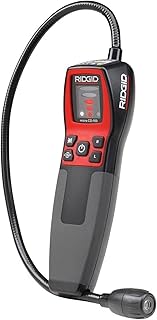
The RIDGID 36163 Micro CD-100 is a professional-grade combustible gas detector engineered to identify leaks in residential and commercial plumbing systems. It is tailored for plumbers, HVAC service specialists, and facility maintenance crews who require dependable leak detection around pipe fittings, appliances, and utility meters.
Its standout feature is the 16-inch flexible gooseneck probe, which allows users to check behind water heaters, inside tight utility cabinets, and along overhead piping. With tri-mode notification capabilities, operators can switch between visual cues, loud audible tones, and tactile vibration alarms that work well in noisy mechanical rooms.
Because the unit relies on staged warning lights and audible frequencies rather than a digital parts-per-million display, technicians who need exact numerical measurements will find it limited. Occasional DIYers seeking a compact pocket-sized sniffer for a one-time project might also prefer a simpler pen-style model.
Bottom line: The RIDGID Micro CD-100 is a rugged, trade-ready combustible gas detector that delivers versatile alert options and deep reach for serious technicians and safety inspectors.
- Brand: RIDGID
- Model: Micro CD-100 (Catalog 36163)
- Probe Length: 16 inches (40 cm) flexible reach
- Gases Detected: Methane, propane, butane, ethanol, ammonia, hydrogen, and combustible gases
- Alarm Modes: Visual, audible, and vibration alerts
- Sensitivity: Adjustable high and low detection settings
- Sensor Type: Field-replaceable combustible gas sensor
- Form Factor: Heavy-duty ergonomic handheld
HVAC technicians and licensed plumbers will appreciate the rugged build and flexible reach of the RIDGID Micro CD-100 when inspecting furnace hookups, gas water heaters, and pipe joints.
Property managers and home inspectors can utilize the multi-gas sensitivity and vibration alerts to conduct routine checks across multi-family units and mechanical rooms without missing faint gas traces.
Homeowners who maintain their own gas appliances will find peace of mind, though those who rarely work around fuel lines may find standard plug-in monitors more convenient for passive monitoring.
Always power on and calibrate the detector in fresh outdoor air prior to entering suspected leak zones to establish an accurate zero baseline.
Keep the flexible gooseneck probe clean and free of dirt, oil, and moisture, as liquid contamination can harm the internal sensor tip.
When the sensor approaches the end of its functional life or shows sluggish response times, install a genuine field-replaceable sensor module to maintain detection precision.
Store the unit in a dry, temperate environment away from corrosive vapors and extreme cold to protect the internal electronics.
How to Choose the Best Natural Gas Leak Detectors: Buying Guide
Continuous Wall Plug-In Alarms vs. Handheld Sniffers

The first major decision when shopping for gas detection gear is choosing between continuous stationary monitors and portable sniffers. Stationary monitors are designed for 24-hour vigilance, mounting directly onto an electrical outlet in your utility closet, kitchen, or basement. Products like the Kidde Carbon Monoxide Detector, Propane, Natural and the First Alert Plug in Combination Explosive Gas draw continuous power from a standard 120-volt AC wall outlet. They actively sample ambient air while your family sleeps, triggering an immediate alert if combustible gas levels rise above safe thresholds.
Handheld sniffers serve a completely different yet equally essential role by pinpointing the precise geographic source of an active leak. A stationary wall unit will tell you that explosive gas is present in the room, but it cannot trace whether the leak stems from a corroded elbow pipe, a loose appliance connector, or a hairline fracture along a black iron pipe. Portable units like the PT520A Natural Gas Detector and the PT199 Natural Gas Leak Detector with Audible allow you to run a sensitive sensor tip directly along pipe joints, shut-off valves, and regulator diaphragms.
For optimal domestic safety, many property owners combine both styles across their residences. A plug-in alarm remains stationed permanently near fuel-burning appliances to provide uninterrupted overnight peace of mind, while a pocket-sized device such as the Natural Gas Detector, TopTes PT177 Gas Leak remains tucked inside a tool organizer ready for periodic checks on outdoor propane grills, seasonal heating equipment, and RV gas lines.
Sensor Reach and Probe Flexibility

Gas plumbing rarely runs in open, easily accessible areas. Instead, fuel lines run behind water heaters, under kitchen cabinets, within floor joists, and inside tight furnace cabinets. Because natural gas is lighter than air and dissipates quickly in open spaces, your detector sensor must get within a few centimeters of the suspected leak point to register an accurate concentration. A detector with poor physical reach will leave you guessing about inaccessible fittings.
Long flexible goosenecks provide superior accessibility when navigating complex plumbing layouts. The Klein Tools ET120 Gas Leak Detector provides an 18-inch flexible gooseneck that holds its shape as you bend it around tight ductwork, clipping securely to the meter body for storage. Similarly, the PT520A Natural Gas Detector features a 17-inch gooseneck, while the RIDGID 36163 CD-100 Micro Combustible Gas Handheld incorporates a 16-inch flexible probe. These generous lengths allow you to inspect fittings located 1 to 5 centimeters away without sticking your hands into dark, cramped machinery.
When portability is your chief concern, alternative probe styles offer distinct advantages. The TopTes PT760 Rechargeable Natural Gas Detector uses a 12-inch stainless steel telescopic probe that extends for hard-to-reach furnace inspections and collapses completely for pocket transport. Meanwhile, the TopTes PT210S Gas Leak Detector features a rigid 4-inch probe that slips neatly into a pocket alongside your favorite The 10 Best Rechargeable Pen Flashlights, providing rapid access for quick seasonal walk-through inspections.
Detection Range and Sensitivity Modes

Gas concentration is commonly quantified in parts per million (ppm) or as a percentage of the Lower Explosive Limit (%LEL). Methane, the primary component of natural gas, reaches its Lower Explosive Limit in air at approximately 50,000 ppm, representing 100% LEL. Because an explosive condition forms when gas reaches that concentration, a dependable safety instrument must identify minuscule fugitive emissions down in the hundreds of ppm range, long before a room approaches combustible proportions.
Dual-range sensitivity adjustments prevent false alarms and sensor saturation when tracking down the origin of an emission. The Klein Tools ET120 Gas Leak Detector provides a high sensitivity mode covering 50 to 1,000 ppm and a low sensitivity mode covering 1,000 to 10,000 ppm. By initiating your inspection on high sensitivity, you can register whether any trace gas is present in the surrounding air, and then switch to low sensitivity as you get closer to the pipe joint to pinpoint the exact weeping thread without overwhelming the sensor.
Direct numerical %LEL readouts provide valuable insight into the severity of an identified leak. Models such as the PT205 Natural Gas Detector with Audible & Visual and the TopTes PT210S Gas Leak Detector offer direct readings between 1% and 10% LEL, representing 100 to 5,000 ppm based on methane. For wider operational parameters, the TopTes PT760 Rechargeable Natural Gas Detector spans from 1% to 20% LEL (100 to 10,000 ppm). Monitoring the numerical %LEL percentage allows homeowners to distinguish between a minor cosmetic maintenance issue and an immediate structural hazard.
Alarm Indicators and Alert Systems
A gas detector is only as helpful as its warning system. In loud basements with running washing machines, howling furnace blowers, or outdoor wind around propane manifolds, faint audio beepers can easily go unnoticed. A robust alert system uses multi-sensory feedback, combining loud sounders with progressive visual cues or physical haptic vibrations to ensure you register the danger regardless of background noise levels.
Sound output levels vary significantly across distinct product form factors. Wall-mounted monitors like the Kidde Carbon Monoxide Detector, Propane, Natural and the First Alert Plug in Combination Explosive Gas produce an ear-piercing 85-decibel sounder designed to wake sound sleepers through closed bedroom doors. Among portable instruments, the Klein Tools ET120 Gas Leak Detector also delivers an 85 dB audible alert, whereas ultra-compact sniffers like the PT520A Natural Gas Detector and the Natural Gas Detector, TopTes PT177 Gas Leak feature 75 dB sounders suited for close-range handheld use.
Visual indicators help you gauge how close you are to the source. Units like the PT199 Natural Gas Leak Detector with Audible and the PT205 Natural Gas Detector with Audible & Visual feature LCD screens that switch from neutral green to alarming red as concentration levels peak. When inspecting loud mechanical rooms where ear protection is required, the RIDGID 36163 CD-100 Micro Combustible Gas Handheld proves uniquely valuable by offering a tri-mode detection suite that incorporates tactile vibration alongside visual LEDs and audible chirps.
Power Supply, Warm-Up Calibration, and Battery Management
Operating reliability depends on how an instrument manages electrical power and initial sensor stabilization. Metal oxide semiconductor sensors and heated beads inside portable gas detectors require a short warm-up period to reach operating temperature and zero out ambient moisture before they can reliably register hydrocarbons. Powering on a detector in an area containing active gas fumes will skew the zero baseline and lead to missed leaks.
Virtually all high-performing sniffers implement a mandatory 30-second preheating cycle. The Natural Gas Detector, TopTes PT177 Gas Leak, the PT199 Natural Gas Leak Detector with Audible, and the PT520A Natural Gas Detector each require turning the device on in clean, outdoor air for 30 seconds of automated baseline calibration. Models like the PT205 Natural Gas Detector with Audible & Visual display an on-screen countdown timer during this warm-up routine, clearly signaling when the sensor is properly primed for leak tracing.
Battery configurations also determine long-term readiness. Portable sniffers such as the TopTes PT210S Gas Leak Detector operate on two AAA alkaline batteries, while the TopTes PT760 Rechargeable Natural Gas Detector utilizes an integrated rechargeable cell with a Type-C charging port. To preserve battery capacity when stored in a home workshop, look for models with automatic power-off functions that turn the instrument off after 5 or 10 minutes of inactivity, along with low-voltage warnings that flash when battery potential falls below 2.4 or 2.5 volts.
Multi-Gas Detection Capabilities and Specialized Features
Although methane detection is the headline feature for natural gas customers, homes and recreational vehicles frequently employ multiple combustible fuel sources. Propane (LPG), butane canisters, fuel oil, and even sewer gases represent distinct combustible hazards. Selecting an instrument calibrated to detect an assortment of hydrocarbons ensures versatility whether you are inspecting a basement boiler or an outdoor camper stove.
Multi-gas capability is standard across modern solid-state sensors. Instruments like the TopTes PT760 Rechargeable Natural Gas Detector and the PT205 Natural Gas Detector with Audible & Visual identify methane, propane, butane, ethane, and coal gas. For specialized mechanical work, the RIDGID 36163 CD-100 Micro Combustible Gas Handheld identifies methane, propane, butane, ethanol, ammonia, and hydrogen, while incorporating a field-replaceable sensor so maintenance professionals avoid retiring the entire unit when the internal sensor element reaches the end of its operational lifespan.
Thoughtful physical enhancements also elevate practical usability. The TopTes PT760 Rechargeable Natural Gas Detector features an integrated front-facing flashlight that illuminates dark corners beneath sinks while you work with The 10 Best Battery Impact Drivers to assemble pipe brackets. In contrast, stationary alarms like the First Alert Plug in Combination Explosive Gas allow homeowners to silence false alarms using standard household television remote controls, eliminating the need to climb onto chairs to reach high ceiling outlets.
| Product | Alarm Alert Level | Reach and Sensor Form | Detection Range |
|---|---|---|---|
| Klein Tools ET120 Gas Leak Detector | 85dB audible alerts | 18-inch flexible gooseneck | 50 to 10,000 ppm (based on Methane) |
| PT520A Natural Gas Detector | 75dB alarm | 17-inch gooseneck | 50-10,000 ppm (Methane) |
| TopTes PT760 Rechargeable Natural Gas Detector | Audible and visual alarm | 12-inch stainless steel telescopic probe | 100ppm-10,000ppm (1%LEL to 20%LEL) |
| TopTes PT210S Gas Leak Detector | 75-decibel audible buzzer | 4-inch probe | 100 ppm to 5,000 ppm (1 Percent LEL to 10 Percent LEL) |
| Kidde Carbon Monoxide Detector, Propane, Natural | 85-decibel alarm | Plug-in wall mount | Senses carbon monoxide, propane, and natural gas |
Why You Should Trust Us
Our editorial team at Daily Deal Here focuses on delivering objective, practical consumer guidance across home improvement, automotive, and safety categories. To create this evaluation of natural gas leak detectors, we synthesized technical documentation, verified product manuals, and analyzed verified customer feedback patterns across thousands of residential applications. We compared sensor response times, detection limits, audible decibel ratings, and chassis durability to identify which units deliver dependable performance under real-world household conditions.
Rather than relying on marketing claims, our methodology centers on cross-referencing manufacturer technical sheets with owner feedback themes. We examined how detectors handle cold-weather garage environments, whether zero-point baseline calibrations remain stable over repeated power cycles, and how intuitive the alert interfaces prove during stressful household scenarios. This data-driven editorial curation ensures that the models we highlight provide reliable detection without overwhelming owners with false alarms or confusing user controls.
Final Thoughts
Investing in reliable gas detection hardware provides indispensable security for any property equipped with natural gas or propane infrastructure. For thorough troubleshooting and professional-grade inspection flexibility, our top overall recommendation is the Klein Tools ET120 Gas Leak Detector. Its 18-inch flexible gooseneck navigates around awkward furnace plenums and hot water tanks, while its dual sensitivity settings allow you to isolate the general area of a leak before pinpointing the exact leaking pipe fitting.
For property managers and homeowners seeking an affordable, pocket-sized sniffer for routine appliance checks, the Natural Gas Detector, TopTes PT177 Gas Leak delivers exceptional value. Despite its compact footprint, it includes automatic 30-second baseline calibration, five red LED concentration indicators, and a responsive 75-decibel sounder that alerts within seconds of locating fugitive hydrocarbon emissions around kitchen ranges and propane cylinders.
If continuous, around-the-clock room monitoring is your primary objective, the Kidde Carbon Monoxide Detector, Propane, Natural remains the premier dedicated choice. Plugging directly into standard wall outlets with a 9-volt battery backup for power failures, it safeguards sleeping occupants against both combustible gas buildup and toxic carbon monoxide poisoning. For additional safety recommendations and workshop tools, explore our comprehensive collection of All buying guides and reviews, or check our seasonal advice on How to Prepare for Black Friday Shopping.
Frequently Asked Questions About Natural Gas Leak Detectors
Where should I install stationary natural gas leak detectors in my home?
Mounting location depends on whether you are primarily monitoring natural gas or propane. Natural gas is lighter than air and rises rapidly toward ceilings, meaning stationary detectors should be positioned high on the wall, roughly twelve inches below the ceiling, and within ten feet of fuel-burning appliances. Propane is heavier than air and sinks to floor level, requiring detectors to be mounted within twelve inches of the floor. Always keep units clear of unconditioned drafts, exterior doors, and direct stove cooking grease.
How often do natural gas leak detectors need sensor replacement or zero-point calibration?
Handheld portable sniffers perform automatic zero-point calibration during their initial 30-second warm-up phase each time you switch them on in clean air. However, the internal catalytic bead or metal oxide sensors inside these instruments degrade over time through exposure to moisture and ambient contaminants. Most residential sniffers last between three and five years under regular domestic usage. Stationary plug-in units feature an internal end-of-life timer, sounding an audible trouble chirp after five to seven years to indicate that the sensor must be replaced.
Can natural gas leak detectors pick up other household fumes or trigger false alarms?
Yes, sensitive combustible gas sensors can occasionally react to volatile organic compounds (VOCs) commonly found in residential environments. Aerosol hairsprays, alcohol-based cleaning agents, mineral spirits, fresh paint solvents, and citrus-based air fresheners can temporarily activate visual and audible alarms. When checking appliances for leaks, ensure the surrounding air is free of recently sprayed household cleaners. If you want to browse safety upgrades or seasonal discounts on diagnostic gear, check out our updated Browse all categories directory.
What is the difference between ppm and percent LEL on natural gas leak detectors in 2026?
Parts per million (ppm) measures absolute gas concentration in the air, while percent LEL reflects how close that concentration is to the Lower Explosive Limit. For methane, 100% LEL occurs at roughly 50,000 ppm, which is the minimum concentration required for the gas to ignite in air. Therefore, an instrument reading 10% LEL is detecting approximately 5,000 ppm of methane. Handheld sniffers tracking small pipe leaks focus on low ppm values, whereas emergency safety monitors display %LEL to communicate immediate fire or explosion risk.
What should I do immediately when natural gas leak detectors sound an alarm?
If a stationary monitor sounds or your handheld detector registers elevated gas levels with an accompanying sulfur odor, stop what you are doing immediately. Do not flip light switches, operate electrical appliances, or start internal combustion engines, as tiny electrical arcs can ignite combustible mixtures. Evacuate everyone from the premises immediately, leaving doors open behind you to assist ventilation if possible. Once you are safely away from the structure, contact your local gas utility emergency dispatch or call 911 from a mobile phone outside.









Write Your Review
No reviews yet. Be the first to share your experience!