

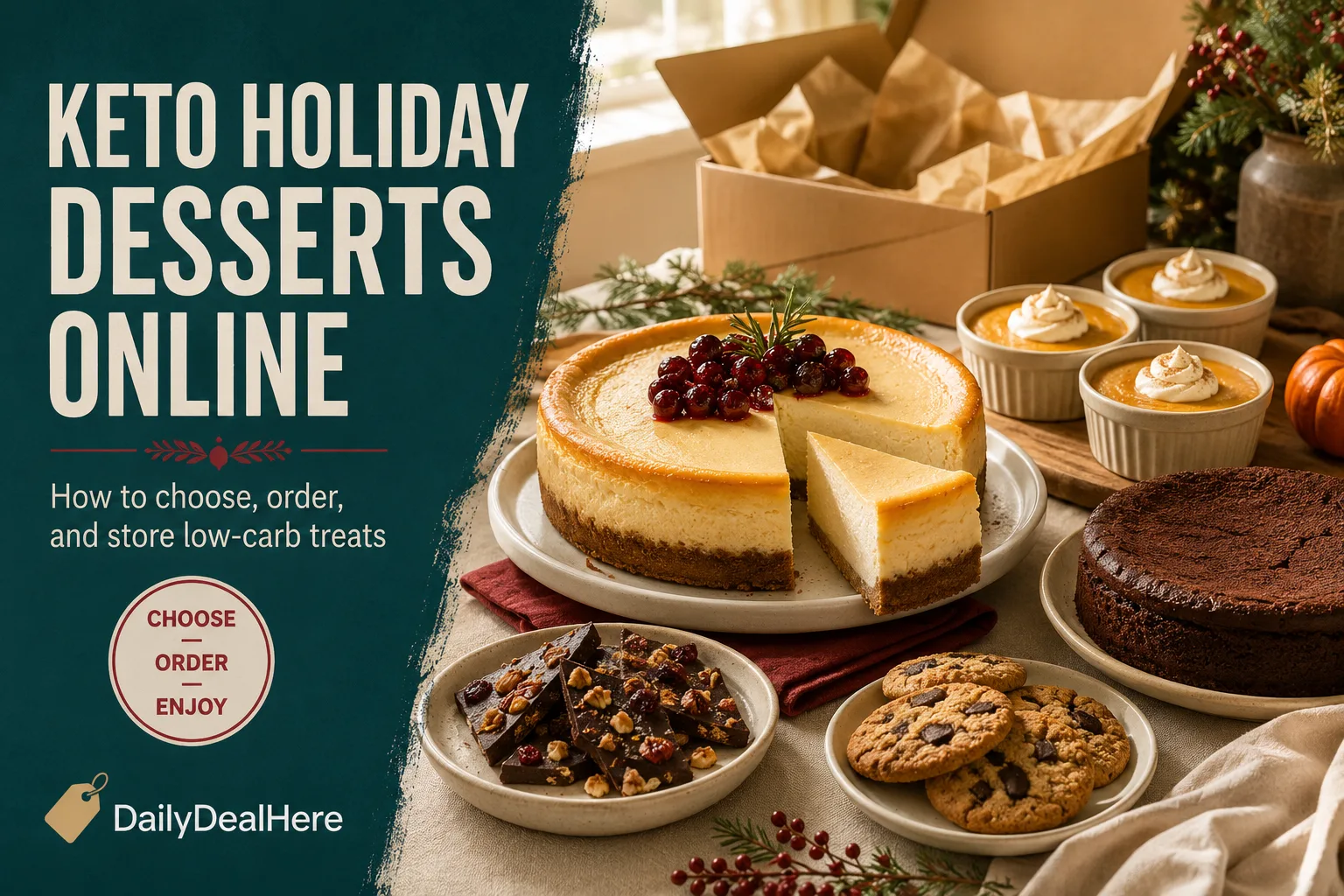
Ordering keto desserts online has become straightforward, and the reason to do it in November rather than in December is stock. Low carb baking runs in small batches, holiday flavours are seasonal, and the good sellers run out before the ordinary ones do. Thanksgiving 2026 falls on Thursday, November 26, and the sensible ordering window opens in the first half of the month.
The harder part is not finding a product. It is reading the label well enough to know what you are actually buying, because this is a category where the front of the pack and the nutrition panel often tell different stories.
This article is general information about shopping and labels rather than medical or dietary advice. Anyone following a ketogenic diet for a medical reason should keep to the guidance they already have.
What makes a dessert keto in the first place
A ketogenic diet is built around keeping carbohydrate intake low enough that the body shifts to using fat as its main fuel. For a dessert that means two changes from the conventional version: the sugar is replaced, and the flour is replaced.
Those two swaps drive everything about how these products taste, cost and behave. Sugar is not only sweetness, it is bulk, browning, moisture and texture. Wheat flour is structure. Removing both and getting a result people want to eat is genuinely difficult, which is why good low carb baking costs more than the ordinary kind.
It also explains the failure modes you will meet: a cooling aftertaste from one sweetener, a gritty finish from another, a dense crumb from almond flour, or a texture that goes dry the day after baking.
Net carbs, and why the number moves
Net carbs is the figure the whole category is marketed on, and it is a calculation rather than a regulated term.
The usual method is total carbohydrate minus fibre minus sugar alcohols, on the reasoning that neither is absorbed the way sugar is. Different manufacturers apply that differently, particularly with sugar alcohols, some of which are partly absorbed. That is why two products with similar nutrition panels can advertise different net carb counts.
The practical habit is to read the nutrition panel rather than the claim on the front. Total carbohydrate, fibre and sugar alcohols are all listed there, so you can do the subtraction yourself and compare products on the same basis.
The sweeteners, and what each one does
Most of the difference between a low carb dessert you enjoy and one you do not comes down to which sweetener was used.
- Erythritol is the most common. It behaves well in baking and has a distinct cooling sensation on the palate that some people notice strongly and others do not at all.
- Allulose browns and caramelises more like sugar than the others, which makes it the best performer in sauces, caramel and anything where you want colour. It is also the most expensive.
- Monk fruit is intensely sweet and almost always blended with erythritol for bulk, so a monk fruit product is usually an erythritol product too.
- Stevia is similarly intense and carries a liquorice-like note at higher doses that divides opinion.
- Xylitol tastes closest to sugar of the alcohols but is seriously toxic to dogs, which matters in a household with a pet.
If you have disliked low carb desserts before, it is worth identifying which sweetener was involved rather than concluding the whole category is not for you. Our roundup of sugar substitutes for keto covers how they behave in recipes.
Sugar alcohols and the digestive warning
This is the practical caution that matters most on a holiday table, where people graze rather than eat one portion.
Sugar alcohols such as maltitol, sorbitol and to a lesser extent erythritol commonly cause digestive discomfort when eaten in quantity, which is why packages often carry a warning about excessive consumption. Tolerance varies a lot between people and is not something anyone discovers gracefully at a family dinner.
Two sensible responses. Serve low carb desserts in normal portions rather than putting a whole tray out for grazing, and if you are introducing a product to guests for the first time, say what it is. People who know their own tolerance can then decide for themselves.
The flours, and what they do to texture
Low carb baking rests on two main flours and they are not interchangeable, which is worth knowing whether you are buying or making.
Almond flour is the workhorse. It produces a moist, slightly dense crumb and a mild flavour that suits most desserts. It is also a tree nut, which rules it out for a nut allergy and makes it the first thing to check when buying for someone else.
Coconut flour absorbs an enormous amount of liquid relative to its weight, so recipes using it need far more egg and moisture. It brings a coconut note that some people taste clearly. Substituting it for almond flour one for one does not work and produces something closer to sawdust.
Neither contains gluten, so low carb desserts are frequently gluten free as a side effect. That is a happy accident rather than a guarantee, and anyone avoiding gluten for medical reasons should still look for the gluten free claim on the packet.
Which holiday desserts convert well
Some traditional desserts survive the conversion almost intact and others fight it the whole way. Choosing from the first group is the easiest decision in this article.
| Dessert | How well it converts | Why |
|---|---|---|
| Cheesecake | Excellent | Already mostly fat and dairy, only the base and sugar change |
| Pumpkin custard or pie filling | Excellent | Eggs, cream, pumpkin and spice, sugar is the only swap |
| Flourless chocolate cake | Excellent | No flour to replace in the first place |
| Panna cotta and mousse | Very good | Cream based, sets without flour |
| Brownies and cookies | Good | Texture differs slightly but holds up |
| Pecan pie | Mixed | Filling relies on syrup, needs allulose to work well |
| Layer cakes with icing | Harder | Structure and volume both depend on sugar |
| Meringue and pavlova | Difficult | Sugar does the structural work |
If you are serving one dessert to a mixed table, cheesecake is the safest choice. It is genuinely good in its low carb form and most guests will not identify it as a substitution.
Buying online: what to look for in a listing
Once you know the ingredients, judging a listing becomes quick.
- A visible nutrition panel, not only a net carb claim. If a seller will not show the panel, that is information in itself.
- Which sweetener, named specifically rather than described as a natural sweetener blend.
- Which flour, which also answers the nut allergy question.
- Shipping method, since anything with cream or fresh dairy needs cold chain delivery and a chosen date.
- Serving size, because a low net carb count per serving means little if the serving is very small.
That last one is the most common way a listing flatters itself. Comparing two products means comparing the same weight, not the same portion.
Shelf stable, frozen or fresh
The format decides your ordering deadline, exactly as it does for the rest of the holiday shop.
Shelf stable items such as cookies, bark, biscotti and baking mixes can be ordered early and stored, which makes them the low risk choice. Frozen desserts arrive on a delivery slot, need freezer space you have to clear in advance, and usually need a day to thaw before serving. Fresh items with cream or custard have the narrowest window and the highest chance of a delivery problem during the busiest shipping week of the year.
For a first order from an unfamiliar seller, shelf stable or frozen is the sensible choice. Save the fresh order for a seller you have used before.
Serving one dessert to a mixed table
The most common situation is one person eating low carb and everyone else eating normally, and there are three ways to handle it.
Serving a single low carb dessert to everyone works if you choose well, and cheesecake or a flourless chocolate cake will pass without comment. Serving two desserts is the honest approach but doubles the work. Serving the conventional dessert plus something simple the low carb guest can eat, such as berries with whipped cream, is the least effort and often the most appreciated, because it does not make an event of the difference.
Whichever route you take, tell the guest what is in the dessert rather than asking them to guess. That is the part that actually matters to someone managing what they eat.
Storage and how long these keep
Low carb baked goods behave differently in storage from conventional ones, mostly because sugar is a preservative and they have very little of it.
Almond flour baking dries out faster at room temperature than wheat baking, so wrapping matters more. Anything with cream cheese, cream or custard belongs in the refrigerator. Most low carb cakes and cheesecakes freeze well, which is genuinely useful for a dessert bought for one person who will not finish a whole cake in three days.
Airtight containers do more work here than they do for conventional baking, and freezing in single portions turns a large dessert into something that lasts through December rather than going stale by Sunday.
Cost, and where the money goes
Low carb desserts cost noticeably more than conventional ones, and it helps to know why before deciding whether to buy or bake.
Almond flour costs several times what wheat flour costs by weight. Allulose and monk fruit blends cost far more than sugar. Production runs are smaller, so the fixed costs spread across fewer units. None of that is a seller taking advantage, it is the ingredients.
Baking at home saves money on cakes and cookies where the ingredient cost dominates. Buying makes more sense for anything technically difficult, particularly pastry and caramel, where the failure rate on a first attempt is high and the ingredients are too expensive to waste twice.
What to skip
Skip anything marketed only as low sugar rather than low carb, since those are different claims and the flour is usually still wheat. Skip products that will not show a nutrition panel. Skip maltitol heavy items if you are serving a crowd, for the reasons above.
And skip buying four different products to try at once. Sweetener preference is personal, and discovering you dislike erythritol across four desserts at holiday prices is an expensive way to learn one fact.
Baking your own: the three adjustments that matter
If you decide to bake rather than buy, low carb recipes fail in predictable ways and three adjustments prevent most of it.
The first is temperature. Almond flour browns faster than wheat flour because of its fat content, so a recipe converted straight across often looks done outside while the middle is still raw. Dropping the oven temperature slightly and extending the time gives a far more even result.
The second is binding. Sugar and gluten both contribute structure, and removing both leaves batters that crumble. Extra egg, a little xanthan gum, or a longer cooling period before cutting all help. Low carb cakes in particular are fragile while warm and firm up considerably as they cool, which is why cutting too early is the most common self inflicted failure.
The third is sweetener volume. Intense sweeteners such as monk fruit and stevia replace the sweetness of sugar but not its bulk, so a recipe that swaps them one for one loses volume and moisture. Blends sold as a one to one sugar replacement solve this by adding erythritol as filler, which is why they are the easier choice for someone converting a family recipe.
Christmas differs from Thanksgiving
The two holidays place different demands on a low carb dessert, and treating them as one shopping trip is a small mistake worth avoiding.
Thanksgiving usually means one dessert course at the end of a large meal. That favours a single showpiece, served in slices, eaten once. A cheesecake or a pumpkin custard fits the shape of the day.
Christmas is a longer stretch of grazing across several days, with things sitting out on a counter and people helping themselves between meals. That favours small, individually portioned items with a longer shelf life: cookies, bark, fat bombs, biscotti. It also makes the sugar alcohol question more pressing, because grazing is exactly the pattern that leads to eating more than a stated serving.
Buying for both at once is sensible on shipping, as long as you buy the right format for each occasion rather than a large cake for a week of picking.
Chocolate, and reading a low carb bar
Chocolate is the easiest low carb treat to buy and the one where labels are most confusing, because two different things are sold in the same space.
Ordinary dark chocolate at a high cocoa percentage is naturally lower in carbohydrate, simply because less of the bar is sugar. It is not marketed as a keto product and is often the cheaper route to the same outcome, which is worth knowing before paying a premium for packaging.
Purpose made sugar free chocolate replaces the sugar with a sweetener, usually erythritol, allulose or maltitol. These vary enormously in quality, and maltitol versions are the ones most associated with digestive complaints. The ingredient list tells you which you are holding within seconds.
For gifting, this distinction matters. A good high cocoa bar reads as a proper present. A sugar free bar reads as a dietary product, which is fine for someone who asked for it and slightly awkward for someone who did not.
Buying for someone else who eats low carb
Buying a low carb dessert as a gift is kind and easy to get slightly wrong, because the category is more personal than it looks.
Sweetener preference is the main variable. Someone who cannot stand the cooling note of erythritol will not enjoy most of the shelf, and someone else will not notice it at all. If you know they buy a particular brand, buying more of that is a better gift than introducing something new.
Almond flour is the other thing to check, since it rules the product out entirely for a nut allergy. It appears in most low carb baking, so it is worth confirming rather than assuming.
The safest gift in this category is not a dessert at all. Good coffee, a nice tea, or the ingredients they bake with themselves all avoid the preference problem completely, and someone who bakes low carb regularly gets through almond flour and sweetener faster than anything else in their cupboard.
Dairy, cream and the rest of the shopping list
Low carb desserts lean heavily on dairy, and the dairy aisle contains a few items that quietly carry more carbohydrate than people expect.
Heavy cream, cream cheese, mascarpone and butter are the backbone of the category and are all low in carbohydrate by nature. Milk is higher because of the lactose, which is why most low carb recipes reach for cream instead. Sweetened condensed milk is entirely off the table unless it is a purpose made sugar free version, and that substitution is the one most likely to derail a converted family recipe.
Flavoured yoghurts and whipped toppings are worth reading rather than assuming, since both frequently contain added sugar even when the packaging leans healthy. Plain versions sweetened at home give you control and usually cost less.
Buy the dairy in the last few days rather than in the November order. It is heavy, it is available everywhere, and it is one of the few holiday ingredients where shipping it makes no sense at all.
The short version
Order shelf stable items in the first half of November and book any frozen delivery at the same time, because small batch sellers run out before the mainstream ones do. Read the nutrition panel rather than the net carb claim on the front, and note which sweetener and which flour the product uses, since those two decide whether you enjoy it and whether it is safe for a guest with a nut allergy.
Choose a dessert that converts naturally rather than one that fights the substitution. Cheesecake, pumpkin custard and flourless chocolate cake all pass at a mixed table without anyone commenting. Serve normal portions rather than putting a tray out to graze on, and tell people what is in it.
Frequently asked questions
When should I order keto desserts for the holidays?
In the first half of November. Thanksgiving 2026 falls on Thursday, November 26, and low carb baking runs in smaller batches than conventional baking, so seasonal items sell out earlier. Frozen and fresh items also need a delivery slot booked in advance.
What are net carbs and why do brands calculate them differently?
Net carbs is usually total carbohydrate minus fibre minus sugar alcohols, on the basis that neither is absorbed like sugar. It is a calculation rather than a regulated term, and manufacturers treat sugar alcohols differently, which is why similar products advertise different numbers. Reading the nutrition panel lets you compare on the same basis.
Which sweetener tastes closest to sugar?
Allulose browns and caramelises most like sugar, which is why it performs best in sauces and caramel, and it is also the most expensive. Erythritol is the most common and carries a cooling sensation some people notice strongly. Monk fruit and stevia are intensely sweet and usually blended with erythritol for bulk.
Which holiday desserts work best in a low carb version?
Cheesecake, pumpkin custard, flourless chocolate cake, panna cotta and mousse convert very well because they rely on eggs, cream and fat rather than on flour and sugar for structure. Meringue and layer cakes are the hardest, since sugar is doing structural work in both.
Are keto desserts also gluten free?
Often, because almond and coconut flour contain no gluten, but that is a side effect rather than a guarantee. Anyone avoiding gluten for medical reasons should still look for a gluten free claim on the packet rather than assuming.









Write Your Review
No reviews yet. Be the first to share your experience!