

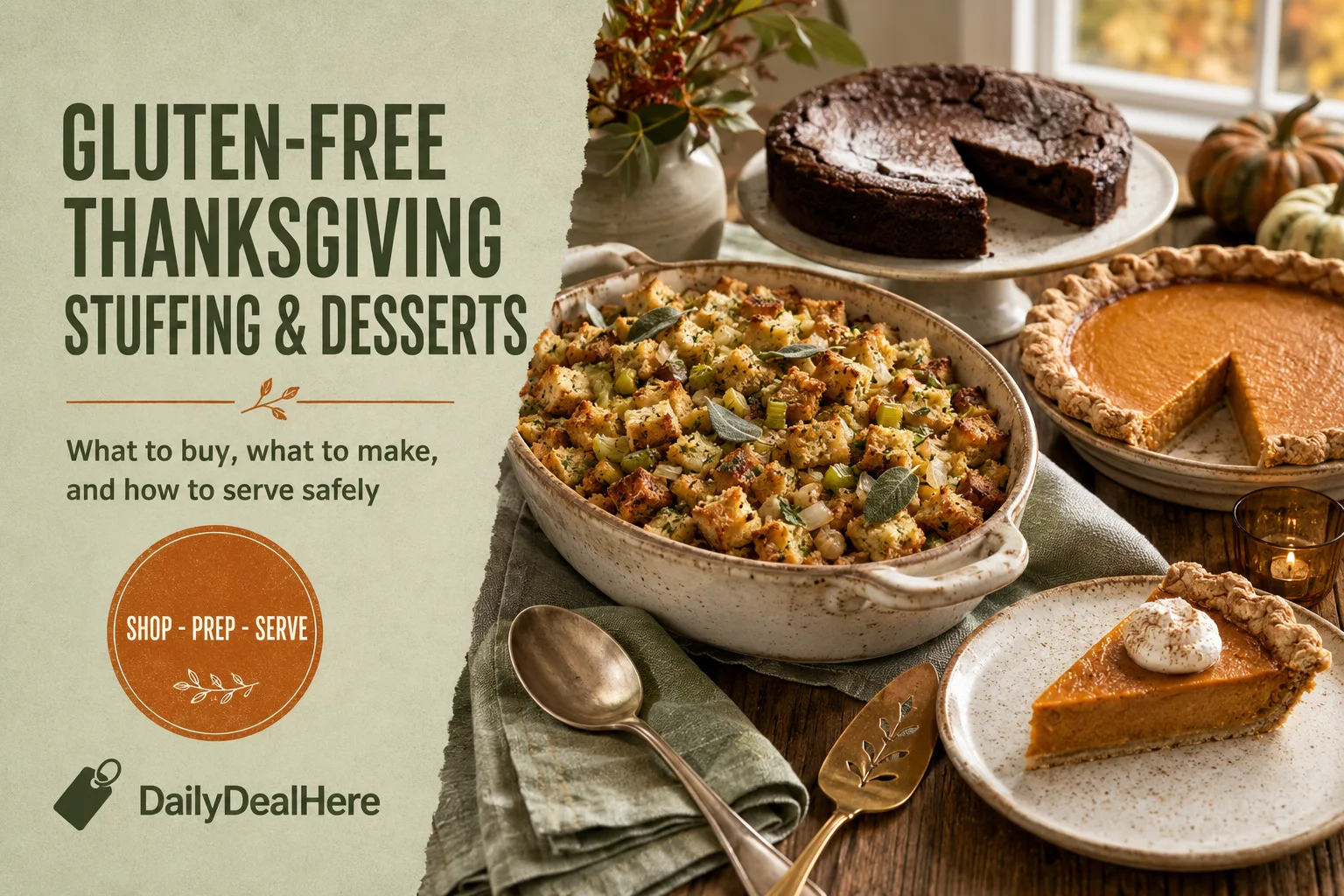
Stuffing and dessert are the two hardest parts of a gluten free Thanksgiving, because both are built on bread and flour and both are the dishes people notice. The good news is that buying them ready made has become genuinely practical, and the shopping is easier if you order in the first half of November rather than the week of the meal.
Thanksgiving 2026 falls on Thursday, November 26. Gluten free specialty items sell out before mainstream ones because the production runs are smaller, so the calendar matters more here than it does for the rest of the shop.
This article is general information about shopping and labelling rather than medical advice. Anyone with coeliac disease or a diagnosed gluten disorder should follow the guidance they already have from their own clinician.
What the gluten free label actually guarantees
The phrase on the packet has a legal meaning in the United States, which is more useful than it sounds because it turns a marketing claim into a measurable one.
Under the FDA gluten free labeling rule, a food carrying the words gluten free, no gluten, free of gluten or without gluten must contain less than 20 parts per million of gluten. That is the lowest level that can be reliably detected with validated analytical methods. The rule also requires that the food does not contain an ingredient that is wheat, rye, barley or a crossbreed of those grains, unless that ingredient has been processed to remove gluten and the finished food still comes in under 20 ppm.
Two practical consequences follow. First, the claim is standardised, so a gluten free label from a large manufacturer and one from a small bakery mean the same threshold. Second, gluten free does not mean gluten absent, which is why people with the strictest requirements pay attention to how a product was made as well as to the label on it.
Where gluten hides on a Thanksgiving table
The obvious items are bread, stuffing, pie crust and rolls. The ones that catch people out are the sauces and the coatings.
- Gravy is usually thickened with wheat flour, including most jarred and powdered versions.
- Cream soups used as a base in casseroles are commonly flour thickened.
- Fried onion toppings on green bean casserole are typically coated in wheat flour.
- Soy sauce in a marinade or a glaze usually contains wheat, unless it is a wheat free tamari.
- Stock and bouillon can contain wheat derived ingredients, so the label is worth reading.
- Self basting turkeys carry an added solution, and the ingredients in that solution vary by producer.
None of these are difficult to replace once you know they are there. The failure mode is assuming a dish is safe because nothing in it looks like bread.
Buying stuffing rather than making it
Stuffing is bread, herbs, stock and fat, so the whole problem is the bread. That makes it one of the easier dishes to solve by buying.
There are three formats on the shelf. Boxed gluten free stuffing mix is the closest to the conventional product and the simplest to prepare. Gluten free bread cubes or croutons let you make stuffing to your own recipe, which suits anyone with a family method they do not want to abandon. A loaf of gluten free bread, dried out yourself, is the cheapest route and takes a day of planning.
Check the stock separately, whichever you choose. A gluten free mix prepared with an ordinary bouillon cube is no longer a gluten free dish, and that is the most common way this goes wrong in a busy kitchen.
Why gluten free stuffing behaves differently
Knowing the mechanics saves the dish, because gluten free bread does not absorb liquid the way wheat bread does.
Wheat bread holds its structure while soaking up stock, which is what gives stuffing its texture. Many gluten free breads are starchier and either soak up liquid very quickly and turn to paste, or resist it and stay dry in the middle. Neither is a fault in the product, it is a different material behaving differently.
The practical adjustments are to dry the bread more thoroughly than you would wheat bread, add the stock in stages rather than all at once, and check the middle before the top browns. Covering the dish for the first part of the bake and uncovering it at the end gives a more even result than baking it uncovered throughout.
Desserts are the easier half
Dessert is where buying gluten free works best, because several classic holiday desserts contain no gluten to begin with.
Naturally gluten free options include flourless chocolate cake, meringue based desserts, custards and pots de creme, poached or baked fruit, rice pudding, and most ice creams and sorbets. Choosing one of these avoids the entire question rather than solving it, which is often the least stressful route on a day with a lot going on.
If the table expects pie, ready made gluten free crusts are widely sold frozen and are the single most useful item in this category. A bought crust with a homemade filling gives a result close to the conventional version with none of the pastry difficulty, and gluten free pastry is genuinely harder to handle than wheat pastry.
Pumpkin pie is closer than you think
The filling of a pumpkin pie is usually gluten free already: pumpkin, eggs, dairy, sugar and spices. Only the crust is the problem, and that is a component you can buy.
Two things to check on canned pumpkin. Make sure it is plain pumpkin rather than pie filling, since the pre-spiced versions vary in what else is in them. And read the spice blend if you are using a mix, because some blends include anti-caking agents derived from wheat.
A crustless pumpkin custard, baked in ramekins, is the version that removes the last risk entirely and takes less time than pastry. It also portions cleanly at a crowded table.
Cross contamination in a shared kitchen
For someone with coeliac disease, a certified product prepared alongside wheat can still cause a problem, which is why the cooking matters as much as the shopping.
The high risk points in a holiday kitchen are flour dust in the air while pastry is being rolled, a shared colander used for wheat pasta, wooden boards and utensils that have handled bread, a toaster, and shared butter or condiment jars that have had a knife with crumbs on it.
The workable approach is sequence and separation. Prepare the gluten free dishes first, before flour is out on the counter. Use clean tools and fresh foil on trays. Keep one set of condiments untouched by other dishes. Cover the gluten free items once they are done.
This is also why buying more of the meal ready made is a reasonable choice in a shared kitchen, rather than a compromise.
Reading a label properly
Beyond the gluten free claim itself, a few habits catch the remaining problems.
Read the full ingredient list rather than the front of the pack, since a product can be free of obvious bread and still contain a wheat derived ingredient. Look for the allergen statement, which in the United States must declare wheat where it is present. Treat advisory statements about shared equipment as meaningful, because they describe the production line rather than the recipe.
Oats deserve a specific note. Oats do not naturally contain gluten, but they are frequently grown and processed alongside wheat, so ordinary oats are not considered safe for people avoiding gluten. Oats labelled gluten free must meet the same under 20 ppm threshold, which is what makes the label worth looking for on anything oat based.
Finally, recipes change. A product that was safe last year can be reformulated, so the label is worth rereading each season rather than trusting memory.
Ordering online, and when to do it
Specialty gluten free products are the items most likely to be out of stock in the last week, because they are produced in smaller quantities and bought by people who cannot substitute.
Order shelf stable items in the first half of November: stuffing mix, crusts if they are shelf stable, flour blends, cookies, stock. Frozen items such as pie crusts and bread need a delivery slot and freezer space, so book those early too.
Buy one spare of anything critical. A single crust that arrives broken on the Tuesday is a problem with no local solution, and the second one costs far less than the panic.
Hosting someone who eats gluten free
If you are the host and one guest avoids gluten, a few decisions make the day much easier for both of you.
Ask early and ask directly how strict it needs to be, because the range runs from a preference to a medical necessity and the answer changes how you cook. Choose dishes that are naturally gluten free for the shared parts of the meal, so the guest is eating the same food as everyone else rather than a separate plate. Keep the packaging of bought items so they can read it themselves if they want to.
Small courtesies matter more than an elaborate substitute dish. Serving the gluten free items first, with clean utensils, before anything else touches them, prevents most problems.
What to buy and what to make
| Dish | Buy or make | Why |
|---|---|---|
| Stuffing | Buy the bread, make the dish | Bread is the hard part, the rest is easy |
| Pie crust | Buy | Gluten free pastry is difficult to handle |
| Pumpkin filling | Make | Naturally gluten free already |
| Gravy | Make | Easy with cornstarch, hard to find safe ready made |
| Rolls | Buy | Small batch baking is not worth the effort on the day |
| Flourless chocolate cake | Make | No substitution needed at all |
Gravy is worth a line of its own. Cornstarch thickens perfectly well and is a straight swap for flour, so the traditional dish survives intact. It is one of the few places where making it yourself is genuinely easier than shopping for it.
Leftovers need the same care
The care taken on the day often disappears the moment the meal ends, which is when a shared serving spoon moves from the stuffing to the potatoes.
Pack the gluten free leftovers first, in their own containers, before the table is cleared into a single pile. Label them, because by Saturday nobody remembers which dish was which. Airtight containers make this straightforward, and keeping the gluten free portions on a separate shelf removes the guesswork entirely.
It is a small amount of work at the end of a long day, and it is what lets the person you cooked for eat the leftovers with the same confidence they ate the meal.
Certified gluten free versus the plain claim
Alongside the FDA claim, some packets carry a certification mark from an independent organisation. The two are related but not identical, and the difference is worth understanding before you pay more for one.
The regulatory claim sets a threshold the manufacturer is responsible for meeting. Third party certification adds an outside audit of the facility and the process, and some certifying bodies set their own limit below the regulatory one. What you are buying with a certification mark is verification and a tighter margin rather than a fundamentally different product.
For most people avoiding gluten by preference, the plain claim is sufficient. For someone managing coeliac disease, particularly a child or anyone who reacts to very small amounts, certification is the extra assurance that often justifies the price difference. This is a decision to make with the guidance the person already has rather than from a shopping article.
A dedicated gluten free facility is the strongest version of this, and manufacturers who operate one usually say so prominently, because it is expensive and it is their main selling point.
Gluten free flour blends and why they vary
If you are baking rather than buying, the flour blend is the decision that determines the result, and the blends on the shelf are not interchangeable.
Blends are built from a mix of starches and flours, typically rice, tapioca, potato, sorghum or corn, in proportions each manufacturer chooses. Some include xanthan gum or a similar binder to replace the structure gluten would have provided, and some do not, leaving you to add it. Substituting one blend for another mid recipe is how a cake that worked last year comes out flat this year.
Two practical rules. Use the blend the recipe was written for where the recipe names one, because the author balanced the liquid around it. And check whether the binder is included before you add your own, since doubling it produces a gummy texture that no amount of baking fixes.
Gluten free batters also benefit from resting before baking, which lets the starches hydrate fully. Twenty or thirty minutes on the counter noticeably improves texture in most recipes, and it costs nothing but planning.
Drinks and the smaller items on the table
The main dishes get all the attention, which is why the last few things to reach the table are the ones most often overlooked.
Beer is made from barley and is not gluten free unless it is specifically brewed to be. Some products are labelled gluten removed rather than gluten free, and that is a different claim made through a different process, which matters to anyone who is strict about it. Wine and most spirits are a separate question, and flavoured or pre-mixed drinks are worth checking on the label like anything else.
Elsewhere on the table, the small items are the ones to read: crackers with a cheese board, croutons on a salad, seasoning blends, marinades, and anything crumbed or coated. Coffee and tea are not an issue in themselves, though flavoured instant mixes occasionally include wheat derived ingredients.
A simple habit covers most of this: if it came out of a packet and has more than three ingredients, read the packet.
Cost, and how to keep it reasonable
Gluten free specialty products cost noticeably more than their conventional equivalents, and a whole holiday menu bought that way adds up quickly.
The way to control it is to spend on the items where the substitute is genuinely difficult and save on the ones that were never a problem. Pie crust, bread and rolls are worth buying because making them well is hard. Vegetables, potatoes, cranberry sauce, roast meat and most desserts based on eggs, cream or chocolate were already gluten free, so they cost exactly what they always did.
Building the menu around naturally gluten free dishes, with two or three bought specialty items filling the gaps, produces a table that costs close to a conventional one. Building it by finding a gluten free version of every single traditional dish is what makes the bill jump.
November promotions do reach this aisle, and shelf stable items such as flour blends, stuffing mix and cookies store well, so buying them early is both cheaper and safer than buying them late.
A shopping order for the month
Reduced to a sequence, the month runs like this and it removes most of the stress from the week itself.
In the first week of November, order the shelf stable specialty items: stuffing mix or bread cubes, flour blend, cookies, stock, and a spare of anything critical. In the second week, book any frozen deliveries such as pie crusts and bread, and clear the freezer space they need before they arrive.
In the third week, read every label you bought, because that is when a reformulated product or a missed advisory statement is still fixable. Confirm with your guest how strict the requirement is if you have not already asked.
In the final days, prepare the gluten free dishes first, before flour comes out on the counter, and cover them once they are done. Then pack the leftovers separately at the end of the night. None of these steps is difficult, and doing them in that order is what turns a complicated meal into an ordinary one.
One habit worth carrying past the holiday: keep a short note of which products worked. Gluten free baking is unusually sensitive to which blend, which crust and which bread you used, and by next November you will not remember. A photograph of the packet takes a second and saves an afternoon of guessing a year later.
Frequently asked questions
What does a gluten free label legally mean?
Under the FDA gluten free labeling rule, a food labelled gluten free, no gluten, free of gluten or without gluten must contain less than 20 parts per million of gluten, which is the lowest level reliably detectable with validated methods. The food also cannot contain wheat, rye, barley or a crossbreed of those grains unless the ingredient has been processed so the finished food stays under that threshold.
Where does gluten hide in a Thanksgiving meal?
Most often in gravy thickened with wheat flour, cream soups used in casseroles, fried onion toppings, soy sauce in marinades, some stocks and bouillon, and the added solution in self basting turkeys. The bread items are obvious, the sauces are what catch people out.
Are oats gluten free?
Oats do not naturally contain gluten but are commonly grown and processed alongside wheat, so ordinary oats are not considered safe for people avoiding gluten. Oats labelled gluten free must meet the same under 20 ppm threshold as any other product carrying the claim.
Why does gluten free stuffing turn out mushy or dry?
Gluten free bread absorbs liquid differently from wheat bread, so it can either soak up stock too fast and collapse or resist it and stay dry inside. Drying the bread thoroughly, adding stock in stages, and covering the dish for the first part of the bake gives a more even result.
When should I order gluten free holiday items?
In the first half of November. Specialty gluten free products run in smaller batches and sell out before mainstream items, and the people buying them cannot easily substitute. Buying one spare of anything critical, such as a pie crust, is worth the small extra cost.






Write Your Review
No reviews yet. Be the first to share your experience!