

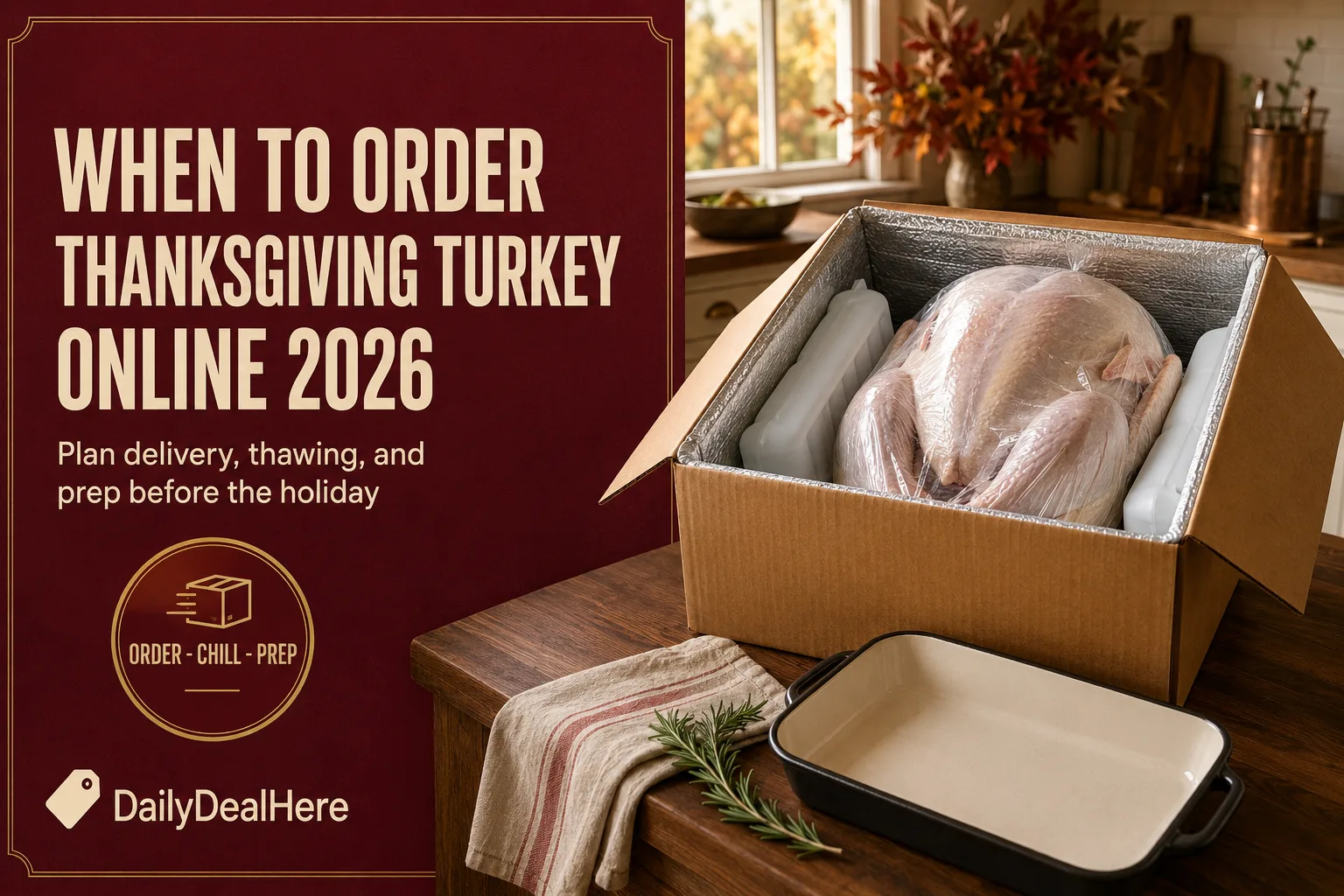
Thanksgiving 2026 falls on Thursday, November 26. If you are ordering the centrepiece online rather than buying it in a shop, the useful ordering window opens in late October and effectively closes in the third week of November, because mail-order meat companies stop taking holiday delivery slots well before the day itself.
The date you need to work backwards from is not the holiday. It is the day the bird has to be in your refrigerator, which for a frozen turkey can be the better part of a week earlier.
Working backwards from November 26
Almost every ordering mistake comes from counting forwards from today rather than backwards from the meal. Backwards, the sequence is fixed and easy to follow.
| When | What has to happen |
|---|---|
| Late October | Order placed for frozen or specialty birds, delivery slot chosen |
| Nov 14 to 18 | Frozen turkey arrives, goes straight into the freezer |
| Nov 20 to 22 | Fresh turkey and prime rib deliveries land |
| Nov 21 to 23 | Thawing begins in the refrigerator, depending on weight |
| Nov 25 | Everything is thawed, brining or seasoning happens |
| Nov 26 | Thanksgiving |
The single most common failure is ordering a large frozen turkey in the week of the holiday. The delivery may well arrive on time and there is still not enough time to thaw it safely, which leaves you choosing between a rushed method and a partly frozen bird.
How long thawing actually takes
This is the number that drives the whole calendar, and it is longer than most people assume. The USDA Food Safety and Inspection Service advises allowing roughly 24 hours for every 4 to 5 pounds when thawing in a refrigerator set at 40 degrees Fahrenheit or below, with the bird in a container so juices cannot drip onto anything else.
| Turkey weight | Refrigerator thawing time | Move it to the fridge on |
|---|---|---|
| 8 to 12 lb | 2 to 3 days | Nov 23 or 24 |
| 12 to 16 lb | 3 to 4 days | Nov 22 or 23 |
| 16 to 20 lb | 4 to 5 days | Nov 21 or 22 |
| 20 to 24 lb | 5 to 6 days | Nov 20 or 21 |
Once thawed, USDA guidance is that a turkey stays safe in the refrigerator for another one to two days, so thawing slightly early is far less risky than thawing late. This is general food safety information rather than a substitute for the guidance on the packaging your supplier provides.
Fresh or frozen: the choice changes your deadline
Fresh and frozen birds are not simply two temperatures of the same product. They come with different ordering windows, different risks and different prices.
A frozen turkey can be ordered early, which is its whole advantage. It arrives whenever the delivery slot allows, goes into the freezer, and waits. The cost is freezer space and the thawing time above, which for a large bird means committing most of a week.
A fresh turkey removes the thawing problem entirely and replaces it with a narrow delivery window. It has to arrive within a couple of days of the meal, which means you are depending on a courier hitting a date during the busiest shipping week of the year. If it arrives late, there is no fallback.
For a first time online order, frozen with a generous margin is the lower risk choice. Fresh suits people who have used the supplier before and trust the delivery.
How much meat to order per person
Ordering online removes the ability to change your mind at the counter, so the quantity has to be right when you place the order.
The widely used planning figure for a whole turkey is about one to one and a half pounds per person, counting bone weight. The lower end feeds the table. The upper end is what produces the leftovers most households actually want, and leftovers are half the point of the meal.
Boneless cuts need less: roughly half a pound per person for a boneless roast or a boneless ham, since none of the weight is skeleton. Bone-in ham sits between the two. A standing rib roast is usually planned at about one rib for every two people, which is a more reliable measure than weight because the bones vary.
Round up rather than down when the number is between sizes. Running short is a worse outcome than a full refrigerator.
Turkey, ham or prime rib: what each one asks of you
The three main centrepieces differ less in flavour than in how much attention they need on the day, which matters when the oven is also doing everything else.
Turkey is the traditional choice and the most demanding. It is large, it takes hours, and the breast and thigh cook at different rates, which is the source of most dry turkey complaints.
Ham is the least stressful. Most holiday hams sold online are already fully cooked and cured, so the work is heating them through and glazing rather than cooking them from raw. That makes ham the sensible choice for a first time host or a small oven. Our guide to the best ham to buy covers how the cuts and cures differ.
Prime rib is the most expensive per person and the least forgiving, because the margin between a good result and an overcooked one is narrow. It is also the fastest to serve once it comes out. If you order one, order the thermometer with it.
The thermometer is not optional for an expensive roast
Cooking a large piece of meat by time alone is guessing, because ovens vary, starting temperatures vary, and a bird that went in colder than expected finishes later than the chart says.
USDA guidance is that turkey must reach a minimum internal temperature of 165 degrees Fahrenheit regardless of cooking method, checked in three places: the thickest part of the breast, the innermost part of the thigh and the innermost part of the wing. One reading in one spot is not enough on a bird that size.
This is where a wireless meat thermometer earns its place, because it lets you watch the temperature climb without opening the oven every twenty minutes and losing heat each time. For prime rib, where the target is a specific degree of doneness rather than a safety minimum, it is the difference between the roast you intended and an expensive lesson.
How cold chain delivery actually works
Understanding the mechanics explains most of the rules suppliers impose, and stops them looking arbitrary.
Meat ships in an insulated box with gel packs or dry ice, sized for a specific number of hours in transit. That budget is why sellers dispatch early in the week: a parcel that enters the network on a Thursday risks sitting in a depot over the weekend, and no amount of insulation is designed for that.
It is also why delivery dates are chosen at checkout rather than estimated afterwards, and why those slots sell out. The supplier is scheduling the cold chain, not just the courier.
Practical consequences: somebody needs to be home, or the parcel needs a safe cool place to sit. A box of frozen meat on a doorstep in the afternoon sun is a problem no packaging solves.
What to do when the box arrives
Open it immediately, even if you are busy. The first ten minutes decide whether a problem is fixable.
- Check the temperature of the meat itself, not the box. Frozen items should still be hard. Fresh items should be cold to the touch, not cool.
- Look at the coolant. Gel packs partly thawed is normal. Completely warm coolant with warm meat is not.
- Photograph anything wrong before unpacking further, including the coolant and any damage to the box.
- Report the same day. Perishable claims usually run on a short deadline measured in days from delivery.
- Get it into the freezer or refrigerator before dealing with the paperwork.
Perishable food is normally excluded from ordinary return windows, so what you are asking for is a replacement or a refund rather than a return. Our guide to the extended holiday return window covers the rules that apply to everything else in your holiday basket.
Freezer space is the constraint nobody plans for
A twenty pound frozen turkey occupies a serious amount of freezer, and it arrives at exactly the moment the freezer is already filling up with everything else for the holiday.
Clear the space before the delivery date rather than on the day. If the bird will not fit, the fallback is ordering fresh with a tight delivery window, or ordering a smaller bird plus a boneless roast, which together feed the same number of people in half the volume.
The same problem returns after the meal, when leftovers need somewhere to go. Portioning and sealing them properly is what makes the difference between eating them and finding them in February. A vacuum sealer is the tool for that, and airtight containers cover the rest.
Reading the label on a mail-order bird
Online listings use terms that sound like quality marks and are actually descriptions of process. Knowing which is which stops you paying for a word.
Heritage describes an older breed, generally slower growing with a stronger flavour and a different shape, usually with less breast meat proportionally. Free range and pasture raised describe housing and outdoor access. Organic describes feed and farming inputs. Basted or self-basting means a solution has been added, which affects flavour and means you should be cautious about brining on top of it.
That last one catches people out. A self-basting bird brined again can end up unpleasantly salty, and the label is the only way to know before you start.
Ordering for a small table
The whole holiday meat market is built around large gatherings, which leaves households of two or three either overbuying or opting out.
The workable alternatives are a turkey breast rather than a whole bird, a half ham rather than a whole one, or a small boneless roast. All three cook faster, need far less thawing time and fit in a normal oven alongside the rest of the meal.
They also change the calendar in your favour. A four pound turkey breast thaws overnight rather than over five days, which means you can order later and worry less about the delivery date.
Prices and what actually drives them
Holiday meat pricing moves for reasons that have nothing to do with the retailer, and knowing them helps you judge whether an offer is real.
Supermarkets use whole turkeys as loss leaders in the ten days before the holiday, sometimes conditional on a minimum spend. That is usually the cheapest whole bird available anywhere, and it is a deliberate strategy rather than a bargain that slipped through.
Mail-order suppliers cannot compete on that and do not try. What they sell is a specific breed, cut or curing style, delivered to your door. Comparing their pricing to a supermarket loss leader is comparing two different products.
Shipping is the number to watch. Cold chain delivery is expensive and is sometimes folded into the item price and sometimes added at checkout, which makes two listings look far closer than they are until the final screen.
Have a fallback before you need one
Deliveries fail during the busiest shipping week of the year, and the failure lands two days before a meal you cannot move.
The fallback does not need to be elaborate. Know which shop near you will still have a bird on the Tuesday, and know what you would cook instead if the answer is none. A ham, a couple of chickens or a boneless roast all work, and all are easier to find at short notice than a whole turkey.
Set a personal deadline of about four days before the meal. If the centrepiece has not arrived by then and the tracking has not moved, act rather than waiting, because on the Wednesday there is nothing left to act with.
The short version
Order in late October or the first days of November. Choose frozen if you have freezer space and want margin, fresh if you trust the supplier and want to skip thawing. Move the bird to the refrigerator based on weight, allowing about 24 hours for every 4 to 5 pounds. Cook to 165 degrees Fahrenheit measured in three places. Open the box the moment it arrives and report problems the same day.
Do that and the online order becomes the easy part of the holiday, which is the only reason to place one instead of standing in a queue on the Tuesday.
The oven is the other bottleneck
Ordering solves the meat problem and creates an oven problem, because the centrepiece occupies the oven for hours at a temperature that suits it and nothing else on the menu.
Large birds hold heat well after they come out, which is what makes resting practical rather than merely traditional. A resting turkey covered loosely stays hot enough to serve for a surprisingly long stretch, and that window is when the oven is free for everything that needed it. Planning the sides around that gap rather than around the bird is what keeps a single oven workable.
This is a genuine argument for ham on a crowded day. A fully cooked ham needs heating through rather than cooking, so it tolerates sharing the oven and it tolerates being finished early. It is also why a boneless roast suits a small kitchen: less time at temperature, less space taken, less rearranging of everything else.
If you are ordering online, this is worth deciding before you choose the cut rather than after. The most impressive centrepiece is the wrong one if it means the vegetables come out cold.
Brining, and when to leave it alone
Brining comes up every year as the fix for dry turkey, and it is genuinely effective, but it interacts badly with some of the birds sold online.
A wet brine means submerging the bird in salted water for hours, which needs a container large enough to hold a turkey and refrigerator space to keep that container cold. That is a real logistical demand in a week when the refrigerator is already full, and it is the reason many people abandon the plan halfway.
A dry brine is salting the surface and leaving the bird uncovered in the refrigerator. It takes no extra vessel, it uses space you already needed for thawing anyway, and it dries the skin, which helps it brown. For most households ordering online it is the more practical of the two.
The important exception: if the label says basted, self-basting or enhanced, a salt solution has already been added during processing. Brining on top of that risks a bird that is genuinely too salty to enjoy, and it cannot be undone on the day. Read the label before you plan the technique.
What is worth ordering online, and what is not
Once you have a delivery arriving, there is a temptation to add the rest of the meal to the same order. Some of that makes sense and some of it is paying shipping for things sitting in a shop two streets away.
Worth ordering: the centrepiece itself, anything regional you cannot buy locally, specialty cures, and shelf-stable items that will be picked over in the last week, such as particular stocks, sauces and baking supplies. These either cannot be replaced locally or will be gone by the time you look.
Not worth ordering: potatoes, onions, carrots, butter, cream, bread. These are heavy, cheap, universally stocked and often discounted in supermarkets in the same week as part of the holiday loss leader strategy. Paying cold chain shipping on cream is how an online grocery order stops making sense.
The middle case is pre-made sides and desserts, which suit a household short on oven space or time and cost considerably more than making them. That is a reasonable trade if you have made the trade deliberately rather than by drifting into it while checking out.
One last piece of timing that costs nothing to get right: confirm the delivery date in writing when the order goes in, and check the tracking on the Monday of holiday week rather than the Wednesday. Suppliers can usually fix a problem that surfaces four days out and can do almost nothing about one raised the night before.
A final word on the people at the other end of the order. Small producers and family butchers take on their whole year of demand in a single fortnight, and their delivery windows exist because they know exactly how many boxes they can pack and dispatch safely in a day. Booking early is not only better for you, it is the thing that lets a small supplier plan properly, which is part of why the good ones close their books well before the holiday rather than taking every order they could.
Frequently asked questions
When should I order a Thanksgiving turkey online in 2026?
Thanksgiving falls on Thursday, November 26, 2026. Order frozen or specialty birds in late October or the first days of November, and expect fresh deliveries to land around November 20 to 22. Mail-order suppliers close holiday delivery slots well before the day itself.
How long does a frozen turkey take to thaw?
USDA guidance is roughly 24 hours for every 4 to 5 pounds in a refrigerator set at 40 degrees Fahrenheit or below. A 16 pound bird therefore needs about four days, and a 20 pound bird closer to five. After thawing it stays safe in the refrigerator for another one to two days.
How much turkey do I need per person?
About one to one and a half pounds per person for a whole bird, counting bone weight, with the upper end producing leftovers. Boneless cuts need roughly half a pound per person, and a standing rib roast is usually planned at one rib for every two people.
What temperature should turkey be cooked to?
USDA guidance is a minimum internal temperature of 165 degrees Fahrenheit regardless of cooking method, checked in the thickest part of the breast, the innermost part of the thigh and the innermost part of the wing. A single reading in one spot is not enough on a large bird.
What should I do if the meat arrives warm?
Photograph the box, the coolant and the meat before unpacking further, then report it to the supplier the same day. Perishable food is normally excluded from standard return windows, so the remedy is a replacement or a refund rather than a return, and those claims usually have a short deadline.









Write Your Review
No reviews yet. Be the first to share your experience!