

Most people shopping for a small log splitter are not clearing a woodlot. They have a stack of rounds by the shed, a stove or a fire pit to feed, and a back that has decided the maul is no longer a reasonable answer. That is a narrower job than the equipment industry usually designs for, and it is why the right machine for a suburban yard is often much smaller than the one the marketing pushes. We looked at 7 splitters from Kindling Cracker, KABIN, SPEED FORCE and more, sorted by rated force, power source, log capacity and how much of your yard the machine has to occupy when it is not working.
Our top pick is the BILT HARD 6.5 Ton Electric Log Splitter, which pairs a 15 amp motor with a hydraulic ram and asks nothing of you between seasons except a dry place to stand. Below we sort the field by mechanism, because choosing between electric, gas and a plain steel wedge is the decision that determines everything else. For the rest of the yard in September 2026, our patio, lawn and garden section covers what works alongside it.

Pros
- Runs from an ordinary household outlet with no engine to maintain
- 6.5 tons covers seasoned rounds up to the size most homes burn
- Quiet enough and clean enough to use in a garage or under cover
- Nothing to winterize beyond keeping it dry
Cons
- Horizontal beam means lifting every round onto the machine
- Tethered to an extension cord of adequate gauge
- Will stall on knotty or green rounds that a gas machine would part
The BILT HARD 6.5 ton is the machine most people shopping this category actually need. It plugs into a normal outlet, drives a hydraulic ram with a 15 amp motor, and parts seasoned rounds without asking you to own a small engine.
Six and a half tons sounds modest next to a gas splitter and it is worth understanding what it covers. Straight grained, seasoned rounds up to around ten inches across go through it without drama, and that describes the large majority of what a household stove or fire pit consumes in a year. The force is matched to the job rather than to a specification comparison.
The quiet is a bigger deal than the specification sheet suggests. An electric splitter is roughly as loud as a shop vacuum and produces no exhaust, so it can work in a garage on a wet afternoon, which is precisely when firewood tends to need splitting. A gas machine cannot follow you indoors under any circumstances.
The limits are the ones every compact electric splitter shares. The beam is horizontal, so each round has to be lifted on, and unless you stand the machine on a bench you will be bent over for the session. Knots and green wood are where it stops, and no amount of patience changes that.
Bottom line: the sensible default for a suburban yard with a stack rather than a woodlot, and the one that costs you nothing between seasons.
- Rated force: 6.5 ton
- Power: 15 amp electric motor, standard household outlet
- Drive: hydraulic ram
- Orientation: horizontal beam
- Exhaust: none, usable under cover
- Maintenance: hydraulic fluid check and dry storage
- Best suited to: seasoned, straight grained rounds
Buy this if you split a few cords a year or less, your rounds are cut for a household stove, and you would rather not own an engine. It suits anyone who wants to work in a garage, and anyone whose back has ruled out the maul.
Look at a gas machine instead if your wood is large diameter, knotty, or arrives green from a felling job. This splitter is built for a specific and very common diet, not for everything.
Keep both hands clear of the wedge and the ram path once a cycle starts, and stop the cycle before repositioning a log rather than reaching in to straighten it. Nobody stands at the far end of the beam, because that is where split pieces leave the machine.
Use an extension cord of adequate gauge for the run, since an undersized cord starves the motor and makes it run hot. Check the hydraulic fluid level before the season, wipe the ram after use, and store the machine dry and out of the weather.

Pros
- Cross wedge quarters a round in one pass instead of two
- 7 tons is at the top of the compact electric range
- 15 amp motor runs from a household outlet
- Hydraulic ram with no engine to maintain
Cons
- A cross wedge demands more force, so grain and seasoning matter more
- Horizontal beam still means lifting every round
- Quartered pieces can be smaller than you want for a fire pit
The PROYAMA 7T takes the compact electric formula and adds the one feature that genuinely speeds the job up: a four way cross wedge. Instead of halving a round, moving each half back to the beam and splitting again, a straight grained round comes out quartered in a single stroke.
That halves the handling, which is where the time actually goes. Anyone who has split a cord knows the ram is rarely the bottleneck, the lifting and repositioning is, and a cross wedge removes a whole round trip from every piece.
Seven tons is at the upper end of what a 15 amp household circuit can drive, which is the right place to be if you are asking a cross wedge to make four faces at once. The extra force is not spare capacity, it is what makes the wedge practical.
The honest catch is that a cross wedge is fussier about wood than a single blade. Straight, seasoned rounds of moderate diameter quarter cleanly. Knotty or twisted grain fights a four way wedge harder than it fights a single one, and you will occasionally want the plain wedge back. Quartered pieces are also smaller, which suits a stove more than an open fire pit.
Bottom line: the pick when volume matters and your rounds are clean, and the machine that will feel fastest in a long session.
- Rated force: 7 ton
- Power: 15 amp electric motor
- Drive: hydraulic ram
- Wedge: four way cross wedge
- Orientation: horizontal beam
- Exhaust: none, usable under cover
- Intended use: home heating and yard maintenance
This suits a household that burns steadily through winter and buys or cuts rounds in reasonable, straight condition. If you value getting through the stack quickly and your wood cooperates, the cross wedge is the reason to choose this over a plain seven ton machine.
Skip it if your wood is knotty or you want large split faces for an open fire. A single wedge is more forgiving on awkward grain.
Set the machine at a working height on a bench or blocks so you are not bent over, and use a cord heavy enough for the run. Seat the round squarely against the plate with the flattest cut face toward the wedge, and let go of the wood before starting the cycle.
Read the grain before committing. Line the cross wedge up with any existing check or crack in the round and the split follows it cleanly. If the ram stalls, stop, retract, turn the round and try a different orientation rather than cycling repeatedly against the same knot.
Pros
- 14 tons handles rounds that stop a compact electric machine
- Auto return ram frees your hands between cycles
- Portable frame designed to be moved to the wood
- Rated for firewood, cabin and seasonal wood prep work
Cons
- Substantially heavier and bulkier than a compact electric splitter
- The listing states the rating and ram behavior without spelling out the power source, so confirm that before ordering
- More machine than a small suburban stack requires
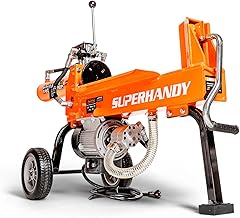
The SuperHandy 14 ton is the middle step in this list, and it exists for the person whose rounds are simply bigger than a compact electric splitter can manage. Fourteen tons is roughly double the force of the electric machines here, and that is the difference between stalling in a dense round and parting it.
The auto return ram is the feature worth paying attention to. Rather than holding a control while the cylinder retracts, you release and it comes back on its own, which frees both hands to reposition or load the next round. Across a couple of hours that removes a lot of dead time and a lot of standing still.
The frame is built to be moved to the wood rather than the other way around, which matters once rounds get heavy enough that carrying them is the hard part of the job. Splitting where the pile is, rather than hauling every round to a fixed machine, changes how tiring a session feels.
Two cautions. This is a substantially larger and heavier machine than the compact electrics, and storage and movement need planning rather than a corner of the garage. The listing also states the rating and ram behavior without spelling out the power source, so confirm that detail on the product page before ordering if it decides the purchase for you.
Bottom line: the right step up when the wood has outgrown an electric splitter, provided you have somewhere to keep it.
- Rated force: 14 ton
- Drive: hydraulic
- Ram: auto return
- Frame: portable
- Wedge: steel
- Intended use: firewood, cabins and seasonal wood prep
- Class: above compact electric, below full size 20 ton machines
This is for a household that burns real volume, or for a cabin or rural property where the wood arrives as it comes rather than pre-cut to a convenient size. Fourteen tons covers most of what a homeowner will meet, including denser species.
It is too much machine for a small suburban stack of seasoned rounds. If a compact electric splitter would handle ninety percent of your wood, the storage and weight of this one is a poor trade.
Before ordering, confirm the power source and the stated maximum log length and diameter on the product page, and measure your existing rounds against them. Rounds cut for a different stove are the most common reason a splitter turns out to be the wrong machine.
Plan the storage before the machine arrives. Work out where it lives out of the weather, whether it fits through your gate, and whether the ground between the store and the wood pile is something you can wheel a heavy frame across.

Pros
- 20 tons parts knotty hardwood that stops smaller machines
- 7HP engine means it works anywhere, with no cord
- Rapid auto return ram keeps cycle times short
- Full beam steel frame built for sustained work
Cons
- Engine brings fuel, oil changes and winter carburetor problems
- Exhaust rules out any enclosed space, including a garage with the door open
- Heavy and bulky enough that storage has to be planned around it
The SuperHandy 20 ton is the largest machine here and the one that stops caring what you feed it. Twenty tons through a steel wedge parts knotty hardwood rounds that would leave an electric splitter sitting there pushing, and the 7HP engine means it goes to the wood rather than waiting at an outlet.
The pump and ram are where the practical speed comes from. A Bucher gear pump and a rapid auto return ram keep the cycle short and free your hands between splits, which is the difference between a machine that feels fast and one that feels like waiting.
A horizontal full beam frame is the layout built for sustained work rather than occasional use. It is heavy, and it is meant to be, because a rigid beam is what stops a big cylinder flexing the frame under load.
Everything about this machine is a trade against convenience. An engine means fuel, oil changes and a carburetor that resents sitting through winter with stale fuel, which is the standard reason a splitter will not start in the fall. Exhaust means it can never be used in a garage, and the weight means storage and movement need real planning. For a small suburban stack, that is a great deal of machine to look after.
Bottom line: the pick when hardwood, big rounds and volume are the reality, and clear overkill when they are not.
- Rated force: 20 ton
- Power: 7HP gas engine
- Pump: Bucher gear pump
- Ram: rapid auto return system
- Frame: horizontal full beam steel
- Wedge: steel
- Intended use: firewood, forestry and harvesting work
This suits rural properties, anyone heating primarily with wood, and people whose rounds come from felled trees rather than a supplier. If knots and big diameters are normal in your stack, this is the class that handles them.
It is the wrong machine for a suburban yard and a few cords of seasoned rounds. The maintenance and storage costs are ongoing, and a quiet electric splitter would do that work without them.
Never run this in a garage, a shed or any enclosed space, even with the door open, because engine exhaust contains carbon monoxide. Work outdoors on level ground with the frame stable before starting.
Both hands stay clear of the wedge and ram path once a cycle begins, and nobody stands at the far end of the beam where split pieces exit. One person operates the control and handles the wood; a helper stacks at a distance rather than feeding logs. Between seasons, drain or stabilize the fuel and change the oil, since stale fuel in the carburetor is the most common no start problem.

Pros
- No axe swing, so the blade never travels toward you
- Cast iron construction with nothing to wear out or maintain
- Protective frame contains the wood and the split pieces
- Needs no fuel, cord or storage beyond a shelf
Cons
- Only takes wood that fits the 6.5 inch opening
- Needs a solid base or mounting point to work properly
- Heavy for its size, and you supply all the effort
The Kindling Cracker inverts the usual problem. Instead of swinging a blade at a stationary piece of wood, the blade sits fixed inside a cast iron ring and you drive the wood down onto it with a mallet. Nothing sharp ever moves toward you, which is the entire point.
For making kindling, that is a better arrangement than a hatchet by a wide margin. The frame holds the wood upright so your hand is not steadying a small piece next to a blade, it contains the split pieces instead of scattering them, and the striking action is short and controlled rather than a swing.
Cast iron is the right material and it is why these last. There is no mechanism, no hydraulics, no motor and no consumables, so the failure modes that end a powered splitter simply do not exist here. It will outlive the person who buys it.
The limits are set by the opening. Wood has to fit inside the 6.5 inch ring, which makes this a kindling and small split tool rather than a cordwood machine, and it needs to sit on something solid, ideally bolted to a stump or a heavy block, or it will move as you strike. You also supply the energy, which is the honest cost of owning no engine.
Bottom line: the best manual answer here for kindling, and a tool you buy once.
- Type: manual kindling splitter
- Material: cast iron
- Opening: 6.5 inch
- Blade: fixed, inside a protective frame
- Operation: strike the wood downward with a mallet
- Mounting: bolt holes for fixing to a stump or block
- Origin: Australian made
Fix the unit to a stump, a heavy block or a solid bench first. Used loose on the ground it walks around as you strike and the whole advantage disappears.
Stand a piece of wood inside the ring on the blade, keep the fingers of your steadying hand above the top of the wood, and strike the top of the wood with a mallet or a heavy striking log. Never strike the cast iron itself with a steel hammer. Work down through the piece rather than trying to split it in one blow, and wear eye protection because chips fly.
Eye protection is the one piece of equipment that is not optional, since flying chips are by far the most common injury with manual splitters. Keep bystanders back and clear the area of anything the wood could bounce off.
Strike the wood, never the blade or the frame, and use a mallet or a striking log rather than a steel hammer on cast iron. Check the mounting bolts stay tight, keep the blade free of rust with a wipe of oil at the end of the season, and store it somewhere it cannot fall on a foot.

Pros
- No fuel, no cord and no maintenance at all
- Safety cover shields the wedge point when not in use
- Splits kindling without an axe swing
- Small enough to store on a shelf
Cons
- Limited to small rounds and kindling work
- You supply all the effort, so volume is slow
- Needs a solid base to be used safely
The SPEED FORCE splitter is the cheapest useful answer in this list and it deserves a serious look before anyone buys a machine. It is a fixed wedge point with a safety cover, and it does one job: turning small rounds and offcuts into kindling without an axe.
That job is a large part of what people actually need. A stove household burns a modest volume of split wood and a steady supply of kindling, and the kindling is the part that keeps needing a hatchet and keeps producing near misses. A fixed wedge removes the swing from the equation entirely.
It also removes everything else. There is no motor to fail, no hydraulic fluid to check, no fuel to stabilize and nothing that objects to sitting in a cold shed for six months. When you want it, it works.
The limits are obvious and worth stating anyway. Small rounds only, kindling and light splits rather than cordwood, and your arms provide the force, so a large stack is a long afternoon. It also has to sit on something solid, since a wedge that shifts as you strike is both useless and unsafe.
Bottom line: buy this first, and only buy a machine if it turns out you genuinely need one.
- Type: manual wedge point splitter
- Operation: drive the wood onto a fixed wedge
- Guard: safety cover for the wedge point
- Power required: none
- Maintenance: none beyond rust prevention
- Best suited to: kindling and small firewood
- Finish: orange
This is for anyone whose real need is kindling rather than cordwood: fire pit users, wood stove households who buy split wood, campers and anyone who has decided a hatchet is more risk than they want in the yard.
It will not replace a splitter if you are processing rounds for winter heat. That is a different job and it needs hydraulics.
Set it on a solid base that will not shift, and keep the safety cover on whenever the tool is not in use. Wear eye protection every time, because chips leaving a struck piece of wood are the injury that actually happens here.
Strike the wood rather than the wedge, keep your steadying hand above the top of the piece and well clear of the point, and stop before your arms get tired enough to lose accuracy. Wipe the wedge and store it dry so the point does not rust.

Pros
- Steel wedge point with no moving parts to fail
- No fuel, cord or maintenance
- Compact enough to keep by the stove or in a shed
- Removes the axe swing from kindling work
Cons
- Kindling and small splits only, not cordwood
- Effort comes from you, so volume is slow
- Needs a stable base underneath it
The KABIN Kindle Quick belongs to the same family as the other manual splitters here: a steel wedge point that the wood is driven onto, rather than a blade swung at the wood. For kindling work that is a straightforwardly safer arrangement, and it is why these tools have found an audience among people who own perfectly good hatchets.
The appeal is how little there is to it. Steel, a point, and no mechanism. Nothing goes stale, nothing seizes over winter, and there is no service interval, which is a real advantage for a tool that gets used in short bursts through the cold months.
Size is the practical difference against a cast iron ring splitter. This is compact enough to keep near the stove or on a shelf rather than needing a stump to bolt to, which suits a household that makes a handful of kindling pieces at a time rather than a batch.
The trade is the same as with every manual splitter. Small pieces only, your arms provide the energy, and it needs to sit on something solid so it does not move under a strike. Knotty or large rounds are outside what this tool is for.
Bottom line: a compact, low commitment way to stop swinging a hatchet at kindling, best for stove households rather than for processing cordwood.
- Type: manual splitting tool
- Wedge: steel point
- Operation: drive the wood onto the fixed wedge
- Power required: none
- Maintenance: none beyond rust prevention
- Best suited to: kindling and small firewood
- Storage: compact enough for indoor storage
This is the pick for a wood stove household that buys split wood and only needs to make kindling, and for anyone who wants a splitting tool that lives indoors rather than in a shed.
Anyone processing rounds for winter heat needs hydraulics instead. Manual wedges are a kindling solution, not a cordwood one, and buying one expecting otherwise leads to disappointment.
Place the tool on a solid, level base that will not shift when struck, such as a heavy block or a stump. A wedge that moves under load is both useless and dangerous.
Stand the wood on the point, keep your steadying hand above the top of the piece, and strike the top of the wood with a mallet rather than hitting the tool itself. Work progressively rather than trying to split a piece in a single blow, wear eye protection throughout, and put the tool away with the point covered or facing down.
How to Choose a Small Log Splitter
Six things decide whether a splitter earns its storage space. Read the safety section even if you skip the rest, because the wedge area on a powered splitter is unforgiving and the rules around it are not suggestions.
Tonnage and What a Rating Really Buys
Rated force is the headline number and it is the one most often misread. A five to seven ton electric splitter will part seasoned, straight grained rounds up to about ten inches across without drama, which covers a very large share of what homeowners actually burn. Ten to fourteen tons handles bigger rounds and tougher species. Twenty tons and up is the territory of gnarled hardwood, big diameter rounds and volume.
More tons is not free. Force comes from a bigger cylinder and pump, and that means more weight, more noise, more space and more maintenance. A twenty ton machine parked in a single car garage for eleven months of the year is a poor trade if six tons would have split everything you actually put in front of it.
Buy for the wood you have rather than for the worst log you can imagine. If a round defeats a small splitter twice a season, splitting it with a maul or setting it aside for the fire pit costs less than owning a machine sized for exceptions. Working out the mix of species and diameters in your stack is a more useful hour than comparing tonnage figures.
Electric, Gas, or a Manual Wedge

An electric splitter runs off a standard household outlet, makes about as much noise as a shop vacuum, produces no exhaust and can therefore be used in a garage or on a covered porch. Between seasons it needs nothing more than storage. The limits are real: a fifteen amp motor caps the force available, and you are tethered to an extension cord of decent gauge.
A gas splitter goes wherever the wood is and delivers force an electric motor cannot. It also brings an engine into your life: fuel, oil changes, a carburetor that dislikes sitting all winter, and noise and exhaust that rule out enclosed spaces. For a suburban yard with a modest stack, that is a lot of machine to maintain.
A manual wedge splitter is the third answer and it is badly underrated. A fixed blade in a frame, or a wedge point you drive wood onto with a mallet, turns rounds into kindling and small splits with no fuel, no cord and no moving parts. It is slower per piece, it needs your effort, and it will not touch a big knotty round. For someone who mostly needs kindling and small stove wood, it is often the only tool required.
Log Diameter, Length and the Knot Problem
Every powered splitter states a maximum log length and diameter, and both are hard limits set by the beam and the ram stroke. Compact electric machines typically top out around twenty inches of length and ten inches of diameter. Measure your existing rounds before ordering, because a stack cut for a different stove is the most common reason a new splitter turns out to be the wrong machine.
Wood condition matters as much as size. Seasoned wood that has dried and started to check splits along lines that are already there, and a small electric machine handles it easily. Green wood is fibrous and stringy, and it demands considerably more force for the same diameter. If you split immediately after felling, size up.
Knots are where small splitters meet their limit, and no rating protects you from them. A round with a branch junction running through it has grain going three directions at once, and a six ton ram will push into it, stall, and sit there. Straight grained, seasoned, reasonably sized rounds are the diet a compact machine is designed for, and matching your wood to that is more useful than buying two extra tons.
Horizontal Beam, Vertical Beam and Moving the Machine

Nearly every compact splitter is horizontal only, which means you lift each round onto the beam. That is fine for small rounds and it is the reason these machines can be light. A vertical machine lets you tip a heavy round on end and split it without lifting, which is what makes big diameter work possible, and it is a feature that arrives with size and weight.
Working height is the detail people forget. A horizontal splitter sitting on the ground has you bent over for the whole session, which is exactly the problem you bought a machine to avoid. Look at whether the model has a stand, or plan on a sturdy bench or a pair of blocks that put the beam somewhere near waist height.
Then think about moving it. Wheels help, but the question is whether you can wheel it over lawn and gravel rather than across a smooth floor, and whether it fits through the gate. A compact electric machine can usually be carried by two people. A gas machine on a full beam frame usually cannot, and that shapes where it lives and where the wood has to be brought.
Cycle Time and the Auto Return Ram
Cycle time is how long the ram takes to travel out and come back, and it sets the pace of the whole job. Compact electric splitters generally sit in the fifteen to twenty second range for a full cycle. That sounds slow written down and feels reasonable in practice, because loading the next round takes time anyway.
An auto return ram is the feature worth looking for. Instead of holding a lever while the ram retracts, you release and the ram comes back on its own, which frees your hands for the next round and cuts the dead time out of every cycle. Over a couple of hours of splitting, that adds up to a meaningful difference in how tired you are at the end.
A four way cross wedge is the other real speed feature. Instead of halving a round and re-loading each half, a cross wedge quarters it in one pass. It works best on straight grained rounds of moderate size and it asks more of the ram, so it pairs naturally with the higher rated machines rather than the smallest ones.
Safety Around the Wedge

The rules that come with these machines are short and they exist because the wedge area is where people get hurt. Both hands stay clear of the wedge and the ram path once a cycle has started, and if a log needs repositioning you stop the cycle first rather than reaching in to nudge it. Never hold a round in place with one hand while working the control with the other.
Nobody should stand at the far end of the beam. Splits leave a splitter with force, and the end of the log is exactly where a piece will come off. One operator, one machine, and any helper stacks wood at a distance rather than feeding logs. Keep children and pets out of the working area entirely, and never let a second person operate the lever while you handle wood.
The manual splitters have their own version of the same rules. You strike the wood, never the blade, and eye protection is not optional because chips fly. Keep the fingers of your holding hand above the top of the wood, use a mallet or a striking log rather than a steel hammer on cast iron, and set the unit on a solid base so it cannot tip.
| Splitter type | Best at | Weak at |
|---|---|---|
| Manual wedge or kindling splitter | Kindling and small splits, no fuel, no storage burden | Needs your effort, useless on large or knotty rounds |
| Electric hydraulic, 5 to 7 ton | Quiet indoor friendly splitting of seasoned rounds | Tethered to an outlet, stalls on knots and green wood |
| Electric hydraulic with cross wedge | Quartering straight rounds in one pass | Cross wedge asks more force, so grain matters more |
| Gas hydraulic, 14 ton and up | Big rounds, hardwood, volume, works anywhere | Engine maintenance, noise, exhaust, weight and storage |
If that table points you at a manual wedge rather than a machine, take the hint and save the storage space. Our article archive covers the rest of the yard, and the tools and home improvement section is where the striking tools live.
Why You Should Trust Us
We build these lists from published specification and from the pattern of what long term owners report rather than from marketing copy. For every splitter here we looked at rated force, power source, beam orientation, whether the ram returns automatically, what the maker states about log capacity, and how the machine has to be moved and stored between seasons. Where a listing states a rating without stating a capacity, we say so instead of filling the gap.
We set aside near identical listings from the same maker that differ only in rating or trim, so every entry here is a genuinely different machine. Owner reports were read for repeated themes rather than one off complaints, since the problems that matter in this category, a ram stalling in knotty wood, hydraulic seepage after storage, and a working height that puts you bent double, repeat once you start looking for them.
Final Thoughts
Best overall is the BILT HARD 6.5 Ton Electric Log Splitter. Six and a half tons through a hydraulic ram covers seasoned rounds up to the size most homeowners actually burn, the 15 amp motor runs from an ordinary outlet, and there is no engine to winterize. For a yard with a stack rather than a woodlot, it is the machine that does the job without becoming a project of its own.
Best value is the SPEED FORCE Firewood Kindling Splitter. It is a fixed steel wedge with a safety cover and nothing else: no motor, no hydraulics, no storage problem, and no season where it refuses to start. For someone whose real need is kindling and small stove splits rather than cordwood, it removes the axe swing from the job for a fraction of what a machine costs.
For specific needs, the PROYAMA 7T Electric Log Splitter is the pick if you want a cross wedge to quarter rounds in one pass, the SuperHandy 14 Ton is the middle step for someone whose rounds are bigger than an electric machine can manage, and the SuperHandy 20 Ton with its 7HP engine is the choice when hardwood and volume are the reality. The Kindling Cracker is the manual splitter to buy if you want cast iron that will outlive you, and the KABIN Kindle Quick is the compact wedge for a wood stove household. More yard and outdoor picks are indexed in our category index.
Small Log Splitter FAQs
How many tons do I need in a small log splitter?
For seasoned, straight grained rounds up to about ten inches across, five to seven tons is genuinely enough and covers most household firewood. Ten to fourteen tons is the step up for larger diameters and denser species, and twenty tons and beyond is for knotty hardwood and volume. Buy for the wood in your stack rather than for the worst round you can picture, because force costs weight, noise, storage and maintenance. A machine that handles ninety percent of your wood plus a maul for the rest usually beats one that handles everything and lives in the way.
Will an electric splitter handle knotty wood?
Often not, and that is a limitation of physics rather than a fault in the machine. A knot is a branch junction where the grain runs in several directions at once, so a wedge cannot follow a line through it, and a compact ram will simply push in and stall. The same machine will part a clean seasoned round of similar diameter without hesitation. Set knotty rounds aside for a maul, a wedge and a sledge, or for the fire pit where they do not need splitting at all.
What are the safety rules that actually matter?
Three of them. Keep both hands well clear of the wedge and the ram path once a cycle has started, and stop the cycle before repositioning a log instead of reaching in. Keep everyone away from the far end of the beam, because that is where a split piece leaves the machine with force. And run the machine alone: one person on the control and on the wood, with any helper stacking at a distance rather than feeding logs. On manual splitters, strike the wood rather than the blade and wear eye protection, since flying chips are the injury that happens most.
Can I use a log splitter indoors or in a garage?
An electric splitter can be used in a garage or under cover because it produces no exhaust and is roughly as loud as a shop vacuum, which is one of the strongest arguments for buying electric in the first place. A gas machine cannot: engine exhaust contains carbon monoxide, and running one in a garage even with the door open is a serious risk. Manual wedge splitters are fine anywhere you have a solid base and room to swing a mallet, which makes them the practical winter answer for people without a covered work area.
How much maintenance does a small splitter need in 2026?
An electric hydraulic machine wants very little: check the hydraulic fluid level, wipe the ram, keep it dry and store it out of the weather. A gas machine adds fuel management, oil changes and the standard problem of a carburetor sitting through winter with stale fuel in it, which is the single most common reason a splitter will not start in the fall. Manual wedges need nothing beyond keeping the blade free of rust. Our yard and garden archive covers the storage and maintenance kit that goes with all three.


Write Your Review
No reviews yet. Be the first to share your experience!