

A battery impact driver is the tool that turns a deck build, a fence line or a weekend of cabinet installs from a wrist-numbing chore into repetitive work you can actually finish. The concentric hammering action drives long screws without cam-out, and because the tool delivers torque in pulses instead of a steady twist, your arm never absorbs the reaction that a drill would dump into it. We looked at 10 impact drivers from Milwaukee, DEWALT, BLACK+DECKER and more, sorted by motor type, battery platform, and whether the listing is a bare tool, a complete kit, or a combo that pairs the driver with a drill.
Our top pick is the DEWALT 20V MAX XR DCF845B Brushless 3 Speed Impact Driver for pairing a compact head with three selectable speed modes and a brushless motor, which is the combination that suits both cabinet hinges and lag bolts. Below we sort the field by what each listing includes and which battery ecosystem it locks you into, since that second decision outlives any single tool. For saws, sanders and everything else that shares the battery, our tools and home improvement section covers the rest of the platform.

Pros
- Three speed modes cover cabinet hardware through lag bolts
- Short brushless head fits between studs and inside cabinets
- Three-LED ring lights the fastener from several angles
- Deepest homeowner battery platform available
Cons
- Bare tool: no battery or charger included
- Priced above brushed drivers with similar torque
The DCF845B is the driver DEWALT built for people who do both fine and rough fastening with the same tool. Its brushless motor allows a head short enough to work inside a cabinet box, and the three-mode selector lets you drop to a low setting for hinges and trim screws and climb to full power for structural fasteners.
The quarter-inch collet loads one-handed, and the ring of three LEDs around it lights the screw head from multiple angles, which owners mention constantly after working under decks and in closets.
Run time on a compact pack is excellent for a driver, and the tool stays cool through long runs of deck screws. The main caveat is the listing: it is a bare tool, so you need DEWALT 20V MAX batteries and a charger already in the shop.
Owners who upgraded from brushed DEWALT drivers describe the difference in size and control as immediate.
Bottom line: the best all-round impact driver here for anyone on, or joining, the DEWALT platform.
- Motor: brushless
- Modes: 3 speed settings
- Collet: quarter-inch hex, one-handed loading
- Lighting: 3 LED ring
- Battery: DEWALT 20V MAX, not included
- Includes: tool and belt hook only
Existing DEWALT 20V MAX owners, and anyone starting a kit who is willing to buy batteries separately for a driver with real control. Ideal for cabinet installers, remodelers and serious DIYers.
Use mode 1 for small screws and hardware, mode 2 for general work, mode 3 for lag bolts and long structural screws. Fit only impact-rated bits. Pair it with a compact 2Ah pack for overhead work and a larger pack for long runs.

Pros
- Very short head and light body for tight spaces
- Drive control modes include a self-tapping screw setting
- Built for daily jobsite use
- Huge M18 tool ecosystem
Cons
- Bare tool, no battery or charger
- Priced for professionals
The M18 Fuel impact driver is what many tradespeople carry every day, and the reason is a combination of size and control. The brushless motor and Milwaukee's electronics allow a head shorter than almost anything else in the category, and the mode selector includes a self-tapping screw setting that stops the tool before it strips the fastener in sheet metal.
Torque is more than enough for any fastener a driver should see, and the tool delivers it smoothly rather than in the violent bursts of older drivers, which reduces cam-out and fatigue.
It is a bare tool, and it makes sense only on the M18 platform, which is one of the largest available and skews professional. Owners describe years of daily use with the main complaint being cost.
Bottom line: the professional pick, for people who will use it every working day and want the smallest capable driver.
- Motor: brushless
- Modes: multiple drive control settings including self-tapping screw
- Collet: quarter-inch hex
- Battery: Milwaukee M18, not included
- Lighting: LED ring
- Includes: tool only
Tradespeople and daily users already on Milwaukee M18, and anyone building a professional-grade kit who wants the most compact driver available.
Use impact-rated bits only. Keep the collet clear of debris so bits seat fully. Store batteries at partial charge in cool conditions and avoid running packs completely flat.

Pros
- Metal gear case shrugs off drops
- LED ring lights the fastener without shadows
- M18 platform access at a lower cost than Fuel
- Simple, proven design
Cons
- Brushed motor runs warmer and shorter than brushless
- Single speed relies on trigger control
- Bare tool, no battery
The 2656-20 is the affordable door into Milwaukee's M18 platform, and it has stayed popular for years because it is tough. The gear housing is metal, the trigger is responsive, and the LED ring around the collet is one of the best-lit front ends in the category.
It is a brushed, single-speed driver, so control comes from your trigger finger rather than a mode selector. For deck and framing work that is fine; for delicate hardware it demands a lighter touch.
Run time and heat are where the brushless Fuel pulls ahead, but for occasional or moderate use the difference is small, and the savings are real.
Owners describe it surviving falls from ladders and years of weekend use.
Bottom line: the durable value pick for M18 owners who do not need brushless refinement.
- Motor: brushed
- Torque: 1,500 inch-pounds
- Collet: quarter-inch hex
- Housing: metal gear case
- Lighting: LED ring
- Battery: M18, not included
M18 owners who want a rugged second driver or a first driver without paying for Fuel, and DIYers who value durability over compactness.
Pair it with a compact M18 pack to keep the weight down. If you find yourself stripping small screws, a lighter trigger pull or a step up to a multi-mode driver solves it. Buy impact-rated bits.

Pros
- Both tools are brushless, unusual in a combo at this level
- Two batteries and charger included
- Covers drilling and fastening in one purchase
- DEWALT 20V MAX platform
Cons
- Compact 2Ah packs limit run time on big jobs
- Impact driver is single speed rather than the three-mode XR
The DCK277D2 is the combo to buy when you want brushless motors on both tools without stepping up to the premium XR line. The drill handles holes and light fastening; the impact driver takes over for long screws and lag bolts, and both share the two included 2Ah packs.
The impact driver is compact and quick, though it lacks the three-mode selector of the DCF845B. For most homeowner and remodel work, trigger control is enough.
The 2Ah packs keep the tools light and are the right size for a driver, but on a long deck build you will lean on the charger. A larger pack down the road solves that.
Owners consistently describe this as the kit that started their DEWALT collection.
Bottom line: the smartest starting point for a brushless DEWALT kit.
- Drill: brushless, keyless chuck
- Impact driver: brushless, quarter-inch hex
- Batteries: 2 x 2Ah 20V MAX
- Charger: included
- Bag: contractor bag
- Lighting: LED on both tools
Anyone starting a cordless kit from scratch who wants brushless efficiency on both tools and plans to add more DEWALT 20V MAX tools later.
Use the drill for holes and small screws, the impact driver for construction fasteners. Rotate the two packs so one is always charging. Add a 4Ah or 5Ah pack when you start using the saws.

Pros
- Battery and charger included
- 2,800 RPM with an LED work light
- Access to the large V20 tool line
- Comfortable grip and simple operation
Cons
- Single battery means waiting on the charger
- Brushed motor, single speed
The CMCF800C1 is the sensible first impact driver for a homeowner: it comes with a V20 battery and charger, it has plenty of speed for deck and fence screws, and it puts you on a platform with a broad range of yard and shop tools.
It is brushed and single speed, so control is by trigger, and it will warm up on very long runs. For the occasional project it is more than adequate.
The single-battery kit is the compromise. For a weekend project it is fine; for a full deck, plan on a second pack.
Owners like the value and the warranty support and mostly wish it came with two batteries.
Bottom line: a solid entry kit on a platform worth growing into.
- Motor: brushed
- Speed: 0 to 2,800 RPM
- Collet: quarter-inch hex
- Battery: 1 x V20, included
- Charger: included
- Lighting: LED work light
Homeowners buying their first impact driver who want a battery in the box and a platform with lawn and shop tools to add later.
Let the tool cool between long fastening runs. Use impact-rated bits. Charge the battery after use and store it indoors away from heat.

Pros
- Two tools, two batteries, charger and bag in one purchase
- Proven brushed motors with years of owner history
- DEWALT 20V MAX platform
- Lower cost than the brushless combo
Cons
- Brushed motors run warmer and shorter than brushless
- Compact packs limit run time on big jobs
The DCK240C2 is one of the most widely owned tool kits in the country, and the reason is simple: it delivers a capable drill and a capable impact driver with two batteries for less than many single brushless tools.
Both tools are brushed, which means a bit more heat and a bit less run time than the DCK277D2, but for homeowner work the difference rarely shows.
The impact driver is compact enough for most cabinet and closet work and has the torque for deck screws and lag bolts. The compact packs keep the tools light and are the right size for the driver.
Owners report these kits lasting a decade of weekend use.
Bottom line: the classic starter combo, still the best way to get two DEWALT tools and two batteries for the least outlay.
- Drill: brushed, keyless chuck
- Impact driver: brushed, quarter-inch hex
- Batteries: 2 x compact 20V MAX
- Charger: included
- Bag: included
- Lighting: LED on both tools
Homeowners and new DIYers who want a complete drill and driver kit on the DEWALT platform without paying for brushless.
If you expect long daily use, spend more on the DCK277D2 brushless combo. If you need a drill and driver for projects a few times a year, this kit is the value choice. Add a larger pack later for saws.
Pros
- Two tools, two batteries and charger in one kit
- V20 platform with a wide tool range
- LED work lights and included bits
- Comfortable homeowner-sized tools
Cons
- Brushed motors
- Compact packs for run time
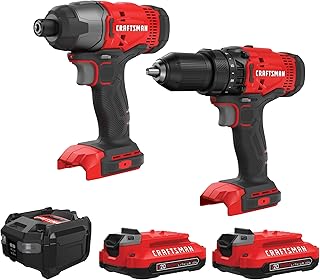
CRAFTSMAN's V20 combo is the direct rival to the DEWALT DCK240C2, and it makes the same pitch: two tools, two batteries, one bag, one purchase. The drill handles holes and light screws, the impact driver drives everything else.
Both tools are brushed and sized for homeowners, with LED lights and a grip that suits smaller hands. The V20 platform includes outdoor power equipment, which is a real advantage for people who want one battery for the yard and the shop.
Run time on the compact packs is fine for projects and short on long jobs, the usual combo-kit caveat.
Owners praise the value and the warranty.
Bottom line: the homeowner combo for anyone who wants their tool battery to also run the string trimmer.
- Drill: brushed, keyless chuck
- Impact driver: brushed, quarter-inch hex
- Batteries: 2 x V20
- Charger: included
- Accessories: 2 bits, bag
- Lighting: LED work lights
Homeowners starting a kit who want a platform covering both shop tools and yard equipment, and anyone loyal to the CRAFTSMAN name.
Keep one pack on the charger while the other works. Use the drill for holes, the impact driver for fasteners. Add impact-rated bits beyond the two included.

Pros
- Battery and charger included at the lowest cost here
- Shares batteries with a broad homeowner tool line
- Light and simple to use
- Plenty of torque for household fastening
Cons
- Brushed, single speed, basic trigger control
- Not built for daily heavy use
- Battery is a small pack
The BDCI20C is the impact driver for people who want the tool a few times a year: assembling furniture, building a raised bed, hanging a fence panel. It arrives with a battery and charger, it weighs little, and it has enough torque for every fastener those jobs involve.
It is brushed and single speed, and it will not keep pace with a DEWALT or Milwaukee on a long deck. That is not its job. Its job is to be there, charged, when the occasional project comes up, and owners say it does that for years.
The POWERCONNECT platform shares batteries with a wide range of BLACK+DECKER home and yard tools, which adds to the value for homeowners.
Bottom line: the best value for light-duty use, and the cheapest way to get a real impact driver with a battery in the box.
- Motor: brushed
- Collet: quarter-inch hex
- Battery: 20V MAX POWERCONNECT, included
- Charger: included
- Lighting: LED work light
- Weight: lightweight homeowner tool
Occasional users who want a complete kit for the least outlay, and BLACK+DECKER POWERCONNECT owners adding a driver to an existing battery.
Let the tool rest during long runs to avoid overheating the brushed motor. Charge the pack after each use and use impact-rated bits.

Pros
- Brushless motor at a budget price
- Two-speed selector and electric brake
- Battery, charger, sockets and bits in the box
- Compact and light
Cons
- Small tool platform beyond the driver
- Battery capacity is modest
- Long-term durability less proven than the major brands
AVID POWER's driver stands out among budget kits by offering a brushless motor and a two-speed selector, features normally reserved for the major brands' mid-range tools. The low mode makes it usable on hardware and small screws, and the brake stops the collet promptly when you release the trigger.
The kit is complete: battery, charger, a handful of sockets and bits. The battery is a modest pack, so plan on charging between large jobs.
The trade-off is the platform. AVID POWER offers a limited range of tools sharing the pack, so this is a driver for people who need a driver, not the start of a large cordless collection.
Owners are generally pleased with the performance for the money, with the usual budget-brand caveats about long-term support.
Bottom line: the most feature-rich budget driver here, best for homeowners who want control without joining a big platform.
- Motor: brushless
- Torque: 2,220 inch-pounds
- Modes: 2 speeds, electric brake
- Collet: quarter-inch hex
- Battery: 20V, included with charger
- Accessories: 4 sockets, 4 bits
Homeowners who want brushless efficiency and a low-speed mode at a budget price and do not plan to build out a large tool platform.
If you expect to add saws and sanders, choose a DEWALT, CRAFTSMAN or Milwaukee driver instead. If this is the only cordless tool you need, the feature set here is hard to beat for the outlay.

Pros
- Complete kit at a very low cost
- Variable speed trigger and LED light
- Light enough for overhead work
- Enough torque for household screws
Cons
- Small 1.3Ah battery limits run time
- Brushed motor, minimal platform
- Not for heavy or daily use
The GALAX PRO is the simplest kit here: a brushed driver, a small 1.3Ah pack and a charger. It drives furniture screws, deck boards and fence pickets without complaint, and at its weight it is comfortable overhead.
The battery is the limit. A 1.3Ah pack runs a driver for a respectable stretch, but a large project will need charging breaks. The platform is minimal, so this is a one-tool purchase.
Owners describe it as a good value for occasional jobs and are clear it is not a jobsite tool.
Bottom line: the cheapest way to get impact-driver convenience for light household work.
- Motor: brushed
- Speed: 0 to 2,800 RPM
- Collet: quarter-inch hex
- Battery: 1.3Ah 20V, included
- Charger: included
- Lighting: LED work light
Apartment and homeowner users who need an impact driver for furniture assembly and small projects, and want the lowest-cost complete kit.
Charge fully before each project. Use impact-rated bits. Feather the trigger for small screws since there is no low mode. Store the battery indoors.
How to Choose a Battery Impact Driver
Three of the ten listings here are combo kits that include a drill, and several are bare tools with no battery at all. Sorting out what is actually in the box is the first job, and the battery platform question is the one that matters for years.
Bare Tool, Kit, or Drill Combo: Know What Is in the Box

A bare tool is the driver alone, no battery, no charger. The DEWALT DCF845B, both Milwaukee M18 drivers and several others here ship that way, and they only make sense if you already own batteries on that platform. Buy a bare tool with no batteries at home and you will spend more on the battery and charger than you did on the driver.
A kit adds at least one battery and a charger. The CRAFTSMAN CMCF800C1, the BLACK+DECKER BDCI20C, the AVID POWER and GALAX PRO listings are kits, and they are the right starting point for someone with no cordless tools at all. Check how many batteries are included; a single-battery kit means waiting on the charger mid-job.
A combo kit adds a drill driver to the package. The DEWALT DCK240C2 and DCK277D2 and the CRAFTSMAN CMCK200C2 are all drill-plus-impact pairs with two batteries and a charger in a bag. If you are building a kit from nothing, the combo is almost always the smarter purchase, because you will want the drill for holes and the impact driver for fasteners, and buying them together with two shared batteries is far cheaper than buying two kits.
The Battery Platform Decision Outlives the Tool
Every cordless tool you buy after this one will want to share its battery, so the platform matters more than any single spec. DEWALT 20V MAX, Milwaukee M18 and CRAFTSMAN V20 are the three deep ecosystems represented here, each with dozens of tools that share the same pack. BLACK+DECKER’s 20V MAX POWERCONNECT line is a large homeowner platform that does not cross over with DEWALT despite the similar name and shared parent company.
AVID POWER and GALAX PRO are budget platforms with a smaller range of tools. They deliver a working impact driver at a low outlay, and for a homeowner who needs one driver and nothing else, that is fine. The limitation shows up the day you want a matching saw or sander and find the options thin.
The practical advice is to pick the platform you can see yourself owning five tools on, then pick the driver within it. For most homeowners that means DEWALT or CRAFTSMAN; for people who work with tools daily it usually means Milwaukee or DEWALT. Owner feedback is consistent that regret in this category comes from platform mismatch far more than from the driver itself.
Brushless Motors and Why They Matter More Here Than in a Drill
An impact driver works its motor harder than a drill does, so the efficiency gain from a brushless motor shows up clearly in run time and in how the tool feels under sustained load. The DEWALT DCF845B, the Milwaukee M18 Fuel and the DEWALT DCK277D2 combo all use brushless motors, and they run cooler and longer on the same battery than the brushed alternatives.
Brushed drivers are not obsolete. The Milwaukee 2656-20, the CRAFTSMAN CMCF800C1 and the DEWALT DCK240C2 combo use brushed motors and remain enormously popular because they are cheaper and, for occasional use, the difference is hard to feel. For a deck a year and hanging shelves, brushed is perfectly adequate.
Where brushless earns its cost is in daily use, in long lag-bolt runs where a brushed motor heats up, and in the compact form factors that only a brushless motor allows. If you notice the tool getting hot on big jobs, that is the signal you are ready to step up.
Torque, Speed Modes, and the Control You Actually Need

Impact drivers advertise inch-pounds of torque, and every unit here has enough for construction screws and lag bolts in the sizes homeowners use. Past a point, more torque is not the goal; control is. The feature that separates the top of the list is selectable speed modes, which let you dial the tool down for small screws in soft wood and cabinet hardware, where full power strips the head or drives the screw straight through the material.
The DEWALT DCF845B offers three modes, the Milwaukee M18 Fuel has selectable modes with a dedicated setting for self-tapping screws, and the AVID POWER surprises with a two-speed selector at its price. Single-speed drivers like the Milwaukee 2656-20 and the BLACK+DECKER rely on trigger feathering, which works but demands more from the user.
Think about the fasteners you drive most. If it is mostly deck and framing screws, a single-speed driver with a good trigger is fine. If you install cabinets, hinges and trim, the low mode is worth paying for, because it is the difference between a clean install and a drawer of stripped screws.
Size, Weight, and Getting Into the Corner

Head length is the spec that decides whether the driver fits between studs or inside a cabinet carcass. The brushless drivers, particularly the DEWALT DCF845B and the Milwaukee M18 Fuel, are noticeably shorter front to back than brushed drivers, and that compactness is the daily-use advantage people mention most after buying one.
Weight follows the battery more than the tool. A compact 1.3Ah or 1.5Ah pack keeps the tool light and balanced for overhead work; a 4Ah or 5Ah pack adds run time and a lot of mass. The kits here mostly ship with compact packs, which is the right choice for a driver even if it is the wrong choice for a circular saw.
Look at the LED arrangement too. A ring of LEDs around the collet, as on the Milwaukee 2656-20 and the DEWALT drivers, lights the fastener from several angles without the shadow a single LED throws. It sounds minor until you are driving screws under a deck.
The Impact Driver Is Not an Impact Wrench
Every tool here has a quarter-inch hex collet, which accepts driver bits and hex-shank drill bits. That is the impact driver’s defining feature and also its limit: it is a screw and bolt tool, not a lug nut tool. An impact wrench has a half-inch square anvil, several times the torque, and is built for wheel nuts and suspension bolts. Listings that mix the two show up in searches, so check the collet before buying.
Within its lane, the impact driver replaces a drill for most fastening. It drives long screws faster, with less wrist strain and far less cam-out than a drill because the hammering keeps the bit seated. What it does not do well is drill clean holes; the impacts chatter a twist bit. That is why the combo kits pair it with a drill rather than pretending one tool does both.
Use impact-rated bits. Standard bits shatter under the hammering, and the shards are a real hazard. Most kits here include a starter bit or two; buy a proper impact-rated set the same day.
| What you are buying | Examples here | Best for | Watch out for |
|---|---|---|---|
| Bare tool | DEWALT DCF845B, Milwaukee M18 Fuel, Milwaukee 2656-20 | Owners already on the platform | No battery or charger included |
| Driver kit | CRAFTSMAN CMCF800C1, BLACK+DECKER BDCI20C, AVID POWER, GALAX PRO | First cordless tool | Single battery means charging breaks |
| Drill and driver combo | DEWALT DCK240C2, DCK277D2, CRAFTSMAN CMCK200C2 | Building a kit from nothing | Check whether the pair is brushed or brushless |
If the driver is going into a garage that also handles cars, the automotive section covers the impact wrenches and sockets that belong alongside it, and our full article index lists every guide we publish.
Why You Should Trust Us
We assembled this list by comparing the published specifications for each driver, including motor type, torque rating, speed modes, head length, collet type and exactly what each listing includes, against the way owners describe using the tools over months and years. Our emphasis was on the patterns that recur across thousands of owner reports: which drivers hold up to daily use, which kits leave people waiting on a charger, and which purchases people regret because of the battery platform rather than the tool.
We ranked control and platform value above raw torque numbers, because every driver here has enough torque for the fasteners homeowners and tradespeople actually drive. Where a listing’s description could mislead, such as combo kits that read like single tools, we said so in the individual reviews.
Final Thoughts
The DEWALT 20V MAX XR DCF845B is our best overall because it delivers the three things that matter most in daily use: a compact brushless head that fits where brushed drivers cannot, three speed modes that make it as useful on cabinet hinges as on lag bolts, and a place on the deepest homeowner battery platform available. It is a bare tool, so it assumes you own DEWALT batteries or plan to; if you do, nothing here is a better buy.
The BLACK+DECKER 20V MAX POWERCONNECT BDCI20C Kit is the best value for someone who needs an impact driver a few times a year and wants a battery and charger in the box for the lowest outlay. For anyone starting from zero, the DEWALT DCK277D2 Brushless Drill and Impact Driver Combo is the best for building a kit, because it pairs a brushless driver with a brushless drill and two batteries in one purchase, and the Milwaukee M18 Fuel is the best for daily professional use where run time and compactness earn their cost every day.
Whichever you pick, buy impact-rated bits and a second battery before the first big job. Our category directory covers the saws and sanders that share the platform, and the store list shows where each brand is currently discounted.
Battery Impact Driver FAQs
What is the difference between an impact driver and a drill?
A drill applies steady rotation through a keyless chuck and is built for boring holes and light fastening. An impact driver applies rotation plus rapid rotational hammering through a quarter-inch hex collet, which drives long screws and lag bolts faster and with far less cam-out and wrist strain. The impacts make a driver poor at drilling clean holes, which is why the combo kits here pair the two tools rather than replacing one with the other.
Can an impact driver remove lug nuts?
Not reliably, and it is the wrong tool for the job. Impact drivers have a quarter-inch hex collet and torque ratings sized for screws and bolts; lug nuts need an impact wrench with a half-inch square anvil and several times the torque. Adapters exist, but they put the driver far outside its design limits and usually fail to break a properly torqued nut loose. The automotive section covers the impact wrenches built for that.
Is a brushless impact driver worth the extra cost?
For frequent or heavy use, yes. Brushless motors run cooler, last longer on a charge and allow a shorter head, and all three of those advantages are more noticeable in an impact driver than in a drill because the driver works its motor harder. For occasional homeowner jobs, a brushed driver like the Milwaukee 2656-20 or the CRAFTSMAN CMCF800C1 does the work fine and costs less. If your current tool gets hot on long fastening runs, that is the sign to step up.
Do I need special bits for an impact driver?
Yes. Use bits marked impact-rated, which are made from a tougher steel and often have a torsion zone that flexes under the hammering instead of snapping. Standard driver bits shatter in an impact driver, and the fragments are a genuine eye hazard. Hex-shank drill bits and socket adapters also need to be impact-rated for the same reason. Most kits here include one or two starter bits; a proper impact set should be your first accessory purchase.
Should I buy a combo kit or just the impact driver?
If you own no cordless tools, buy the combo. A drill and an impact driver cover different jobs, you will want both within a month, and the combo kits here include two batteries and a charger that would cost more than the second tool if bought separately. If you already own batteries on a platform, buy the bare tool within that platform instead; paying for a charger and batteries you already have is the most common overspend in this category.
Write Your Review
No reviews yet. Be the first to share your experience!