

Every lock in this category is described as heavy duty, high security and anti theft. Those words are free to print and none of them are graded by anyone. The useful question is not whether a lock is secure, it is what tool defeats it and how long that takes, because a cable that stops an opportunist walking off with your bike and a shackle that resists bolt cutters are separated by seconds of work with a tool that fits in a jacket.
Our top pick is the Kryptonite Evolution Mini-7 Bike U-Lock, because it is the only lock here carrying an independent security rating rather than a manufacturer’s own adjective. Below are 8 locks from Master Lock, Kryptonite, Sportneer and more, sorted by the tool that beats them. Our sports and outdoors guides cover the rest of your kit, and this list is current for October 2026.

Pros
- Sold Secure Gold rating from independent testing
- 13mm hardened shackle resists bolt cutters
- Compact shape leaves no room for leverage
- Includes a cable for the front wheel
Cons
- Small shackle limits which anchors you can use
- Heavier than a cable lock to carry
The reason this lock leads the list is that somebody outside Kryptonite attacked it and published a grade. Sold Secure testing uses real tools under timed conditions, which makes it the only claim in this category that is not the manufacturer describing its own product.
The engineering behind the grade is the shackle. At 13mm of hardened steel, bolt cutters struggle to get purchase on a round bar of that diameter, which pushes an attacker toward an angle grinder. That is loud, visible and slow, and those three things are what actually protect a bike in a public place.
The mini format is the other half of the design. A small loop means almost no empty space once the lock is around a frame and a stand, so there is nowhere to seat a lever. The cost is flexibility: you have to park next to something the shackle will reach around.
Bottom line: the lock to buy if the bike matters and it gets left in public.
- Shackle: 13mm hardened steel
- Rating: Sold Secure Gold
- Included: 4 ft accessory cable
- Locking: keyed cylinder
- Format: mini U-lock with frame bracket
Best for commuters, city riders and anyone leaving a bike locked in public for hours, and for riders whose insurance specifies a security grade.
Less suited to someone who parks in varied places and needs a lock that reaches around wide posts.
Lock through the frame and rear wheel to a fixed anchor, then use the supplied cable for the front wheel. Two attack surfaces means two tools.
Keep the lock off the ground and turn the keyhole downward. Ground contact gives a thief a hammering surface and an upward keyhole collects rain and grit.

Pros
- Manganese steel links resist cutting better than plain steel
- Short length keeps weight down for daily carry
- Keyed cylinder avoids combination weaknesses
- Chain flexes around anchors a U-lock will not fit
Cons
- 2.8 feet limits which anchors you can reach
- Bronze grade holds out for less time than a Gold rated lock
This is the practical everyday lock in the list. A chain gives you something a U-lock cannot, which is the ability to wrap around anchors of awkward shapes, and manganese steel links put it well above cable in terms of what tool is needed to get through it.
The short length is deliberate. At 2.8 feet it is light enough that people actually carry it, and a chain that lives on the bike is worth more than a heavier one that stays at home. It also limits slack, which reduces the leverage available to an attacker.
What you give up compared with our top pick is grade and shackle thickness: this one is rated Sold Secure Bicycle Bronze against the Evolution at Gold. For a bike left for an hour outside a shop or a gym this is a sound choice. For an all day station park, step up.
Bottom line: the best balance of resistance, weight and price here.
- Links: 7mm manganese steel
- Length: 2.8 ft, approximately 85cm
- Locking: keyed cylinder
- Sleeve: protective cover over links
- Rating: Sold Secure Bicycle Bronze
- Use: everyday commuting and short stops
Best for daily riders making short and medium stops, and for anyone who finds U-locks awkward against the anchors on their route.
Less suited to overnight outdoor parking, where a thicker chain or a rated U-lock is the sensible minimum.
Pull the chain tight around the frame and the anchor rather than leaving slack. Slack is what a lever needs.
Do not let the chain rest on the ground when locked. Concrete gives a thief a solid backing to strike against.

Pros
- Four feet reaches anchors shorter chains cannot
- Hardened steel links require substantial bolt cutters
- Keyed locking rather than a dial mechanism
- Sleeve protects frame paint and clothing
Cons
- Longer chain means more weight to carry
- Extra length adds slack unless wrapped tightly
This is the answer when 2.8 feet of chain will not go around the thing you need to lock to. Street furniture is inconsistent, and a longer chain turns awkward anchors into usable ones.
Hardened steel links keep it in the middle tier of resistance, which is to say a thief needs proper bolt cutters rather than a cable cutter. The keyed cylinder avoids the specific weakness of cheap dial mechanisms, which can sometimes be worked open by feel with no tools at all.
The cost of the extra length is weight and slack. Weight is a carrying question, and slack is a security one, so wrap the chain tightly rather than leaving a loose loop hanging when you lock up.
Bottom line: the longer keyed chain for riders who park against awkward anchors.
- Chain: 4 ft hardened steel
- Locking: keyed cylinder
- Sleeve: protective cover
- Use: bikes, motorcycles, gates and fences
Best for riders whose usual parking spots need more reach, and for households wanting one chain that also covers a gate or a shed.
Less suited to riders counting grams, where a shorter chain or a mini U-lock is easier to live with.
Take up the slack before locking. A four foot chain hanging loose gives more leverage room than a shorter one pulled tight.
Thread through the frame and rear wheel where possible, so one pass covers the two most valuable parts of the bike.
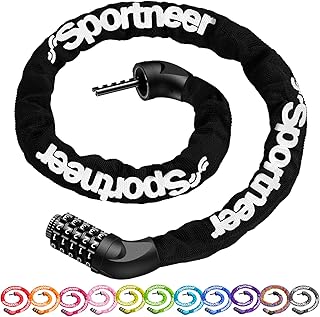
Pros
- Five digits make guessing far slower than four
- No keys to lose or leave behind
- Choice of three lengths
- Chain construction rather than braided cable
Cons
- Dial mechanisms are the attack surface on cheaper locks
- Combination must be reset carefully or it can be forgotten
The most common way people lose access to their own bike is losing the key, and a combination lock removes that failure entirely. This one uses five digits rather than the four found on many budget locks, which multiplies the work involved in guessing.
It is also a chain rather than a cable, which puts it in a meaningfully higher tier of cut resistance. That combination, keyless plus chain, is less common than it should be, since most keyless locks in this class are cables.
The thing to be aware of is that dial mechanisms are the attack surface on inexpensive combination locks. Applying tension and turning each dial can reveal digits by feel on weaker mechanisms, which no amount of chain thickness prevents. For medium risk situations that is an acceptable trade for never carrying a key.
Bottom line: the best keyless option here, and a genuine chain rather than a cable.
- Locking: 5 digit resettable combination
- Lengths: 3.2, 3.6 and 4 ft options
- Construction: chain with protective sleeve
- Use: bikes and general security
Best for riders who share a bike with family members, who lose keys, or who simply prefer not to carry them.
Less suited to long unattended parking in high theft areas, where a keyed cylinder and a rated shackle are the stronger option.
Set a combination that is not a birthday or a repeated digit, and write it somewhere at home rather than relying on memory after a holiday.
Spin the dials after locking. Leaving them one click from the code is the equivalent of leaving a key in the lock.

Pros
- Light and easy to carry or stow
- Flexible enough to thread through wheels and frames
- Combination removes the need for keys
- Vinyl coating protects paintwork
Cons
- Braided cable is cut quickly by a cable cutting tool
- Not appropriate as the only lock in a high risk area
Understood correctly, this is a useful product. Cable locks are light, flexible and quick to use, and they stop somebody wheeling an unattended bike away. That is a real job and a lot of bike theft is exactly that opportunistic.
What a braided cable does not do is resist a prepared thief. The construction is many thin strands, and a hand tool intended for cutting cable goes through it very quickly. No coating or marketing phrase changes that, and it applies to every cable lock rather than to this one specifically.
The right way to buy this is as a secondary lock, threaded through a front wheel while a chain or U-lock secures the frame and rear wheel, or as a lock for short stops where the bike stays in sight.
Bottom line: buy it as a second lock, not as the only one.
- Cable: 4 ft braided steel, 5/16 inch
- Locking: combination
- Coating: weather resistant vinyl
- Colour: black
- Use: secondary lock and short stops
Best as a second lock for a front wheel, for a child's bike, or for short stops in quiet places where the bike is not left long.
Not appropriate as the sole lock for a bike left in a public place for hours.
Pair it with a chain or U-lock rather than using it alone. Two lock types force a thief to carry two tools.
Thread it through the front wheel and the frame together, so removing the wheel does not release the cable.

Pros
- Six feet reaches distant or awkward anchor points
- Set your own combination is easier to remember
- Long enough to secure two bikes together
- Light for its length
Cons
- Cable construction is cut quickly with the right tool
- Extra length leaves considerable slack
Length is the reason to choose this over the four foot version. Six feet will loop around a wide post, reach a rack that is further away than you would like, or pass through two bikes at once, which is useful on a family outing.
Setting your own combination is a small but genuine advantage, because a number you chose is a number you remember, and forgotten codes are the keyless equivalent of a lost key.
The security position is the same as any cable lock, and the extra length makes it slightly worse on one specific point: more slack means more room for a lever. Use it as a secondary lock, wrap it tightly, and do not leave a bike relying on it alone.
Bottom line: the long cable option, with the same caveats as every cable.
- Cable: 6 ft braided steel, 1/2 inch diameter
- Locking: 4 digit set your own combination
- Coating: vinyl
- Use: secondary lock, multiple bikes, distant anchors
Best for families locking several bikes together, and for riders whose usual parking needs more reach than a standard lock allows.
Not the choice for securing a valuable bike left alone in a public place.
Wrap the excess around the frame rather than leaving a long loop hanging. Slack is the main disadvantage of a long cable.
When locking two bikes, pass the cable through both frames rather than through wheels, so neither bike can be freed by removing a wheel.

Pros
- Mounting bracket means it stays with the bike
- Resettable combination avoids carrying keys
- Half inch cable is thicker than many budget cables
- Light enough not to affect handling
Cons
- Still a braided cable and cut quickly by the right tool
- Bracket adds clutter to a small frame
The mounting bracket is the reason to prefer this over an unmounted cable. A lock only protects a bike if it is with the bike, and a lock that lives in a bag is a lock that gets left behind on the day you needed it.
The cable itself is a half inch braided steel with a resettable combination, which is a sensible specification for its class. It threads easily through wheels and around frames and weighs little enough that you forget it is there.
The security ceiling is the same as every cable in this list. Treat it as a deterrent and a second layer rather than a primary defence, and pair it with a chain or U-lock whenever the bike is left for more than a few minutes.
Bottom line: the most convenient cable here thanks to the bracket.
- Cable: 4 ft, 1/2 inch braided steel
- Locking: resettable combination
- Included: frame mounting bracket
- Coating: protective vinyl
- Use: secondary lock and short stops
Best for casual riders who want a lock permanently attached to the bike, and as a second lock alongside a chain or U-lock.
Not appropriate as the only lock for a valuable bike left unattended.
Fit the bracket where the lock will not rattle against the frame, then check it after the first few rides and retighten.
Use it through the front wheel while a stronger lock takes the frame and rear wheel.

Pros
- Chain construction rather than braided cable
- Keyed cylinder avoids dial mechanism weaknesses
- Short length keeps weight manageable
- Works for gates, sheds and motorcycles too
Cons
- Three feet limits which anchors it will reach
- No independent security rating
A chain at three feet with a keyed cylinder is the sensible everyday configuration, and this one covers more than bikes. Households often need one lock for a bike, a shed, a gate and occasionally a ladder, and a chain is far more adaptable in that role than a U-lock.
Being keyed rather than dialled removes the specific weakness of budget combination mechanisms, and the sleeve over the links means it can be wrapped around a frame or a gate without leaving marks.
The limits are length and the absence of independent testing. Three feet reaches a standard bike stand but not much more, and while the construction is a clear step above cable, you are relying on the description rather than a graded result.
Bottom line: a versatile keyed chain for bikes and everything else around the house.
- Chain: 3 ft with protective sleeve
- Locking: keyed cylinder with spare keys
- Use: bikes, motorcycles, doors, gates and fences
- Construction: hardened chain links
Best for households wanting one lock that covers a bike, a gate and a shed, and for riders who prefer keys to dials.
Less suited to riders who need extra reach or to anyone whose insurance specifies a security grade.
Lubricate the cylinder once or twice a year with a dry lubricant. Heavy oil attracts grit, and a seized lock outdoors in winter is almost always a neglected cylinder.
Keep the keyhole facing downward when locked so it collects less water, and store the spare key somewhere other than the bag on the bike.
How to Choose a Bike Lock
Six things decide whether a lock suits your situation. The first is by far the most important and the one the listings work hardest to blur.
What Each Type Actually Resists

Braided steel cable, which covers both Master Lock products and the Titanker cable here, is made of many thin strands wound together. It is flexible, light and easy to thread through a wheel, and it is cut by a hand tool made for cutting cable in a matter of seconds. That is not a defect in these particular products, it is what cable is. Its real job is to stop somebody wheeling your bike away casually.
Chain locks are the middle tier. The Kryptonite Keeper uses manganese steel links, and the GRIFEMA, Sportneer and Titanker chains use hardened steel. A chain has to be attacked link by link with bolt cutters, and the jaw size needed grows with the link thickness. Bolt cutters that will cut a thin chain fit under a coat, while the ones needed for thick links are awkward to carry and obvious to onlookers.
A hardened U-lock shackle, such as the 13mm shackle on the Evolution Mini-7, is a different problem again. Bolt cutters struggle to get purchase on a thick round hardened bar, so the practical attack becomes an angle grinder. That is loud, throws sparks and takes time, which is exactly the deterrent you are paying for.
Independent Ratings, and What Gold and Bronze Mean

Sold Secure is an independent body that attacks locks with real tools under timed conditions and awards grades based on how long they hold. Two locks here carry that certification: the Kryptonite Evolution Mini-7 at Gold and the Kryptonite Keeper 785 at Bicycle Bronze. Every other security claim on this page comes from the company selling the product.
This matters practically as well as philosophically, because some insurers and some workplace bike storage schemes require a lock at a specified grade. If your bike is insured, read the policy before you buy: a claim can be refused if the lock did not meet the stated standard, regardless of how sturdy it felt.
The gap between Gold and Bronze is a gap in how long a lock holds out, not a pass and a fail, so a Bronze rated chain is a tested product at a lower grade rather than an untested one. The absence of any rating does not make a lock useless either. It means you are relying on the material description, the link or shackle thickness and the manufacturer’s reputation instead of a tested result. For a bike left briefly outside a shop, that is a reasonable position. For a bike left at a station all day, it is not.
Key or Combination
Combination locks remove the problem of losing a key, which is the single most common way people end up cutting off their own lock. The Sportneer, both Master Lock cables and the Titanker cable all use combinations, and several let you set your own number rather than living with a printed one.
The trade off is at the low end of the market. Inexpensive multi dial combination mechanisms can sometimes be worked open by applying tension and turning each dial until a click or a change in resistance gives the digit away. It takes patience and no tools at all, which is a very different threat model from cutting. More dials makes this slower, and better mechanisms resist it, but a keyed lock removes the attack entirely.
Keyed locks bring their own housekeeping. Keep the spare somewhere other than your bike bag, and if the lock lives outdoors, expect to lubricate the cylinder occasionally. The GRIFEMA, Titanker chain and Kryptonite products here are keyed.
Length, Weight, and the Leverage Problem
Length looks like a straightforward convenience decision and it is not. A longer cable or chain reaches more anchor points and lets you secure both wheels, which is why six foot cables sell well. It also means more slack, and slack is what a thief uses to insert a bar and lever the lock apart.
This is the reason mini U-locks exist. A small shackle leaves almost no room inside the loop once it is around a frame and a stand, so there is nowhere to seat a lever. It is less convenient, and the inconvenience is the security feature. The same logic applies to chains: pull the chain tight around the frame and the anchor rather than leaving it hanging loose.
Weight follows length and thickness directly. A short manganese chain or a mini U-lock is carryable on a daily commute. A long thick chain is heavy enough that people leave it locked at their destination instead of carrying it, which is a legitimate strategy if you always park in the same place.
How You Lock It Matters More Than What You Buy
A good lock used badly protects less than a modest lock used well. The rules are simple and consistently ignored. Lock through the frame, not only through a wheel, because a quick release wheel comes off in seconds and leaves the rest of the bike gone. Lock to something fixed that cannot be lifted over, which rules out short posts and railings with an open end.
Keep the lock off the ground. A lock resting on concrete gives a thief a solid surface to hammer against, and ground level makes it easier to stand on a bar for leverage. Fill the space inside the shackle or pull the chain tight, and position the keyhole facing down so it is harder to attack and collects less water.
Where a bike is left overnight or all day, two different lock types beat one expensive lock, because they require two different tools. A U-lock through the frame and rear wheel plus a cable through the front wheel is the standard arrangement, and several cables here are sold with exactly that secondary role in mind.
Mounting, Weather, and Living With It

A lock that is annoying to carry gets left at home, which is why mounting matters more than it appears. The Titanker cable includes a mounting bracket, and U-locks typically clip to a frame tube. Chains without a mount usually end up wrapped around a seat post or carried in a bag, where a bare chain will mark paint and clothing.
Weather protection is the reason most locks in this list have a vinyl or fabric sleeve. It stops the lock scratching the frame, and on chains it stops the links marking whatever they touch. The part that actually needs care is the cylinder: a keyhole facing upward collects rain and grit, and a seized lock in winter is nearly always a neglected cylinder rather than a broken mechanism.
Use a dry lubricant or a lock specific product once or twice a year. Heavy oil attracts grit and eventually makes the problem worse, which is a common mistake with locks left outdoors year round.
| Lock | Type | Locking | Realistic role |
|---|---|---|---|
| Kryptonite Evolution Mini-7 | 13mm U-lock and cable | Key | Primary lock, independently rated |
| Kryptonite Keeper 785 | Manganese chain, 2.8 ft | Key | Everyday lock, Sold Secure Bronze |
| GRIFEMA Chain | Hardened chain, 4 ft | Key | Longer reach primary lock |
| Sportneer Chain | Chain, 3.2 to 4 ft | 5 digit combination | Keyless everyday lock |
| Master Lock 8143D | Cable, 4 ft | Combination | Secondary lock or low risk stops |
| Master Lock 8122D | Cable, 6 ft | Combination | Reaching awkward anchors |
| Titanker Cable | Cable, 4 ft with bracket | Combination | Secondary lock, easy to carry |
| Titanker Chain | Chain, 3.3 ft | Key | Bikes, gates and general use |
Read the realistic role column rather than the product name. Several of these are excellent products with a job that is not stopping a determined thief. More gear guides are in our article archive.
Why You Should Trust Us
We build these lists from published specifications and verified buyer feedback, and here we made a point of separating tested claims from marketing ones. Sold Secure grading is an independent result. Phrases like high security and anti theft are not, and they appear on cable locks and hardened shackles alike.
We have also been direct about what cable locks are for, rather than quietly ranking them alongside hardened U-locks as though the difference were a matter of degree. A list that implies a braided cable and a 13mm shackle offer comparable protection is worse than no list, because the person reading it makes a decision about a bike they cannot afford to lose.
Final Thoughts
The Kryptonite Evolution Mini-7 is our best overall. The 13mm hardened shackle pushes an attacker toward power tools rather than hand tools, the compact shape leaves no room for leverage, and the Sold Secure Gold rating means somebody outside the company attacked it and recorded how long it held.
The Kryptonite Keeper 785 chain is the best value pick. Manganese steel links and a short 2.8 foot length give you real resistance in something light enough to carry every day, and it carries a Sold Secure Bicycle Bronze rating, so its grade comes from independent testing rather than from the box.
Then buy for your situation. If you need more reach to lock to awkward anchors, the GRIFEMA four foot chain is the longer keyed option. If you would rather not carry keys, the Sportneer combination chain gives you chain level resistance without them. The Master Lock and Titanker cables are the right answer as a second lock through a front wheel, or for short stops in low risk places, and the Titanker chain covers gates and general household use as well as bikes. Whatever you buy, lock through the frame and keep the lock off the ground. Our sports section has more cycling guides.
Frequently Asked Questions
Is a cable bike lock good enough in 2026?
For short stops in low risk places, or as a second lock securing a front wheel, yes. As the only lock on a bike left all day, no. Braided cable is cut by a hand tool in seconds, which is why cables are best understood as a deterrent against opportunists rather than protection against someone who came prepared.
What does Sold Secure Gold mean?
It is a grade awarded by an independent testing body that attacks locks with real tools under timed conditions. Gold is a higher grade than Silver or Bronze. It is the only rating in this list that comes from outside the manufacturer, and some insurance policies specify a minimum grade, so it is worth checking your policy before buying.
Should I choose a key or a combination lock?
Combinations remove the risk of losing a key, which is the most common reason people end up cutting their own lock off. Keyed cylinders remove the possibility of a combination being worked out by feel, which is a realistic weakness in inexpensive dial mechanisms. Pick based on which failure you think is more likely for you.
Why are mini U-locks considered more secure than large ones?
Because there is less empty space inside the shackle once it is around the frame and the stand. Empty space is where a lever goes, and levering is one of the quickest ways to defeat a lock without cutting. The inconvenience of a small lock is the security feature, not a compromise.
Do I need two locks?
For a bike left overnight or all day in a public place, two different types is genuinely better than one expensive lock, because it forces a thief to bring two different tools. A U-lock through the frame and rear wheel plus a cable through the front wheel is the usual arrangement. More cycling guides are in our article archive.

Write Your Review
No reviews yet. Be the first to share your experience!