

Fingersave is printed on a lot of goalkeeper gloves and explained on almost none of them. It refers to a stiffening spine built into the finger of the glove, and the reason it exists is specific: a shot that catches a fingertip can bend the finger backwards past its normal range, and a spine stops that. What the listings leave out is that the same spine also resists the bend you want, the one your hand makes when it wraps around a ball.
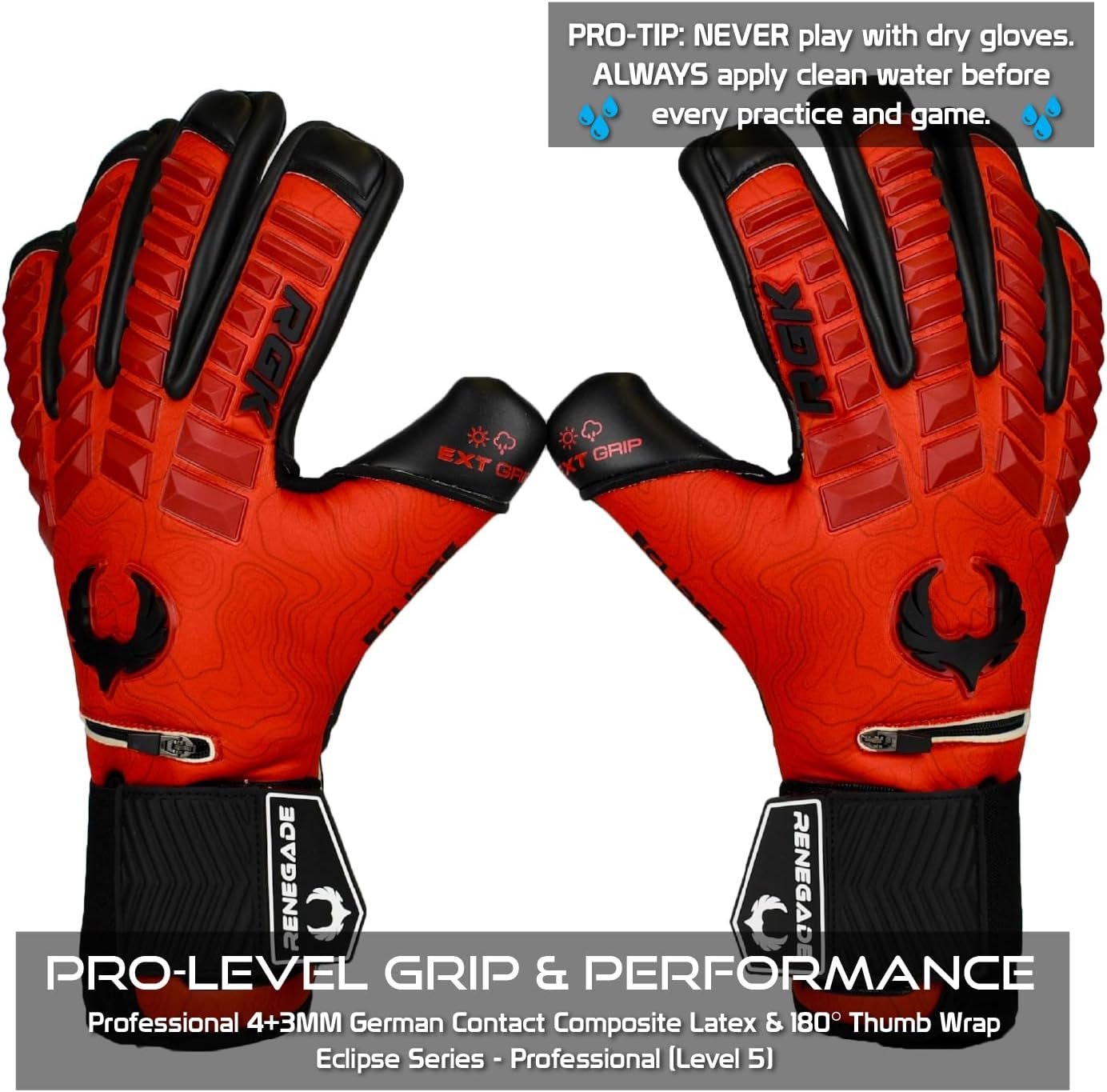
Our top pick is the Renegade GK Eclipse Professional Soccer Goalie Gloves for pairing a thick contact grip palm with finger protection in a build aimed at serious play. Below are 8 pairs from Sportout, Malker, Renegade GK and more, compared on spine type, latex thickness and sizing rather than on marketing language. Our sports and outdoors guides cover the rest of the kit, and this list is current for October 2026.

Pros
- Thick contact grip palm with finger protection in one glove
- Wide numeric size range covering youth and adult hands
- Built for match play rather than casual use
- Clear level grading within the brand range
Cons
- Soft grip latex wears quickly on artificial turf
- More glove than a beginner keeper needs
This is the glove for a keeper who has decided they are a keeper. The palm uses a thick paired latex construction, which does two things at once: it grips, and it cushions the impact of a hard shot so the hand is not doing all the absorbing.
Finger protection is integrated rather than bolted on, and the numeric sizing runs wide enough that a youth player and an adult can both be fitted properly. That matters more here than in most gloves, because a spine that does not line up with the finger joints is decoration.
The thing to plan around is wear. Soft high grip latex is designed to be slightly tacky and artificial turf strips it fast. Keepers who train on turf should treat these as match gloves and keep something harder wearing for midweek sessions.
Bottom line: the strongest all round pick here if you play competitively and mostly on grass.
- Palm: 4+3mm extended contact grip latex
- Finger protection: fingersave spines
- Sizes: 6 to 12
- Level: 5 in the Renegade range
- Use: adult and youth competitive play
Best for keepers playing regular competitive matches on grass who want protection without giving up palm grip.
Not the right first pair for a beginner, and not the right choice for someone training exclusively on artificial surfaces.
Rinse the palms in cool water after a match to lift grit out of the latex, then air dry away from direct heat. Heat hardens latex and cracks it.
Store them palm to palm rather than folded, and never leave them compressed at the bottom of a kit bag while damp. Wet latex left folded develops permanent creases that turn into splits.

Pros
- Paired latex construction at an accessible price
- Size range spans children, youth and adults
- Finger protection included as standard
- Straightforward fit that suits most hand shapes
Cons
- Latex is not at the level of competitive match gloves
- Sizing runs wide, so measuring is essential
This is the sensible default for a keeper who needs a working pair of gloves rather than a competitive tool. It has the two things that matter structurally, a paired latex palm and finger protection, and it is made across a size range wide enough to fit most players in a squad.
The latex will not match a top level match glove for tackiness, and that is fine for the situations this glove is bought for: training sessions, school matches, recreational leagues. In exchange it holds up better than the softest palms, which is the correct priority when gloves see turf regularly.
The one thing to get right is sizing. Because the range is wide, ordering by age label rather than measuring is the common mistake, and an oversized glove moves the finger spines away from the joints they are supposed to support.
Bottom line: the best balance of protection, grip and durability for most players here.
- Palm: 4+3mm latex
- Finger protection: finger protect spines
- Sizes: kids, youth and adult range
- Closure: wrist strap
- Use: training and recreational matches
Best for school and club keepers, players who train more than they play matches, and anyone buying a first serious pair.
Less suited to keepers chasing maximum grip for competitive fixtures, who should look at the higher grade latex options.
Measure around the palm in inches and add about one to get the size number. Do not buy a size up for growing room, since that is the single change that undoes finger protection.
If the player trains mostly on artificial turf, buy two pairs over a season rather than one expensive pair, because turf wear is the limiting factor rather than build quality.

Pros
- Breathable construction suits warm weather sessions
- Fingersave spines included
- Lighter feel than paired latex gloves
- Sized for kids through adults
Cons
- Single layer palm cushions less on hard shots
- Thinner latex wears through faster
Where the paired latex gloves in this list prioritise cushioning, this one prioritises breathability and weight. That is a real distinction rather than a marketing one: a 4mm single layer palm feels noticeably lighter and runs cooler through a long session.
The fingersave spines are still there, so a keeper is not trading protection for comfort. What they are trading is impact absorption, since a thinner palm passes more of a hard shot through to the hand.
For summer training, for younger keepers who find thick gloves clumsy, and for anyone who overheats in a full paired construction, this is the more comfortable option. For heavy shot stopping it is the lesser one.
Bottom line: the training and warm weather pick within the same family.
- Palm: 4mm latex, single layer
- Finger protection: fingersave spines
- Back of hand: breathable construction
- Sizes: kids, youth and adult
- Use: training and warm conditions
Best for training sessions, warm climates and younger keepers who find thicker gloves stiff and hot.
Not the pick for facing hard shots regularly, where a thicker palm does useful work absorbing impact.
Dampen the palms lightly before play. Goalkeeper latex grips better slightly wet than bone dry, and thinner palms show that difference more.
Rotate two pairs if you train several times a week. Latex needs to dry fully between sessions, and a thin palm that never dries properly degrades quickly.

Pros
- Double wrist wrap keeps the glove aligned on impact
- Fingersave protection included
- Strong grip latex palm
- Suits keepers returning from wrist strain
Cons
- Firm wrist wrap feels restrictive to some players
- Extra wrapping takes longer to put on
Most goalkeeper glove reviews treat the wrist closure as an afterthought. It is not, and this glove is built around that idea. A glove that rotates slightly during a save moves the finger spines out of line with the joints at the exact moment they are needed, so wrist security and finger protection are the same problem.
The double wrap here holds the glove firmly and adds support to the wrist itself, which is why it appeals to keepers who have had wrist strains. The cost is a stiffer feel around the joint and a slightly slower job putting them on.
Palm grip is solid rather than exceptional, which suits the intended user: someone who wants a dependable, secure glove for regular play rather than the tackiest possible latex for one big match.
Bottom line: choose this if your gloves shift on impact or your wrists need support.
- Finger protection: fingersave spines
- Wrist: double wrap protection and support
- Palm: strong grip latex
- Sizes: youth and adult
- Use: training and matches
Best for keepers who find gloves twisting on impact, and for players who want extra support around the wrist joint.
Less suited to keepers who dislike pressure on the wrist or want the fastest possible glove change on the sideline.
Loosen the wrist wraps fully before removing the gloves rather than pulling them off against the closure, which stretches the hook and loop over time.
If the wrap is being used for support after an injury, treat it as a comfort measure and not as medical strapping. Anyone playing through wrist pain should be assessed rather than taped up.

Pros
- Lighter palm suits developing keepers
- Finger protection with a less rigid feel
- Hybrid cut balances fit and contact area
- Several colourways and a wide size range
Cons
- Thinner palm than the top level model
- Less cushioning against hard shots
The Vulcan sits a step below the Eclipse in the same family, and the differences are instructive. The palm is slightly thinner, the construction is a hybrid cut, and the overall feel is lighter and less demanding.
For a developing keeper that combination is often better than the higher level glove. A thinner palm gives more feel for the ball, the lighter build is less tiring across a session, and the softer top tier latex that wears out fastest is not part of the equation.
Finger protection is present but tuned to be less rigid, which shortens the adjustment period for a keeper moving from plain gloves. If a young player has previously rejected fingersave gloves as feeling like plaster casts, this style of construction is the one to try next.
Bottom line: the right step up glove between a first pair and a competitive one.
- Palm: 3.5+3mm hybrid latex
- Finger protection: Pro-Tek fingersaves
- Cut: hybrid
- Sizes: 6 to 11
- Level: 3 in the Renegade range
Best for developing keepers, for players moving up from a beginner pair, and for anyone who found rigid fingersave gloves uncomfortable.
Not the choice for a keeper facing hard senior shots, who will want the thicker palm.
Compare it directly against the Eclipse in this list. Same brand, same protection concept, thinner palm and lighter feel. Choose by how hard the shots are that you actually face.
Brand level numbers are internal grades. A level three here cannot be compared with a level three from a different manufacturer.

Pros
- Latex on the back of the hand as well as the palm
- Double layer wristband holds the glove in position
- Fingersave protection included
- Even build quality for recreational play
Cons
- Backhand latex traps more heat
- Grip is good rather than class leading
The unusual detail here is latex on the back of the hand as well as the palm. That is a real functional choice rather than a cosmetic one, because keepers punch and parry with the backhand more often than beginners expect, and a latex backing grips the ball on those contacts instead of letting it skid.
The double layer wristband does the same job as other secure closures in this list, keeping the glove from rotating during a save so the finger spines stay lined up with the joints.
The trade off with a fully latex construction is heat. These run warmer than the breathable models here, which is worth weighing if most of your football happens in summer.
Bottom line: a well rounded recreational and youth glove with a genuinely useful backhand.
- Palm: premium latex
- Backhand: latex covered
- Finger protection: fingersave
- Wrist: double layer wristband
- Use: youth and recreational play
Best for youth and recreational keepers who want a secure, well rounded glove and who use the backhand to parry.
Less suited to hot weather training, where breathable constructions are more comfortable.
Set the wristband tension once and leave it. Adjusting it every session stretches the closure faster than playing in it does.
Air the gloves between sessions rather than sealing them in a kit bag. Fully latex constructions hold moisture longer than breathable ones.

Pros
- Grip focused palm helps beginners hold the ball
- Sized specifically for children and youth hands
- Simple construction that is easy to put on
- Light enough for younger players
Cons
- Grip focused rather than built around a finger spine
- Basic construction compared with branded options
This is a starter glove and it is honest about it. The emphasis is on a grippy palm, which is what actually helps a young keeper hold onto a ball, rather than on the finger spine technology that dominates the marketing in this category.
For a child playing school football or in a first season at a club, that is usually the right priority. Grip determines whether the ball sticks. Finger protection matters most when shots start arriving with enough force to bend a finger back, and that comes later.
Sizing is for children and younger players, so it fits hands that adult gloves in nominally small sizes often do not. Build quality is basic and the gloves will not last multiple seasons of hard use, which is reasonable for a size a child will outgrow anyway.
Bottom line: a sensible first pair when protection is not yet the priority.
- Palm: strong grip latex
- Sizes: kids and youth
- Closure: wrist strap
- Build: lightweight starter construction
- Use: school and beginner club football
Best for children starting in goal, for school matches and for a spare pair to keep in the bag.
Not the pick for a keeper facing hard shots, who needs a dedicated finger spine and a thicker palm.
Note that this pair leads on grip rather than on a finger spine. If protection is the reason you are shopping, choose one of the explicitly fingersave models in this list instead.
Measure the child's palm rather than buying by age. Hand size at a given age varies widely and a loose glove is worse than a slightly firm one.

Pros
- Finger protection in a youth specific size range
- Grip latex palm for holding the ball
- Light construction suited to younger players
- Simple to fit and adjust
Cons
- Entry level latex will not match branded match gloves
- Limited cushioning against hard shots
This pair covers the case where a young keeper needs protection sooner rather than later, typically because they have moved into a level where shots carry real pace or because they have already had a bent finger.
It puts a finger spine into a genuinely youth sized glove, which is less common than it sounds. Many gloves marketed to children are adult patterns in small sizes, and in those the spine sits wrong on a small hand and does very little.
The palm grips well for the class of glove and the whole thing is light, which matters for a player who has to hold their hands up for ninety minutes. The materials are entry level and will not survive several seasons, but a child will move up a size before that becomes the issue.
Bottom line: the youth pick when finger protection is the reason for the purchase.
- Finger protection: fingersave spines
- Palm: strong grip latex
- Sizes: youth and children
- Closure: adjustable wrist strap
- Use: club and school football
Best for young keepers moving into competitive age groups, and for parents buying after a finger injury.
Less appropriate for an adult keeper, who will find the sizing and materials limiting.
Check the fit at the start of every season. A child whose fingers have grown past the spine sections is wearing protection that no longer lines up with their joints.
Rinse and air dry after muddy sessions. Grit ground into latex wears the palm faster than the diving does.
How to Choose Fingersave Goalkeeper Gloves
The differences that matter in this category are structural, and most of them are visible if you know where to look. Work through these six points before you sort by anything else.
What the Spine Does and What It Costs You

A fingersave spine is a strip of stiffer material running inside the finger of the glove, from around the base knuckle toward the tip. When a ball strikes the end of the finger, the spine spreads that force along the whole finger rather than letting the joint take it, which is what prevents a hyperextension.
The cost is in the other direction. Catching a ball is not a passive act, the hand closes around it, and a spine that resists backward bending also resists that closing motion to some degree. Keepers who move to fingersave gloves from plain ones often describe the first few sessions as feeling like the glove is fighting them. Most adapt within a couple of weeks. Some never like it and go back.
This trade-off is why fingersave is close to standard for youth players and optional for senior ones. A developing keeper faces shots they cannot always get two clean hands to, and the protection is worth more than the last few percent of feel. An experienced keeper making fine adjustments on a wet ball may value the feel more.
Rigid Spines Versus Removable and Semi-Flexible
Not all spines behave the same way. Fixed rigid spines are sewn in permanently and offer the most resistance to backward bending, which is the most protection and the least feel. Semi-flexible designs allow a controlled amount of forward bend so the hand can still close naturally while backward movement remains limited.
A third arrangement uses removable spines that slide into sleeves in the fingers. These are the most adaptable, because a keeper can take out the spines for training and put them back for matches, or remove them from one or two fingers only. If a keeper is unsure whether they will get on with fingersave, a removable system is the low risk way to find out.
The Renegade Vulcan and Eclipse models sit at different levels of the same family, which is a useful way to see the difference: the higher level glove pairs the protection with a thicker contact palm aimed at competitive play, while the lower level version is lighter and more forgiving.
Sizing: The Detail That Makes Fingersave Useless
This is the most important paragraph on the page. A fingersave spine is designed to sit along the bones of the finger, with the flex points of the spine roughly matching the joints of the hand. If the glove is a size too large, the spine sits too far forward, the joints end up between the supported sections, and the protection is largely theoretical. A glove that is too small forces the finger to bend against the spine constantly, which is uncomfortable and wears the latex at the seams.
Goalkeeper glove sizes are numbers, not letters, and are usually taken by measuring around the palm in inches and adding one. Buying a size up so a child gets two seasons out of a pair is common and is exactly the mistake that removes the benefit you paid for. If a growing player needs headroom, a removable spine model handles it better than an oversized fixed one.
Several gloves here, including both Sportout models and the Renegade pairs, are sold across a wide numeric size range covering kids, youth and adult hands. Measure before you order rather than reading age labels, since hand size at a given age varies enormously.
Latex Thickness and Where You Actually Play
Palm latex is quoted in millimetres, and you will see figures like 4mm or 4+3mm. The single number is the palm thickness. The paired number means palm plus an additional layer, usually on the backhand or as a second contact layer. Thicker latex means more cushioning on a hard shot and, generally, more grip.
Where this becomes a buying decision is the surface. Soft grippy latex is designed to be slightly tacky, and that softness is destroyed quickly by artificial turf, which is abrasive in a way grass is not. A keeper training on turf three times a week will wear through a soft high grip palm in a fraction of the time it lasts on grass. If that is your situation, treat the grippiest gloves as match day gloves and keep a harder wearing pair for training.
Damp conditions cut the other way. Most goalkeeper latex grips better slightly wet than bone dry, which is why keepers spit on their palms or carry a water bottle. A glove that feels merely acceptable in a dry back garden often feels excellent in a match.
Cut, Closure, and How the Glove Holds On

Cut describes how the palm is stitched together. A flat cut uses a single piece of latex with external seams and gives a roomier fit. A roll finger cut wraps the latex around the fingers, increasing the contact area with the ball. A negative cut has the seams on the inside for a tighter feel. Hybrids mix these. For most youth and recreational keepers the differences are smaller than the difference between correct and incorrect sizing.
The wrist closure matters more than people expect. A wide strap that wraps fully around the wrist keeps the glove from shifting on impact, and the Malker and MAMBA models here both make a point of double wrist protection. A glove that rotates slightly on a save puts the spine out of alignment at the exact moment you need it aligned.
Strapless or knitted wrist designs, like the strapless model in this list, trade some of that security for comfort and a sock-like fit. They suit keepers who dislike pressure on the wrist and are less appropriate for anyone who has had a wrist injury.
What Level Numbers Mean
Some manufacturers, Renegade among them, number their gloves by level. These are internal grading systems rather than an industry standard, so a level 5 from one brand cannot be compared with a level 5 from another. Within a single brand, the numbers are genuinely useful: they usually track latex quality, palm thickness and the sophistication of the cut.
For a keeper playing weekly on grass, the middle of a brand’s range is normally the sweet spot. The top level gloves use the softest latex, which grips best and wears fastest, and that combination only makes sense if the gloves are reserved for matches.
The First Wash and Why New Gloves Feel Slippery
A new pair of goalkeeper gloves often grips worse than the old pair they replaced, and keepers who do not know why assume they bought badly. The usual cause is residue left on the latex from manufacturing, a thin film that sits on the surface and stops the palm doing its job. Washing a new pair before the first session removes it. This is standard practice among keepers and almost never mentioned on the packaging.
Use cool water and, if anything at all, a small amount of dedicated glove wash. Hot water and ordinary detergent both attack latex, and a glove that has been through a washing machine is usually finished. Squeeze the water through the palm rather than wringing the glove, which stresses the seams and can distort the finger spines.
Drying is the step people get wrong. Latex hardens when it dries too fast, so keep gloves away from radiators, hot cars and direct sun. Lay them flat or hang them palm outward at room temperature, and never fold a damp pair into a kit bag, where the creases set and eventually split.
| Glove | Palm latex | Finger protection | Best suited to |
|---|---|---|---|
| Renegade GK Eclipse | 4+3mm contact grip | Fingersave | Competitive keepers on grass |
| Sportout Youth and Adult | 4+3mm | Finger protection | Wide size range, all levels |
| Sportout Fingersave | 4mm | Fingersave | Breathable option for training |
| Malker Fingersave | Grip latex | Fingersave, double wrist | Keepers wanting wrist support |
| Renegade GK Vulcan | 3.5+3mm hybrid | Pro-Tek fingersaves | Developing keepers |
| MAMBA Goalkeeper | Premium latex | Fingersave, double wristband | Recreational and youth play |
| Kids Strong Grip Latex | Latex palm | Grip focused | Younger players starting out |
| Youth Fingersave | Latex palm | Fingersave | Kids needing protection first |
If you only take one thing from the table, let it be that palm thickness and protection are separate decisions. More guides like this are in our article archive.
Why You Should Trust Us
We assemble these lists from manufacturer specifications and verified buyer feedback, and we are careful about what can be verified. Latex thickness, spine type, cut and available sizes are stated by the maker and easy to check. Claims about grip being the best available are not, so we describe the construction and let you match it to your surface and level.
We also filtered this list for category accuracy. A search for fingersave gloves returns grip sprays, glove wash and outfield gloves alongside the actual product, and none of those belong on a page about goalkeeper gloves. Every item here is a pair of goalkeeper gloves, and where a model emphasises grip rather than a finger spine we say so instead of letting the heading imply otherwise.
Final Thoughts
The Renegade GK Eclipse is our best overall. It combines a thick contact grip palm with finger protection and sits at the level where a competitive keeper gets real grip without moving into the fragile top tier latex that only survives if the gloves never see a training session.
The Sportout Youth and Adult goalie gloves are the best value pick. They cover an unusually wide size range, include finger protection and use a paired latex construction, which is a lot of glove for a player who is still growing or still deciding how serious they are about the position.
Beyond that, choose by situation. Keepers who want wrist security should look at the Malker or the MAMBA with their double wrist designs. A developing keeper stepping up from a first pair is well served by the Renegade Vulcan. Younger players who need protection more than performance are covered by the two youth focused pairs at the end of the list, and a keeper training mostly on artificial turf should buy the harder wearing option and save the soft latex for matches. Our sports section covers the rest of the kit bag.
Frequently Asked Questions
Do fingersave goalkeeper gloves actually prevent injuries?
They reduce the risk of a finger being bent backwards past its normal range by a ball striking the fingertip, which is the specific injury they are designed for. They do not protect against impacts to the hand generally, and they only work when the glove fits, because a spine in an oversized glove sits away from the joints it is meant to support.
Will fingersave make it harder to catch?
Slightly, at first. The spine resists the finger closing as well as the finger bending back, so the glove feels stiffer than a plain pair. Most keepers adjust within a couple of weeks. If you want to keep the option open, choose a model with removable spines so you can train without them and play with them.
How do I size goalkeeper gloves?
Measure around the widest part of the palm in inches and add roughly one to get the glove number. Do not size up for growing room on a fixed spine glove, because the protection depends on the spine lining up with the finger joints.
Why do my gloves wear out so fast on artificial turf?
Soft grip latex is deliberately tacky and turf is abrasive, so the surface that gives you grip is sanded away with every dive. Keep a thicker, harder wearing pair for turf training and reserve softer palms for match days on grass.
What do glove level numbers mean in 2026?
They are each brand’s own grading of its range and are not comparable between brands. Inside one brand they usually track latex quality and palm construction, so a higher number means more grip and typically faster wear. More comparisons are collected in our article archive.
Write Your Review
No reviews yet. Be the first to share your experience!