

Search for a training collar and Amazon returns four products that have almost nothing in common: remote e-collars, automatic bark collars, prong collars and choke chains. They are grouped by the word “training” and separated by everything else, including what problem they address, how they are fitted, and how much of the outcome depends on the handler rather than the hardware.
A Golden Retriever adds specific constraints. Adults typically sit in the 55 to 75 pound range, which sits comfortably inside the weight window every collar here publishes, so weight is rarely the deciding factor. The coat is. A dense double coat is the reason contact points and fit matter more on this breed than on a short-haired dog of the same size. For September 2026 we compared 7 training collar for golden retriever from Starmark, SGODA, SportDOG and more, grouped by what they actually do. Our top pick is the SportDOG FieldTrainer 425X for its published 500 yard range and 21 levels of adjustment, which is the combination that suits off-lead recall work in open country. If you are kitting out the rest of the household, the pet supplies section covers the rest.

Pros
- Published 500 yard range with 21 adjustment levels
- Waterproof receiver suits a breed that swims
- Established name in field training equipment
- Rechargeable receiver and remote
- Tone and vibration modes alongside stimulation
Cons
- Shorter published range than several budget rivals
- Costs more than the generic remote collars in this group
This is the unit aimed at people doing actual field work rather than garden training, and the specification reflects that. SportDOG publishes 500 yards of range and 21 levels of adjustment, and the receiver is built waterproof rather than splash resistant.
For a Golden that combination is well matched. This is a breed that will go into water without being asked, so a receiver rated for submersion is not a luxury. The 21 levels give enough granularity to find a low working setting rather than jumping between nothing and too much.
The published range is shorter than the 3300 foot figures advertised by several cheaper collars here. That comparison is less meaningful than it looks, because none of those figures survive trees or buildings. What 500 yards of tested line-of-sight buys is confidence that the collar is working comfortably inside its envelope at the 100 to 200 yards where recall actually happens.
The honest drawback is price relative to the generic units in this group, which publish bigger numbers for less. You are paying for the brand's field-training track record and the build, not for a longer number on the box.
Bottom line: the pick for off-lead work in open country with a dog that swims, and overkill for a garden.
- Published range: 500 yards
- Stimulation levels: 21
- Modes: tone, vibration, stimulation
- Receiver: waterproof
- Power: rechargeable receiver and remote
- Intended use: field and off-lead training
Owners working a Golden off lead in fields, woodland edges and around water, where recall at distance is the training goal and the dog will get wet.
If your dog is walked on lead in town and the problem is pulling, this is the wrong category entirely and a lead-based tool will serve you better.
Fit snugly with room for a finger, use the longer contact points on a double coat, and remove the collar for long periods rather than leaving it on continuously.
Check contact points are tight with the collar off the dog. Loose contacts give intermittent delivery, which is inconsistent and teaches nothing.
Confirm what the law says where you live before use. Electronic collars are restricted or banned in some countries and regions.

Pros
- Largest body of owner feedback in this group
- Published 3300 foot range covers any realistic park distance
- Beep and vibration modes alongside stimulation
- Weight range comfortably covers an adult Golden
- Rechargeable
Cons
- Published range assumes clear line of sight and drops in woodland
- Lower average rating than the specialist field units here
This is the volume seller of the category and the reason is straightforward: it publishes a long range, covers almost any dog size, and has accumulated an enormous body of owner feedback.
The 3300 foot figure is roughly 1100 yards, more than double the SportDOG's published number. Read that as marketing headroom rather than a working promise, because line-of-sight figures do not survive trees, buildings or a dog behind a hedge. In an open park at a hundred yards, it is comfortably inside its envelope.
The three modes matter more than the range for most owners. Beep and vibration cover a lot of everyday use, and having them on the same handset means you are not committed to stimulation for routine signalling.
The weight window of 5 to 120 pounds spans the whole dog world, which tells you this is a general-purpose unit rather than one designed around a specific breed. For a Golden that is fine, but pay attention to the contact points supplied and expect to fit the longer set.
Bottom line: the sensible default for park and garden training, with the caveat that its headline range is a best case rather than a working figure.
- Published range: 3300 feet
- Modes: beep, vibration, stimulation
- Dog weight range: 5 to 120 pounds
- Receiver: waterproof
- Power: rechargeable
Owners doing recall and distance work in parks and gardens who want the widely used option with the most owner history behind it.
Less suited to serious field work around water, where a purpose-built field trainer has the edge on build and support.
Fit snug with a finger of room, use the long contact points on a Golden's coat, and re-check fit when the coat changes with the seasons.
Start at the lowest level and work up only until the dog notices. The point of a wide level range is to find a low setting, not to use a high one.
Check local law before use. Rules on electronic collars differ by country and region.

Pros
- Very fine level granularity for finding a low working setting
- Beep and vibration modes included
- Rechargeable
- Covers a wide dog weight range
Cons
- Level count is not directly comparable between brands
- Newer listing with less owner history than the leaders here
The distinguishing claim here is granularity: 123 levels against the 21 published by the SportDOG. The reasoning behind wanting more steps is sound, because the useful setting for a given dog is low and specific, and a collar with coarse steps can jump from unnoticed to clearly too much.
The caveat is that a level count is not a unit of measurement. Two collars advertising the same number can space their steps differently and start from different points, so a bigger number tells you the maker prioritised fine adjustment rather than giving you something you can compare directly.
Beyond that this is a conventional modern remote collar: beep, vibration and stimulation on one handset, rechargeable, covering a wide weight range that includes an adult Golden comfortably.
The honest limitation is history. It is a newer listing with less accumulated owner feedback than the units that have been selling for years, so there is less evidence about how it holds up over seasons of use.
Bottom line: worth a look if fine adjustment is your priority, with the usual caution that level counts are a design signal rather than a spec you can compare.
- Advertised levels: 123
- Modes: beep, vibration, stimulation
- Operation: handheld remote
- Power: rechargeable
- Compatibility: wide dog weight range
Choose this if you have previously found a collar too coarse, meaning one step did nothing and the next was clearly too much. That is the specific problem fine granularity solves.
If you want the most owner history behind a purchase, the longer established units in this guide give you more to read before deciding.
Work upward from the lowest setting and stop at the first level the dog notices. A high level count is only useful if you use the low end of it.
Use the longer contact points on a thick coat and check the fit regularly. Check local regulations on electronic collars before use.

Pros
- Three training modes on one handset
- Offered in rechargeable and non-rechargeable variants
- Compact receiver
- Established listing with steady feedback
Cons
- Two similar listings make it easy to order the wrong power type
- Lower average rating than the leaders in this group
PATPET covers the standard three-mode formula and adds one genuinely useful option: the range includes both a rechargeable unit and a non-rechargeable variant that runs on cells.
That choice is more practical than it sounds. A rechargeable collar is cheaper to run and one less thing to buy, but it has to be charged, and a collar with a flat battery is a collar that does nothing at the moment you need it. Cells remove charging from the routine at the cost of buying them.
The receiver is on the compact side, which suits a dog that will be wearing it for a session rather than all day. Modes are the usual beep, vibration and stimulation on a single handset.
The thing to watch when ordering is that the two variants look almost identical on the listing page. Read the title carefully so you get the power type you intended, because it is the most common complaint attached to this range.
Bottom line: a competent mid-range remote collar whose most interesting feature is letting you pick how it is powered.
- Modes: beep, vibration, stimulation
- Operation: handheld remote
- Power: rechargeable or non-rechargeable variants
- Receiver: compact
- Compatibility: wide dog weight range
Owners who want a straightforward three-mode remote collar and have a preference about batteries, in either direction.
It suits occasional users particularly well, since a non-rechargeable unit sitting in a drawer for a month is ready when you pick it up.
Confirm which variant you ordered before the first session, and keep spare cells with the collar if you chose that version.
Fit snug with the long contact points on a Golden, and check local law on electronic collars before use.

Pros
- Works automatically while you are out of the room or out of the house
- Beep and vibration only, with no static correction option
- Five sensitivity levels let you tune out background noise
- Rechargeable rather than running on coin cells
- Sized for small, medium and large dogs on one collar
Cons
- Only useful on your own dog, not a neighbor's
- Needs recharging more often on a heavy barker
- Sensitivity has to be dialled in over several days
The FAFAFROG collar solves the problem no handheld can touch: barking that happens when nobody is there to press a button. It detects your dog's own bark and responds on its own, escalating from an audible beep to vibration if the barking continues, and it has no static mode at any setting, which is the reason it made this list.
Five sensitivity levels sound like marketing until you live with a collar. Too sensitive and it fires at the television or a dog two gardens away, too relaxed and a soft barker never triggers it. Five steps is enough resolution to land on a setting that catches real barking and ignores the rest, though expect to spend the first few days adjusting.
The trade offs are the ones inherent to the format. It only works on the dog wearing it, so it does nothing about the neighbor's beagle. Battery life depends entirely on how much your dog barks, so a chronic barker will have you charging it noticeably more often than the packaging implies. And a collar has to be worn correctly, snug enough that the sensor contacts the throat, to work at all.
Bottom line: the pick for unattended barking, and the safest choice for owners who want an automatic device but do not want a static option sitting in the menu.
- Type: automatic bark collar
- Correction: audible beep and vibration, no static
- Sensitivity: five adjustable levels
- Power: rechargeable battery
- Fit: adjustable strap for small, medium and large dogs
- Detection: bark activated
- Use case: unattended barking by your own dog
This is for the owner whose dog barks at the door, at the window or at nothing in particular while they are at work or asleep. No handheld device helps in that scenario, because handhelds need a hand.
It also suits apartment dwellers under pressure from neighbours or a building manager, where the barking has to reduce quickly and consistently rather than only when someone is home to intervene.
It is not the right tool if the barker belongs to someone else, if your dog barks from separation distress rather than habit, or if your dog will not tolerate wearing a collar for long periods.
Fit matters more than any setting. The collar needs to sit snug enough that the sensor makes contact with the throat, but you should still slide two fingers underneath comfortably. A loose collar either fails to trigger or rubs.
Take it off overnight and during long unsupervised periods, and check the skin under the contact points regularly. Continuous wear is not recommended by any manufacturer in this category.
Start on the lowest sensitivity and the mildest mode, then move up only if there is no response after several days. If barking is driven by distress rather than habit, remove the collar and speak to a vet or a qualified behaviourist instead.

Pros
- Works only while on lead, nothing electronic involved
- Sized by links for a precise fit
- Plastic links avoid the appearance of a metal prong collar
- Long-established design with heavy owner feedback
Cons
- Only addresses pulling, does nothing at distance
- Fit by link count is easy to get wrong
This is a mechanical tool and it belongs to the on-lead half of this guide. It does nothing when the lead is off, and it does nothing when the dog is not pulling. That narrowness is worth understanding before buying, because it is often bought expecting broader results.
Construction is moulded plastic links rather than metal prongs, which changes the appearance considerably and, for many owners, the willingness to use one in public. Function is comparable: pressure distributes around the neck in response to the dog's own forward pressure.
Fit is by link count, not by buckle. That is a real difference from a flat collar and the source of most complaints, because a collar with too many links sits low on the neck and does nothing at all. Fitting it correctly is the difference between a tool and an ornament.
The large size covers the neck of an adult Golden. As with any collar in this group, it should be used under supervision and removed rather than left on.
Bottom line: a focused on-lead tool for pulling, with a fitting step that people routinely get wrong.
- Type: plastic link training collar
- Size: large
- Sizing method: add or remove links
- Use: on lead only
- Power: none
Fit it high on the neck, just behind the ears, rather than low where a flat collar sits. A collar sitting low has no effect regardless of how many links it has.
Remove links until the collar sits snug at that position rather than hanging. The correct number of links is almost always fewer than the collar ships with for a given size.
Use on lead and under supervision only. Never leave this or any training collar on an unattended dog, and never attach a lead to it for tethering.
Inspect links regularly. The links are the wear item on this design and a cracked link should be replaced rather than used.

Pros
- Simple mechanical design with nothing to fail
- Highest average rating in this group
- Published dimensions make sizing straightforward
- No electronics, batteries or fitting adjustments
Cons
- Tightens under tension, so technique matters a great deal
- On-lead use only and unsuitable for tethering
The chain collar is the oldest design in this comparison and the simplest. It tightens as tension increases and loosens when tension stops, which means everything about how it behaves depends on the handler's timing and lead work.
Specification is refreshingly concrete: 24 inches of chain with 3.5mm links. Those two numbers tell you whether it fits and how heavy it is, and there is nothing else to compare. It carries the highest average rating in this group, which reflects that a simple object does what it says.
Sizing is by chain length rather than adjustment, so measuring the neck first matters. Too long and it never releases properly, too short and it will not go on.
This is emphatically an on-lead tool used under supervision. It should never be left on an unattended dog and should never be used as a tethering point, because a chain that tightens under tension is exactly the wrong thing to leave on a dog that might snag it.
Bottom line: a simple, well-rated mechanical option whose results depend almost entirely on handling rather than on the product.
- Type: chain choke collar
- Length: 24 inches
- Link thickness: 3.5mm
- Material: metal chain
- Use: on lead, supervised
Measure the neck and add roughly two to three inches to choose a length. A chain that is much longer than that hangs and does not release cleanly.
Check which way the chain is threaded before use. Threaded the wrong way it does not release when tension stops, which is the single most important detail with this design.
On lead and supervised only. Remove it as soon as the walk ends and never use it as a tie-out or tethering point.
Inspect the ring and the join for wear. Those are the two points that fail on a chain collar, and both are visible if you look.
How to Choose a Training Collar For Golden Retriever
Four Different Tools Under One Search Term

The first decision is not which product, it is which category. A remote e-collar like the SportDOG, Bousnic, INVIROX and PATPET units is handler-operated: you decide when a signal is sent and at what level. An automatic bark collar such as the FAFAFROG fires on its own when it detects barking, with no handler involved. Those two are opposite in the most important way, which is who is making the decision.
Prong collars and their plastic equivalents, such as the Starmark, work only while the lead is attached and the dog is pulling. They apply pressure around the neck in response to the dog’s own movement. A choke chain like the SGODA works on the same principle with a different mechanism, tightening as tension increases.
Matching the tool to the problem is most of the job. Distance recall in a field is a remote collar question. Pulling on the lead on a pavement is a lead and collar question. Barking while you are out of the house is a bark collar question. Buying the wrong category is the most common and most expensive mistake in this market, and no amount of product quality fixes it.
Range, and Whether You Will Ever Use It
Published range is the headline number on every remote collar and the one most likely to be misread. The SportDOG publishes 500 yards. The Bousnic and several rivals publish 3300 feet, which is roughly 1100 yards. Those figures describe line of sight in open ground with nothing in between.
Real range drops with terrain, buildings, trees and even the dog’s own body between transmitter and receiver. A collar publishing 1100 yards is not twice as useful as one publishing 500 yards in a wooded park, because neither is achieving its published figure there. What extra range genuinely buys is margin, so that at 200 yards you are well inside the working envelope rather than at its edge.
Be honest about where you will use it. If your dog is never off lead beyond a hundred yards, range is not your deciding specification and you should weigh fit, waterproofing and level granularity instead.
Level Granularity: 21 Steps Versus 123
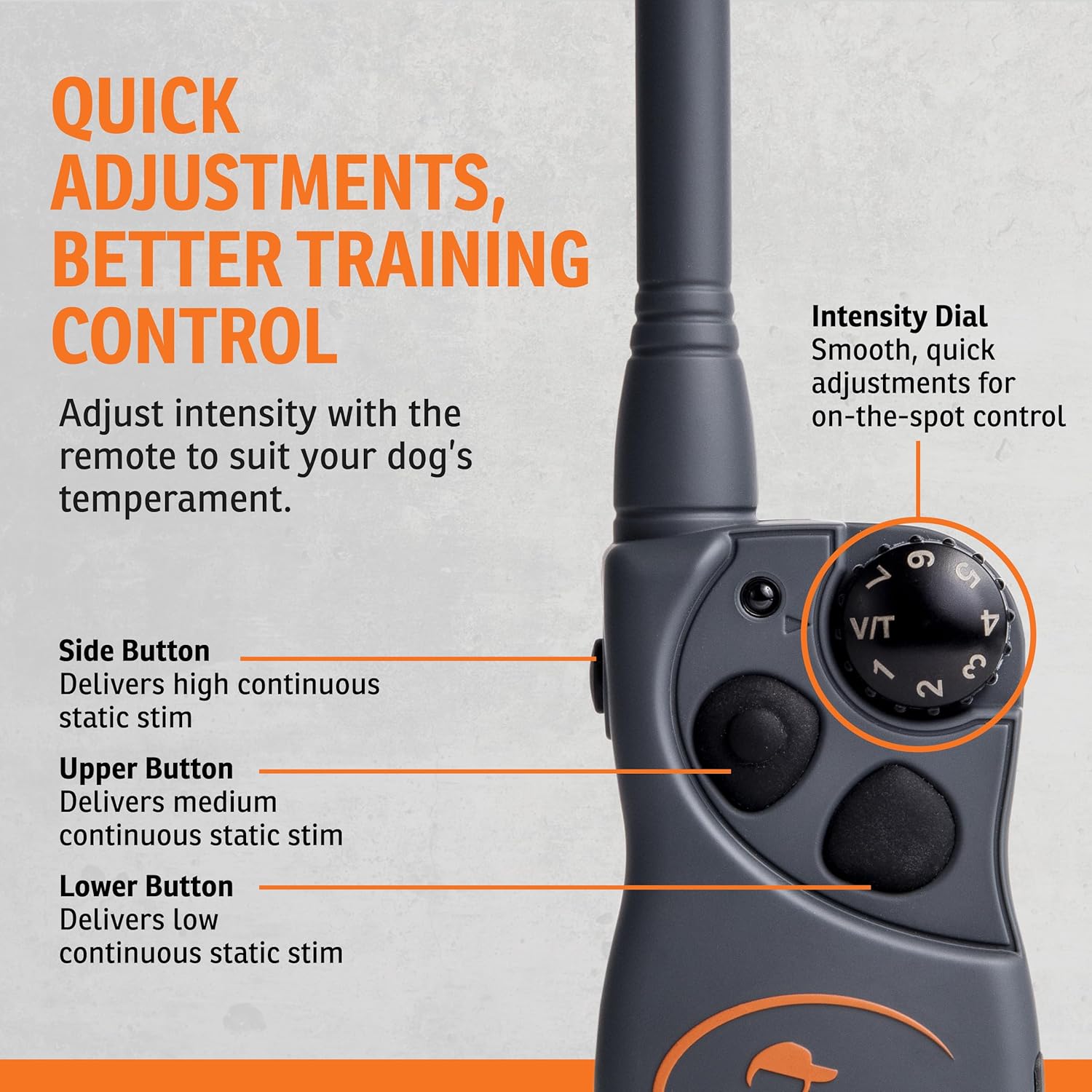
Remote collars publish a number of stimulation levels, and the range in this group is wide. The SportDOG publishes 21 levels, the INVIROX advertises 123. More steps sounds better and the reasoning is worth spelling out.
Fine granularity matters because the useful working level for a given dog is low and specific. A collar with few, widely spaced steps can jump from a level the dog does not notice to one that is clearly too much, with nothing usable in between. More steps makes it easier to find the setting where the dog notices and nothing more.
What the number does not tell you is how the steps are spaced or where they start. Two collars advertising the same count can behave differently. Treat a high level count as a sign the maker took granularity seriously rather than as a measurement you can compare directly between brands.
Coat Thickness and Contact Points
This is where a Golden differs from a short-haired dog of the same weight. A dense double coat holds the receiver away from the skin, which is why most remote collars ship with two sets of contact points, short and long. On a Golden the longer set is usually the one that works, and using the short set on a thick winter coat is the most common reason an owner concludes a collar is faulty.
Fit is the other half. A receiver that slides around the neck loses contact intermittently, which produces inconsistent results and teaches the dog nothing. The published guidance across this category is a snug fit with room for a finger underneath, checked again after the coat blows out in spring.
Prong and plastic prong collars have a related fit question. They are sized by adding or removing links rather than by tightening a buckle, and a collar with too many links sits low and does nothing. The Starmark uses moulded plastic links for the same reason and is fitted the same way.
Waterproofing and Battery Life
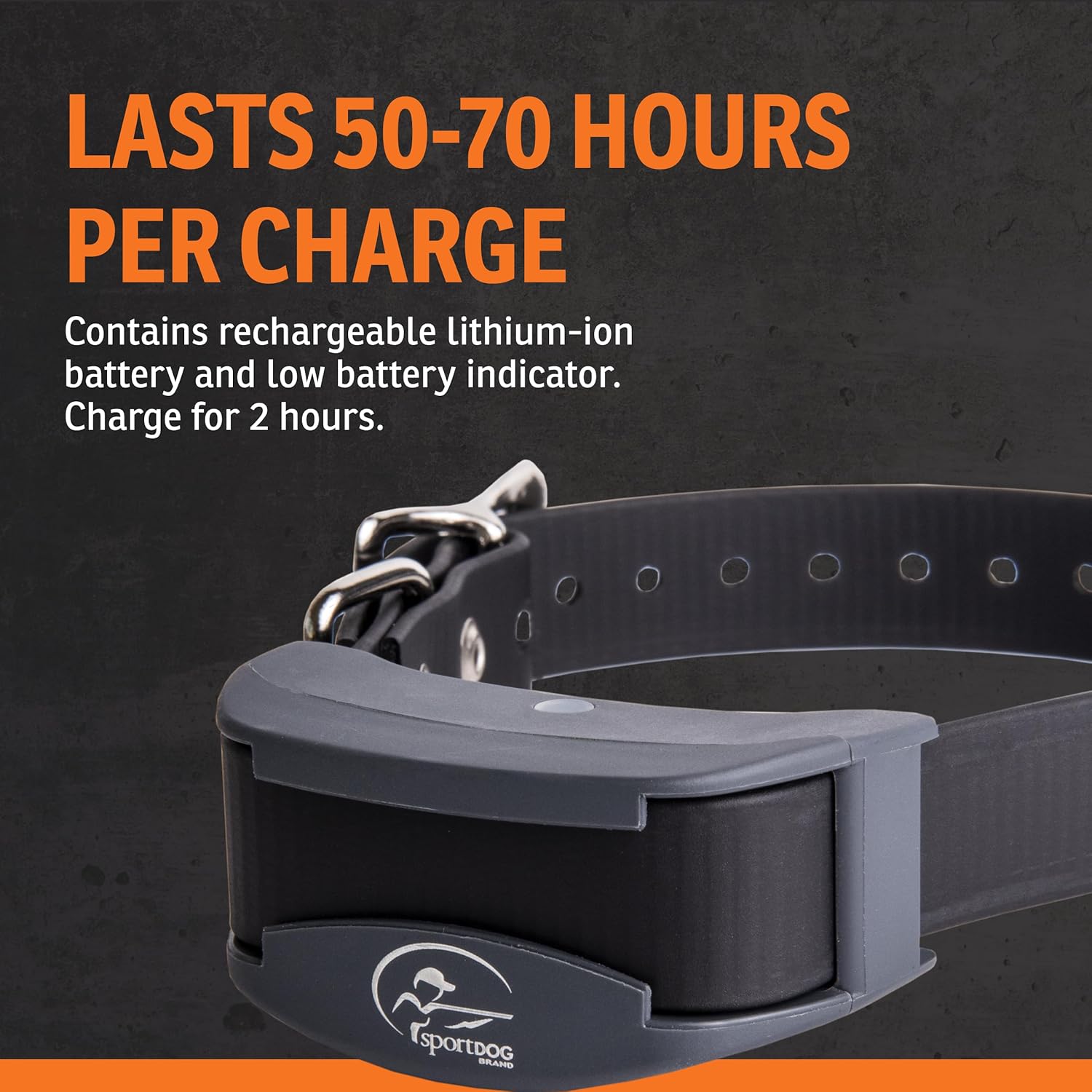
Goldens swim. That single fact rules out any receiver that is only rated splash resistant, and it is worth checking whether the published rating covers the receiver only or the remote as well. Most of the remote collars here publish waterproof receivers; fewer publish the same for the handheld unit you will be holding in the rain.
Battery approach splits the category. Most modern units are rechargeable, which suits regular use and means you charge the receiver and remote together. The PATPET listing in this group includes a non-rechargeable variant, which removes charging from the routine at the cost of buying cells. Neither is wrong, but mixing them up when ordering is a common annoyance.
For a working day in the field, the specification that matters is standby time rather than active use, because the collar spends most of the day switched on and doing nothing. Look for the number the maker publishes for standby rather than for continuous stimulation.
Welfare, Local Rules and Honest Limits
Aversive collars are contested among trainers and regulated differently depending on where you live. Some countries and regions restrict or ban electronic collars outright, and rules change. Check what applies where you live before buying, because a legal restriction is not something a product page will tell you.
It is also worth being clear about what hardware can and cannot do. A collar delivers a signal. It does not teach a dog what the signal means, and every reputable maker in this group publishes an instruction manual that says the same thing in more words. If you are addressing anxiety-driven barking or reactivity, a bark collar addresses the noise rather than the cause, and a qualified trainer is the better first purchase.
None of that makes the equipment useless. It means the equipment is one part of a process. More of our pet coverage is in the pet supplies section.
What Is in the Box, and What You Buy Again
Remote collars arrive with more small parts than most buyers expect, and the parts you lose are the ones that stop the unit working. Check the listing for two sets of contact points, a charging cable, a test light and a strap. On a thick-coated breed the long contact points are not an optional extra, they are the ones you will fit, so a unit that ships with only one length is a poorer buy for a Golden regardless of its other specifications.
The test light is the small accessory worth keeping. It clips onto the contacts and shows that a signal is being delivered, which lets you confirm the unit is working without guessing from the dog’s behaviour. It is also the fastest way to distinguish a flat battery from a fitting problem.
The consumables differ by design. Rechargeable units, which is most of this group, cost you nothing ongoing but need charging into the routine, and both receiver and remote need it. Non-rechargeable variants, such as the alternative PATPET listing, trade that for buying cells. Straps wear and are usually replaceable; contact points loosen and should be checked with the collar off rather than on the dog.
Mechanical collars have fewer consumables and one real failure point. On a prong or plastic prong collar the links themselves are the wear item, and on a chain the ring and the join are where wear shows. Both are cheap to replace and worth inspecting rather than assuming.
Quick Comparison
| Type | Who triggers it | Works when | Problem it targets |
|---|---|---|---|
| Remote e-collar | Handler, by button | Any distance in range | Off-lead recall and distance control |
| Automatic bark collar | The collar itself | Owner absent or present | Nuisance barking |
| Prong or plastic prong | The dog, by pulling | Only on lead | Pulling on the lead |
| Choke chain | The dog, by pulling | Only on lead | Pulling, close handling |
Why You Should Trust Us
We build these guides by starting with the products owners actually buy and keep, then reading them against what each maker publishes. For this category we gathered current training collars, filtered them by verified customer ratings and the volume of that feedback, then grouped the shortlist by mechanism rather than by score, because a bark collar and a remote trainer are not competing for the same job.
Where a maker publishes a range, a level count or a waterproof rating, we use their figure and say so. Where a specification is not published, such as how stimulation levels are spaced, we say that rather than inventing a comparison. You can find the rest of our guides in the articles library.
Final Thoughts
For a Golden being worked off lead in open country, the best overall choice is the SportDOG FieldTrainer 425X. Its published 500 yard range covers realistic working distances with margin, 21 levels give usable granularity, and it is built around a waterproof receiver, which matters for a breed that will find water.
The best value pick is the Bousnic remote collar, which carries by far the largest body of owner feedback in this group and publishes a longer nominal range for everyday park use. If your issue is barking rather than recall, the FAFAFROG is the automatic option and a different purchase entirely. For pulling on the lead, the Starmark plastic prong and the SGODA chain are the two mechanical answers here, and both work only while the lead is attached.
Buy for the specific problem, check the rules where you live, and treat the collar as one part of a training plan. You can browse the rest of the department on our categories page.
FAQs
What size training collar for golden retriever suits a Golden Retriever?
Adult Goldens usually fall in the 55 to 75 pound range, which sits inside the published weight window of every remote collar in this guide, since most cover roughly 5 to 120 pounds. Weight is therefore rarely the constraint. Neck fit and coat thickness are. Measure the neck, then check the strap length the maker publishes, and expect to use the longer contact points supplied in the box.
Does a thick double coat stop a collar working?
It can, and it is the most common reason an owner thinks a unit is faulty. A dense coat holds the receiver off the skin so the contact points never reach it. Most collars ship with two lengths of contact point for exactly this reason, and on a Golden the longer set is usually the correct one. Re-check the fit when the coat changes with the seasons.
Is more range always better in 2026?
Only up to a point. Published ranges assume clear line of sight, so a collar rated at 3300 feet will not deliver that in woodland or around buildings. Extra range is best understood as margin: it keeps you well inside the working envelope at the distances you actually use. If your dog is never more than a hundred yards away, spend your attention on fit, waterproofing and level granularity instead.
What is the difference between a bark collar and a remote collar?
Who decides. A bark collar detects barking and responds on its own, with no person involved, which is why it can be used while you are out. A remote collar does nothing until you press a button, so it depends on you seeing the behaviour and responding at the right moment. They address different problems and they are not interchangeable.
Are these collars legal where I live?
It depends on your country and sometimes on your region, and the rules have changed in several places in recent years. Electronic collars in particular are restricted or banned in some jurisdictions. A product listing will not tell you this, so check local regulations before ordering. Where they are permitted, most makers publish guidance on introduction and use, and following it matters more than the specification you bought. Our pet supplies section has more guides for dog owners.







Write Your Review
No reviews yet. Be the first to share your experience!