

Space saver bags do one thing well and one thing not at all, and almost every listing blurs the difference. They remove air, which shrinks volume. They do not remove mass, which is what an airline scale measures. Understanding that distinction is the difference between fitting a week of clothes into a carry-on and standing at a check-in desk repacking a bag that is now compact and still overweight. This shortlist of 7 space saver bags for travel picks from HIBAG, BAGAIL, BAGSMART and more is grouped by the three technologies that actually exist in this category.
Our top pick is the BAGAIL Compression Packing Cubes set, because a zippered compression cube needs no pump, no power and no valve, which means it works identically on the outbound and the return leg. If you are compressing bulky bedding or coats rather than clothes, the vacuum options do more. For the bag they all go into, see our guide to carry-on luggage.

Pros
- Works identically on the outbound and return legs, with no pump
- Manufacturer publishes the real figure: 30 to 40 percent saved over regular cubes
- 320D fabric chosen for tear resistance and structure rather than minimum weight
- Published dimensions and garment counts for each cube size
- Reusable for years rather than a season
Cons
- Cannot be flattened like a vacuum bag, and bulges in the middle after compression
- Must not be filled beyond two thirds, or the zipper jams and compression drops
Compression cubes win this category on reliability rather than on raw numbers. A vacuum bag compresses more, and a vacuum bag also requires a working pump, an intact valve and a zip that seals perfectly, in a hotel room, on the night before a flight. A cube requires a zip you close with your hand.
BAGAIL is unusually straight about the limits, which is a reason to trust the rest of what it says. Its own material states that compression cubes cannot be flattened like vacuum bags and will bulge in the middle after compression, and that the saving is 30 to 40 percent over regular cubes rather than the dramatic figures plastic bags quote. It also publishes what fits: the extra large cube at 17.5 by 12.75 by 4 inches takes three sweaters or two coats, the medium takes four shirts.
The one instruction people ignore is the two thirds rule. Filling a cube fuller than that makes compression worse, not better, and the manufacturer notes that an overloaded cube saves 10 percent at most while risking zipper teeth damage. The 320D fabric is heavier than the lightest cubes on the market and is chosen for tear resistance.
Bottom line: the correct default for clothing on a round trip, and the set to buy if you only buy one.
- Type: compression packing cubes
- Set sizes: 4, 6 or 8 pieces depending on option
- Fabric: 320D
- Compression: second zip, no pump required
- Saving: 30 to 40 percent over regular cubes, as published
- Extra large: 17.5 by 12.75 by 4 inches, 3 sweaters or 2 coats
- Large: 13.75 by 12.75 by 4 inches, 2 hoodies or 3 pairs of trousers
- Medium: 13.75 by 9.75 by 4 inches, 4 shirts
- Small: 11 by 6.75 by 4 inches, 4 t-shirts
Do not fill a cube beyond two thirds of its volume. This is counterintuitive and it is the manufacturer's own instruction: an overloaded cube compresses worse, saving as little as 10 percent, and puts the whole load on the zipper.
Roll rather than fold inside the cube, and when closing the compression zip, place a finger behind the slider and pull along the zip's direction so fabric does not get caught in the teeth. If it does jam, reverse the slider gently while easing the trapped fabric outward rather than forcing it.
Anyone flying with a carry-on, anyone travelling for more than a weekend, and anyone who has ever repacked a case on a hotel bed to find one item.
Less useful for compressing bedding or coats into storage, where a pump-driven vacuum bag does far more.

Pros
- Enough pieces to organise a full checked case
- Expandable cubes hold more before compression than fixed ones
- Includes garment-style bags for longer items
- Consistent sizing makes cubes stack squarely
- Compression zips are chunky and well stitched
Cons
- Nine or eleven pieces is more than a carry-on needs
- Larger cubes are harder to compress fully by hand
Where a four-cube set organises a carry-on, this one organises a household. Nine or eleven pieces is the right quantity for a checked case, a family trip, or anyone who prefers to leave cubes permanently packed with categories of clothing between trips.
The expandable design is the meaningful feature. An expandable cube holds a larger uncompressed volume and then squeezes down, which gives a bigger delta than a fixed-size cube. On a bulky item such as a fleece, that difference is obvious.
The honest caveat is that large cubes are harder to compress by hand than small ones, because you are pushing air out of a bigger volume through the same fabric. Kneeling on a large cube while pulling the second zip works and is not elegant.
Bottom line: the pick for checked luggage and family packing, and unnecessary if you fly carry-on only.
- Type: compression packing cubes
- Set sizes: 9 or 11 pieces
- Compression: second zip
- Expandable: yes
- Extras: garment bag pieces included
- Pump required: no
Families packing several people into shared cases, long trips with varied clothing, and anyone who stores off-season clothes in cubes between journeys.
Overkill for a weekend bag, where a smaller set costs less and takes up less room when empty.
Do not force the compression zip past a jam. The zip carries all the load and a forced slider will separate the teeth permanently. Open it a little, redistribute the contents, then close again.
Air cubes out after a trip before storing. Fabric cubes hold moisture from worn clothing and will smell if packed away sealed.

Pros
- Light fabric adds very little to a weight-limited carry-on
- Several set sizes so you can buy only what fits your case
- Mesh top panels let you see contents without opening
- Compression zip runs smoothly under load
- Compact when empty for the return journey
Cons
- Lighter fabric is less abrasion resistant over years of use
- Less expansion room than heavier expandable cubes
On airlines with a cabin bag weight limit, the weight of your organisation system is not a rounding error. A heavy set of cubes can eat a meaningful share of a seven kilogram allowance before a single garment goes in. This set is built light for exactly that reason.
The mesh top panels are the practical detail. You can see which cube holds what without unzipping anything, which sounds trivial until you are looking for socks in a dark hotel room.
Light fabric is a trade rather than a free win. It abrades faster at the corners over years of use, and there is less give when you want to overfill a cube before compressing. For carry-on travel, that is the right side of the trade.
Bottom line: the pick for weight-limited cabin bags, where every gram of packing hardware counts against your allowance.
- Type: compression packing cubes
- Set sizes: 2, 4, 6 and 14 piece options
- Compression: second zip
- Material: lightweight fabric with mesh panels
- Pump required: no
Carry-on-only travellers, especially on carriers that weigh cabin bags. Also good for anyone who wants a small set to supplement cubes they already own.
Less suited to heavy long-term use in checked luggage, where a sturdier fabric will last longer.
Fill cubes to their uncompressed capacity before pulling the compression zip. A half-full cube compresses to a floppy shape that wastes case space rather than saving it.
Keep one cube empty on the outbound leg for laundry. Dirty clothes go in it, and the cube stops them contaminating clean items.

Pros
- No pump, no power, works in any hotel room
- Extra-thick material holds a seal better than thin generic bags
- Compresses more than a fabric cube on bulky items
- Sized for carry-on, suitcase and backpack use
- Cheap enough to treat as consumable
Cons
- Rolling out the air by hand takes effort on large bags
- Plastic creases clothing more than a fabric cube does
Roll-up bags are the sensible middle of this category. You get materially more compression than a fabric cube because you are actually forcing air out through a valve, and you keep the property that matters most for travel: it works with nothing but your hands.
Material thickness is what separates a roll-up bag that works from one that reinflates. Thin bags leak at the zip and split at the corner where the roll creases hardest. This set uses noticeably thicker plastic, and the difference shows on the return trip.
Two limitations. Rolling a large full bag by hand is genuine work, and doing four of them takes fifteen minutes. And plastic against fabric creases clothing more than a soft cube does, so keep linen and structured shirts out of them.
Bottom line: the value choice, and the right technology for anyone who needs real compression away from home.
- Type: roll-up compression bags
- Compression: one-way valve, no pump required
- Material: extra-thick plastic
- Sizes: luggage, carry-on and backpack formats
- Waterproof: yes, once sealed
Lay the bag flat and press it before sealing to remove the easy air, then close the zip and roll from the sealed end toward the valve. Rolling from the wrong end traps air behind the roll.
Check the zip channel for stray threads before sealing. One thread across the seal is the difference between a compressed bag and a fully inflated one in the morning.
Cruise and flight travellers who need to compress on both legs, anyone packing bulky fleece or jackets, and travellers who would rather not carry a pump.
Not the right choice for delicate fabrics, and less convenient than cubes if organisation matters as much as volume.
Pros
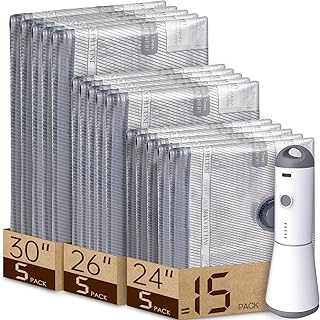
- Rechargeable Type-C pump makes repeat use practical, unlike hand pumps
- Published 4000 pascal suction reaching 80 percent compression in about ten seconds
- Fifteen bags across three large sizes covers a full wardrobe
- Pump is small enough to travel with even though the bags are full size
- LED power indicator so you know the charge state before you pack
Cons
- Bags run 24 to 30 inches, so this is a storage set rather than a carry-on set
- A lithium battery pump usually needs to travel in the cabin
This is the set that fixes the main flaw in vacuum bags. A hand pump technically works and practically does not, because evacuating several full bags with a small manual pump is tedious enough that most people stop doing it. This pump is Type-C rechargeable, rated at 4000 pascals, and the manufacturer states it reaches 80 percent compression in about ten seconds per bag.
Be clear about what you are buying, because the listing language suggests otherwise. The fifteen bags are five each at 30, 26 and 24 inches, which are storage sizes rather than carry-on sizes. What travels well is the pump: it is slim, it charges from the same cable as your phone, and it has an LED power indicator.
Two things to plan for. A lithium battery pump generally has to travel in the cabin rather than in checked luggage. And a flat battery reduces the set to plain plastic bags, so charge it the night before you pack rather than the morning you leave.
Bottom line: the maximum-compression option with the most usable pump here, best understood as a storage set whose pump happens to travel.
- Type: vacuum compression bags
- Quantity: 15 bags, 5 each at 30, 26 and 24 inches
- Pump: Type-C rechargeable, 4000 pascals as published
- Compression: stated 80 percent in about 10 seconds per bag
- Pump features: switch button, LED power indication
- Seal: double zip with one-way valve
Do not compress to the absolute maximum. A fully evacuated bag becomes a rigid block that will not conform to the curves of a suitcase, and you can end up with a smaller bundle that fits worse.
Charge the pump before departure and again before the return leg. Treat it like a phone rather than like a packing accessory.
Best suited to storing bedding, coats and off-season clothing, and to anyone who wants the pump available on a trip without carrying the large bags.
If you specifically want carry-on sized vacuum bags, this is not that set; a roll-up compression bag sized for luggage is the better match.

Pros
- Twenty genuine bags: 4 jumbo, 4 large, 4 medium and 8 small
- Double zipper plus a triple seal valve rather than a single seal
- Works with a household vacuum cleaner as well as the included hand pump
- Published up to 80 percent space saving on bulky bedding
- Thick material stated to block dust and moisture for long-term storage
Cons
- Eight of the twenty bags are small, the size most people use least
- Hand pumping twenty bags is slow; a vacuum cleaner is much faster
This is the storage end of the category rather than the travel end, and it is worth being clear about that. Twenty bags in four sizes is built for comforters, blankets, pillows and winter coats, which are the items where vacuum compression pays off most because they are almost entirely air.
Two details separate it from the cheapest sets. The seal is a double zipper backed by a triple seal valve rather than a single-layer arrangement, which is where these bags usually fail, and the material is thick enough that the manufacturer positions it for long-term dust and moisture protection rather than for a single trip.
The published figure of up to 80 percent space saving is realistic for bedding and optimistic for clothing. A duvet really does shrink to a fraction of its loose volume; a stack of jeans barely changes. Note also that eight of the twenty bags are small, so read the distribution rather than the headline count, and use a household vacuum cleaner for the bulk of a seasonal changeover since the hand pump is slow across twenty bags.
Bottom line: the right set for storing bedding and off-season clothes at home, and the wrong one to take on a plane.
- Type: vacuum storage bags
- Quantity: 20 bags, 4 jumbo, 4 large, 4 medium, 8 small
- Pump: hand pump included; also works with a household vacuum cleaner
- Seal: double zipper with triple seal valve
- Compression: up to 80 percent space saving as published
- Protection: stated to block dust and moisture
Anyone storing winter bedding, doing a seasonal wardrobe changeover, or packing a house for a move. Also useful for protecting textiles from damp and moths in a loft or garage.
Not a travel product despite the space saver name; the sizes and the hand pump both point at home use.
Never seal anything damp. A sealed bag with residual moisture is an ideal environment for mildew, and you will not discover it for months.
Unpack down bedding at least once a season. Long-term compression permanently flattens down, and a duvet stored compressed for a year does not fully recover.

Pros
- Twelve bags covers a whole family for one trip
- No pump or extractor required at any point
- Transparent so you can identify contents at a glance
- Very low cost per bag
- Light and flat to carry when unused
Cons
- Thinner material than premium roll-up bags, so seals are less durable
- Best treated as semi-disposable rather than a long-term purchase
Sometimes the right answer is quantity. A twelve-pack of roll-up bags at this price lets you compress everything for a family holiday and not care much whether every bag survives the return leg. That is a legitimate strategy and it is what this set is for.
The design is the standard roll-up: zip seal, one-way valve, push the air out by rolling. No pump, no power, nothing to charge. Transparent material means you can see what is inside without opening anything.
The material is thinner than the premium roll-up options, and that is where the price goes. Seals hold for a trip and sometimes for several; expecting three years of use from them is optimistic. Buy them as a consumable and the value is excellent.
Bottom line: the cheap bulk option, good for a family trip or a one-off move, and not the set to rely on indefinitely.
- Type: roll-up compression bags
- Pieces: 12 pack
- Pump: not required
- Material: transparent plastic
- Seal: zip with one-way valve
Families packing several suitcases at once, one-off moves, and anyone who wants compression without committing to a long-term system.
Not the choice for a frequent traveller, who is better served by fabric cubes that last for years.
Do not overfill. A thin bag stuffed to capacity splits at the corner where the roll creases hardest, and that split is not repairable.
Roll on a hard flat surface rather than a bed. A soft surface absorbs the pressure you are trying to apply to the bag.
How to Choose Space Saver Bags For Travel
There are three genuinely different products sold under this name. Choosing the wrong one is why people buy space saver bags, use them once and never again.
Three Technologies and What Each One Actually Does

Vacuum seal bags use a valve and a pump, either a hand pump or a household vacuum cleaner. They achieve the greatest compression by a wide margin, and 80 percent volume reduction on bulky items is the figure both Fygrip and Vacbird publish, because a pump removes air that no amount of body weight can squeeze out. Vacbird quotes a 4000 pascal electric pump reaching that 80 percent in about ten seconds per bag, which is the difference between doing this once and doing it every trip.
Roll-up bags have a one-way valve and no pump. You lay the bag flat, seal the zip, then roll from the closed end and the air is pushed out through the valve. Compression is meaningful but lower than a pump can achieve, and the enormous advantage is that they work anywhere, including a hotel room in a country where your plug does not fit.
Compression packing cubes are a different idea entirely. A fabric cube with two zips: pack it, close the first zip, then close the second zip which pulls the panel down and compresses the contents. BAGAIL is unusually straight about what that buys, stating on its own packaging that cubes save 30 to 40 percent of the space regular cubes use, that they cannot be flattened the way a vacuum bag can, and that they will bulge in the middle after compression. They compress least of the three, they are reusable indefinitely, and they double as organisation, which the plastic bags do not.
Volume Is Not Weight, and Airlines Weigh
This is the trap. Compressing clothes changes nothing about their mass. A carry-on allowance has two constraints, dimensions and weight, and space saver bags help with exactly one of them. On carriers with a strict cabin bag weight limit, compression can actively hurt you by making it easy to pack more than you are allowed to carry.
There is a second, subtler problem. Vacuum-compressed clothing forms a dense solid block, and a rigid block does not conform to the shape of a suitcase the way loose clothing does. It is entirely possible to compress a bundle so hard that it becomes awkward to fit into the case it was meant to fit into. Compress to fill the space you have, not to the maximum the bag allows.
The honest use case for maximum compression is bulky and light: puffer jackets, fleece, spare bedding, towels. Those items are almost all air, so removing it is nearly free. Compressing jeans and shoes gains very little volume and costs you a lot of packing flexibility.
The Return Trip Problem

Almost every disappointed review of vacuum travel bags describes the same discovery, made in a hotel room on the last night. Vacuum bags need a pump. The hand pump that came in the set is small and slow, and using it to evacuate four large bags takes real effort. If the set relies on a household vacuum cleaner, you simply do not have one.
Rechargeable pumps solve this at the cost of remembering to charge them and of a lithium battery you may need to carry in the cabin. Roll-up bags avoid the problem entirely, which is why they remain popular despite compressing less.
The rule of thumb: if the bag is coming home with you, choose a technology that needs nothing but your hands. If you are shipping winter bedding to storage and it stays there, a pump-based bag is the better tool.
Wrinkles, Fabrics and What Should Never Be Compressed
Compression creases everything, and how badly depends on the fibre. Synthetics and knits recover after a few hours on a hanger. Linen and cotton shirts do not, and a compressed linen jacket arrives looking like it was slept in. Roll rather than fold inside the bag, since a rolled garment creases along soft curves rather than along hard folds.
Two categories deserve a specific warning. Down jackets and down sleeping bags lose loft if stored compressed for long periods, and loft is the entire insulating mechanism; compress them for a journey, then unpack them immediately on arrival. Leather and structured tailoring should not be compressed at all, because the shape is built in and pressure destroys it.
Counting Sets Honestly
Count is not the problem so much as distribution, and the good sets publish theirs. Fygrip’s 20 bag set breaks down as 4 jumbo, 4 large, 4 medium and 8 small, so nearly half the set is the size most people use least. BAGAIL publishes cube dimensions and what fits in each: extra large at 17.5 by 12.75 by 4 inches takes three sweaters or two coats, large takes two hoodies or three pairs of trousers, medium takes four shirts, small takes four t-shirts. That is the information you need and it is rarely on the front of the box.
Watch for accessories counted as pieces, too. Packing cube sets sometimes include a laundry pouch and a shoe bag in the headline number, and a set of four large plus four medium is a genuinely different product from a set of eight mediums even though both say eight.
What matters for travel is how the pieces map to your case. A typical carry-on takes two large cubes side by side or one large plus two mediums. Buying a set with six smalls in it wastes most of the purchase. Read the size breakdown, not the headline count.
Valves, Zippers and Where These Fail

Plastic vacuum bags fail at the double zip and at the valve. The zip needs the slider run twice and pressed along its length with a thumb, and a single grain of grit in the channel is a slow leak that leaves you with a fully re-inflated bag by morning. The valve fails when its rubber flap does not seat, usually because a thread of fabric is caught under it.
Compression cubes fail at the second zip, which carries all the compression load, and the manufacturers know it. BAGAIL prints a warning that overfilling may overload the zipper, causing teeth damage and misalignment that leads to jamming, and instructs users not to fill a cube beyond two thirds of its volume. Look for a chunky zip and reinforced stitching at the ends of the zip run. Cubes still fail far less often than plastic bags, which is the main argument for spending more on them once rather than replacing bags each year.
What Actually Gets Measured at the Gate
Compression only pays off if you know which constraint you are up against, and airlines apply two different ones inconsistently. Dimensions are checked with a sizer, a rigid frame your bag has to drop into. Weight is checked with a scale, usually only when a bag looks suspicious or when the flight is full. Knowing which one your carrier enforces changes how you should pack.
Against a sizer, the enemy is bulge rather than volume. A soft bag that fits on paper still fails if one side swells past the frame, and an over-compressed rigid block is exactly the thing that creates a bulge, because it will not flatten when the bag is pushed into the sizer. Distributing compressed bundles flat across the base of the case beats stacking one dense lump against a side panel.
Against a scale, compression does nothing at all, and it is worth repeating because the entire category is marketed in a way that implies otherwise. If your airline enforces a cabin bag weight limit, weigh your packed bag at home with a luggage scale before you leave. Discovering the number at the gate costs money and the compression bags will not help.
One tactic that does work on both constraints: move dense items into the personal item that goes under the seat, since that bag is rarely weighed and rarely sized. Books, chargers, cables and toiletries are heavy and small, which is the opposite profile from the clothing you are compressing. Compress the light bulky things, carry the heavy small things separately, and you are optimising the right variable in each place.
| Product | Technology | Pump needed | Best for |
|---|---|---|---|
| BAGAIL Compression Cubes | Zippered cube | No | Round trips and organisation |
| Veken 9 and 11 Set Cubes | Zippered cube | No | Large sets covering a full case |
| BAGSMART Compression Cubes | Zippered cube | No | Lightweight sets for carry-on only |
| HIBAG Roll Up Bags | Roll-up valve bag | No | Cruise and flight packing with no power |
| Vacbird Vacuum Bags, 15 Pack | Vacuum with rechargeable pump | Yes, included | Maximum compression with a pocket-sized pump |
| Fygrip Vacuum Bags, 20 Pack | Vacuum with hand pump | Yes, or a vacuum cleaner | Bedding and seasonal storage |
| ALMING Compression Bags | Roll-up, no valve pump | No | Cheap bulk packing for one trip |
Compression only helps if the bag itself is the right shape, and our guide to crossbody bags for travel covers the personal item that sits alongside it. The rest of our travel coverage is in the Luggage and Travel Gear section.
Why You Should Trust Us
We check every product against its current listing and we drop anything where the manufacturer cannot be identified. That mattered unusually here. This category is dominated by unbranded listings selling what appear to be the same three factory products under a rotating set of names, and a bag with no manufacturer means no replacement valve, no consistency between reorders and no accountability when a seam splits.
We also read the one-star reviews first, and in this category they are unusually informative because the failures are so consistent: bags that reinflate overnight, hand pumps that snap at the nozzle, and sets whose piece count includes accessories. Those specific failure modes are what the cons in each entry describe, rather than generic complaints.
Final Thoughts
Best overall is the BAGAIL Compression Packing Cubes set. It compresses less than a vacuum bag and it works every single time, in any hotel room, with no pump, no charge and no valve to fail. For travel specifically, reliability on the return leg matters more than the maximum compression figure on the box.
Best value is the HIBAG roll-up compression bags. Roll-up bags sit in the middle on compression and at the bottom on price, they need nothing but your hands, and the extra-thick material in this set holds a seal better than the thin generic versions.
If you genuinely need maximum compression, the Vacbird set is the way to get it and its Type-C rechargeable pump is small enough to travel even though the bags themselves run from 24 to 30 inches. The Fygrip set, which works with a hand pump or a household vacuum cleaner, is the better answer for bedding and seasonal storage that stays at home. The Veken and BAGSMART cube sets are the picks if you want more pieces or a lighter set respectively, and the ALMING bags are the cheap option for a single trip. More travel picks are in Luggage and Travel Gear, and everything new is in our latest articles.
Space Saver Bags For Travel FAQs
Do space saver bags reduce the weight of my luggage?
No. They remove air, which reduces volume only. Your bag will be smaller and exactly as heavy, and on airlines with a cabin bag weight limit that can work against you by tempting you to pack more. Use compression to fit what you have decided to take, not as a way to take more.
Can I use vacuum bags without a vacuum cleaner?
Yes, if the set includes a hand pump or a rechargeable pump. Hand pumps work but are slow, and evacuating several large bags is genuine effort. Roll-up bags need no pump at all: you seal the zip and roll from the closed end so air escapes through a one-way valve. For travel, that independence is usually worth more than the extra compression a pump gives.
Are compression cubes better than vacuum bags for travel in 2026?
For clothing on a round trip, generally yes. Cubes compress less but they never fail to reseal, they organise a case so you are not unpacking everything to find one shirt, and they last for years. Vacuum bags win when the items are bulky and mostly air, such as coats and bedding, and when you do not need to repack them away from home.
Why did my vacuum bag reinflate overnight?
Almost always the zip rather than the valve. Run the slider along the full length twice, then press the seal between finger and thumb along its entire run to feel for a gap. Check that no fabric thread is trapped in the zip channel or under the valve flap, because a single thread is enough to leak. If it still fails, the bag is damaged and will not recover.
What should I never put in a compression bag?
Structured tailoring and leather, because pressure destroys shapes that were built in. Anything damp, because compressed damp fabric in a sealed bag grows mould quickly. And down should be unpacked as soon as you arrive; long-term compression permanently reduces loft, which is the only reason down insulates. More packing gear is in our carry-on luggage guide.

Write Your Review
No reviews yet. Be the first to share your experience!