

Reverse osmosis is the most thorough filtration you can install in a kitchen, and it is also the most misunderstood. It removes dissolved solids that carbon filters pass straight through, which is why it is the answer for genuinely hard or contaminated supplies, and it does that by pushing water through a membrane fine enough to strip out minerals you might want to keep. Our shortlist covers 8 reverse osmosis system picks from iSpring, APEC Water, Express Water and more, sorted by how they are installed and how much water they waste getting there.
Our top pick is the iSpring RCC7AK-BN for pairing NSF certification with an alkaline remineralisation stage, which puts back some of what the membrane necessarily takes out. If your filtration problem is portable rather than plumbed, our guides to RV water filters and outdoor water filters cover that instead. This list is current for October 2026.

Pros
- Certified to NSF/ANSI 58, the standard specific to RO systems
- Alkaline stage adds calcium, magnesium and potassium back
- Patented top-mounted filters change in about 20 seconds
- Largest rating history in this category
Cons
- Tank takes real cupboard space
- Drain ratio is typical of tank systems rather than good
Reverse osmosis has one universal complaint attached to it: the water tastes flat. That is not a fault, it is physics, because the membrane removes the calcium and magnesium that give water most of its flavour along with everything else. The RCC7AK answers that with an alkaline remineralisation stage after the membrane.
Around it sits a conventional and well proven six stage layout rated at 75 gallons per day, which is generous for a tank system and means the tank refills faster after a heavy draw. Certification is to NSF/ANSI 58, the standard written specifically for reverse osmosis systems, which is a stronger claim than the vague references to NSF standards that fill this category. The filters are also top-mounted and patented, turning a cartridge change into a twist rather than a session under the sink with a bucket.
Two honest limits. A tank system takes up real space under the sink, and its drain ratio is typical of the type rather than notably good, so a tankless design will waste less water if that matters to you.
Bottom line: the best-rounded under-sink system here, and the one that addresses the taste problem head on.
- Model: RCC7AK-BN
- Stages: 6
- Rated output: 75 GPD
- Alkaline media: calcite, mineral balls, Corosex
- Adds back: calcium, magnesium, potassium
- Certification: NSF/ANSI 58
- Filter change: patented top-mounted, two steps
Homeowners on hard or heavily treated supplies who want the most thorough filtration available in a kitchen.
Not for renters who cannot drill a worktop for the dedicated tap.
Check incoming pressure before installing; below roughly 40 to 45 psi output falls sharply and a booster or permeate pump is needed.
Flush the new membrane as the manual specifies before drinking, and again after any long period unused.

Pros
- Long established design with a deep service history
- NSF certified
- Standard housings keep filter costs low
- Simple, well documented installation
Cons
- No remineralisation stage
- 50 GPD refills slowly after a large draw
If you want reverse osmosis and nothing else, this is the default answer and has been for years. Five stages, 50 gallons per day, NSF certification, and a design that plumbers and DIYers alike already know how to service.
The long track record matters more in this category than in most. Filters and membranes are consumables, and a system that has been on the market for years has readily available cartridges and a large body of documentation for when something needs attention in five years' time.
What you do not get is a remineralisation stage, so expect the flat taste that RO produces. Many owners add an inline remineralising cartridge later, which is straightforward on a system using standard fittings.
Bottom line: the value pick, and the sensible default if features are not the point.
- Model: ROES-50
- Stages: 5
- Rated output: 50 GPD
- Certification: NSF certified
- Format: under sink with storage tank
Choose this if you want proven and serviceable over featured. Choose the iSpring if the flat taste of RO water would bother you.
An inline remineralising cartridge can be added later if needed.
Change sediment and carbon pre-filters every six to twelve months; a blocked pre-filter destroys membranes prematurely.
Sanitise the housings when changing filters rather than only swapping cartridges.

Pros
- NSF certified five stage system
- Clearly labelled filter stages
- Strong rating average
- Straightforward under-sink installation
Cons
- No remineralisation stage
- Tank system drain ratio
Express Water competes directly with the established five stage systems and differentiates mainly on how easy the machine is to live with. Cartridges are clearly labelled, which sounds trivial until the first filter change happens two years after installation and nobody remembers which housing holds what.
Performance is the conventional 50 gallons per day with a storage tank, and the system carries NSF certification, which is the assurance to look for rather than a vague reference to standards.
Like the other classic tank designs here, it has no remineralisation stage and a drain ratio typical of the type. If either of those matters, the alkaline iSpring or a tankless system answers better.
Bottom line: a solid certified alternative to the default, chosen for serviceability.
- Model: RO5DX
- Stages: 5
- Rated output: 50 GPD
- Certification: NSF certified
- Format: under sink with storage tank
Compare directly against the APEC ROES-50 on price and on local cartridge availability; they occupy the same position.
Neither addresses taste; budget for an inline remineraliser if that matters.
Label the installation date on each housing with a marker; it is the simplest way to keep a filter schedule.
Turn off the feed and depressurise before opening any housing.

Pros
- Highest rating average of any system here
- Full Contact remineralisation acts twice, not once
- Permeate pump improves recovery and output
- Large capacity filters reduce change frequency
Cons
- Costs more than the standard five stage systems
- Proprietary cartridge design
The Home Master carries the best rating average on this list, and its two distinctive features explain a good deal of that. Full Contact remineralisation adds minerals at two points during production rather than as a single pass at the end, which produces a more consistent result than a single post-filter cartridge.
The permeate pump is the second. It uses the energy of the drain water rather than electricity to raise pressure across the membrane, which both increases output and improves the recovery ratio, so less water goes to waste without adding a socket under the sink.
The costs are price and lock-in: it sits above the standard five stage systems, and its filter modules are proprietary rather than generic ten inch cartridges, so servicing means buying from one supplier.
Bottom line: the connoisseur's tank system, and the best-tasting result here without going tankless.
- Model: TMAFC-ERP Artesian Full Contact
- Stages: 7
- Remineralisation: twice during production
- Pump: permeate pump, non-electric
- Format: under sink with storage tank
Households where drinking water taste is the point of the purchase rather than a side effect.
Also a sensible choice on lower pressure supplies, where the permeate pump recovers performance.
Keep to the manufacturer's filter schedule; proprietary modules are the price of the design and skipping changes wastes the membrane.
Check the permeate pump is clicking during production; silence usually means the drain line is restricted.

Pros
- No storage tank, so no stale stored water
- 600 GPD produces on demand rather than slowly
- Frees the cupboard space a tank uses
- Better drain ratio than tank systems
Cons
- Needs a power socket under the sink
- Stops producing water in a power cut
Tankless reverse osmosis solves two problems at once. It removes the pressurised tank that dominates an under-sink cupboard, and it means the water in your glass was made seconds ago rather than sitting in a bladder for a week.
Six hundred gallons per day is not a marketing exaggeration in the way tank system ratings can be; it reflects a much larger membrane running at higher pressure, which is also why tankless designs recover more of the feed water and send less to drain.
The requirement is electricity. There must be a socket under the sink, and in a power cut the system produces nothing, where a tank system would still hand you whatever it had stored. In most homes that is a fair trade for the space.
Bottom line: the modern answer, and the pick if cupboard space and water waste both matter.
- Model: G3P600
- Type: tankless reverse osmosis
- Rated output: 600 GPD
- Power: mains socket required
- Format: under sink, no storage tank
Households with a socket under the sink who want the cupboard back and dislike stored water.
Not for homes with frequent power cuts or no under-sink power.
Fit the socket on an RCD protected circuit; this is an electrical device living under a sink.
Follow the flush cycle after each filter change before drinking.

Pros
- 3:1 recovery ratio, 75 percent pure water against roughly 20 percent for traditional RO
- Certified to NSF/ANSI 58, 42, 53 and 372
- 1200 GPD fills a cup in about five seconds
- Real-time TDS and filter life indicators on the faucet
Cons
- Requires under-sink power
- Newer product with a shorter service record
Two things distinguish this from the rest of the tankless group. The first is recovery. Frizzlife publishes a 3:1 purified water ratio, meaning roughly 75 percent of the feed water leaves as drinking water, against about 20 percent for a traditional 1:4 system. On a metered supply that difference is the running cost of the machine.
The second is how it states its certification. Rather than referring vaguely to NSF standards, it names 58, 42, 53 and 372 and shows the certificates: respectively RO system performance, aesthetic effects, health-related contaminants and lead-free materials. That precision is what to insist on, because certifying one component is a far weaker claim than certifying a system.
Output is the highest here at 1200 GPD, which fills a cup in about five seconds rather than a trickle, and the faucet carries real-time TDS and filter life indicators so you are not guessing when a cartridge is due.
Bottom line: the best-documented system on this list, and the one that wastes the least water.
- Model: PD1200
- Stages: 11
- Rated output: 1200 GPD
- Recovery: 3:1, about 75 percent pure water
- Certification: NSF/ANSI 58, 42, 53, 372
- Faucet: real-time TDS and filter life indicators
- Filter life: CP 12 months, RO 24 months, TC 6 months
Compare against the Waterdrop on price, filter cost and physical dimensions; both occupy the tankless position.
Prefer this one if documented certification is important to you.
Check the drain saddle connection carefully after installation; tankless systems move more water and a weeping drain line under a sink goes unnoticed for weeks.
Flush after every filter change.

Pros
- No installation, drilling, or plumbing connection needed
- 5-stage reverse osmosis targets a wider range of contaminants than carbon filters
- Built-in remineralization stage adds minerals back after filtering
- WQA and NSF certified components
- Self-contained tank means no external storage tank under the sink
Cons
- Highest price point among the systems in this list
- Produces some wastewater as part of the RO process
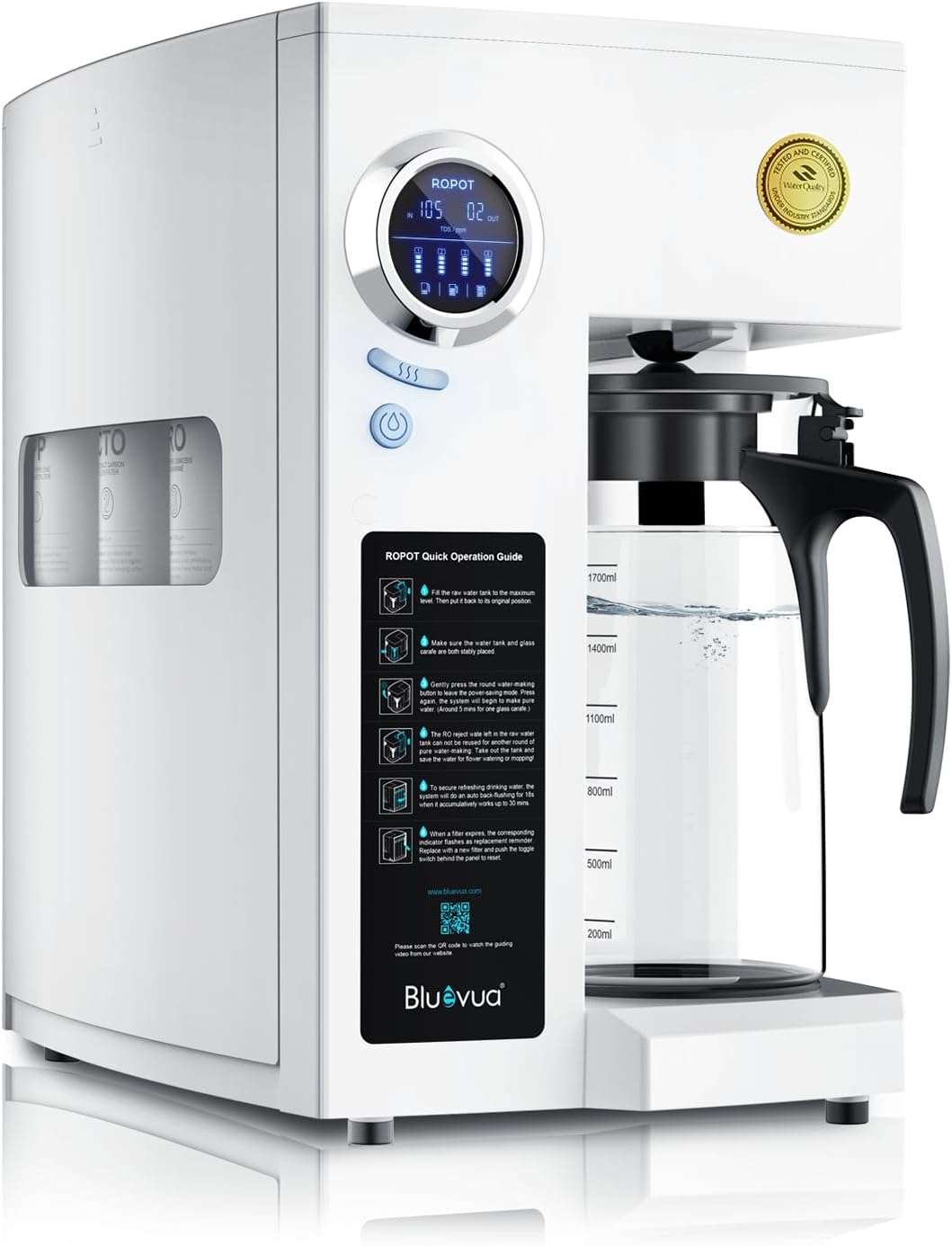
The Bluevua RO100ROPOT brings reverse osmosis filtration to a countertop unit that needs no plumbing hookup. Water is loaded into a top reservoir, an internal pump pushes it through a 5-stage RO process, and filtered water collects in a built-in tank ready to dispense.
Because it uses RO membranes rather than carbon alone, it can reduce a broader range of dissolved contaminants than a simple dispenser or gravity filter, and the added remineralization stage puts some minerals back in so the output doesn't taste flat. WQA and NSF certified components back up the filtration claims.
The tradeoffs that come with RO apply here too: some water is used as wastewater during the filtration process, and the unit costs more upfront than a gravity or carbon system. It also needs an outlet nearby since the pump runs on electricity.
Bottom line: for a household that wants RO-level filtration without cutting into cabinets or plumbing, this is the most practical countertop option in this lineup.
- Filtration: 5-stage reverse osmosis with remineralization
- Installation: none, self-contained countertop unit
- Certifications: WQA and NSF certified components
- Power source: standard electrical outlet
- Display: digital screen for filter life and usage tracking
Fill the top reservoir with tap water, plug the unit in, and press the dispense button once the light indicates the tank is ready. The digital display tracks how much filter life remains so replacement filters can be ordered ahead of time.
Empty and rinse the reservoir periodically to prevent buildup, and replace RO membranes and pre-filters on the schedule shown on the display rather than waiting for taste or flow to noticeably drop. Keep the unit on a stable, level counter since it holds standing water.

Pros
- UV sterilization stage targets bacteria alongside standard RO filtration
- No installation, plumbing, or drilling required
- NSF/ANSI 58 certified filtration components
- 4:1 pure-to-drain ratio wastes less water than older RO designs
- Countertop design fits households without under-sink space
Cons
- Premium price for the added UV stage over standard RO units
- Still needs an electrical outlet to run the pump and UV lamp
The SimPure Y7P-BW is a 5-stage countertop reverse osmosis system, but the feature that sets it apart from the other RO units here is a built-in UV sterilization stage. Standard RO membranes are effective against dissolved contaminants, but adding UV light targets bacteria and other microorganisms that can be a bigger concern for households on well water or water they don't fully trust.
Like other countertop RO systems, it needs no plumbing installation and no drilling into a sink or countertop. NSF/ANSI 58 certified components cover the core RO filtration path, and the 4:1 pure-to-drain ratio is more efficient than older RO designs that waste several gallons for every gallon of filtered water.
The added UV stage does push the price above a standard RO unit, and it still needs an outlet nearby to run both the pump and the UV lamp.
Bottom line: for anyone specifically worried about bacteria in their water supply rather than just taste or chemical contaminants, this is the strongest pick in this list.
- Filtration: 5-stage reverse osmosis plus UV sterilization
- Certification: NSF/ANSI 58 certified components
- Pure-to-drain ratio: 4:1
- Installation: none, countertop unit
- Power source: standard electrical outlet
Fill the reservoir with tap water, plug the unit in, and allow the UV and RO stages to complete before dispensing. Filter and UV lamp status indicators show when maintenance is due, so replacements can be scheduled ahead of a noticeable drop in output.
Replace the UV lamp and RO filters on the schedule the indicators recommend, since UV effectiveness drops off before it fully stops working. Keep the unit dry on the outside and away from the edge of the counter since it holds water internally.
How to Choose a Reverse Osmosis System
Three decisions cover most of this category: whether the system goes under the sink or on the counter, whether it uses a storage tank or produces water on demand, and how much water it sends down the drain for every litre it delivers. Everything else is refinement.
Under-Sink Versus Countertop
Traditional systems, including the iSpring, both APEC-style multi-stage units, the Express Water and the Home Master, mount under the sink and feed a dedicated tap you drill into the worktop. They deliver the most water, hide entirely, and require plumbing work plus a hole in the sink or counter.
Countertop systems, such as the Bluevua and SimPure units here, need no plumbing at all. You fill a reservoir and the machine does the rest, which makes them the only realistic option for renters, and they can move house with you. The costs are counter space, a smaller output, and refilling by hand.
For most homeowners the under-sink route is better value per litre. For anyone who cannot drill a worktop, a countertop unit is not a compromise so much as the only door into reverse osmosis at all.
Tank Systems Versus Tankless

Classic under-sink systems make water slowly and store it in a pressurised tank. A 50 gallon per day rating does not mean fast; it means the membrane produces that volume over a full day, so the tank exists to give you a glassful immediately. When the tank empties, refilling takes hours.
Tankless systems such as the Waterdrop G3P600 and the Frizzlife use a pump and a much larger membrane to produce water on demand, which is why their ratings run into the hundreds of gallons per day. They free up the cupboard space a tank occupies and never serve stale stored water.
The trade is electricity. A tankless system needs a socket under the sink and stops producing water in a power cut, whereas a tank system will still give you whatever it has stored. Neither is wrong; it depends on whether cupboard space or independence from the grid matters more to you.
What GPD Actually Tells You
Gallons per day is a laboratory figure measured at a specified pressure and temperature, usually around 60 psi with warm feed water. Real households rarely match those conditions, and output falls with lower pressure and colder water, which is why a system rated at 50 GPD may deliver noticeably less in a cold house on a mains supply at 40 psi.
Check your incoming pressure before buying. Most systems specify a minimum, commonly around 40 to 45 psi, and below that a permeate pump or booster pump is needed. This is the most common reason a new system underperforms, and it has nothing to do with the quality of the unit.
Drain Ratio: The Number Nobody Advertises

Reverse osmosis works by rejecting concentrated water to drain, and that rejected water is a real cost. Traditional tank systems commonly run at ratios around three or four litres to drain for every litre produced, and older units can be worse.
Modern tankless designs are dramatically better. The Frizzlife PD1200 publishes the comparison directly: a 3:1 purified water ratio, meaning 75 percent of the feed water comes out as drinking water, against roughly 20 percent for a traditional RO system running at 1:4. That is because a bigger membrane running at higher pressure recovers far more of the feed. Over a year the difference is measured in thousands of litres, and on a metered supply it is money.
If a listing does not state a drain ratio, assume it is not flattering. It is the specification most likely to be omitted, and it is the one that determines the running cost of the system beyond filters.
Remineralisation, Alkaline Stages, and Taste
An RO membrane removes dissolved minerals along with contaminants, and the result tastes flat to many people because calcium and magnesium contribute much of what we read as flavour in water. That is the reason alkaline and remineralising stages exist.
The iSpring RCC7AK adds an alkaline stage after the membrane, and the Home Master takes a different approach with its Full Contact design, mineralising the water twice during production rather than once at the end. Both are aimed at the same complaint.
Two honest notes. Health claims about alkaline water are far weaker than the marketing suggests, and the sensible reason to want remineralisation is taste rather than wellness. And if you have a whole-house softener already, RO water plus a remineralising stage is usually the best drinking water you can produce at home without buying bottles.
Certification: What NSF Numbers Mean
Several systems here carry NSF or ANSI certification, and the numbers are not interchangeable. NSF/ANSI 58 is the standard specific to reverse osmosis systems. Standard 42 covers aesthetic effects such as chlorine taste and odour, 53 covers health-related contaminants such as lead and cysts, and 372 covers lead-free materials in the components themselves.
Read the wording carefully, because manufacturers often certify individual components rather than the whole system, and a listing saying certified to NSF standards is doing less work than one stating the system is certified to NSF/ANSI 58. The Frizzlife listing here names 58, 42, 53 and 372 specifically and shows the test certificates, which is the level of detail worth looking for. By contrast the Bluevua countertop unit is certified against NSF/ANSI 372, the lead-free materials standard, which is a real certification but a much narrower one than 58; both are honest, and they are not equivalent.
Filter Costs, Changes, and the Real Running Total
The purchase price is the smaller half of the cost. Sediment and carbon pre-filters typically need changing every six to twelve months, the membrane every two to three years, and any post-filter or alkaline stage annually. Before buying, look up the replacement cartridge prices for the specific model, because they vary far more between brands than the machines do.
Systems using proprietary twist-in cartridges are quicker to change and lock you into one supplier. Systems using standard ten inch housings are slower and cheaper to feed, since generic cartridges fit. Neither is better in the abstract; decide whether you value the two minute filter change or the lower annual bill.
One habit matters more than any of this: sanitise the system and flush the new membrane when you change filters, following the manufacturer’s instructions. A system left standing unused for weeks, particularly a tank system, benefits from being drained and refilled before you drink from it again.
What Reverse Osmosis Does Not Solve
It is worth being clear about scope, because RO is frequently bought to fix problems it does not touch. It treats water at one tap. It does not soften the water reaching your washing machine, your shower or your boiler, so if limescale is the complaint, a whole-house softener is the appliance you actually need and an RO system under the sink will change nothing about scale in the kettle upstairs.
It also does not remove every dissolved gas. Volatile compounds and dissolved gases can pass a membrane, which is why the carbon stages before and after the membrane are doing real work rather than padding the stage count. When a manufacturer advertises seven stages, several of those are carbon and sediment stages that exist precisely because the membrane alone is not the whole answer.
And it does nothing about bacteria growing downstream of it. A membrane blocks organisms, but a storage tank or a length of tubing left standing for weeks is a place where biofilm can establish on the clean side. That is the argument for the UV stage on one of the countertop units here, and the reason every manual tells you to sanitise the system at filter changes and flush it after a holiday. If your supply is untreated well water rather than a municipal one, that instruction is not optional.
| Pick | Format | Stages | Rated output | Notable |
|---|---|---|---|---|
| iSpring RCC7AK-BN | Under sink, tank | 6 | 75 GPD | NSF/ANSI 58, alkaline stage |
| APEC ROES-50 | Under sink, tank | 5 | 50 GPD | NSF certified, long track record |
| Express Water RO5DX | Under sink, tank | 5 | 50 GPD | NSF certified |
| Home Master TMAFC-ERP | Under sink, tank | 7 | Artesian Full Contact | Highest rated here, double remineralisation |
| Waterdrop G3P600 | Under sink, tankless | Multi | 600 GPD | No tank, on demand |
| Frizzlife PD1200 | Under sink, tankless | 11 | 1200 GPD | 3:1 recovery, NSF/ANSI 58, 42, 53, 372 |
| Bluevua RO100ROPOT | Countertop | 5 | Portable | NSF/ANSI 372, TDS display |
| SimPure Y7P-BW | Countertop | 5 plus UV | Portable | UV stage, NSF referenced |
Water quality affects everything downstream of the tap; our home and kitchen section covers the appliances it runs through.
Why You Should Trust Us
Every system here was checked against its live listing for format, stage count, rated output, certification wording and whether a remineralising stage is included. Certification wording in particular rewards close reading, since certifying a component is a much weaker claim than certifying a system to NSF/ANSI 58, and listings blur the two routinely.
We have not measured rejection rates or drain ratios on a bench, and we say so plainly. What we can do is explain why a gallons per day figure rarely matches household output, why the drain ratio is the specification most often left out, and where the health claims attached to alkaline stages outrun the evidence. More guides are collected in our articles section.
Final Thoughts
The iSpring RCC7AK-BN is our best overall pick. It pairs NSF certification with a six stage layout that includes alkaline remineralisation, addressing the flat taste that puts people off reverse osmosis, and it has by far the largest body of customer feedback in this category.
For best value, the APEC ROES-50 is the long-standing default in this market: a straightforward five stage, 50 GPD, NSF certified system with a track record measured in years rather than months. If you want reverse osmosis without any additional features, buy it and stop reading.
Beyond those, choose by constraint. The Home Master if taste matters most and its double remineralisation appeals, the Waterdrop G3P600 or Frizzlife if you want the cupboard space back and have a socket under the sink, the Express Water as a straightforward certified alternative, and the Bluevua or SimPure countertop units if you rent or cannot drill a worktop. Whichever you pick, check your water pressure first and look up the replacement filter prices before ordering.
Frequently Asked Questions
Does a reverse osmosis system waste a lot of water?
Traditional tank systems commonly send three or four litres to drain for every litre produced. Modern tankless designs are much better, often quoting two to one or better, because a larger membrane at higher pressure recovers more feed water. If a listing does not state its drain ratio, assume the figure is not flattering.
Does reverse osmosis remove minerals I need?
It removes dissolved minerals along with contaminants, which is why RO water tastes flat to many people. Diet supplies the overwhelming majority of dietary minerals, so the practical issue is taste rather than nutrition. Systems with alkaline or remineralising stages, such as the iSpring and Home Master here, address exactly that.
What does 50 GPD or 600 GPD actually mean?
It is the membrane’s rated production over a full day under laboratory conditions, typically around 60 psi with warm feed water. It is not a flow rate at your tap. Real output falls with lower pressure and colder water, which is why tank systems store water rather than making it on demand.
Can I install one myself?
Most competent DIYers can fit an under-sink system in two to three hours, and the awkward part is usually drilling the worktop or sink for the dedicated tap rather than the plumbing. Countertop units need no installation at all. Check your incoming pressure against the system’s stated minimum before you start.
How often do the filters need changing in 2026?
As a rule, sediment and carbon pre-filters every six to twelve months, the RO membrane every two to three years, and post or alkaline stages annually, with hard or heavily sedimented supplies shortening all of those. Look up cartridge prices for your specific model before buying, since annual running costs vary far more than the machines do. More home guides are in our category index.





Write Your Review
No reviews yet. Be the first to share your experience!