

Sizing filtration for a pool that sits in the ground is a different job from sizing it for a soft sided pool on the lawn. The water volume is larger, the plumbing is rigid PVC instead of hose clamps, and the pump has to pull water through a skimmer, a main drain and often a dedicated vacuum line before it ever reaches the tank. That is why so many of the sand filter systems that dominate the search results are the wrong tool: they are built for above ground pools holding eight to fifteen thousand gallons, and they stall out on a real inground circuit. For October 2026 we pulled together 8 options that are genuinely rated for inground use and sorted them by what they actually cover, with picks from Rx Clear, Swimline, Hayward and more.
Our top pick is the Rx Clear Radiant Complete Sand Filter System, because it arrives as a matched 24 inch tank and 1 HP pump rated for inground pools up to 33,000 gallons, so nothing has to be sized by guesswork. Below that you will find a mix of two kinds of product, and the difference matters more than any single spec. Some are complete systems with the pump already paired to the tank. Others are bare filter tanks meant to bolt onto a pump you already own or buy separately, which is the normal path when an old tank cracks but the motor is still healthy. We flag which is which on every pick, and the guide underneath explains how to match tank diameter and pump flow to the gallons in your pool. If you are still shopping around the yard, our wider patio, lawn and garden coverage has more outdoor equipment roundups.

Pros
- Ships as a matched tank and pump, so nothing has to be sized by guesswork
- 24 inch tank with 300 pound sand capacity covers pools up to 33,000 gallons
- Rated for inground pools rather than adapted from above ground equipment
- Six position multiport valve includes a waste setting for vacuuming heavy debris
- Leaves genuine headroom on a standard 16 by 32 foot pool instead of running at its limit
Cons
- Sand is not included and a 24 inch tank needs roughly 300 pounds of it
- Single speed motor, which some state energy codes no longer permit for new installations
- Large footprint that assumes a prepared and level equipment pad
The Rx Clear Radiant Complete Sand Filter System is a full equipment pad solution rather than a component. The box contains a 24 inch filter tank, a six position top mount multiport valve and a 1 HP Mighty Niagara self priming pump, already sized to work together. It is aimed at owners of standard residential inground pools who are replacing a failed system or commissioning a pool that has been sitting idle, and who would rather not calculate whether a given pump will overrun a given sand bed.
The capacity figures are where it separates itself from most of the search results in this category. A 24 inch tank holding 300 pounds of sand and a rating that reaches 33,000 gallons means a common 16 by 32 foot pool of roughly 21,000 gallons runs with real margin rather than at the ceiling. That margin translates into lower operating pressure, longer intervals between backwash cycles and less water wasted every time you do backwash. The pump is genuinely self priming, which matters because an inground pump usually sits above the water line on a deck side pad and has to lift water rather than receive it by gravity.
The compromises are the ones common to the whole sand filter category plus one that is worth planning around. Sand is not included, so budget for roughly 300 pounds of pool grade silica and have it on site before you start. The motor is single speed, and a growing number of states now require variable speed motors above a certain horsepower for new and replacement residential pool installations, so check your local energy code before ordering. The unit is also physically large and heavy once loaded, which means a level slab rather than loose gravel.
Bottom line: this is the pick for anyone who wants the sizing decision made for them on a normal inground pool. It is the only product in this roundup that arrives as a correctly matched inground pair with capacity to spare, and that combination is why it takes the top slot.
- Type: complete sand filter system, pump included
- Tank diameter: 24 inches
- Sand capacity: 300 pounds
- Pump: Mighty Niagara, 1 HP, self priming
- Valve: six position top mount multiport
- Rated pool volume: up to 33,000 gallons
- Application: inground swimming pools
- Sand or media: sold separately
Best suited to owners of standard residential inground pools in the 15,000 to 33,000 gallon range who are replacing an entire equipment pad or opening a long dormant pool. It is also the safest choice for a first time buyer, because the pump and tank arrive already matched and there is no risk of pairing a motor that overruns the sand bed.
It is more system than a plunge pool or spool needs, and owners of soft sided above ground pools should look at smaller and cheaper dedicated units instead.
Set the tank on a level concrete slab before adding sand, because a loaded 24 inch tank is extremely difficult to reposition. Fill the tank roughly halfway with water first, which cushions the laterals at the base and stops the sand from cracking them as it drops.
Buy union fittings even though PVC adapters are included. Unions are what let you disconnect the pump or valve later without cutting pipe, and they pay for themselves the first time you service the system. Confirm the pump circuit is properly bonded to the pool bonding grid and protected against ground faults before energising it.

Pros
- Complete system with the pump already matched to the tank
- 1.5 HP motor rated at 4,500 GPH, the strongest flow of any bundled unit here
- States both above ground and inground use rather than above ground only
- Strong turnover margin on pools in the 15,000 to 18,000 gallon range
- Multiport valve and strainer basket included
Cons
- 18,000 gallon ceiling rules it out for larger inground pools
- 19 inch tank is a size smaller than the 24 inch tanks most builders specify
- Sand is not included
- Single speed motor only
This XtremepowerUS unit is the value pick because it delivers the two things that matter most on an inground circuit, a complete matched package and real pump power, without moving into premium pricing. The 1.5 HP motor carries a 4,500 GPH rating, the highest of any bundled system in this roundup, and the listing states both above ground and inground use rather than quietly restricting itself to soft sided pools.
That pump strength is the reason it works where cheaper sand filter pumps fail. Published flow figures are measured with almost no resistance, and an inground circuit subtracts from them at every step: buried rigid pipe, a skimmer basket, a main drain, elbows and often a heater. Starting from 4,500 GPH rather than 2,400 GPH leaves enough in reserve to still hit a full turnover in eight hours once the real system has taken its cut. The included strainer basket is also a practical necessity on an inground pool that pulls leaves through a skimmer all season.
The limit is capacity, and it is a hard one. An 18,000 gallon ceiling covers smaller inground rectangles, most kidney shaped pools and many older builds, but a standard 16 by 32 foot pool at roughly 21,000 gallons is already past it. The 19 inch tank is also a size below the 24 inch tanks pool builders typically specify, which means shorter intervals between backwash cycles. Sand is sold separately as usual.
Bottom line: the strongest pump per dollar on this list and a genuine complete system, provided your pool sits under 18,000 gallons. Past that figure, step up to a 24 inch tank instead of asking this one to work above its rating.
- Type: complete sand filter system, pump included
- Tank diameter: 19 inches
- Pump: 1.5 HP, high flow
- Rated flow: 4,500 GPH
- Valve: multiport
- Strainer basket: included
- Rated pool volume: up to 18,000 gallons
- Application: above ground and inground swimming pools
- Sand or media: sold separately
The right pick for smaller inground pools under 18,000 gallons where the owner wants a complete pad in one purchase and cares more about flow than about tank size. It also suits large above ground pools that have outgrown the fractional horsepower units sold with them.
Owners of pools above 18,000 gallons should treat the rating as a genuine limit rather than a suggestion, because running a tank past its capacity means constant backwashing and rising pressure.
Backwash when the pressure gauge reads roughly eight to ten PSI above its clean baseline rather than on a fixed schedule, since a slightly loaded sand bed traps fine particles better than a spotless one. Empty the strainer basket weekly during leaf fall, because a blocked basket starves the pump and can cause it to run dry.
Never open the tank lid or move the valve handle while the pump is running. Shut the motor off, release pressure through the air relief valve and only then turn the handle, as switching a multiport valve under pressure is the most common way these valves are destroyed.

Pros
- 24 inch tank sized for large residential inground pools
- ProSeries line is widely recognised, so parts and service are easy to source
- Top mount valve keeps the equipment pad footprint compact
- Self cleaning lateral design spreads flow evenly across the sand bed
- Highest customer rating of any product in this roundup
Cons
- Tank only, so it needs a pump you already own or buy separately
- You must confirm your existing pump does not exceed the tank design flow
- Sand is not included and this tank takes a large quantity
The Hayward W3S244T is the tank half of a system rather than a complete package, and that is precisely its purpose. The most common filtration failure on an inground pool is not the pump dying, it is the tank cracking or the laterals inside breaking while a perfectly healthy motor sits next to it. This is the replacement for that situation, in the 24 inch size that pool builders most often specify for full sized residential pools.
Its strongest argument is familiarity. The ProSeries line is the tank most pool service companies carry on the truck, which means replacement laterals, valve spiders, clamp bands and O rings stay easy to find for years rather than becoming a hunt through obsolete part numbers. The internal lateral design spreads flow evenly across the full sand bed instead of letting water carve channels through it, which is what actually determines whether fine particles get trapped. Among everything in this roundup it also carries the highest customer rating.
The obvious caveat is that you are buying half a system. You need a pump, and more importantly you need to confirm that the pump you already own does not exceed the tank design flow rate, because an oversized motor on any sand tank causes channeling and leaves a pool cloudy despite perfect circulation. Sand is separate, and a 24 inch tank swallows a large quantity of it.
Bottom line: the safe, serviceable choice when the pump is fine and the tank is not. If you want a name your pool service will recognise without hesitation, this is it.
- Type: sand filter tank, pump not included
- Model: W3S244T ProSeries
- Tank diameter: 24 inches
- Valve: top mount multiport
- Rated pool volume: large residential pools
- Application: pool sand filtration
- Sand or media: sold separately
Before ordering, find the design flow rate of this tank and compare it against the maximum flow of the pump already on your pad. The pump must sit at or below the tank figure. A motor that overruns the tank will circulate water beautifully and filter poorly, because the water carves channels through the sand instead of passing evenly through it.
Working from the other direction, divide your pool volume by eight to find the gallons per hour needed for a full daily turnover, then allow headroom above that number for the resistance in rigid plumbing. If your existing pump cannot hit that figure, replace both halves rather than pairing a new tank with a motor that was already undersized.
Note the clean pressure reading the day after a sand change and treat that as your baseline, since backwash timing is measured against it rather than against an absolute number. Backwash at roughly eight to ten PSI above baseline, then rinse before returning the valve to filter, which resettles the bed and stops sand blowing back into the pool.
Always stop the pump before moving the multiport handle. Turning a valve under pressure is the fastest way to shred the spider gasket inside it, and that failure sends sand straight into the pool.

Pros
- Side mount valve leaves the tank lid clear for sand changes and servicing
- Explicitly built for inground pools rather than adapted from above ground gear
- Suits equipment pads with limited overhead clearance
- Commercial grade construction from a brand used by professional installers
- Large 24 inch tank sized for full size residential pools
Cons
- Tank only, so a pump must be sourced separately
- Side mount plumbing may not line up with an existing top mount pad layout
- The most expensive way into this category and more filter than a small pool needs
- Sand is not included
The Pentair TR60 Triton II is the most serious piece of equipment in this roundup and the only side mount design here. Instead of sitting on the tank lid, the multiport valve bolts to the side of the tank. That single difference is the whole reason to choose it: the top of the tank stays clear, so the lid comes off for a sand change or an internal inspection without unplumbing the valve first.
Two situations make that layout worth paying for. The first is an equipment pad with limited overhead clearance, such as one tucked under a deck, a soffit or a low equipment enclosure, where a top mount valve simply will not come apart in the space available. The second is any pool where you expect to change sand on schedule rather than putting it off, since a sand change on a top mount tank means breaking plumbing every time. The Triton II line is what professional installers put on residential pools that need to last, and the 24 inch tank is sized for full size backyard builds.
The costs are real. It is tank only, so a pump is a separate purchase and a separate sizing exercise. Side mount plumbing arrives at the tank from a different direction than top mount, so an existing pad laid out for a top mount unit will usually need repiping rather than a straight swap. It is also considerably more filter than a small or seasonal pool justifies.
Bottom line: buy this when overhead clearance is tight, when serviceability matters more than upfront cost, or when you want the equipment specification a professional installer would choose.
- Type: sand filter tank, pump not included
- Model: TR60 Triton II, part EC-140264
- Tank diameter: 24 inches
- Valve: side mount multiport
- Application: inground swimming pools
- Access: lid clear for sand bed servicing
- Sand or media: sold separately
The pick for owners of full size inground pools who are building or rebuilding an equipment pad and want the specification a professional would install. It is also the answer whenever headroom above the tank is limited, since a top mount valve needs vertical clearance that a covered or enclosed pad often does not have.
It is the wrong buy for a small pool, for anyone who needs a pump in the same purchase, or for a straight like for like swap of an existing top mount tank without repiping.
Match the pump to the tank design flow rather than to the largest motor you can afford. Exceeding the tank figure causes channeling through the sand, so more horsepower past that point buys worse filtration, not better. Divide pool volume by eight to find the gallons per hour required for a daily turnover and choose a pump that clears it with margin but stays under the tank ceiling.
Plan the plumbing before ordering. A side mount valve takes its connections at tank side height, so measure the run from your pump discharge to that point and budget for union fittings at both ends so the equipment can be isolated later without cutting pipe.

Pros
- Built in 24 hour timer automates the daily turnover cycle
- Complete system with a 1 HP motor rated at 3,962 GPH
- Seven way valve covers filter, backwash, rinse, waste, recirculate and closed
- States both above ground and inground use
- Removes the cost of a separate external pump timer
Cons
- 18,000 gallon ceiling excludes larger inground pools
- 19 inch tank means more frequent backwashing than a 24 inch tank
- Sand is not included
- Fewest customer ratings of any product in this roundup
The VINGLI system covers the same ground as the other bundled 19 inch units here, a complete tank and pump package rated for above ground and inground pools to 18,000 gallons, and adds one feature none of the others include: a 24 hour timer built into the unit. Since correct filtration means running the pump on a schedule rather than by memory, that integration removes a separate purchase and a separate installation from the job.
The pump itself is a 1 HP motor rated at 3,962 GPH, which is comfortably above what the eight hour turnover rule demands for an 18,000 gallon pool and leaves margin for the resistance that rigid inground plumbing adds. The seven way valve is the more useful configuration, because it includes a waste position that lets you vacuum heavy debris straight out of the pool without pushing it through the sand bed, which is exactly what you want after a storm. Cheaper four way valves omit that setting.
Two limits are worth being clear about. Capacity tops out at 18,000 gallons, which excludes a standard 16 by 32 foot pool, and the 19 inch tank holds less sand than the 24 inch tanks elsewhere on this list, so backwash intervals are shorter. It also carries the fewest customer ratings here, which means less accumulated evidence about long term durability than the established names.
Bottom line: the pick when you want the pump scheduled automatically and your pool sits under 18,000 gallons. The timer is a genuine convenience rather than a specification sheet flourish.
- Type: complete sand filter system, pump included
- Tank diameter: 19 inches
- Pump: 1 HP heavy duty
- Rated flow: 3,962 GPH
- Valve: seven way multiport
- Timer: integrated 24 hour
- Rated pool volume: up to 18,000 gallons
- Application: above ground and inground swimming pools
- Sand or media: sold separately
Start from one full turnover a day. Divide your pool volume by the pump flow rating to find the hours needed, then set the timer for at least that long. For most pools within this unit's range that lands near eight hours, and splitting it into two blocks rather than one continuous run keeps the water moving across a longer part of the day.
Extend the schedule during heat waves, heavy swimming or leaf fall, and shorten it as the season winds down. If the water still clouds despite a full daily turnover, the cause is almost always chemistry or an undersized tank rather than run time, so add chemicals or capacity rather than hours.
Suits owners of inground pools under 18,000 gallons who want scheduling handled inside the unit, and owners of large above ground pools who need more pump than the fractional horsepower systems sold with those pools provide.
Skip it for a full size inground pool above 18,000 gallons, and skip it if you already run a timer at the breaker panel, since the built in scheduler is the main reason to choose this over the alternatives.

Pros
- 37,000 gallon rating is among the highest capacities in this roundup
- Explicitly described for inground pools
- Six way valve includes the waste position for vacuuming heavy debris
- PVC adapters included, which shortens the plumbing shopping list
- 24 inch tank means long intervals between backwash cycles
Cons
- Tank only, so a pump is a separate purchase and a separate sizing decision
- Newer name with fewer accumulated customer ratings than the established brands
- Sand is not included and a 24 inch tank needs a large quantity
- Adapters are included but unions generally are not
The Aquastrong 24 inch tank is the high capacity budget option in the tank only group. Its stated ceiling of 37,000 gallons is among the highest here, and unlike much of this category the listing describes inground pools directly rather than leaving you to infer whether it belongs on a buried circuit. For an owner whose old tank has cracked while a healthy pump sits beside it, that combination of capacity and clarity is the whole proposition.
Capacity headroom is worth more than it first appears. A 24 inch tank holds a deeper sand bed with more surface area, so it runs at lower pressure for the same flow, traps more debris between cycles and wastes less water each time you backwash. On a pool near 21,000 gallons a tank rated to 37,000 is not oversized, it is a tank operating comfortably instead of at its limit. The six way valve includes the waste position, which lets you vacuum heavy debris directly out of the pool rather than loading it into the sand.
The trade offs are the usual ones for a tank only purchase plus one specific to a newer brand. You must supply a pump and verify it does not exceed the tank design flow. Included PVC adapters shorten the plumbing list but rarely cover union fittings, which you should buy anyway. Aquastrong also carries fewer accumulated ratings than Hayward or Pentair, so there is less long term evidence to lean on.
Bottom line: the most capacity per dollar among the tank only picks, and a sensible choice for a large pool where the existing pump is still sound.
- Type: sand filter tank, pump not included
- Tank diameter: 24 inches
- Valve: six way multiport
- Rated pool volume: up to 37,000 gallons
- Application: inground swimming pools
- Included: PVC adapters
- Sand or media: sold separately
Divide your pool volume by eight to find the gallons per hour needed for a daily turnover, then choose a pump that clears that figure with margin for the resistance in rigid pipe, elbows, a skimmer and any heater on the circuit. On a pool approaching this tank's ceiling that generally means a 1 HP motor or larger.
Check the other direction as well. Confirm your pump does not exceed the tank design flow, because pushing too much water through a sand bed causes channeling and the pool stays cloudy no matter how well the water circulates.
Half fill the tank with water before adding sand. The water cushions the laterals at the base of the tank and stops 300 pounds of falling silica from cracking them, which is the most common way a new tank is ruined during its first hour of ownership.
Use the supplied PVC adapters, but add union fittings on both the inlet and the outlet. Unions let you isolate the tank for future service without cutting pipe, and on a 24 inch tank that will eventually need a sand change, that is not optional in practice.

Pros
- Highest stated capacity in this roundup at 37,200 gallons
- Listing names inground and above ground use together
- Stand included, which solves levelling on a gravel or uneven pad
- 22 inch tank holds a deep sand bed for long backwash intervals
- Backed by a large volume of customer ratings
Cons
- Tank only, so a pump must be sourced and sized separately
- 22 inch is a less common size, so replacement internals are harder to source than 24 inch
- Sand is not included
- Capacity claim is generous relative to the tank diameter
This XtremepowerUS tank carries the highest stated capacity of anything in this roundup at 37,200 gallons, and the listing names inground and above ground pools together rather than restricting itself to soft sided installations. It arrives as a tank, a top mount multiport valve and a stand, with no pump, which places it in the same group as the Hayward, Pentair and Aquastrong picks.
The included stand is a more practical detail than it sounds. Filter tanks have to sit level, and many home equipment pads are gravel or pavers rather than poured concrete. A supplied stand removes the levelling problem instead of leaving you to build a base, and it lifts the tank clear of standing water. The 22 inch diameter holds a deep sand bed, which is what buys long intervals between backwash cycles and low operating pressure. It also carries a large volume of accumulated customer ratings, which is more real world evidence than most tanks in this price band offer.
Two cautions apply. Treat the 37,200 gallon figure as optimistic for a 22 inch tank, since it exceeds what several 24 inch tanks here claim, and size against your own gallon calculation rather than the headline number. The 22 inch diameter is also a less common size than 18, 19 or 24 inch, which makes replacement laterals and valve internals harder to source years down the line. Sand is separate as always.
Bottom line: the most capacity per dollar in the tank only group, with a stand thrown in, provided you treat the top end rating conservatively and already have a suitable pump.
- Type: sand filter tank, pump not included
- Tank diameter: 22 inches
- Valve: top mount multiport
- Stated pool volume: up to 37,200 gallons
- Application: inground and above ground swimming pools
- Included: stand
- Sand or media: sold separately
Suits owners of larger pools who need to replace a failed tank while keeping an existing pump, and who are working with a gravel or paver equipment pad where the supplied stand saves building a level base.
Look elsewhere if you want a pump in the same purchase, or if long term parts availability matters more to you than upfront cost, since 24 inch tanks from the established brands are far easier to find internals for.
Use pool grade silica sand, normally sold as number 20 grade, or a glass media equivalent. Do not substitute play sand or builder's sand: the grain size and shape are wrong, and fine material will pass straight through the laterals and back into the pool.
Half fill the tank with water before pouring sand so the laterals at the base are cushioned. Plan on replacing the media every three to five years, because the grains gradually round off and stop trapping fine particles even though the system keeps circulating normally.

Pros
- Complete system with pump included at the smallest size on this list
- Listing names inground pool use directly
- Compact 14 inch tank fits equipment pads with very little space
- Rated flow clears a full turnover for pools near its 10,500 gallon ceiling
- Compatible with soft sided pools as well, which broadens its resale use
Cons
- 10,500 gallon ceiling is well below a standard inground pool
- 1/2 HP motor is the weakest here and leaves little margin on rigid plumbing
- 14 inch tank holds little sand, so backwash intervals are short
- Sand is not included
The Swimline HydroTools system is the smallest complete unit here and the only one whose listing names inground pool use while staying under an 11,000 gallon ceiling. That makes it a specific answer to a specific question: what do you put on a plunge pool, a spool or a small older inground pool that does not justify a 19 or 24 inch system? Most products in that size bracket are built purely for soft sided above ground pools, so a compact unit that states inground use is genuinely useful.
Within its range the numbers work. A 2,400 GPH rating against a 10,500 gallon ceiling clears a full turnover in well under eight hours on paper, and the compact 14 inch tank fits equipment pads where a full size tank simply will not go. It also carries by far the largest volume of customer ratings on this list, which reflects how widely this size sells across both pool types.
The limitations are structural rather than faults. A 1/2 HP motor is the weakest here, and published flow figures assume almost no resistance, so a long run of buried rigid pipe with elbows and a skimmer will erode that 2,400 GPH considerably. A 14 inch tank holds a small sand bed, which means backwashing more often than any other pick here. Above roughly 10,500 gallons this system is simply the wrong tool, and stretching it is how people end up with cloudy water and a pump running all day.
Bottom line: the right choice for a small inground pool and the wrong choice for a full size one. Buy it for a plunge pool or a spool, not for a backyard rectangle.
- Type: complete sand filter pump system, pump included
- Model: HydroTools 71405
- Tank diameter: 14 inches
- Pump: 1/2 HP, 0.45 THP
- Rated flow: 2,400 GPH
- Valve: multiport
- Rated pool volume: up to 10,500 gallons
- Application: inground pools, also compatible with soft sided above ground pools
- Sand or media: sold separately
The pick for plunge pools, spools and small or older inground pools holding around 10,500 gallons or less, where a 19 inch or 24 inch system would be oversized and would not physically fit the equipment space available.
It is not suitable for a standard 16 by 32 foot inground pool, which holds roughly twice this system's rating. Owners of full size pools should start at a 19 inch tank and a 1 HP motor as an absolute minimum.
Measure the vertical distance from the water line to where the pump will sit before buying. A 1/2 HP motor has limited lift, so keeping the pump as close to pool level as the pad allows preserves flow that the plumbing would otherwise take away.
Keep the pipe run short and use as few elbows as the layout permits, since every fitting subtracts from a flow figure that has little margin to begin with. Half fill the tank with water before adding sand to protect the laterals, and expect to backwash more often than a larger tank would need.
How to Choose an Inground Pool Filter And Pump Combo
Filtration is one of the few pool purchases where the wrong choice shows up within a week. Undersize the tank and you will be backwashing every few days while the water still looks dull. Oversize the pump against the tank and you push water through the sand bed too quickly for it to trap anything, which is the classic reason a brand new system leaves a pool cloudy. The six criteria below are the ones that decide whether a system works on an inground pool or merely survives on one.
Match Tank Size to the Gallons Your Pool Holds

Tank diameter is the single number that most closely tracks capacity, because a wider tank holds a deeper bed of sand and presents more surface area to the water passing through it. As a rough map, a 12 to 14 inch tank is built around pools near 10,000 gallons, an 18 to 19 inch tank lands in the 15,000 to 24,000 gallon range, and a 22 to 24 inch tank covers 30,000 gallons and up. A typical rectangular inground pool measuring 16 by 32 feet with an average depth of five and a half feet holds roughly 21,000 gallons, which puts most homeowners squarely in 19 inch territory at minimum and 24 inch territory if they want margin.
Buying bigger than you need is the safe direction to err. A larger tank runs at lower pressure for the same flow, holds more debris between backwash cycles, and wastes less water each time you do backwash. The penalty is footprint, sand cost and the price of the unit itself. Buying smaller is the direction that punishes you, because the bed clogs faster, pressure climbs, flow drops and the pump works harder against the restriction for as long as you own it.
Work out your real volume before you shop rather than trusting the number the builder quoted years ago. For a rectangular pool, multiply length by width by average depth in feet, then multiply by 7.5. Average depth means the shallow end depth plus the deep end depth divided by two, not the deepest point. Round pools use the radius squared, multiplied by pi, by average depth, by 7.5. That single calculation drives every other decision on this page.
Pump Flow Rate and the Turnover Rule
The standard target is one full turnover of the pool in eight hours, meaning the pump should move your entire water volume through the filter in that window. Divide your gallons by eight to get the gallons per hour the pump needs to deliver. A 21,000 gallon pool therefore wants a pump around 2,600 GPH on paper. In practice you want headroom above that figure, because published GPH ratings are measured with almost no resistance, while your plumbing, your skimmer basket and your filter bed all subtract from it.
This is exactly where above ground systems fall short on inground pools. A 2,400 GPH unit will technically meet the eight hour rule for a 19,000 gallon pool on paper, but it was engineered for a short flexible hose run and almost no vertical lift, not for buried rigid pipe, a main drain and a heater. The complete systems on this list that carry inground ratings sit at 1 HP and above with flow figures in the 3,900 to 4,500 GPH band for a reason.
There is a ceiling as well as a floor. Every filter tank has a maximum design flow rate, and pushing more water than that through the sand bed causes channeling, where the water carves paths through the media instead of filtering evenly. A 1.5 HP pump on an undersized tank will circulate beautifully and clean poorly. Pump and tank are a pair, and treating them as one purchase is why complete systems are attractive for a first time replacement.
Complete System or Filter Tank Only
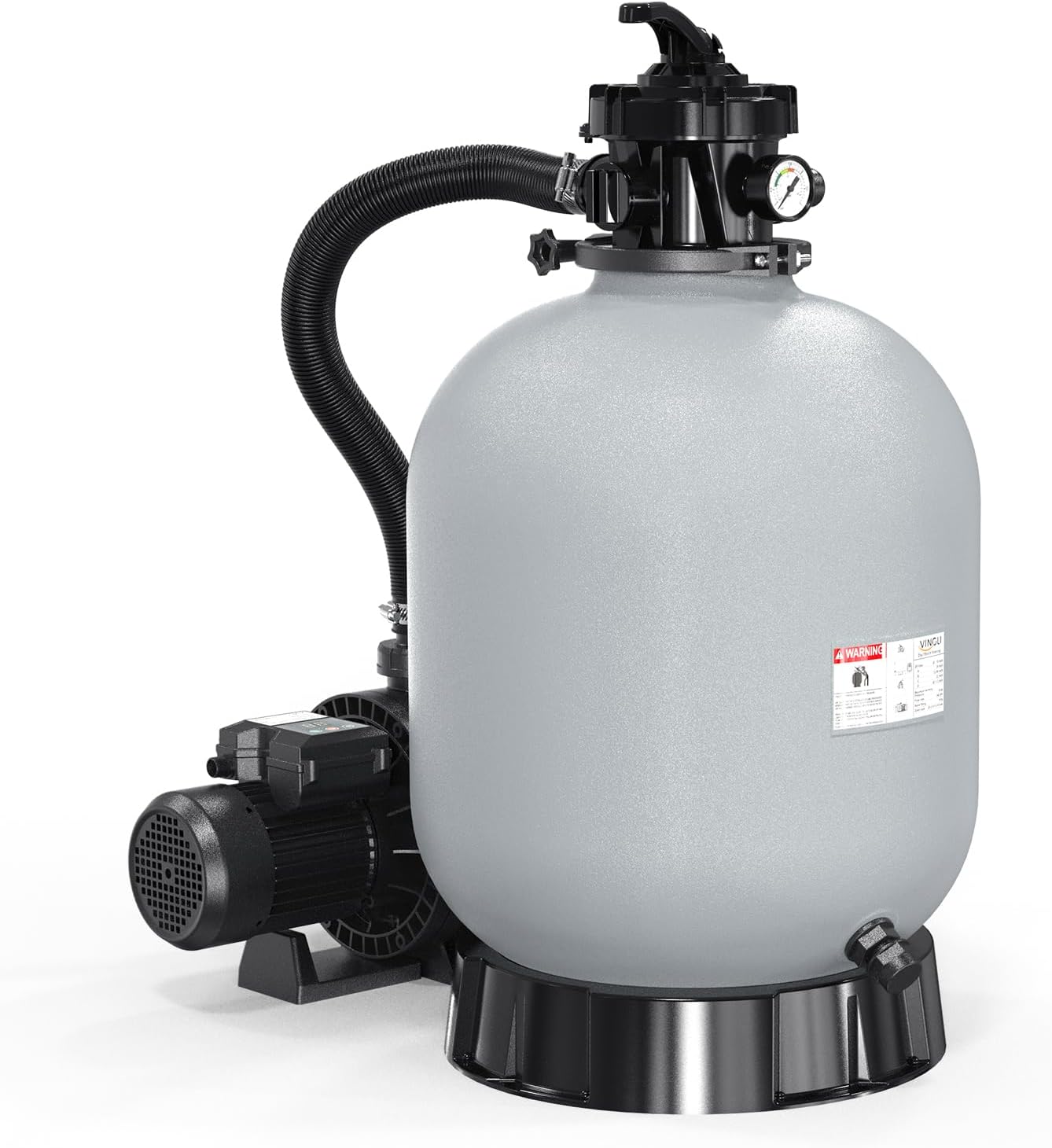
Roughly half the products here ship as a complete system with the pump already mounted and matched to the tank, and half are bare filter tanks with a multiport valve. The complete route removes the sizing risk and usually costs less than sourcing the two halves separately, so it suits anyone replacing a whole equipment pad or opening a pool that has been dormant. The Rx Clear Radiant Complete system and the XtremepowerUS 19 inch system with its 1.5 HP pump both fall into this group.
The tank only route makes sense in the very common situation where a filter tank has cracked, the laterals inside have broken, or the tank is simply too small, while the pump is still sound. Pentair, Hayward and Aquastrong tanks in this roundup all serve that job. You keep the motor you know, you keep the existing electrical, and you only have to solve the plumbing between the pump discharge and the valve inlet. The caveat is that you must confirm your existing pump does not exceed the tank design flow, which is a spec worth reading before ordering.
One thing neither route includes is the sand itself. Almost every tank on the market ships empty, and a 24 inch tank typically swallows around 300 pounds of pool grade silica or an equivalent volume of glass media. Budget for that separately and have it on site before you start, because a half filled tank is not a functional filter.
Inground Rated Versus Above Ground Only Units
This is the trap that catches most shoppers, because search results for pool filtration are dominated by above ground gear that looks identical in thumbnails. Read the listing title and the capacity rating rather than the photo. Units described as being for above ground pools, sold with hose adapters and clamp fittings, and rated to 10,000 or 15,000 gallons are built for a different application. Several of the highest reviewed sand filter pumps on the market are exactly that, and their reviews are glowing precisely because above ground owners are using them correctly.
The practical differences go beyond capacity. Above ground pumps typically sit at or slightly below the water line and rely on gravity feed rather than genuine self priming ability, so they struggle to pull water up from a pool deck to an equipment pad. Their connections are sized for flexible hose, not one and a half or two inch rigid PVC, so you end up adapting fittings that were never meant to hold that pressure. Their strainer baskets are smaller, which matters on an inground pool that collects leaves through a skimmer all season.
A few products genuinely span both worlds and say so plainly, listing above ground and inground use together with a capacity figure that reaches into the twenties or thirties of thousands of gallons. Those are legitimate. The ones to avoid for a buried pool are the units whose titles mention only above ground pools or that pair a small tank with a fractional horsepower motor. If in doubt, the capacity ceiling in gallons is a more honest signal than any marketing phrase.
Top Mount Versus Side Mount Valves

The multiport valve is the handle you turn to switch between filter, backwash, rinse, waste, recirculate and closed. On a top mount design the valve sits on the lid of the tank, which keeps the footprint tight and makes the unit cheaper to build. On a side mount design the valve bolts to the side of the tank, leaving the top clear so you can open the lid and service the sand bed without unplumbing the valve first.
Top mount is the right default for most residential pools and covers the majority of picks here, including the Hayward and XtremepowerUS tanks. Side mount, represented by the Pentair Triton II, earns its keep on larger installations and on equipment pads with low overhead clearance, and it makes the eventual sand change noticeably less painful. Valve position also affects where your plumbing has to arrive, so check it against your existing pad layout rather than assuming the pipes will reach.
Count the valve positions too. A six way or seven way valve gives you the full set of functions including waste, which lets you vacuum heavy debris straight out of the pool without sending it through the sand. Four way valves save money and lose that capability, which is a real omission after a storm drops a tree’s worth of leaves into the water.
Plumbing, Fittings and Electrical Requirements
Inground pools almost always run one and a half or two inch rigid PVC. Confirm the port size on any tank or pump before ordering, and expect to buy union fittings even if the box includes adapters, because unions are what let you disconnect the equipment later without cutting pipe. Many kits include basic PVC adapters, which is helpful, but few include the unions, primer, cement and thread sealant a clean installation needs.
On the electrical side, most residential pool pumps in this class run on standard 115 volt household current, though several are convertible to 230 volts. Any pool pump circuit needs proper bonding to the pool’s bonding grid and ground fault protection, and in most jurisdictions that work falls under the electrical code whether or not a permit is pulled. If your existing pad was wired for a smaller motor, verify the circuit can carry the new one before you buy. Related equipment and outdoor power tools are covered in our tools and home improvement section.
Finally, think about where the unit will physically sit. Filter tanks need clearance above for a top mount lid or to the side for a side mount valve, plus room to swing a wrench on the clamp band. Tanks sold with a base or stand solve the leveling problem on a gravel pad, while tanks sold bare assume you have a concrete slab ready.
| Model | Tank size | Pump included | Rated pool volume |
|---|---|---|---|
| Rx Clear Radiant Complete | 24 inch | Yes, 1 HP | Up to 33,000 gallons |
| XtremepowerUS 19 inch system | 19 inch | Yes, 1.5 HP | Up to 18,000 gallons |
| Hayward W3S244T ProSeries | 24 inch | No, tank only | Large residential pools |
| Pentair TR60 Triton II | 24 inch, side mount | No, tank only | Large residential pools |
| VINGLI 19 inch with timer | 19 inch | Yes, 1 HP | Up to 18,000 gallons |
| Aquastrong 24 inch tank | 24 inch | No, tank only | Up to 37,000 gallons |
| XtremepowerUS 22 inch tank | 22 inch | No, tank only | Up to 37,200 gallons |
| Swimline HydroTools 14 inch | 14 inch | Yes, 1/2 HP | Up to 10,500 gallons |
Read that table alongside your own gallon figure rather than top to bottom. The largest system is not the best system for a small plunge pool, and the cheapest complete unit is not a bargain if it caps out below your water volume. More outdoor and seasonal roundups are collected on our articles page.
Why You Should Trust Us
We build these roundups from the listings themselves and from verified customer ratings, not from press releases. For this category we started with a wide sweep of sand filter and pump results, then applied one filter that removed most of the field: the product has to be rated by its manufacturer for inground use, or carry a capacity figure and pump specification that a real inground pool can actually use. That single rule cut a long list down to the shortlist above, because the category is overwhelmingly stocked with above ground equipment.
We do not claim to have installed every unit on this page, and we think you should be skeptical of any site that says otherwise about heavy plumbed equipment. What we do is read the specification sheets closely, cross reference tank diameter against stated pool capacity, note where a listing quietly says above ground only, and tell you plainly whether a pump is in the box. Where a product is a strong piece of equipment aimed at a different application, we say that instead of quietly ranking it anyway. Our full category index lives at Daily Deal Here categories.
Final Thoughts
Best overall goes to the Rx Clear Radiant Complete Sand Filter System. It is the one product here that solves the whole problem in a single box for a standard inground pool: a 24 inch tank with a 300 pound sand capacity, a matched 1 HP Mighty Niagara pump, a six position valve, and a rating that reaches 33,000 gallons. For the very common 16 by 32 foot pool it leaves genuine headroom rather than running at its limit, and there is no risk of pairing a pump and tank that disagree with each other.
Best value is the XtremepowerUS 19 inch sand filter system with the 1.5 HP pump. It is a complete system with the highest flow figure of any bundled unit here, it states both above ground and inground use, and it covers pools to 18,000 gallons, which suits smaller inground rectangles and most kidney shaped pools. If your pool is closer to 30,000 gallons and you already own a healthy pump, the Aquastrong 24 inch tank and the XtremepowerUS 22 inch tank are the two highest capacity tank only options, and the Hayward W3S244T is the safe choice if you want a name your pool service will recognize.
Two picks serve narrower jobs. The Pentair TR60 Triton II is the one to buy when overhead clearance is tight or when you expect to change sand often, thanks to its side mount valve, and it is the most serious piece of equipment on the list. At the other end, the Swimline HydroTools 14 inch system is the only inground rated complete unit sized for pools near 10,500 gallons, which makes it the sensible answer for a plunge pool or a small spool rather than a full sized backyard pool. For more seasonal outdoor gear, browse our sports and outdoors roundups.
Frequently Asked Questions
What size tank does an inground pool filter and pump combo need for a 20,000 gallon pool?
A 19 inch tank is the practical minimum for 20,000 gallons and a 22 to 24 inch tank is the more comfortable choice. The pump should deliver at least 2,500 gallons per hour to hit a full turnover in eight hours, and realistically you want a 1 HP or larger motor to cover the resistance in buried rigid plumbing. Going one tank size up from the minimum lengthens the interval between backwashes and keeps operating pressure lower for the life of the system.
Can I put an above ground sand filter on an inground pool?
Sometimes physically, rarely well. The two obstacles are priming and plumbing. Above ground pumps are usually designed to sit at or below the water line and gravity feed, so they struggle to lift water from a pool deck up to an equipment pad, and their hose sized fittings have to be adapted to rigid PVC. Capacity is the other limit, since most above ground units cap out around 15,000 gallons. If the listing names only above ground pools, treat that as the manufacturer telling you the answer.
How many hours a day should the pump on an inground pool filter and pump combo run in 2026?
Eight hours a day is the traditional baseline, sized so the pump moves one full pool volume through the filter. Heavy bather load, hot weather and heavy tree cover all push that number up, and many owners split the run into two blocks rather than one long cycle. Units with a built in timer, such as the VINGLI system here, make that scheduling automatic. If your water still clouds after a full turnover every day, the problem is usually chemistry or an undersized tank rather than run time.
Do I need a variable speed pump for an inground pool?
Not to filter properly, but energy codes in a growing number of states now require variable speed motors above a certain horsepower for new and replacement installations on residential pools. None of the complete systems in this roundup use variable speed motors, so check your local requirement before buying a single speed replacement. Where variable speed is not mandated, a single speed pump matched correctly to the tank still filters exactly as well, it simply costs more to run over a season.
How often should I backwash and change the sand?
Backwash when the pressure gauge climbs roughly eight to ten PSI above its clean starting reading, which for most pools works out to every two to four weeks in season and more often after a storm. Do not backwash on a schedule, because a slightly dirty bed actually filters better than a spotless one. The sand itself typically lasts three to five years before the grains round off and stop trapping fine particles. More equipment guides are indexed on our patio, lawn and garden page.

Write Your Review
No reviews yet. Be the first to share your experience!