

A hand pump bottle is fine for a doorway, but it will never reach the shady hedge line where mosquitoes actually spend the day. That is the job of a backpack mosquito fogger: a machine you wear on your back, powered by a small engine or a motor, that pushes treated mist across a whole yard in one pass. We looked at 6 wearable machines from Tomahawk Power, Invatech Italia, PetraTools and more, sorted by what they actually put out, how far that output travels, and how long you can keep walking before you stop for fuel or a charge. Our top pick is the Tomahawk Power Turbo Fogger for its gas engine and large tank, which let one person cover an acre sized property without hunting for an outlet.
One thing worth saying before the picks: this is application equipment, not a product that kills anything on its own. Everything here is only as safe and as effective as the label on the bottle you pour in. If you have not settled on a product yet, our guide to outdoor bug spray for the house perimeter covers the chemistry side. This piece is about the hardware.

Pros
- Gas engine puts no cord or battery limit on working range
- 3.7 gallon tank covers a large property without a refill stop
- Blower wheel carries fog into hedges and tree canopy
- Converts to a leaf blower when the mosquito season ends
- Adjustable output from light haze to heavy coverage
Cons
- Two stroke engine needs correctly mixed fuel and seasonal upkeep
- Loud enough that hearing protection is required
- Heavy on the back once the tank is filled
The Tomahawk Power Turbo Fogger is the machine most people picture when they search for a backpack mosquito fogger. It is a wearable gas unit built around a small two stroke engine that spins a blower wheel, and the moving air is what carries atomized liquid away from the wand. That air assist is the reason a gas unit reaches a tree line from the middle of a lawn while an electric sprayer cannot.
The 3.7 gallon tank is the largest in this roundup and it changes how a big job feels. On a property with long fence lines and wooded edges you can finish a full perimeter pass without walking back to the mixing station, which matters more than the spec sheet suggests once you are wearing the machine. Output is adjustable, so an open lawn gets a light haze while dense shrubs get a heavier pass.
The trade is everything that comes with a small engine. You mix fuel, you keep fresh fuel at the start of each season, and you give the spark plug and air filter attention. It is also loud in the way a backpack leaf blower is loud, so hearing protection is part of the routine and early morning use will be noticed by neighbors. Full, the unit is a genuine load on the shoulders.
Bottom line: this is the pick for anyone with real acreage or a wooded boundary who wants fog to travel. Buyers on small suburban lots will find it more machine, more noise and more maintenance than the job needs.
- Type: gas backpack mist blower and fogger
- Engine: 3HP class two stroke, mixed fuel
- Tank capacity: 3.7 gallons
- Output: adjustable fog volume
- Secondary use: leaf blower with nozzle change
- Carry: backpack frame with padded shoulder straps
Owners of half acre and larger properties, anyone with a wooded or hedged boundary, and people who already run other gas yard equipment and are comfortable mixing fuel. It also suits small property maintenance operations that treat several sites in a day, since refuelling takes seconds while recharging does not.
It is the wrong machine for a compact yard near close neighbors, for anyone unwilling to maintain a two stroke engine, and for people who want to work quietly in the early morning.
Read the label of whatever product you apply before mixing, follow its dilution rate exactly, and wear the protective equipment it specifies. Chemical resistant gloves, eye protection and long sleeves are the baseline, and many fogging labels also call for a respirator.
Do not apply when the air is moving, since fine fog is designed to drift and a breeze will carry it onto a neighbor's property. Flush the tank and lines with clean water after every job so residue does not harden in the nozzle, and store the machine with fuel handled according to the manual.

Pros
- Cold fog needs no propane bottle and no heating element
- Gas power keeps you free of cords and charge times
- Long throw suits open lawns and hedge lines
- Adjustable output for different densities of planting
- Built for repeat seasonal use rather than one summer
Cons
- Mixed fuel and engine maintenance are part of ownership
- Loud in the same way a backpack blower is loud
- Heavier and more machine than a small lot requires
The Invatech Italia Mister Duster is the second gas option here and it takes a different route to the same result. Rather than heating a solution into a thermal fog, it atomizes cold, which means no propane bottle to buy and no hot surfaces to manage while you walk. For homeowners nervous about a flame based fogger, that alone makes it worth a look.
In use it behaves like the Tomahawk: engine noise, an air stream that carries mist past the wand, and enough reach to treat a hedge line without standing in it. Output is adjustable, so the same machine can lay a light pass over open lawn and a heavier one into dense planting. Being gas, its working radius is whatever a tank of fuel allows.
Where it asks something back is upkeep and weight. Two stroke engines want correctly mixed fuel, a clean air filter and a rinse of the lines after every job. It is also a substantial thing to wear once filled, so a compact yard will feel over served by it.
Bottom line: a solid alternative to our top pick for anyone who wants cold fog and gas range, particularly on properties where running an extension cord is not realistic.
- Type: gas backpack cold fogger and mist sprayer
- Engine: two stroke, mixed fuel
- Fogging method: cold atomization, no propane required
- Output: adjustable flow control
- Carry: backpack frame with shoulder straps
- Typical use: yard, perimeter and hedge line applications
Mix only the volume you plan to apply, since leftover solution is waste you then have to store or dispose of under the label rules. Start at the far corner of the property and work back toward your exit so you are never walking through fresh fog.
Aim into the shaded resting sites rather than over open grass: the underside of shrubs, the base of hedges, fence lines and the shaded wall of the house. Keep the wand moving at a steady walking pace, and stop the moment the trees start moving in the wind.
The pesticide label is the legal instruction for dilution, permitted sites, re-entry time and required protective equipment, and it outranks any general advice. Wear chemical resistant gloves, eye protection and long sleeves at a minimum.
Rinse the tank, lines and nozzle with clean water after every application. Keep output away from open water and blooming plants where pollinators are working, and give treated surfaces the drying time the label states before letting pets back outside.

Pros
- True ULV cold fog without fuel or an engine
- Quiet enough for early morning work near neighbors
- Adjustable flow from fine mist to heavy surface coverage
- Starts instantly with no priming or pull cord
- Lighter to carry than either gas unit here
Cons
- Needs a household outlet, so an extension cord sets your radius
- Cord management around shrubs and deck posts is a nuisance
- Plastic construction feels less rugged than the gas machines
The LONYEON is the easiest entry into real ULV fogging. A 1200 watt motor runs off a standard household outlet and atomizes the solution into a genuine cold fog, so you get the drifting droplet behavior that defines the category without mixing fuel or pulling a starter cord. It is quiet, which means a pass at six in the morning bothers nobody.
The 8 litre tank holds roughly 2.1 gallons, enough for a residential perimeter with margin, and the flow control is more useful than it sounds. Dialled down it produces a light haze for open lawn; opened up it moves toward a wet spray that coats surfaces. Rated range sits in the twenty six to forty foot band, which is generous for an electric unit and covers most suburban hedge lines from a standing position.
The cord is the whole compromise. Your working radius is your longest extension cord, and dragging that cord past shrub beds, garden furniture and deck posts is the part owners complain about. Build quality is also lighter duty than the gas machines, which is reasonable at this level but worth knowing if you plan heavy weekly use.
Bottom line: the best choice for a yard close to the house where an outlet is within reach, and the cheapest honest route into ULV fogging.
- Type: corded electric ULV cold fogger, backpack format
- Power: 1200 W from a standard household outlet
- Tank capacity: 8 litres, about 2.1 gallons
- Spray range: rated around 26 to 40 feet
- Droplet control: adjustable flow rate
- Carry: padded backpack straps
Homeowners on a quarter acre or similar lot where an outdoor outlet reaches most of the yard, and anyone who wants fog rather than spray but does not want an engine. It also suits people who need to fog indoor spaces such as a garage, barn or workshop, where a gas unit is not an option.
Skip it if your treatment area is far from the house, if you have no outdoor outlet, or if you expect the ruggedness of a commercial gas machine.
Run the extension cord out first and lay it along a path you will not cross repeatedly, then work away from the outlet so the cord trails behind you rather than under your feet. Use a cord rated for the load and keep connections off wet ground.
Start with the flow low and increase only if coverage looks thin, since ULV output goes further than most people expect. Flush with clean water after every job, and never plug in with a wet connection.

Pros
- Long battery runtime suits a full perimeter in one session
- Six nozzles cover fine mist through to a distance jet
- Pressure adjustable up to 90 PSI for different foliage
- Battery meter removes the guesswork on remaining charge
- Quiet operation with no fuel or cord
Cons
- Produces spray droplets, not the drifting fog of a ULV unit
- You walk the whole boundary with the wand, so coverage takes longer
- Recharge time limits back to back jobs on a single pack
The PetraTools HD4000 is not a fogger and we would rather say so plainly. It is a battery powered backpack sprayer, and it earns its place here because it does the other half of a mosquito plan: laying a lasting barrier treatment on the foliage, fence boards and shaded walls where adults rest, so the yard keeps working for weeks rather than for one evening.
The headline strength is runtime. A long working window on a charge means a full residential perimeter, including the fiddly parts behind sheds and under decks, without a battery swap halfway. Pressure is adjustable up to 90 PSI and there are six nozzles in the box, so a fine cone handles leaf undersides while a jet reaches a spot you would otherwise walk to.
The limits are the ones inherent to spraying. Droplets are far larger than ULV fog, so nothing drifts into a canopy for you and coverage is a function of where you point the wand. That means walking the whole boundary rather than treating it from a few standing positions, and it means a recharge before the next property.
Bottom line: the strongest all round applicator here for people who want residue that lasts, and the best pick when the job is long and access to power is not.
- Type: battery powered backpack sprayer
- Tank capacity: 4 gallons
- Pressure: adjustable up to 90 PSI
- Nozzles: six, including fine mist and jet patterns
- Battery: rechargeable pack with level meter
- Runtime: rated for extended continuous sessions
The nozzle you fit changes the machine more than the pressure dial does. A fine cone gives the smallest droplets this unit can make, which is what you want on leaf undersides and dense hedging where a barrier product needs to reach shaded surfaces.
A flat fan covers wide, low areas such as a lawn edge or mulch bed quickly and evenly. The jet nozzle trades coverage for distance and is for spot work, for example the underside of a high eave, and should not be your default for a full perimeter pass.
Follow the product label for dilution, permitted surfaces, re-entry interval and required protective equipment. Chemical resistant gloves and eye protection are the minimum for any barrier application.
Rinse the tank, pump and nozzles with clean water after each job, since dried concentrate is the usual reason a sprayer will not prime the following spring. Store the battery indoors and off a full discharge over winter.
Pros
- Two batteries in the box, so one charges while the other works
- 31 inch telescopic wand reaches under decks and shrub bases
- Six nozzles cover mist, fan and jet patterns
- Adjustable pressure with no manual pumping
- Quiet enough for an early morning pass
Cons
- 73 PSI is lower than the strongest sprayer here, so throw is shorter
- 2.0Ah packs are modest, so heavy sessions drain them
- Sprays rather than fogs, so nothing drifts into a canopy
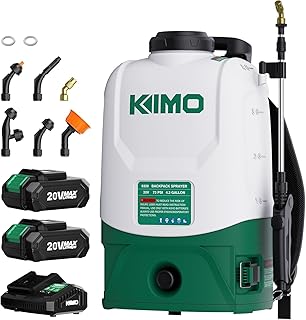
The KIMO is our value pick because of one packaging decision: two batteries come in the box. On a barrier spray job the limiting factor is almost never the tank, it is the charge, and having a second pack on the bench means you finish the property in one visit instead of two. That is worth more in practice than a few extra PSI.
The 4.3 gallon tank is the largest capacity in this roundup, and the 31 inch telescopic wand is the feature owners mention most. Mosquito resting sites sit low and shaded, under deck boards, at the base of hedging and along fence bottoms, and a wand that extends means treating those without crouching your way around the yard. Six nozzles cover the usual patterns and pressure is adjustable with no pumping to do.
Its ceiling is real though. At 73 PSI the throw is shorter than the higher pressure units, so you work closer to the surface. The 2.0Ah packs are modest in capacity, which is exactly why two of them matters. And like every sprayer here, it wets surfaces rather than filling the air, so it is the residue tool rather than the knockdown tool.
Bottom line: the sensible buy for a typical suburban yard where you want lasting coverage, quiet operation and no fuel, and the pick we would hand to a first time buyer.
- Type: battery powered backpack sprayer
- Tank capacity: 4.3 gallons
- Pressure: 73 PSI, adjustable
- Batteries: two 2.0Ah packs included
- Wand: telescopic, extends to 31 inches
- Nozzles: six patterns supplied
Homeowners on a standard suburban lot who want a barrier treatment they can repeat every few weeks without noise, fuel or a cord. The second battery makes it a good fit for anyone who dislikes stopping mid job, and the telescopic wand suits yards with decking, raised beds and low hedging.
Look elsewhere if you specifically need airborne fog, or if your property is large enough that you would rather treat it from standing positions than walk it.
Charge both packs before you start and keep the spare indoors rather than in a hot shed, since heat shortens pack life. Mix only what you will apply, then work the boundary in one direction so you can see which sections are done.
Extend the wand for the low work first, deck skirts, hedge bases and fence bottoms, then retract it for open foliage. Flush the tank and nozzles with clean water at the end of every job.

Pros
- 100 PSI is the highest adjustable pressure in this group
- Runs on Makita 18V packs you may already own
- Battery and charger included, so nothing else to buy
- Five nozzles for different surfaces and distances
- No pumping, with steady pressure through the tank
Cons
- Only one battery supplied, so a long job means a pause
- Running at full pressure drains the pack faster
- Spray droplets do not drift the way ULV fog does
The SideKing covers the same ground as our value pick and gets there with more pressure. At up to 100 PSI it is the strongest sprayer in this group, which shows up as a longer reach from the nozzle and better penetration into dense hedging. For a barrier application on thick planting, that extra push is genuinely useful.
The other draw is the battery platform. It accepts Makita 18V packs, so anyone already invested in that system has spare batteries on the shelf and a charger they trust. A battery and charger are supplied as well, so the unit works out of the box for buyers who own nothing else.
The catch is that one pack is what you get, and higher pressure draws harder on it. If your yard needs the full four gallons at full pressure, plan for a pause unless you have a second Makita battery. Like the other sprayers here, it produces wet droplets rather than airborne fog, so it is a residue tool and will not clear the air before an evening outdoors.
Bottom line: the pick for dense planting and for anyone already on the Makita platform, with the caveat that a spare pack turns it from good into genuinely convenient.
- Type: battery powered backpack sprayer
- Tank capacity: 4 gallons
- Pressure: adjustable up to 100 PSI
- Battery: 18V, compatible with Makita 18V packs
- Included: battery and charger
- Nozzles: five patterns supplied
Choose this one if you already own Makita 18V batteries, because the value calculation changes completely when spare packs are free. Choose it also if your property has thick hedging or tall shrubs where a low pressure sprayer struggles to reach shaded inner foliage.
If you own no cordless platform and expect long sessions, a unit shipped with two batteries will serve you better. Pressure is only an advantage while there is charge left to deliver it.
Apply only products whose labels permit the site and the method, and follow the stated dilution, protective equipment and re-entry interval. Gloves, eye protection and long sleeves are the baseline for any yard application.
Run clean water through the pump and every nozzle you used at the end of the job. Store the battery indoors, avoid leaving it flat over winter, and keep the tank empty and dry between applications.
How to Choose a Backpack Mosquito Fogger
Shoppers usually search for one thing and find two very different categories on the shelf. True foggers atomize liquid into a fog that hangs and drifts. Powered backpack sprayers push wet droplets onto surfaces. Both are worn, both cover a yard far faster than a hand sprayer, and each one fails at the job the other is built for. The criteria below are ordered the way the decision actually happens.
Fog Versus Spray: Droplet Size Decides Coverage
The single number that separates these machines is droplet diameter. A cold ULV fogger breaks liquid into droplets in the range of roughly 10 to 50 microns. Droplets that small stay airborne for a while, drift sideways with the air stream, and settle on the undersides of leaves where adult mosquitoes rest. That drifting behavior is the whole point of fogging a yard before an evening event.
A powered backpack sprayer works at the other end of the scale. Even on its finest nozzle it produces droplets several times larger, which fall quickly and wet the surface they hit. That is exactly what you want for a barrier treatment, where the goal is a lasting residue on foliage, fence boards and the shaded side of the house rather than a cloud in the air.
So the honest answer is that the two categories serve different timelines. Fog knocks down what is flying now and does little tomorrow. A barrier spray does little tonight and keeps working for weeks. Plenty of homeowners eventually own one of each, and if you can only buy one, buy for the timeline that matters to you.
Power Source: Gas Engine, Corded Electric, or Battery

Gas units are the only ones that combine real throw distance with unlimited range. A two stroke engine drives a blower wheel that carries fog well past the wand tip, which is how the Tomahawk Power and Invatech Italia machines reach a tree canopy. The trade is mixed fuel, spark plugs, air filters and a noise level that calls for hearing protection.
Corded electric units such as the LONYEON pull about 1200 watts from a standard household outlet. They are quiet, they start instantly, and they cost less to keep running. The catch is the cord. Dragging fifty feet of extension cord around shrub beds and deck posts is genuinely annoying, and it caps your working radius at whatever your longest cord allows.
Battery machines from PetraTools, KIMO and SideKing sit in between. There is no fuel, no cord and very little noise, so you can treat a yard early in the morning without waking anyone. Runtime is the limit, and it is worth checking whether a second pack is in the box or whether the unit takes a battery platform you already own.
Tank Size and What It Weighs on Your Back
Tank capacity in this class runs from roughly two gallons to just under four. It is easy to read that as a simple bigger is better spec, and it is not, because you carry every ounce of it. Water alone weighs a bit over eight pounds per gallon, so a full four gallon tank adds more than thirty pounds on top of the machine itself.
Match the tank to the property instead. A quarter acre lot rarely needs more than two gallons of finished mix for a perimeter pass, and a smaller tank means a lighter walk and less leftover solution to deal with. Larger lots, long fence lines and wooded edges are where a bigger tank earns its weight by cutting out mixing stops.
Harness quality matters as much as capacity. Padded shoulder straps, a waist belt and a frame that keeps the tank off your spine are the difference between a comfortable hour and a sore back. Every machine on this list advertises padded straps, but the gas units are heavier before you add a drop of liquid.
Throw Distance and the Shape of Your Yard

Throw distance decides how much of your yard you can stand still and treat. The corded LONYEON is rated in the range of twenty six to forty feet, which is generous for an electric unit and covers most residential hedge lines from the middle of the lawn. Gas mist blowers push further still because a real blower wheel is doing the work.
Battery sprayers are the opposite. Pressure figures of seventy three to one hundred PSI translate to a stream measured in feet, not tens of feet, so you walk the whole boundary with the wand pointed where you want the residue. A telescopic wand, like the thirty one inch one on the KIMO, helps you reach the underside of low branches without crouching.
Draw your yard in your head before you choose. A flat open lawn with a hedge on one side favors a long throw machine you can operate from a few standing positions. A yard cut up by raised beds, play equipment and a deck favors a sprayer with a wand you can point into each pocket. Our patio, lawn and garden section has more equipment guides for outdoor work.
Nozzles, Flow Control and What Goes in the Tank
Adjustable flow is the feature that turns one machine into several. On a fogger, a flow dial moves you from a light haze suited to an open lawn up to a heavy output for dense shrubs. On a sprayer, a nozzle set does the same thing: a fine cone for foliage, a flat fan for wide low passes, and a jet for spot work at distance.
Compatibility with what you plan to apply matters more than the nozzle count. Water based concentrates are the safe default across every machine here. Oil based solutions, which some yard fogging products call for, are not accepted by every unit, and putting one through a machine that is not rated for it can swell seals and clog the pump. Check the manual for that specific line before you mix.
Whatever goes in the tank, the pesticide label is the legal instruction and it outranks anything written here or in the machine manual. It sets the dilution rate, the sites you may treat, the wait time before people and pets return, and the personal protective equipment required. Read it before you mix, not after. Our roundup of pest control sprays is a useful place to compare the label language on common concentrates.
Noise, Protective Gear and Weather
A two stroke backpack unit is about as loud as a leaf blower, so hearing protection is not optional and neighbors will know you are working. Electric and battery machines are quiet enough for conversation. Whichever you pick, chemical resistant gloves, eye protection and long sleeves are the baseline, and many labels also call for a respirator when fogging.
Wind is the variable that ruins an application. Fine fog is designed to drift, which means a breeze will carry it off your property and onto a neighbor’s vegetable bed or an open window. Calm conditions at dawn or dusk are standard practice, and those hours also line up with peak mosquito activity. If the trees are moving, wait for another day.
Finally, plan around pollinators, ponds and pets. Avoid blooming plants where bees are working, keep output away from open water, and give treated surfaces the drying time the label specifies before letting a dog back out. None of this is optional detail; it is the part of the job a machine cannot do for you.
| Machine | Power source | Approx. tank | Output type |
|---|---|---|---|
| Tomahawk Power Turbo Fogger | Gas, two stroke | 3.7 gallons | Mist blower fog |
| Invatech Italia Mister Duster | Gas, two stroke | Around 3 gallons | Cold fog |
| LONYEON 8L ULV | Corded electric, 1200 W | 2.1 gallons | Cold ULV fog |
| PetraTools HD4000 | Battery | 4 gallons | Pressurized spray |
| KIMO 4.3 Gal | Battery, two packs | 4.3 gallons | Pressurized spray |
| SideKing 4 Gallon | Battery, Makita 18V | 4 gallons | Pressurized spray |
Why You Should Trust Us
We build these shortlists from what buyers report after a full season of use, not from marketing copy. For this category we started with every wearable machine that came back in a search for a backpack mosquito fogger, then removed the aerosol cans, propane wands and handheld foggers that dominate those results, because none of them is worn or covers a yard in a single pass. We also removed duplicate configurations of the same base machine so that six entries mean six genuinely different tools.
What is left is deliberately mixed. Three of the six atomize into fog and three pressurize a spray, and we say plainly which is which rather than pretending the categories are interchangeable. Ratings and customer feedback informed the ranking, but the ordering above reflects how closely each machine matches what someone typing this search is trying to do: treat a whole outdoor space, wearing the equipment, in one pass.
Final Thoughts
The Tomahawk Power Turbo Fogger is our best overall because it answers the search most literally. It is a gas backpack mist blower with a 3.7 gallon tank, it throws fog far enough to treat a tree line from the lawn, and it swaps to a blower nozzle when the season ends. Accept the mixed fuel, the maintenance and the noise, and it will cover more ground per hour than anything else here.
The KIMO 4.3 Gal is our best value pick. Two batteries in the box mean one is charging while the other works, the telescopic wand reaches under decks and into shrub bases, and the whole thing runs quietly enough for an early morning pass. It is a barrier sprayer rather than a fogger, so treat it as the residue tool in your kit. The SideKing covers the same ground at higher pressure and runs on Makita 18V packs, which is the deciding factor if you already own that platform.
For a yard close to the house, the LONYEON 8L is the easiest way into real ULV fogging: plug it in, dial the flow, no fuel to mix. For large or wooded properties where a cord is not realistic, the Invatech Italia Mister Duster is the second gas option and produces a cold fog without propane. The PetraTools HD4000 is the pick when runtime matters most, since its long working window suits big perimeter jobs. Fogging equipment is also only one layer of a yard plan, so it pairs well with yard ant control and with a bug zapper bulb near the patio.
Frequently Asked Questions
Does a backpack mosquito fogger actually get rid of mosquitoes?
It reduces the adult mosquitoes present at the time of application in the area you treat, and that is the honest limit of what fogging does. Fog does not create a lasting barrier, and mosquitoes fly in from neighboring properties within days. Lasting relief comes from combining an application with source reduction: emptying standing water in saucers, gutters, tarps and toys, since that is where the next generation is developing. Treat the machine as one tool in a routine rather than a permanent fix.
What can I put in a backpack fogger?
Only a product whose label lists your intended use and whose formulation your machine is rated to handle. Water based insecticide concentrates are the common choice and are accepted by every unit in this list. Oil based fogging solutions are a different matter and can damage seals in machines not built for them, so check the manual first. Never mix products beyond what the labels permit, and never guess a dilution rate: the label sets it, and applying at a stronger rate is both unlawful and a waste of concentrate.
When is the best time of day to fog a yard in 2026?
Early morning or the hour around dusk, on a calm day. Those windows match the periods when many mosquito species are most active, and they are usually the least windy part of the day, which keeps fine droplets on your own property. Avoid applying in full midday sun, when fog evaporates quickly, and avoid any day with noticeable wind. Check the label for the re-entry interval as well, since it tells you how long people and pets should stay off the treated area.
Is a fogger or a backpack sprayer better for a small yard?
For a small yard, a battery backpack sprayer is usually the more practical buy. You can wet the specific foliage, fence line and shaded walls where mosquitoes rest, the residue keeps working for weeks, and there is no engine noise at seven in the morning. A fogger makes more sense when you want a fast knockdown before an evening outdoors, or when the property is large enough that walking every foot of the boundary with a wand is unrealistic.
How much maintenance does a gas backpack fogger need?
More than most buyers expect. A two stroke engine needs correctly mixed fuel, fresh fuel at the start of each season, occasional spark plug and air filter attention, and a rinse of the tank and lines with clean water after every job so residue does not harden in the nozzle. Skipping the rinse is the most common cause of a machine that will not spray next spring. Electric and battery units skip the engine chores but still need that same post job flush. More equipment comparisons are in our articles hub.



Write Your Review
No reviews yet. Be the first to share your experience!