

Composting used to mean a heap at the far end of the yard, a pitchfork and a lot of patience. That is no longer the deal. A new generation of indoor composters keeps the whole process inside the house, on a counter, under a sink or tucked into a cupboard, so coffee grounds and carrot tops never sit in the trash long enough to smell. For September 2026 we pulled together a shortlist of 10 models from SCD Probiotics, Epica Kitchen, Utopia Kitchen and more, ranked using real customer ratings and the volume of verified feedback behind each one. Our top pick is the EPICA Stainless Steel Countertop Compost Bin for its sealed dual-filter lid, wipe-clean stainless body and the largest base of positive owner feedback in the category.
The lineup below covers three different approaches: sealed collection pails with activated carbon filters that hold scraps until you empty them, hanging and under-sink caddies for kitchens with no counter to spare, and a full bokashi fermentation kit that actually breaks material down indoors. Whichever route you take, the goal is the same, which is getting food waste out of the bin and into soil without turning your kitchen into a fruit fly nursery. If you want more ideas for the room where most of that waste starts, our home and kitchen deals section is a good next stop.

Pros
- Sealed lid with two carbon filters holds odor for several days
- Solid stainless steel body does not absorb smells over time
- 1.3 gallon size matches a three to five day emptying rhythm
- Wide opening makes scraping and rinsing quick
- Huge base of long-term owner feedback
Cons
- Heavier than plastic bins of the same volume
- Replacement filters are a recurring cost
- Brushed finish shows fingerprints in a bright kitchen
The EPICA is the default answer for anyone who wants food scraps off the cutting board and out of the kitchen trash without thinking hard about it. It is a 1.3 gallon stainless steel pail with a lid that seats firmly and carries two activated carbon filters rather than the single filter most rivals use.
The strength here is boring competence. Stainless steel does not take on the smell of onion and coffee the way plastic does after a year, the interior wall is smooth so residue rinses off, and the capacity is genuinely well judged: it fills in roughly three to five days for a small household, which is about as long as a carbon filter comfortably holds odor. That alignment between size and filter life is why so few owners report smell problems.
The downsides are the ones stainless always brings. It is heavier than a plastic caddy, the brushed exterior picks up fingerprints, and you will be buying replacement filters a few times a year. None of that is a dealbreaker, but if you want a bin you can hang on a cabinet door, this is not it.
Bottom line: if you want one countertop composter that will still be doing its job in five years and you do not need it to process the scraps, this is the safest pick on the list.
- Capacity: 1.3 gallons, roughly 5 liters
- Material: stainless steel body and lid
- Odor control: two activated carbon filters
- Placement: countertop
- Cleaning: hand wash, wide opening, removable lid
- Liners: compatible with standard compostable bags
Best suited to households of two to four who cook most nights and want a set-and-forget collection point. It is also a sensible choice for anyone who has tried a plastic bin before and given up because it started to smell permanently. Renters with municipal green bin collection get the most out of it, since the pail simply feeds the curbside program.
Rinse the interior each time you empty it and dry the rim, since trapped moisture around the lid seal is where residue builds. Swap the carbon filters every one to three months, sooner if you notice odor with the lid shut. Avoid abrasive scouring pads on the exterior finish, and keep meat and dairy out to prevent pests.

Pros
- Stainless build at a noticeably lower price
- Same practical 1.3 gallon working capacity
- Charcoal filter handles everyday fruit and vegetable waste
- Simple lift-off lid, nothing to break
- Low-risk way to try indoor composting
Cons
- Single filter rather than a dual system
- Lid seal is less tight than premium rivals
- Finish scratches more easily
Utopia Kitchen built its reputation on making the sensible version of kitchen basics at a friendlier price, and this compost pail follows the formula. You get the same stainless steel body and the same 1.3 gallon capacity as bins costing considerably more, with a charcoal filter seated in the lid.
In daily use it does the core job well. Fruit and vegetable trimmings, coffee grounds and eggshells sit in it for a few days without announcing themselves. The lift-off lid is simple and there is no hinge or latch to fail, which is quietly valuable in a product that gets opened several times a day with wet hands.
Where it gives ground is at the margins. The lid rests rather than clamps, so it is less forgiving if you push past five days between emptyings, and it uses one filter where the pricier bins use two. The exterior finish also picks up scratches faster if it lives next to a knife block.
Bottom line: the best value on this list by a clear margin, and the right choice if you are not yet sure indoor composting will become a habit.
- Capacity: 1.3 gallons
- Material: stainless steel, silver finish
- Odor control: one activated charcoal filter
- Lid: lift-off with handle
- Placement: countertop
- Cleaning: hand wash
Buy this if price is the deciding factor and you empty the bin at least twice a week. Step up to a dual-filter model if your household produces a lot of wet fruit waste in summer, or if the bin has to sit in a warm spot near a window. Order a multipack of replacement filters at the same time so you are not caught out in month two.
Line it or leave it bare, both work. Add scraps loosely rather than packing them down, because compressed material holds moisture and speeds up odor. Empty every three to four days, rinse with warm soapy water, and let the interior air dry before replacing the lid.

Pros
- Lid rotates open and stays put while you scrape
- Smooth interior with no corners for residue
- Largest capacity among the countertop pails here
- Light enough to carry outside one-handed
- Trusted brand with strong long-term feedback
Cons
- Plastic can retain faint odor after heavy use
- No carbon filter in the base design
- Charcoal color shows water spots
OXO approached this differently from the stainless crowd. Instead of sealing scraps behind a filter, the Easy-Clean bin focuses on making the pail so quick to empty and rinse that odor never gets a chance to establish. The lid rotates fully open and stays there, so you can scrape a board in with one hand.
The interior is the real feature. There are no sharp internal corners, no rivets and no ledge under the rim, which means a rinse under the tap genuinely clears it rather than leaving a ring you scrub later. At 1.75 gallons it is also the roomiest countertop option here, useful for a family that cooks in volume or preps vegetables in batches.
The trade-off is material. Plastic is lighter and cheaper to produce, but over a year of citrus and coffee it can hold a faint background smell that stainless does not. The design leans on frequent emptying rather than filtration, so it suits people who take scraps out every two or three days.
Bottom line: the pick for larger households and for anyone who abandoned a previous bin because cleaning it was a chore.
- Capacity: 1.75 gallons, about 6.6 liters
- Material: plastic body, charcoal finish
- Lid: rotates open and holds position
- Interior: smooth walls, no internal corners
- Placement: countertop
- Cleaning: rinse or dishwasher
A good match for families of four or more, batch cooks and anyone who prepares a lot of vegetables at once. It is also the friendliest option for households where several people add scraps, since the one-handed lid means nobody has an excuse to leave peelings on the board.
Empty every two to three days rather than waiting for it to fill, since this design relies on turnover rather than heavy filtration. Rinse immediately after emptying while residue is still fresh. If you notice odor building, a rinse with diluted white vinegar clears plastic more effectively than soap alone.

Pros
- Ventilated design keeps scraps drier and slows decomposition
- Compact 1 gallon footprint for small counters
- Removable inner section simplifies emptying
- Replaceable odor filter in the lid
- Neat graphite styling that suits modern kitchens
Cons
- Vented design needs emptying every two to three days
- Smallest capacity of the mainstream picks
- Works best with compostable liner bags
Joseph Joseph took the contrarian route with this caddy. Where most indoor bins try to seal scraps in, this one deliberately lets air move through the body. The logic is sound: moisture is what drives fast, smelly decomposition, so keeping the contents drier slows the whole process down.
In practice it works, with one condition. The caddy is designed around compostable liner bags, and airflow through the vents dries the outside of the bag so the contents do not turn into a wet sludge. Owners who use it bare and let scraps sit report more odor than those who use liners, so factor the bags into your running cost.
At 1 gallon it is the most compact of the mainstream picks, which is exactly why it suits apartment kitchens where counter space is measured in inches. The graphite finish is understated and the inner section lifts out cleanly, so emptying does not involve carrying the whole unit.
Bottom line: an excellent small-kitchen choice if you empty every two or three days and are happy to use liners; less suited to a household that wants to fill and forget.
- Capacity: 1 gallon, 4 liters
- Material: plastic, graphite finish
- Odor control: replaceable filter plus ventilation
- Design: vented body for airflow
- Placement: countertop or under sink
- Liners: designed for compostable bags
Best for apartment and small-kitchen households of one to three people who cook regularly and take scraps out often. It also suits anyone already using the Joseph Joseph waste separation range, since it slots into that system visually and physically.
Choose this if counter space is your binding constraint and you are comfortable buying liner bags. If you would rather not deal with consumable bags, a sealed stainless pail is the better fit. Check that your local composting program accepts certified compostable liners before committing to this workflow.

Pros
- Mounts on a cabinet door to free counter space
- Generous 2.4 gallon capacity for the format
- Lid swings open with a light push
- Doubles as a small bathroom or office bin
- Inexpensive relative to stainless rivals
Cons
- Plastic body needs regular rinsing to stay fresh
- No carbon filter as standard
- Hanging mount depends on cabinet door clearance
The Tiyafuro solves the problem that stops many people composting indoors, which is that there is simply nowhere to put a bin. It hangs on the inside of a cabinet door directly under the sink, so scraps go straight from the board into a container that is invisible the rest of the time.
What sets it apart from other hanging caddies is capacity. At 2.4 gallons it holds roughly twice what a typical small caddy manages, which means the convenience of the hanging position does not come with constant emptying. The push-open lid is light and works with a wrist when both hands are full.
The compromises are what you would expect at the price. It is plastic, so it needs a proper rinse rather than a wipe, and there is no carbon filter in the standard design, meaning it relies on the lid seal and on you emptying it. Cabinet door clearance is worth measuring first, since a full 2.4 gallon bin needs room to swing.
Bottom line: the best answer for a small kitchen that has no counter to spare but still wants real capacity.
- Capacity: 2.4 gallons
- Material: plastic, gray finish
- Mounting: cabinet door hook or freestanding
- Lid: push-open
- Inner bucket: removable
- Other uses: bathroom, office, camping
Made for renters, small apartments and kitchens where every inch of counter is spoken for. It also works well as a second collection point in a large kitchen, for example next to a prep island where most chopping happens.
Check the cabinet door has clearance for the bin to swing without hitting shelves or plumbing. Rinse the inner bucket every time you empty it, and let it dry before rehanging. Since there is no filter, keep meat, dairy and heavily sauced leftovers out and empty at least twice a week.

Pros
- Three charcoal filters included, roughly a year of use
- Powder-coated stainless resists rust and stains
- Oval shape sits neatly against a backsplash
- Farmhouse styling stands out from plain steel bins
- Strong owner ratings for odor control
Cons
- Painted finish can chip if knocked
- Oval footprint is less space-efficient than round
- Premium price for the capacity
Granrosi built this one for kitchens where the compost bin has to look like it belongs on the counter. The oval white body with a farmhouse profile reads more like a canister than a waste container, which matters when the alternative is a plain steel bucket sitting next to your coffee setup.
Underneath the styling it is a properly specified pail. The body is coated stainless rather than plastic, so it resists rust and does not take on odor, the lid seats snugly, and the box includes three charcoal filters instead of the single filter most rivals ship. At a typical replacement interval that is close to a year of coverage before you spend anything more.
The oval shape is a mixed blessing. It tucks against a backsplash nicely but wastes a little space compared with a round pail of the same volume, and the painted finish is more vulnerable to chips than bare brushed steel if it gets knocked against a tap.
Bottom line: the pick when appearance matters as much as function, and the included filter stock softens the higher price.
- Capacity: 1.3 gallons
- Material: coated stainless steel, white
- Shape: oval countertop profile
- Included: three charcoal filters
- Lid: fitted with carry handle
- Cleaning: hand wash, wipe exterior
Aimed at people furnishing an open-plan or farmhouse-style kitchen where the bin is permanently on show. It suits households of two to four with an ordinary volume of fruit and vegetable waste, and anyone who resents buying filters as a separate purchase.
Wipe the painted exterior rather than scouring it, since abrasives will dull the finish. Keep it back from the edge of the counter to avoid knocks that chip the coating. Rotate through the supplied filters on a one to three month schedule and note the replacement size before you run out.

Pros
- Dual filter design gives odor two barriers
- Highest owner rating in this roundup
- Spare filters included in the box
- Clean white finish hides fingerprints
- Sturdy lid seals firmly without sticking
Cons
- Costs more than single-filter equivalents
- Two filters means two consumables to track
- Narrower opening than the OXO design
The RED FACTOR is the odor specialist of this group. Rather than relying on a single carbon disc in the lid, it uses a two-stage arrangement so escaping air passes through filtration twice. That is the main reason it carries the highest owner rating on this list.
The rest of the build supports that focus. The lid seals firmly but still lifts without a fight, the stainless body is finished in white so fingerprints do not show the way they do on brushed steel, and spare filters come in the box rather than as a first-week reorder. For a kitchen that runs warm, or a household producing a lot of juicy summer fruit waste, the extra filtration is genuinely useful rather than a marketing line.
You pay for it. This is one of the more expensive 1.3 gallon pails available, and having two filters means two consumables to remember. The opening is also a little narrower than the widest-mouth designs, so scraping a large board takes slightly more care.
Bottom line: the choice for anyone who has fought a losing battle with kitchen odor before and wants the belt-and-braces answer.
- Capacity: 1.3 gallons
- Material: stainless steel, white finish
- Odor control: dual filter system
- Included: spare filter set
- Placement: countertop
- Cleaning: hand wash
Built for odor-sensitive households, open-plan kitchens where the living area shares air with the cooking space, and anyone in a warm climate where scraps break down fast. It is also a reasonable pick for people who empty less often than the ideal and want filtration to cover the gap.
Worth the premium if smell has been your sticking point. If you empty every two days and keep the bin in a cool kitchen, a single-filter model will serve you just as well for less. Confirm the replacement filter sizes for both stages when you order, since forgetting the second one is a common slip.

Pros
- Tiny footprint fits kitchens with almost no space
- Hangs on a cabinet door or stands freely
- Lid seals well for the size
- Light enough to carry with one finger
- Inexpensive and easy to replace
Cons
- 0.8 gallon fills fast for a family
- Plastic body needs frequent rinsing
- No carbon filter included
Not every kitchen can accommodate a gallon-plus pail, and the LALASTAR exists for the ones that cannot. At 0.8 gallons it is deliberately small, sized for one or two people, an RV galley, an office kitchenette or a dorm room where the alternative is nothing at all.
For the format it is well executed. The lid seals more convincingly than most mini caddies, the hook lets it live on a cabinet door out of sight, and the whole thing weighs so little that emptying is a one-finger job. Because it is small it also gets emptied more often, which is quietly the best odor control there is.
Its limits are obvious. A family cooking vegetables nightly will fill it in a day or two, and there is no carbon filter in the standard package, so it depends entirely on the lid seal and on your emptying discipline. The plastic body needs a proper rinse each time rather than a wipe.
Bottom line: the right answer for very small spaces and mobile kitchens, and the wrong one for a busy family kitchen.
- Capacity: 0.8 gallons, 3 liters
- Material: plastic, blue finish
- Mounting: cabinet hook or freestanding
- Lid: sealing with lift handle
- Intended use: kitchen, RV, office, dorm
- Cleaning: hand rinse
Single occupants, couples who cook lightly, van and RV kitchens, offices and student housing. It is also a useful second bin for a bathroom or bedroom where a small lidded container is handy for other purposes.
Empty daily or every other day given the size, and rinse straight afterwards. Avoid packing scraps down to squeeze in more, since compaction traps moisture and defeats the lid seal. If odor becomes an issue, a small sheet of activated carbon cut to fit inside the lid is an easy retrofit.
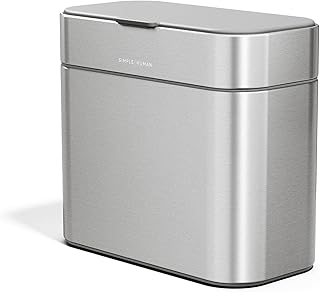
Pros
- Detaches from a step can and returns out of sight
- Brushed stainless build feels substantial
- Compact 1.06 gallon size for a prep station
- Smooth interior wipes clean quickly
- Excellent fit and finish for the category
Cons
- Designed around compatible simplehuman cans
- No carbon filter in the standard caddy
- Small capacity for the price
The simplehuman caddy is less a standalone bin than a component of a system. It clips onto the rail of a compatible step can, so the collection point lives inside the main bin cupboard and only comes out onto the counter when you are actually chopping. That solves the aesthetic objection to countertop composting entirely.
Build quality is where simplehuman usually justifies its pricing and this is no exception. The brushed stainless body is properly rigid, the interior is smooth with no seams to trap residue, and the handle and clip mechanism feel engineered rather than moulded. At 4 liters it is sized for a prep session rather than a week of scraps.
The catch is that the value proposition depends on you owning or wanting a compatible can. Used purely as a freestanding pail it is small and expensive for what it holds, and there is no carbon filter, so it relies on being emptied at the end of each prep session rather than storing material for days.
Bottom line: outstanding if it joins a simplehuman can in your kitchen, hard to justify as a standalone purchase.
- Capacity: 1.06 gallons, 4 liters
- Material: brushed stainless steel
- Design: detachable, clips to compatible step cans
- Odor control: lid seal, no filter as standard
- Placement: counter during prep, cupboard between uses
- Cleaning: wipe or rinse
Ideal for existing simplehuman step can owners and for people who want no visible waste container on the counter. It suits cooks who prep in defined sessions and empty as they finish, rather than households accumulating scraps over several days.
Check compatibility with your step can model before ordering, since the rail fitting is the whole point. If you do not own a compatible can, a sealed 1.3 gallon stainless pail gives you more capacity and filtration for less money. Treat this as a prep caddy rather than a storage bin.

Pros
- Ferments meat, dairy and cooked food that pails cannot handle
- Sealed bucket keeps the process odor controlled
- Spigot drains liquid for use as diluted plant feed
- Actually processes waste instead of only storing it
- Starter bran included to begin immediately
Cons
- Needs a continuing supply of bokashi bran
- Requires soil or a trench for the final burial step
- 5 gallon footprint takes real floor or cupboard space
Everything else on this list stores scraps. The All Seasons kit from SCD Probiotics is the one product here that genuinely processes them indoors. It is a bokashi system, meaning scraps are layered with bran carrying lactic acid bacteria and sealed in an airtight bucket where they ferment rather than rot.
The practical payoff is the material it accepts. Meat, fish, dairy, oily leftovers and cooked food all go in, none of which belong in a carbon-filter pail. Because the bucket is sealed and the process is anaerobic, the smell stays inside, and what escapes when you open it is a sour pickled note rather than the smell of rotting food. The spigot drains off the liquid that accumulates, which dilutes heavily into a plant feed or goes down the drain.
You have to accept two ongoing commitments. Bran is a consumable you will keep buying, and fermented bokashi material is not finished compost; it needs to be buried in soil or added to a pile for a couple of weeks to complete. Apartment dwellers with no soil access need a plan, whether that is a large planter, a community garden or a neighbor with a bed to spare.
Bottom line: the pick for anyone who wants an indoor system that actually converts waste, and who has somewhere to bury the result.
- Capacity: 5 gallons
- Type: bokashi anaerobic fermentation
- Included: bucket, lid, spigot, 1 gallon of dry bran
- Cycle: roughly two weeks sealed, then burial
- Accepts: fruit, vegetables, meat, dairy, cooked food
- Ongoing supplies: inoculated bokashi bran
Add scraps in layers, sprinkling a handful of bran over each one, then press down to remove air pockets and seal the lid immediately. Drain the liquid through the spigot every few days and dilute it heavily before using it on plants. When the bucket is full, leave it sealed for about two weeks, then bury the contents in soil or add them to an outdoor pile to finish.
Keep the lid sealed between additions, since oxygen is what turns fermentation into rot. White mold on the surface is normal and expected; green or black growth means air is getting in. Store the bucket away from direct heat, and rinse it between batches without harsh disinfectants that would kill the beneficial culture.
What to Look For in Indoor Composters
Indoor composting products are not interchangeable. Some of them are storage vessels that buy you a few days before a trip to the outdoor pile or the municipal green bin. Others ferment or dehydrate material and hand you something you can dig straight into a planter. Working out which category you actually need is the single decision that determines whether the thing gets used or ends up in a cupboard. The criteria below are the ones that matter in daily use.
Odor Control and Filter Design

Odor is the reason most people give up on indoor composting, so start here. Nearly every countertop pail on this list relies on activated carbon filters seated in the lid. Carbon adsorbs the volatile compounds that escape as scraps begin to break down, and a well-sealed lid keeps the rest contained. The differences show up in the details: how many filters sit in the lid, whether the lid clamps or simply rests, and how easy the filter is to replace when it saturates.
Two filters beat one. The RED FACTOR bin uses a dual filter arrangement, one in the lid and a second lower in the housing, which gives odor two barriers instead of one. The Joseph Joseph caddy takes the opposite approach and vents deliberately, using airflow to keep scraps drier so they decompose more slowly and smell less. Both strategies work, but they suit different habits. Vented designs reward emptying every two or three days; sealed designs let you stretch that out.
Filters are consumable. Expect to swap them every one to three months depending on how wet your scraps run. A bin that ships with spare filters, as the RED FACTOR and Granrosi models do, saves you a reorder in the first season. Check that replacements are sold in multipacks and are a standard round size before you commit, because proprietary shapes get expensive.
Capacity and Where It Will Live

Capacity sounds like a simple bigger-is-better number, and it is not. A 1.3 gallon pail is the sweet spot for a household of two to four people cooking most nights, because it fills in roughly three to five days, which happens to match how long carbon filters hold odor comfortably. Go larger and you are storing partly decomposed material longer than the filter can mask. Go smaller, as with the 0.8 gallon LALASTAR, and you trade capacity for the ability to hang it on a cabinet door where it takes no counter space at all.
Measure before you buy. Under-sink placement means checking clearance around plumbing and whether the lid can open fully in that space. Counter placement means deciding whether you want the thing to look like an appliance or like part of the decor. The simplehuman caddy is built to detach from a larger step can, so it works for people who want the collection point to disappear entirely between uses. The bokashi kit from SCD Probiotics needs the most room at 5 gallons, but it earns the space by actually processing material rather than just holding it.
Materials, Cleaning and Durability

Stainless steel dominates this category for good reason. It does not absorb odor the way plastic can over time, it wipes clean with soap and water, and it resists the acidity of citrus peels and coffee grounds. The trade-off is weight and price. Powder-coated and plastic bins are lighter and often cheaper, and the better ones, including the OXO and Joseph Joseph models, use smooth interior walls and removable inner buckets so nothing collects in a corner you cannot reach.
Look for a removable inner bucket or a wide mouth. Scraping a wet pail clean through a narrow opening is the fastest way to stop using it. The OXO design opens wide and the whole lid lifts off, which is a small thing that pays off every week. Check whether the manufacturer says the inner bucket is dishwasher safe, and treat any bin with rivets or seams on the inside with suspicion, because those are where residue lodges.
Liners, Consumables and Running Cost
The purchase price is not the whole cost. Filters are the recurring expense on every collection pail, and compostable liner bags are optional but popular because they make emptying nearly mess free. If your local program accepts certified compostable bags, liners are worth it. If you are heading to a backyard pile, skip them and rinse the pail instead, since many liners break down slowly in a cool home heap.
Bokashi is the outlier on running cost. The SCD Probiotics starter kit needs a steady supply of inoculated bran, roughly a handful sprinkled over each layer of scraps, and you will buy more bran every couple of months. In exchange you get a system that handles meat, dairy and cooked food, which no simple carbon-filter pail can claim. Electric dehydrating units carry a different recurring cost in the form of electricity and replacement carbon cartridges, so the cheapest sticker price rarely stays cheapest over a year.
Noise, Cycle Time and Convenience
Collection pails are silent and have no cycle at all, which is their quiet advantage. Powered countertop composters grind and dry a batch in anywhere from three to twenty hours and produce a low hum plus a fan noise that is noticeable in an open-plan kitchen at night. Bokashi ferments silently over roughly two weeks in the sealed bucket, then needs a burial or trench step to finish. If you live in an apartment with no soil access, that final step is the part to plan for before you buy.
Convenience is really about how many steps sit between the cutting board and the finished product. Fewer steps means more consistent use. A hanging caddy that sits within arm’s reach of where you chop will collect far more waste over a year than a handsome pail parked across the room. For yard-side finishing gear, our patio, lawn and garden category covers tumblers and outdoor bins that pair well with any of these indoor collectors.
| Type | Typical Capacity | Odor Method | Time to Usable Output | Ongoing Supplies |
|---|---|---|---|---|
| Countertop pail, sealed | 1.0 to 1.75 gal | Carbon filter in lid | Storage only, no output | Filters, optional liners |
| Hanging or under-sink caddy | 0.8 to 2.4 gal | Carbon filter, lid seal | Storage only, no output | Filters, optional liners |
| Vented caddy | 1.0 gal | Airflow keeps scraps dry | Storage only, no output | Filters, liners |
| Bokashi fermenter | 5 gal | Sealed anaerobic bucket | About 2 weeks, then burial | Inoculated bran |
| Electric dehydrator | 0.5 to 1 gal | Heat plus carbon cartridge | 3 to 20 hours per batch | Cartridges, electricity |
Why You Should Trust Us
We build these shortlists from verified customer data rather than press releases. Every product here was pulled from live Amazon listings, then filtered to keep only models holding a rating of 4.0 stars or better with a meaningful volume of reviews behind that score, so a handful of enthusiastic early buyers cannot push a weak product onto the list. From that filtered pool we read through owner feedback looking for the complaints that repeat, since a pattern of the same gripe across hundreds of reviews tells you more about long-term ownership than any spec sheet.
We also curate for genuine variety instead of padding a round number. Duplicate colorways, near-identical relistings and outdoor tumblers that do not belong in an indoor roundup were all removed, which is why this list covers sealed pails, hanging caddies and a fermentation kit rather than ten versions of the same stainless bucket. Our editorial picks stay independent of any commission we may earn, and you can browse the rest of our work in the articles archive.
Final Thoughts
Best overall goes to the EPICA Stainless Steel Countertop Compost Bin. It gets the fundamentals right: a genuinely sealed lid, a stainless body that will not hold odor after a year of citrus and coffee, a 1.3 gallon capacity that matches the working life of a carbon filter, and the deepest pool of satisfied owners in the category. It is the safe recommendation for a household that simply wants scraps off the counter and out of the trash.
Best value is the Utopia Kitchen Countertop Compost Bin. It delivers the same stainless construction and the same 1.3 gallon working capacity at a noticeably friendlier price, and the charcoal filter does the job. If you are not sure indoor composting will stick as a habit, this is the low-risk way to find out. For the smallest kitchens, the LALASTAR hanging bin solves the counter-space problem outright, and the Tiyafuro caddy does the same trick with more room to spare.
If you want more than storage, the SCD Probiotics All Seasons bokashi kit is the pick. It is the only system here that ferments meat, dairy and cooked leftovers indoors, and it turns a two week wait into material your garden beds can use. Whichever you choose, pair it with a plan for where the finished scraps go, and check our category directory for related kitchen and garden gear.
Frequently Asked Questions
Do indoor composters smell bad in the kitchen?
Not if you match the bin to your emptying habit. Sealed pails with activated carbon filters hold ordinary fruit, vegetable and coffee waste for three to five days with no noticeable odor. Smell usually appears for one of three reasons: a saturated filter that needs replacing, meat or dairy going into a bin not designed for it, or the pail sitting full for over a week. Rinse the bin when you empty it, swap filters on schedule, and the problem largely disappears.
What can I put in an indoor composter?
For carbon-filter collection pails, stick to fruit and vegetable scraps, coffee grounds and filters, tea bags without staples, eggshells, and plain bread or grains. Keep out meat, fish, bones, dairy, oils and anything heavily sauced, because those attract pests and overwhelm a filter fast. A bokashi system is the exception, since the fermentation process handles meat, dairy and cooked food that a simple pail cannot.
How often should I change the carbon filters in 2026?
Most manufacturers suggest every one to three months, and the honest answer is that it depends on how wet your scraps run and how warm your kitchen is. A household producing lots of juicy fruit waste in summer will saturate a filter faster than one tossing in coffee grounds and eggshells. The practical signal is simple: when you start noticing odor with the lid closed, the filter is done. Some owners extend filter life by letting them air out in sunlight for a day between uses.
Do I need compostable liner bags?
They are optional. Liners make emptying cleaner and cut down on scrubbing, which matters if the bin lives on a busy counter. They make the most sense when your city collection program accepts certified compostable bags. If your scraps are heading to a backyard heap or a tumbler, a bare pail that you rinse each time is simpler and cheaper, since many liners break down slowly in a cool pile and end up in the finished compost as shreds.
Can indoor composters actually make usable compost, or do they just store scraps?
Most countertop bins are collection vessels, not processors. They hold material odor-free until you move it to a pile, a tumbler or a municipal bin. Two categories genuinely process material indoors: bokashi fermenters, which pickle scraps in a sealed bucket over roughly two weeks before you bury the result, and electric grinding dehydrators, which reduce a batch to a dry soil amendment in hours. Decide which of those two jobs you want before you shop, and see our kitchen essentials roundups for gear that pairs with either route.



Write Your Review
No reviews yet. Be the first to share your experience!