

Ask ten people what the best tarp is and you will get ten answers, because they are all covering different things. A roofer riding out a storm, a painter protecting hardwood floors, and a backpacker shaving grams off a shelter kit all need the same basic object, but they need it built from completely different cloth. That is why shopping for a tarp really means shopping for a material first and a size second.
Our top pick is the Xpose Safety 16 Mil Brown Poly Tarp for its thick laminated polyethylene body, heat-sealed seams and reinforced grommet edge, which together survive far more wind cycling than the thin blue tarps sold at checkout counters. To build this guide we pulled 10 covers from Dry Top, Free Soldier, Xpose Safety and more, grouped them by what they are actually woven from, and looked at how each fabric behaves once real weather gets at it. Below you will find the shortlist, then a breakdown of how polyethylene, cotton canvas and coated ripstop nylon differ on waterproofing, UV life, tear strength, weight and cost, updated for September 2026. If you are outfitting a yard or workshop, the rest of our patio, lawn and garden coverage pairs well with this one.

Pros
- Sixteen mil laminated poly is genuinely waterproof, not just repellent
- Rope-reinforced hem stops grommets pulling through under wind load
- Brown and silver faces carry heavy UV inhibitor loading
- Grommets set close enough for a proper multi-point tie-down
- Handles roof cover, load cover and storage duty equally well
Cons
- Stiff and heavy to fold compared with lighter poly grades
- Not breathable, so condensation forms under sealed loads
- Finished size runs a few inches under the stated dimension
This is the poly tarp people buy after a cheap blue one shreds on them. At 16 mil, the woven polyethylene scrim is laminated on both faces with enough film that the cloth feels closer to a truck cover than a sheet, and it does not flutter and work-harden the way thin economy tarps do in a steady wind.
The real difference is the edge construction. A rope is folded into the hem and the grommets are set through that reinforced band rather than through a single thin fold, which is where almost every tarp actually fails. Combined with grommet spacing tight enough to distribute load across many tie points, it survives storm cycling that pulls the corners clean off lighter covers.
The brown and silver faces are the other reason to choose this over a blue tarp of the same thickness. Blue poly is typically the least UV stabilized grade a manufacturer offers, while the brown and silver grades carry more inhibitor and reflect more heat, which slows the chalking and embrittlement that ends a tarp's life.
The trade-offs are weight and stiffness. Folding one back up alone in a breeze is awkward, and because the film is fully sealed, anything organic stored under it will sweat unless you leave the sides open for airflow.
Bottom line: if you need one tarp that covers a roof, a load or a woodpile and you do not want to think about it again for several seasons, this is the default answer.
- Material: laminated woven polyethylene
- Thickness: 16 mil
- Waterproof rating: fully waterproof, non-breathable
- Hem: rope-reinforced, double folded
- Grommets: rustproof metal, closely spaced perimeter
- Seams: heat sealed
- Color: brown one face, silver reverse
- UV treatment: stabilized resin
- Emergency and semi-permanent roof cover
- Covering equipment, pallets and material on a job site
- Winter storage for boats, trailers and mowers
- Ground cover under heavy work where puncture risk is high
- Any application where the cover stays pitched for months
Rinse grit off before folding, since trapped debris abrades the laminate from the inside when the tarp is stacked. Fold rather than crumple: repeated creasing in the same place is what eventually cracks heavy poly.
Store rolled in shade. Even off-season, sunlight through a garage window will degrade the exposed outer fold over time. Small punctures patch permanently with poly tarp tape applied to a clean dry surface on both faces.

Pros
- Eighteen ounce cotton duck is the heaviest consumer canvas weight
- Breathes, so nothing sweats underneath it
- Chars instead of melting near sparks and hot work
- Rustproof grommets prevent the stains that rot cotton
- Can be re-treated when repellency fades
Cons
- Water repellent rather than fully waterproof under standing water
- Very heavy to handle at larger sizes
- Will mildew if rolled up damp
- Sold at cut size, so the finished panel is smaller
Canvas is the material poly cannot replace, and 18 oz duck is the weight where that becomes obvious. The cloth is dense enough to feel like a drop of tent canvas rather than a sheet, and it drapes over irregular loads instead of tenting and catching wind the way stiff plastic does.
Its defining property is breathability. Cotton fibers swell when wet and close the weave against rain from above, but water vapor still passes through, so lumber, firewood or a stack of hay under this tarp gives up moisture instead of stewing in it. Anyone who has lifted a poly tarp off a woodpile and found it soaked underneath understands the difference immediately.
It is also the only material here that tolerates heat. Spatter from grinding or welding chars cotton rather than punching a hole through it, which is why every fabrication shop keeps canvas around and no shop keeps poly near a torch.
The limits are honest ones. Sustained standing water will eventually wet through, it is heavy enough that larger sizes are a two person handling job, and it must be dried before storage or mildew sets in fast. Note that the size on the listing is cut size, so the hemmed panel is several inches smaller on each dimension.
Bottom line: buy canvas when breathability, abrasion or heat resistance is the actual requirement, and accept that it costs more and weighs more than plastic.
- Material: 100 percent cotton duck canvas
- Weight: 18 oz per square yard
- Water performance: repellent and breathable
- Treatment: water repellent and mildew resistant finish
- Grommets: rustproof metal on reinforced hem
- Sizing: listed at cut size, finished size is smaller
- Color: olive drab
- Breathes, so covered wood and equipment do not condense
- Chars rather than melts near sparks and embers
- Grips a load instead of sliding off it
- Quiet in wind rather than snapping and flapping
- Repairable and re-treatable rather than disposable
Dry the tarp completely before folding. Mildew is the single most common way a good canvas cover gets ruined, and it takes only a few damp days rolled up in a shed.
Brush off dirt rather than pressure washing, since high pressure drives water through the weave and strips the repellent finish. Re-treat with a canvas wax or a fabric water repellent when rain starts soaking in rather than beading.

Pros
- Largest footprint here for the money
- Light enough for one person to spread and fold
- Fully waterproof laminated poly face
- Grommets around the full perimeter for tie-downs
- Easy to justify replacing when it wears out
Cons
- Economy grade UV treatment, expect roughly a season in full sun
- Thin enough to tear at a puncture under wind load
- Blue poly is the least sun resistant grade
- Not suitable for permanent roof cover
This is the tarp you buy by the square foot rather than by the mil. At 20 by 30 feet it covers a boat, a trailer, a debris pile or a whole project area for a fraction of what the equivalent footprint costs in a heavy grade, and for a great many jobs that is exactly the right trade.
The poly is fully waterproof, the same laminated construction as the thick grades, just less of it. Over a winter, thrown over a covered load and tied down properly, it does the job without complaint. The light weight is a genuine advantage too: a heavy 16 mil tarp this size is a two person wrestling match, while this one can be spread and folded solo.
What you give up is lifespan. Economy blue poly carries the least UV inhibitor of any grade, and left permanently exposed to a hard summer it will chalk, stiffen and begin splitting within a season. Punctures propagate quickly in thin poly, so a branch that a heavy tarp would shrug off can open a running tear here.
Used the way it is meant to be used, as a seasonal or short term cover that gets replaced, none of that is a problem. Used as a roof, it is a false economy.
Bottom line: the best value on this list for anyone who needs a lot of coverage now and is not asking the tarp to live outdoors for years.
- Material: woven polyethylene with laminated film
- Grade: economy weight
- Size: 20 x 30 feet nominal, finished size slightly smaller
- Water performance: fully waterproof
- Grommets: perimeter spaced
- Color: blue
Pitch it at a real angle. Water pooling in a sag stretches thin poly and doubles the load on every grommet, and a pool that freezes will split the panel outright.
Tie off with a loop through the grommet rather than a knot cinched hard against the metal, and add a tennis ball or a rag ball tie where you need a tie-out but there is no grommet. Take it down when you do not need it up: exposure time is what kills economy poly.
- Seasonal boat, trailer and mower covering
- Contractors covering material for days rather than months
- Yard cleanups, leaf hauling and debris containment
- Temporary shade or rain fly at events
- Anyone needing maximum coverage on a tight budget

Pros
- Packs down small enough for a daypack
- Multiple tie-out points allow several pitch configurations
- Coated ripstop resists tearing far above its weight
- Reinforced corners at the main load points
- Doubles as ground sheet, awning or hammock fly
Cons
- Coating wears with abrasion and hard folding
- Not intended for long term outdoor exposure
- Smaller footprint than any utility tarp here
This is a shelter tarp, not a cover tarp, and the distinction matters. The fabric is coated ripstop rather than laminated poly, which means the grid of reinforcing threads stops a puncture from running into a tear, and the whole thing rolls into a stuff sack instead of into a bulky slab.
Pitching is where it earns its keep. Tie-outs along the edges and across the panel let you rig it as an A-frame over a hammock, a lean-to against wind, a flat awning off a vehicle or a simple ground sheet, all from the same piece of cloth. Utility tarps with corner-only grommets cannot do that.
Water performance is genuinely good while the coating is intact. It sheds sustained rain, and the reinforced corners take guy line tension without deforming the panel. What it will not tolerate is abrasion: dragging it over gravel or repeatedly folding it along the same hard crease wears the coating thin, and that is the eventual failure mode rather than the fabric tearing.
It is also not a fabric to leave pitched all summer. Nylon and polyester shelter cloth is built for dozens of nights out and years in a pack, not for permanent sun exposure.
Bottom line: the right material when the tarp has to travel with you, and the wrong one for anything that lives on a roof.
- Material: coated ripstop synthetic shelter fabric
- Water performance: waterproof coated surface
- Tie-outs: multiple perimeter and panel points
- Corners: reinforced for guy line tension
- Packing: compact stuff sack
- Intended use: camping, backpacking, hammock shelter
Pitch with a ridgeline rather than tying corner to corner. A taut line through the center tie-outs takes the load and lets you adjust the sides without dropping the whole rig.
Angle one edge low into the prevailing wind and leave the opposite side open for airflow. A fully sealed pitch keeps rain out but collects condensation on the underside, which then drips as soon as anything brushes the fabric.
Shake out grit and let the tarp dry before packing. Storing damp coated fabric compressed in a stuff sack is what makes coatings go tacky and start delaminating.
Avoid folding along the same lines every time. Stuffing loosely rather than folding neatly is actually better for coated shelter fabric, since it spreads wear instead of concentrating it on set creases.

Pros
- Extremely light for the coverage it gives
- Several size options from compact to full hammock coverage
- Comes with guy lines and stakes ready to pitch
- Ripstop weave contains punctures
- Sheds rain reliably in a properly tensioned pitch
Cons
- Thin fabric needs care around branches and gravel
- Sun exposure over long periods degrades the coating
- Best used with a ridgeline rather than corner-tied
Where the FREE SOLDIER tarp is a general camp shelter, this one is tuned specifically as a rain fly, and the sizing options make that clear: pick the footprint that matches your hammock or tent rather than buying one oversized panel and carrying the extra weight forever.
The material is the lightest on this list. Ripstop with a waterproof coating, thin enough that the whole kit including lines and stakes disappears into a pack, and strong enough for the job because the ripstop grid stops small punctures from running. That is the entire argument for synthetic shelter cloth over poly.
Pitched with tension on the guy lines, it sheds rain without sagging, and the included hardware means you are not assembling a kit from parts before the first trip. Reinforced tie-outs handle the tension that a light fabric would otherwise deform around.
The care requirements follow from the weight. Thin coated cloth does not like sharp branches, sustained UV or being dragged across rock. Treat it as shelter that lives in a pack and it lasts for years of trips; treat it as a utility cover and it will not last a season.
Bottom line: the lightest way to get a reliable rain roof over a hammock or tent, provided you accept that light fabric requires a little care.
- Material: ultralight coated ripstop
- Sizes: multiple footprints from compact to full coverage
- Included: guy lines and stakes
- Water performance: waterproof coating
- Tie-outs: reinforced perimeter points
- Color: OD green
- Compact sizes for solo hammock coverage in mild weather
- Mid sizes for full hammock plus gear underneath
- Largest sizes for storm coverage or a shared camp kitchen
- Size up if you camp where wind drives rain sideways
- Size down if pack weight is the deciding factor
Run a continuous ridgeline between anchors and hang the tarp from it, so the fly can slide and adjust independently of the hammock. It makes setup in the rain far quicker.
Keep guy lines at roughly a 45 degree angle to the ground. Too shallow and the fabric flaps, too steep and the tie-outs take a straight pull that light cloth handles poorly.

Pros
- Eight mil sits at a sensible middle of the poly range
- Noticeably tougher than standard economy blue tarps
- Still light enough to handle and fold alone
- Green face is more UV stable than plain blue
- Fully waterproof laminated construction
Cons
- Not thick enough for permanent roof duty
- Grommet spacing is wider than on heavy grades
- Finished dimensions run under the stated size
Most poly tarp buyers are choosing between a throwaway economy sheet and a construction grade slab, and 8 mil is the sensible middle ground almost nobody thinks to look for. It is roughly double the substance of the cheapest blue tarps while staying light enough to spread, fold and store without help.
In practice that means it survives a full season of covering with margin, handles being taken down and put back up repeatedly without tearing at the folds, and shrugs off the light punctures that open running tears in thinner poly. The green colorway also holds up better in sun than the blue grades, which are typically the least stabilized resin a factory runs.
Water performance is the same as any laminated poly: complete. Rain does not pass through the panel, and the reinforced hem keeps grommets from pulling free under normal tie-down loads.
The limits are what you would expect at this thickness. It is not a multi-year roof cover, grommet spacing is wider than on heavy grades so wind load concentrates on fewer points, and like every poly tarp the finished panel is a few inches smaller than the number on the listing.
Bottom line: the poly tarp to buy when the economy grade feels too flimsy and the construction grade is more tarp than the job needs.
- Material: laminated woven polyethylene
- Thickness: 8 mil
- Water performance: fully waterproof
- Hem: reinforced with metal grommets
- Color: green
- Sizing: finished size slightly under nominal
- Homeowners wanting one general purpose tarp in the shed
- Camping and event shelter where weight still matters
- Seasonal equipment and furniture covering
- Emergency rain cover that gets reused rather than binned
- Anyone burned by an economy tarp splitting mid-season
Always pitch with fall so water runs off. Mid-weight poly handles rain fine but a pooling sag concentrates weight on two grommets and pulls them through.
When using it as shelter, tie out every grommet rather than just the corners. Wider spacing means each grommet carries more load, so leaving some untied puts all the wind force into the ones you did use.
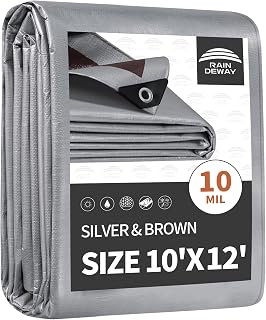
Pros
- Silver face reflects heat and slows UV damage
- Ten mil is a genuine step up from economy grades
- Reinforced edges and metal grommets around the perimeter
- Reversible: silver out for heat, brown out for light blocking
- Fully waterproof laminated construction
Cons
- Heavier and stiffer to fold than mid-weight tarps
- Still short of construction grade for permanent roof use
- Non-breathable, so condensation forms under sealed loads
The silver and brown combination is not cosmetic. The reflective face bounces sunlight and heat away, which keeps whatever is under the tarp cooler and slows the UV breakdown of the plastic itself. On a vehicle, a boat or a stack of material sitting through summer, that difference is measurable by touch.
At 10 mil, the panel is substantially more robust than economy poly without crossing into the stiff, two-person-to-fold territory of 16 mil construction grades. Reinforced edges carry the grommets, so the usual failure mode of eyelets tearing out of a thin hem is much less likely.
The reversibility is genuinely useful. Silver out through summer for heat rejection, brown out in winter if you want the cover to absorb a little warmth or simply blend in. Either way the waterproofing is identical since both faces are laminated.
The compromises are the standard poly ones. It does not breathe, so anything that gives off moisture underneath will condense on the inner face, and while 10 mil holds up far better than economy grades it is still not the choice for a cover meant to stay pitched for years.
Bottom line: the best mid-to-heavy poly option here when sun exposure, not abrasion, is your main enemy.
- Material: laminated woven polyethylene
- Thickness: 10 mil
- Faces: reflective silver and brown
- Water performance: fully waterproof
- Edges: reinforced with metal grommets
- Treatment: UV resistant, rot and mildew proof
- Silver out reflects solar heat and reduces temperature underneath
- Silver out also slows UV degradation of the tarp itself
- Brown out blocks light for anything that should stay dark
- Both faces are equally waterproof, so orientation is a heat choice
- Flip seasonally to spread wear across both surfaces
Hose off dust before folding, particularly on the silver face where grit dulls reflectivity and abrades the laminate during storage.
Roll rather than sharply fold when storing for long periods. Ten mil poly holds a crease, and repeated creasing in the same place is where cracks eventually start.

Pros
- Absorbs drips instead of letting paint pool and skate
- Lies flat rather than sliding underfoot like plastic sheeting
- Washable and reusable across many projects
- Made from recycled cotton fiber
- Breathable, so covered furniture does not sweat
Cons
- Untreated canvas is absorbent, not waterproof
- Heavy spills will eventually soak through to the floor
- Needs drying before storage to avoid mildew
Canvas drop cloth is the material that plastic sheeting can never replace indoors, and the reason is friction. Plastic slides underfoot on hardwood and tile, and drips sit on the surface until someone tracks them across the room. Cotton canvas lies flat, stays put and soaks a drip on contact.
This one is woven from recycled cotton, which does not change how it behaves but does make it easier to justify buying a cloth you intend to keep for a decade. It washes, it takes accumulated paint without becoming unusable, and it folds down softer and flatter than any synthetic.
It is also breathable, which matters for the other half of its job. Furniture covered in plastic through a renovation traps humidity against the finish, while canvas lets it pass. For the same reason it works outdoors over a wood or metal item you want dry but not sealed.
The honest limitation is that untreated canvas is absorbent by design. It handles drips and splashes, not standing water. A full can tipped over will find the floor eventually, so put plastic under the canvas if that is a real risk.
Bottom line: the correct material for interior work and furniture covering, and a poor choice anywhere waterproofing is the actual requirement.
- Material: 100 percent recycled cotton canvas
- Treatment: untreated, absorbent
- Reusable: machine washable
- Water performance: absorbent, not waterproof
- Typical size: 6 x 9 feet
- Intended use: painting, furniture and floor protection
Tape the leading edge down along baseboards. Canvas stays put far better than plastic but a rolled edge is still a trip hazard on a ladder day.
Wash it before the paint fully cures if you want the cloth to stay soft. Cured latex stiffens canvas permanently, which does not hurt performance but makes folding it a chore.
Dry it fully before folding. Cotton mildews quickly when stored damp, and mildew both stains and weakens the fiber.
Shake out grit before washing so abrasive particles do not grind through the weave in the machine. Stored dry and clean, a canvas drop cloth outlasts dozens of plastic sheets.

Pros
- Light enough to deploy and pack away one handed
- Reinforced grommets despite the light gauge
- Fully waterproof laminated poly surface
- Folds compact for storing in a vehicle
- Cheap enough to keep several on hand
Cons
- At 5.5 mil this is a light duty cover, not a roof tarp
- Punctures can propagate into tears under wind
- Limited UV life in continuous sun exposure
Not every job needs a heavy tarp, and there is a real case for the light gauge. At 5.5 mil this folds small enough to live in a trunk or a toolbox, deploys in seconds and weighs almost nothing to throw over a load or spread on the ground.
The construction is better than the gauge suggests. Edges are reinforced and the grommets are set through that band rather than through bare film, which is the difference between a light tarp that survives being tied down and one that tears out at the first gust.
Waterproofing is not a compromise here, since laminated poly is waterproof at any thickness. What thickness buys is puncture resistance and UV lifespan, and both of those are modest at 5.5 mil. A branch or a sharp corner can start a tear that runs, and continuous summer exposure will chalk the surface within a season.
Used as intended, as a light utility sheet for covering, ground protection and short jobs, it is a genuinely useful thing to own several of. Used on a roof, it is the wrong tool.
Bottom line: the convenience option, worth having in a vehicle or shed, but do not ask it to do heavy tarp work.
- Material: laminated woven polyethylene
- Thickness: 5.5 mil
- Water performance: fully waterproof
- Edges: reinforced with metal grommets
- Typical size: 6 x 8 feet
- Treatment: UV resistant
- Keeping a spare cover in a vehicle or workshop
- Ground sheets under work or picnic setups
- Short term covering of tools and materials
- Yard work, leaf hauling and cleanup
- Anyone who values fold-down size over lifespan
Inspect the surface before spreading on gravel or a rough deck. Light poly picks up punctures from below far more easily than from above.
If a tear starts, tape both faces immediately with poly tarp tape. In thin poly a small tear runs with the weave and a five minute repair saves the panel.

Pros
- Construction grade 16 mil in a large single panel
- Brass grommets resist corrosion better than plain steel
- Reinforced edges spread wind load across the hem
- Covers a long footprint without seaming two tarps
- Fully waterproof and rot resistant
Cons
- Heavy and stiff, awkward to fold alone at this size
- Non-breathable, so airflow must be left at the sides
- Bulky to store compared with lighter grades
The advantage of a large single panel is that you do not have to overlap two tarps and hope the seam sheds water. At 10 by 20 feet in a 16 mil grade, this covers a long load, a trailer or a stretch of roof in one piece, with no lap joint to leak or flap.
Brass grommets are the detail worth paying attention to. Plain steel eyelets rust, and a rusting grommet both weakens and stains the surrounding material over a season outdoors. Brass keeps working, which matters when the cover is tied down for months rather than days.
The 16 mil laminate itself behaves like the other construction grade tarp here: genuinely waterproof, stiff enough not to flutter destructively in wind, and thick enough that a branch scrape does not open a running tear. UV treatment is what stretches it across multiple seasons rather than one.
The cost is handling. This much heavy poly is unwieldy, folding it back down alone in any breeze is a fight, and stored folded it takes real shelf space. Like all poly it seals rather than breathes, so leave the sides open over anything that gives off moisture.
Bottom line: choose this when you need construction grade material across a long footprint and can live with the weight.
- Material: laminated woven polyethylene
- Thickness: 16 mil
- Size: 10 x 20 feet nominal
- Grommets: brass on reinforced hem
- Water performance: fully waterproof
- Treatment: UV, tear and fade resistant
- Long roof runs and semi-permanent structure cover
- Trailer, boat and vehicle covering through winter
- Pool and deck covering out of season
- Job site material protection over months
- Any job where a lap seam between two tarps would leak
Fold with two people and along consistent lines, then roll the folded strip. A 16 mil panel this size creases hard, and repeatedly creasing the same spot is where cracking starts years later.
Check the brass grommets for elongation each season. A grommet that has begun to oval is a warning that the tie-down load is concentrated on too few points, and adding more tie-outs will save the hem.
How to Choose the Best Tarp Material for the Job
Every tarp on the market comes down to three families of cloth: woven polyethylene laminated with plastic film, cotton canvas duck, and lightweight coated nylon or polyester ripstop. Vinyl and PVC make up a fourth family used mostly on flatbed trucks and industrial machinery, and it is worth knowing about even though it rarely shows up in consumer sizes. Each family trades one virtue for another, and the trick is knowing which virtue your job actually needs.
Waterproof Versus Water Repellent

Polyethylene tarps are genuinely waterproof. The woven scrim in the middle carries the strength, and the laminated film on both faces means water has no path through the cloth at all. Rain beads and runs off, and a poly tarp pitched at any real angle will keep a woodpile bone dry through a week of drizzle. The failure point is never the fabric face, it is the grommet line or a puncture, which is why reinforced edges matter more than the mil number alone.
Cotton canvas works on an entirely different principle. The fibers swell when wet and close the weave, so a treated canvas tarp sheds a downpour rather than blocking it outright. Manufacturers call this water repellent for a reason: sustained standing water or a hard pressure spray will eventually wet through. In exchange you get a fabric that breathes, so moisture trapped underneath escapes instead of condensing into a puddle on your equipment. Anything organic, from firewood to a stack of lumber, keeps far better under canvas than under plastic.
Coated ripstop nylon and polyester sit in between. A silicone or polyurethane coating gives a hydrostatic rating high enough for shelter duty, but the coating is what does the work, and abrasion or hard folding will wear it thin over years of use. For a rain fly this is fine. For dragging brush across gravel, it is the wrong cloth.
UV Resistance and How Long a Tarp Lasts Outdoors

Sunlight, not rain, is what kills most tarps. Untreated polyethylene goes chalky and brittle in a single hard summer, which is exactly what happens to the cheap blue covers people staple over a shed roof and forget. Better poly tarps blend UV inhibitors into the resin during manufacture, and the heavier grades carry more of it simply because there is more plastic to load. A 16 mil brown or silver poly cover left permanently exposed will typically outlive an 8 mil blue one by several seasons.
Canvas ages differently. Cotton does not embrittle the way plastic film does, so an 18 oz canvas tarp softens and fades rather than cracking, and it can be re-treated with a wax or water repellent when it starts to wet through. The catch is mildew: canvas rolled up damp will grow mold in a week. Canvas rewards owners who dry it before storage and punishes owners who do not.
Nylon has the shortest exposed life of the three. It is superb for a shelter that spends most of its life in a stuff sack and a few dozen nights outdoors, and poor for anything that lives on a roof year round. Polyester ripstop holds up to sun noticeably better than nylon and also stretches less when wet, which is why more shelter makers have moved toward it.
Reading Thickness: Mil, Ounces and Denier
The three material families do not share a unit of measure, which is the single most confusing part of tarp shopping. Poly tarps are sold by mil, one thousandth of an inch of total thickness, commonly 5 mil for light utility work up to 16 mil for construction grade. Canvas is sold by ounces per square yard, where 10 oz is a light drop cloth and 18 oz is heavy industrial duck. Ripstop is sold by denier, a measure of yarn thickness, where 20D is ultralight backpacking cloth and 210D is a rugged camp tarp.
None of these numbers convert to each other, so comparing a 16 mil poly to an 18 oz canvas by the number alone is meaningless. What you can compare is behavior. Below is how the four families stack up on the traits that decide whether a cover survives the job.
| Material | Water performance | UV life exposed | Tear resistance | Weight | Relative cost |
|---|---|---|---|---|---|
| Polyethylene (poly) | Fully waterproof, no breathability | 1 to 5 years by grade | Good in heavy mil, poor in economy | Moderate | Lowest |
| Cotton canvas duck | Water repellent, breathable | Very good, re-treatable | Excellent, abrasion friendly | Heaviest | High |
| Coated ripstop nylon | Waterproof while coating lasts | Modest, best stored indoors | Excellent for its weight | Lightest | Moderate to high |
| Vinyl or PVC | Fully waterproof, oil and chemical proof | Excellent | Highest | Very heavy | Highest |
Weight, Packability and Handling
Weight is not a small detail once a tarp gets large. A 20 by 30 foot economy poly cover is a two person job to spread in any breeze, and an 18 oz canvas of the same footprint is heavier still, closer to a piece of furniture than a sheet. That mass is a feature when you want a cover to stay put over a woodpile without lifting in gusts, and a liability when you need to throw the same cover over a load by yourself at a job site.
Ripstop nylon inverts the whole equation. A twelve by ten foot camping tarp packs down to roughly the size of a water bottle and carries in a daypack without thought. If your tarp needs to move with you, this is the only family worth considering, and the sports and outdoors side of our catalog covers the rest of that kit.
Grommets, Hems and Where Tarps Actually Fail
Almost no tarp fails in the middle of the panel. It fails at a grommet that pulled through a thin hem, or along a seam that let go under load. Look for grommets set every 18 to 24 inches rather than only at corners, brass or rustproof metal rather than bare steel, and a rope-reinforced or double-folded hem behind them. On canvas, rustproof grommets matter doubly because a rusting eyelet stains and rots the surrounding cotton.
Cut size versus finished size is the other trap. Canvas is usually advertised at cut size, then hemmed, so a 6 by 8 foot listing arrives closer to 5 feet 6 inches by 7 feet 6 inches. Poly tarps shrink a similar few inches from the stated dimension. Order one size up when the cover has to reach something specific.
Matching Material to the Job

Roof and long term outdoor cover: heavy poly, 12 mil or thicker, in brown or silver rather than blue. It is waterproof, cheap enough to replace, and the heavy grades carry enough UV inhibitor to last multiple seasons. Hauling and load cover: heavy poly again, or vinyl if oil and abrasion are in the picture. Firewood and lumber: canvas, because breathability prevents the trapped condensation that rots wood under plastic.
Painting and interior work: cotton canvas drop cloth, which lies flat, absorbs drips instead of letting them pool and skate underfoot, and washes for reuse. Welding and hot work: canvas only, since molten spatter goes straight through plastic film. Camping and hammock shelter: coated ripstop nylon or polyester. Vehicle and equipment cover: mid weight poly for short term, a fitted breathable cover for long term, since a sealed plastic sheet traps moisture against paint. Our automotive section goes deeper on that last one.
Why You Should Trust Us
We built this shortlist from verified customer feedback at scale rather than from manufacturer copy. Every cover here clears a 4.0 star average across a substantial number of buyer ratings, which filters out both the unproven listings and the ones whose seams and grommets draw consistent complaints. We then read through the critical reviews specifically, because tarps fail in predictable ways and buyers describe those failures plainly.
Our editors also weight for material honesty. A listing that states its mil rating, its ounce weight or its denier, and that specifies grommet spacing and finished dimensions, tells you far more than one leaning on the words heavy duty. Where a spec looked inflated against what owners reported, we said so in the individual write-ups rather than quietly leaving it out. You can browse the rest of our buying guides on the articles page.
Final Thoughts
For most people asking which tarp material is best, the honest answer is heavy polyethylene, and the Xpose Safety 16 Mil Brown Poly Tarp is the clearest expression of it. Sixteen mils of laminated poly with reinforced edges and closely set grommets handles roof cover, load cover and storage duty without asking anything of you beyond a decent tie-down. It is the cover to buy when you want the problem to go away.
On value, the Dry Top Multi-Purpose Economy Poly Tarp in 20 by 30 feet is hard to argue with. It is a lighter grade and it will not spend three years on a south facing roof, but for covering a boat trailer over winter, tenting a project or throwing over a debris pile, buying square footage cheaply is exactly the right call. Step up to the White Duck 18 oz Canvas Tarp when breathability or heat resistance is the real requirement, and the Salt Earth Cotton Canvas Drop Cloth when the job is indoors and involves paint.
If your tarp has to travel, ignore the mil ratings entirely. The FREE SOLDIER Waterproof Camping Tarp and the Gold Armour Rainfly Tarp are the two shelter grade ripstop options here, and either one packs smaller than a fleece while pitching into a solid rain roof. Choose the fabric family first, then the size, and the tarp aisle stops being confusing. More outdoor and workshop gear sits under tools and home improvement.
Frequently Asked Questions
What is the strongest tarp material available in 2026?
By raw tear and abrasion strength, vinyl coated polyester leads, which is why it covers flatbed loads and industrial machinery. Among the materials most buyers actually shop, heavy cotton canvas at 18 oz and laminated polyethylene at 16 mil are close behind, with canvas better against abrasion and poly better against water. Strength alone is rarely the deciding factor, though. A 16 mil poly tarp with grommets every two feet will outlast a stronger fabric hung from four corner eyelets, because the load path matters more than the cloth rating.
Is canvas or poly better for covering firewood?
Canvas, and the reason is breathability rather than waterproofing. Firewood needs to give up moisture to season properly. Seal a stack under plastic and the water that evaporates out of the wood condenses on the underside of the tarp and rains straight back down onto the pile. Canvas lets that vapor pass while still shedding rain from above. If you only have poly on hand, cover the top of the stack and leave the sides completely open so air can move through.
How long will a poly tarp last outside?
Roughly one season for an economy blue tarp in the 5 to 8 mil range under full sun, two to three seasons for a 10 to 12 mil UV treated cover, and three to five years for a 16 mil brown or silver grade. Shade, milder climates and taking the cover down between uses all extend those numbers considerably. Wind is the accelerant: a tarp that flaps constantly work-hardens the plastic and tears at the grommets long before sunlight alone would have finished it.
What tarp material should I use for camping?
Coated ripstop nylon or polyester, in the 20D to 210D range depending on how much weight you are willing to carry. These pack small, pitch tight, and shed rain reliably as long as you keep the coating away from sharp abrasion. Poly tarps work for car camping where weight does not matter, but they are noisy in wind, stiff in the cold and bulky in a pack. Look for taped or sealed seams and enough tie-out points along the edges, not just at the corners, so you can pitch in more than one configuration. Our category directory lists the rest of the outdoor gear guides.
Can I use a poly tarp for welding or near a fire?
Only canvas, and preferably canvas sold as a flame retardant welding blanket. Polyethylene and nylon both melt on contact with spatter or an ember, and a hole appears instantly. Untreated cotton canvas resists sparks far better because it chars rather than melting, though it is not fireproof and should not be treated as such. For any regular hot work, buy cloth rated for it rather than assuming a general purpose canvas tarp will cope.
Why do tarps have a different color on each side?
On silver and brown poly tarps the two faces do different jobs. The silver side reflects sunlight and heat, so facing it out keeps whatever is underneath noticeably cooler and slows UV damage to the cloth itself. The darker side blocks light, which matters when you are covering something that should stay dark. Flip the tarp seasonally if you like: silver out in summer for heat rejection, dark out in winter to absorb a little warmth.
Write Your Review
No reviews yet. Be the first to share your experience!