

Cockroaches do not give up ground easily, and most people who reach for a boric acid product have already burned through a can of spray that only scattered the problem. Boric acid works differently. It is a slow acting stomach poison that roaches pick up on their legs and antennae, groom off, and swallow, which is exactly why it keeps working after the initial application instead of clearing a room for one evening. Our top pick is the Harris Boric Acid Roach and Silverfish Killer Powder with Lure for its EPA registered roach label, its built in food lure, and a fine powder texture that settles into the cracks roaches actually travel through. For September 2026 we narrowed the field to 6 options from JT Eaton, Harris Roach, HARRIS Boric and more, and every one of them carries a pesticide label that names cockroaches, which matters far more than the purity number printed on the front of a jar.
Choosing the best boric acid for roaches is less about finding an exotic formula and more about matching format, applicator, and coverage to the room you are treating. A powder that vanishes into a wall void behind a dishwasher is not the same job as a tablet you press into a drawer well. Below you will find our shortlist, a buying guide that explains why we refuse to recommend unlabeled chemical grade powder for pest work, and answers to the questions readers send us most. You can browse more home and yard picks in our patio, lawn and garden section once you have a plan in place.

Pros
- EPA registered label that names roaches, palmetto bugs, waterbugs and silverfish
- Formulated lure gives roaches a reason to walk through the treatment
- Fine powder settles into cracks, wall voids and appliance gaps
- Keeps working for weeks after application as long as it stays dry
- Pointed nozzle bottle applies a thin film without a separate duster
Cons
- Easy to squeeze out too much at once, and a visible pile repels roaches instead of attracting them
- Loses effectiveness where it gets damp, so humid bathrooms need reapplication
- Slower than a contact spray, which frustrates anyone expecting same day results
This is the bottle most people picture when they hear the words boric acid roach powder. Harris has sold this formulation for decades under an EPA registration that names cockroaches, palmetto bugs, waterbugs and silverfish, and the powder arrives already blended with a lure so roaches are drawn into the treated area rather than skirting it.
What it does well is reach. The powder ships in a squeeze bottle with a pointed nozzle, fine enough to be puffed into the gap behind a refrigerator, under a dishwasher, into the void beneath a kick panel, and along the back edge of a cabinet after the lower drawers come out. Roaches pick it up on their legs and antennae, ingest it while grooming, and carry material back toward the harborage, which is why an application keeps producing results for weeks as long as the area stays dry. The manufacturer label notes that insects contacting the powder die within seventy two hours of contact, though reducing an established population is a multi week project.
The weakness is user technique rather than chemistry. Squeeze too hard and the powder lands in drifts, and roaches walk around heavy deposits instead of through them. Short, gentle puffs from a few inches back are what the label describes, and anyone treating a whole house at once may still prefer the bellows duster packed into the 32 oz version. Moisture is the other limitation: a bathroom that stays damp will need retreatment more often than a dry pantry wall.
Bottom line: if you are buying one boric acid product for a house with a roach problem, this is the one. It has the label, the lure, the reach, a built in applicator and the track record, and the only thing it asks of you is a light hand.
- Format: loose insecticidal dust with formulated lure
- Active ingredient: boric acid
- Container: 1 lb (16 oz) squeeze bottle with pointed nozzle
- Labeled pests: cockroaches, palmetto bugs, waterbugs, silverfish
- Registration: EPA registered insecticide
- Residual: continues working for weeks while kept dry
- Odor: odorless after application, non staining
Follow the product label. It calls for a light dusting puffed into areas where roaches have been seen: behind and beneath the refrigerator and stove, under sink cabinets, around drain and pipe openings, along baseboards and into cracks and crevices. A barely visible film is the target, not a white line.
Hold the nozzle at the mouth of the crack and use short, gentle squeezes rather than a steady stream. Any powder still visible after application should be brushed into the crack or removed, and reapply as the label directs if the material gets wet, vacuumed up or disturbed by cleaning.
Boric acid is toxic if swallowed. Apply only in areas inaccessible to children and pets, and keep children and animals out of the treatment area until you have finished and cleaned up any visible residue.
Never dust countertops, tables, cutting boards, dish areas, pet bowls or pet bedding, and avoid contaminating food and feed. Store the bottle capped in its original packaging in a dry place out of reach. If a child or pet swallows any, call Poison Control or your local emergency number immediately and keep the label with you.

Pros
- Powder duster included in the bag, so no separate applicator purchase
- Twice the volume for large homes, garages and rental turnovers
- Same EPA registered lure blended formulation as the 16 oz version
- Duster makes it far easier to reach deep voids and kick panel gaps
- Resealable bag keeps the remainder dry between rounds
Cons
- More powder than a small apartment will ever use, and stored bulk can cake in humid spaces
- The included duster is a basic bellows rather than a professional applicator
- Bulkier bag is awkward to store in a tidy under sink cabinet
Treat this as the bulk version of the standard Harris bottle. The chemistry and the labeled pest list are the same lure blended boric acid dust, but the 32 oz package includes a powder duster, and that single addition changes the outcome more than any formulation difference on this list.
The reason is simple. The most common failure with boric acid dust is applying too much of it, and pouring from a bag guarantees exactly that. A bellows duster puffs a film so light you have to look twice to see it, which is the application the label describes and the one roaches will actually walk through. It also reaches places fingers cannot, including the void behind a kick panel, the space under a dishwasher, and the gap behind a wall mounted cabinet.
The volume is the tradeoff. Thirty two ounces is generous for a single family home and excessive for a one bedroom apartment, and boric acid draws moisture, so a half used bag left in a damp garage can clump. Store the remainder sealed and dry and it holds fine. The duster itself is basic, a squeeze bellows rather than a pro grade applicator, but it does the job it was included for.
Bottom line: choose this over the 16 oz bottle when you are treating a large or multi room property, or when you know you will need a second and third round. The included duster alone justifies the step up.
- Format: loose insecticidal dust with formulated lure
- Active ingredient: boric acid
- Container: 32 oz resealable bag
- Applicator: powder duster included inside the bag
- Labeled pests: cockroaches, palmetto bugs, waterbugs, silverfish
- Registration: EPA registered insecticide
- Residual: continues working for weeks while kept dry
Fill the duster roughly halfway rather than to the top, so the bellows has air to move the powder. Hold the tip at the mouth of the crack and give short, gentle squeezes from a few inches back, letting the puff carry the dust in rather than packing it.
Work along the label approved sites: behind and under appliances, under sinks, around drain and pipe openings, into cracks and crevices. Brush in or remove anything left visible when you are done, and follow the label for reapplication.
This size makes sense for a house rather than an apartment, for a garage or basement in addition to the kitchen, and for landlords and property managers who treat several units and want applicator and material in one order.
If your problem is confined to one bathroom or a single kitchen cabinet, the 16 oz bottle or a small puffer is the smarter buy and you will not be storing leftover powder for years.

Pros
- No loose powder, so nothing settles on surfaces you touch
- Tablets can be counted, placed precisely and retrieved later
- Lure is built into the tablet to draw roaches to the bait
- Fits drawer wells, cabinet corners and appliance gaps neatly
- 145 tablets cover many placements across several rooms
Cons
- Cannot reach into wall voids the way a puffed dust can
- Lower boric acid concentration than the dusts, since most of the tablet is bait matrix
- Label caps placements at twelve tablets per room, so heavy infestations still need a dust
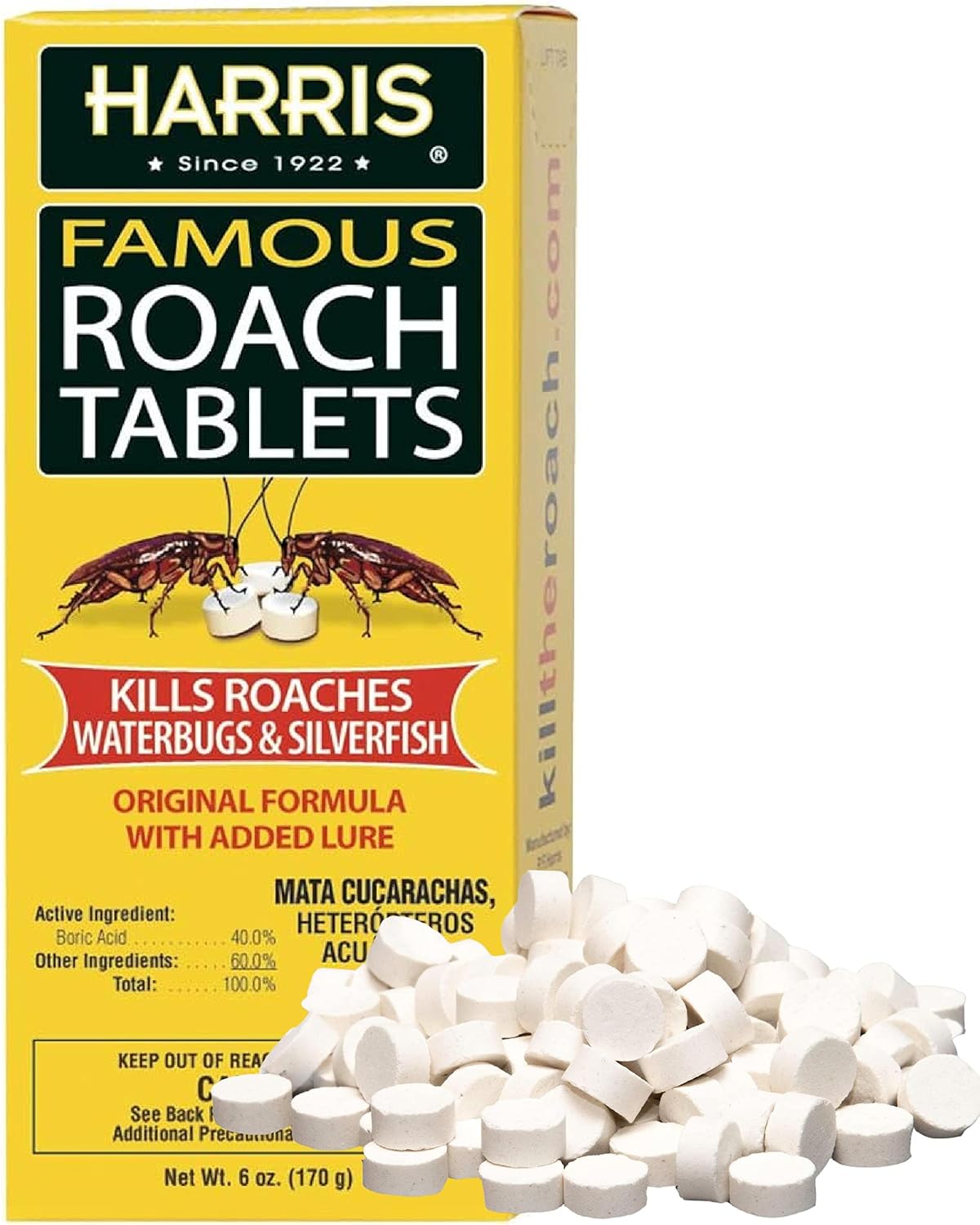
These tablets are the answer to the most common objection to boric acid, which is that nobody wants white powder drifting around a kitchen. Harris presses boric acid together with a lure into small tablets you place by hand, so the active ingredient stays where you put it and nothing settles on a surface you later lean on.
Placement is where they shine. The label directs you to sites like the space under and behind the refrigerator, stove, sinks, tubs, dishwasher, washing machine and dryer, into openings around drains and pipes, and into cracks along baseboards and cabinet corners. It also suggests pulling out lower kitchen and bathroom drawers and dropping tablets into the empty drawer wells, an enclosed space roaches use constantly and homeowners almost never treat. Because you place a known number in known spots, you can go back and check or remove them.
The limits are real. The tablets carry a lower boric acid concentration than the dusts here, since the rest of the tablet is the bait that convinces a roach to feed, and the label caps you at no more than twelve tablets per room. A tablet also cannot travel into a wall void, so deep harborage stays untouched. This is why we treat tablets as a companion to a dust in a serious infestation rather than a replacement for one. The rating on this product runs a little lower than its siblings, and the pattern in feedback is people expecting a dust level knockdown from a bait format.
Bottom line: the best choice when loose powder is a non starter, and an excellent partner to a dust when you want cabinets and drawers covered without residue.
- Format: pressed bait tablets with formulated lure
- Active ingredient: boric acid, 40 percent
- Container: 6 oz package, approximately 145 tablets
- Maximum placement: no more than twelve tablets per room
- Labeled pests: cockroaches and other insects named on the label
- Registration: EPA registered insecticide
- Residue: none on treated surfaces when placed correctly
Work through the label sites methodically: under and behind the refrigerator, stove, sinks, tubs, dishwasher, washing machine and dryer, into openings around drains, water pipes and electrical conduits, and into cracks and crevices along baseboards and in the corners of cabinets, cupboards and closets.
Remove the lower drawers in kitchen and bathroom cabinets and in bedroom dressers, then place tablets in the drawer wells before sliding the drawers back. Any tablet still visible after placement must be pressed into a crack or removed, and the label allows no more than twelve tablets in any one room.
Tablets are still an insecticide and boric acid is toxic if swallowed. Place them only where children and pets cannot reach or dislodge them, which rules out open floor edges, the backs of accessible low shelves and anywhere a dog can nose around.
Keep them away from food, dishes, food preparation surfaces, pet bowls and pet bedding, and store the package closed and out of reach. If a child or animal swallows a tablet, call Poison Control or your local emergency number right away with the label in hand.

Pros
- Puffer bottle applicator built into the package
- Ninety nine percent boric acid with no filler to dilute the deposit
- Excellent control over how little powder you put down
- Labeled for roaches, palmetto bugs, ants and silverfish
- Tamper evident resealable container for storage between rounds
Cons
- No lure in the formulation, so placement accuracy matters more
- Puffer nozzle can clog if the powder picks up humidity
- One pound goes further than a small apartment needs
JT Eaton has supplied the pest control trade for a long time, and this dust reflects that background. It is straight boric acid at ninety nine percent, packaged in a puffer bottle rather than a bag, and labeled for roaches, palmetto bugs, ants and silverfish. There is no lure in the mix, which makes it a placement driven product rather than an attract and wait one.
The bottle is the reason to buy it. Squeezing the container sends a fine plume of powder into a crack from several inches away, which is precisely the light film the label asks for and the hardest thing to achieve from an open bag. For narrow work along a baseboard seam, around a pipe collar, or into the gap at the back of a cabinet, it is the most controllable option here.
Two caveats. Without a lure you are relying on your own read of where roaches travel, so spend the extra ten minutes looking for droppings and grease marks before you dust. And boric acid attracts moisture, so a nozzle left in a humid bathroom cabinet can clog, which a gentle tap and a dry storage spot solves.
Bottom line: the pick for people who want surgical placement rather than volume, and a good complement to a lure blended dust used elsewhere in the same home.
- Format: insecticidal dust in a puffer bottle
- Active ingredient: boric acid, 99 percent
- Container: 1 lb tamper evident resealable container
- Labeled pests: roaches, palmetto bugs, ants, silverfish
- Registration: EPA registered insecticide
- Application: crack and crevice, light dusting
- Residual: long lasting while kept dry
Choose this one if your problem is defined and localized, if you already own a bag of lure blended dust and want a precision applicator to go with it, or if you dislike the mess of transferring powder into a separate duster.
Choose a lure blended product instead if you are unsure where the roaches are harboring, since the lure does some of the finding for you. Choose a superfine non clumping dust if the treatment area is a damp basement or crawl space.
Apply only where children and pets cannot reach. The puffer makes it tempting to dust quickly along an open floor edge, and that is exactly the application to avoid in an occupied home.
Keep the powder away from food, dishes, preparation surfaces, pet bowls and bedding, brush in or remove anything visible after application, and store the bottle closed and dry out of reach. If swallowed, contact Poison Control or emergency services immediately and bring the label.

Pros
- Superfine, non clumping formulation that keeps flowing in humid conditions
- Non repellent, so roaches move through the deposit rather than around it
- Broad labeled pest list beyond roaches alone
- Professional supply product available to homeowners
- One pound bottle has its own pointed nozzle and also fills a bellows duster
Cons
- No lure included, so it depends entirely on correct placement
- Nozzle bottle is workable but a bellows duster still gives a finer film in tight voids
- Costs more per ounce than a basic bag of roach powder
BorActin is what a boric acid dust looks like when it is designed for people who apply insecticide for a living. Rockwell Labs formulates it as a superfine ninety nine percent boric acid dust with a focus on what the trade calls dustability, meaning how readily the powder leaves an applicator and lays down as a film instead of a clump.
That matters most in the conditions where ordinary boric acid struggles. Basements, crawl spaces, laundry areas and older buildings hold humidity, and a hygroscopic powder in a bottle there will cake and then release in lumps. This formulation resists that, so the last application out of the bottle behaves like the first. It is also non repellent, which is the property you want in a dust: roaches keep using a treated gap as a highway rather than rerouting around it.
What you do not get is a lure. The bottle carries its own pointed nozzle, so you can apply straight from it, but this is still powder for someone who has already identified the harborage, and it carries the CAUTION signal word along with the usual warnings about swallowing, inhaling dust and eye irritation. Its label reaches beyond roaches to palmetto bugs, waterbugs, ants other than carpenter ants, fruit flies, phorid flies, silverfish and darkling beetles.
Bottom line: the upgrade pick for damp spaces and for anyone already equipped with a duster who wants the powder itself to be the best available.
- Format: superfine non clumping insecticidal dust
- Active ingredient: boric acid, 99 percent
- Container: 1 lb bottle with pointed applicator nozzle
- Behavior: non repellent, long residual
- Labeled pests: cockroaches, palmetto bugs, waterbugs, ants except carpenter ants, fruit flies, phorid flies, silverfish, darkling beetles
- Registration: EPA Reg. No. 73079-4
- Signal word: CAUTION
Best suited to homeowners treating a damp basement, crawl space, laundry room or older building, and to anyone who owns a bellows duster and wants a powder that will not clog it.
Less suited to a first time buyer treating one kitchen, who is better served by a lure blended product that does some of the harborage hunting for them.
Follow the label. Apply straight from the nozzle bottle, or load a duster partway, then lay a light film into cracks, crevices, voids and the gaps behind and beneath appliances and fixtures in the sites the label approves. Avoid breathing the dust and keep it out of your eyes and off your clothing.
Because there is no lure, spend time first identifying harborage using droppings, smears and the corners where roaches gather, then treat those routes rather than dusting broadly.

Pros
- Two sealed bags means the second stays dry until the follow up round
- Ninety nine percent boric acid at a low cost per ounce
- Clear label directions naming specific placement sites
- Labeled for cockroaches, silverfish and ants
- Long running drugstore brand that is easy to restock
Cons
- No applicator included, so a separate duster is close to essential
- No lure in the formulation
- Fewer customer ratings than the long established Harris products
Enoz Roach Away is the value option, and the two bag pack is the reason. You get a full thirty two ounces of ninety nine percent boric acid split across two sealed 16 oz bags, which matters more than it sounds: boric acid draws moisture from the air, and a bag you opened six months ago is not in the same condition as one still factory sealed. Open one for the initial treatment and the second is waiting in good shape for the follow up.
The label is plain and specific, which we like. It directs application behind the refrigerator and stove, under the sink, around drain openings, along baseboards, into the corners of cabinets and inside closets, and it tells you to brush any visible powder into cracks and crevices or remove it. That is exactly the light film application that makes boric acid work.
What is missing is equipment and lure. There is no applicator in the pack and no attractant in the powder, so you are supplying both the aim and the duster. Feedback volume is also lower than on the Harris products simply because this listing is newer, not because the formulation is unproven. Willert has sold Roach Away for a long time.
Bottom line: the most material for the money, and a smart buy for a whole home treatment if you already have a duster or are willing to add one.
- Format: loose insecticidal powder
- Active ingredient: boric acid, 99 percent
- Container: two 16 oz bags, 32 oz total
- Labeled pests: cockroaches, silverfish, ants
- Registration: EPA registered insecticide
- Applicator: not included
- Storage: keep in original container in a dry place
Per the label, sprinkle a light application behind the refrigerator and stove, under the sink, around drain openings, along baseboards, in the corners of cabinets and inside closets. A duster or puffer gives a far better result than pouring.
Any powder visible after application must be brushed into cracks and crevices or removed, and you reapply as necessary. Keep the second bag sealed until you need it.
The label is explicit: apply only in areas inaccessible to children and pets, keep children and pets out of the treatment area until application is complete, and do not treat pets with this product. Avoid contaminating feed and foodstuffs.
Store in the original container in a dry place inaccessible to children and pets, and do not reuse or refill an empty bag. If someone swallows the powder, call Poison Control or your local emergency number immediately with the label available.
What to Look For in the Best Boric Acid For Roaches
Boric acid is an old, well documented insecticide, and the chemistry itself is not what separates a good purchase from a wasted one. The differences that matter live on the label, in the applicator, and in how well the format suits your home. Here is what we weighed.
An EPA Registered Roach Label Beats a High Purity Number
Search for boric acid online and you will find plenty of jars advertising ninety nine percent purity, sold as laundry boosters, cleaning powders, or bulk industrial chemical. Those products are chemically similar to what is inside a roach dust, but they are not registered as pesticides, and their labels say nothing about cockroaches, application sites, or the precautions that go with treating a kitchen. Using them for pest control means using a product outside its labeled purpose, which is both a legal problem and a practical one, because you get no application directions and no guidance on where the powder is safe to place.
Every product on this list carries an EPA registration number and a label that names roaches, palmetto bugs, waterbugs, or silverfish, along with approved placement sites and required precautions. That label is the instruction manual, and it is the only source we follow when describing how a product should be used. If a jar of powder does not tell you where to put it and what to keep away from it, it does not belong in a pest control project no matter how pure the contents are.
The purity figure is also less meaningful than shoppers assume. Two of our picks pair boric acid with a formulated lure, and one tablet product uses a lower active concentration precisely because the rest of the tablet is bait matrix that convinces a roach to feed. Higher percentage does not automatically mean faster results when the roach never encounters the material in the first place.
Dust, Tablets, and Which Format Suits Your Rooms
Loose dust is the most versatile format. Puffed as a light film, it clings to roach legs and gets ingested during grooming, and it can reach into wall voids, motor housings, and the gap behind a refrigerator where no other format goes. The catch is that dust demands restraint. A visible white drift is worse than useless because roaches walk around heavy deposits rather than through them, and the label on every dust here tells you to brush visible powder into cracks or remove it.
Tablets solve a different problem. They are discrete, they do not drift, and they can be tucked into drawer wells, cabinet corners, and the space under a dishwasher without leaving residue on surfaces you touch. Households with curious toddlers or pets often find tablets easier to control, because a tablet can be counted, placed, and later retrieved. The tradeoff is reach: a tablet cannot travel into a wall void, so deep harborage stays untreated.
Plenty of readers end up using both, dust for voids and inaccessible gaps, tablets for enclosed cabinetry. If you are outfitting a whole home rather than spot treating one bathroom, buying one of each usually beats buying a larger container of a single format.
Applicator Design and How Cleanly the Powder Flows
The single biggest complaint about boric acid dust has nothing to do with whether it kills roaches. It is that people cannot apply a thin enough layer. A plain bag with no applicator invites you to pour, and pouring produces exactly the heavy pile that roaches avoid. A squeeze bottle with a pointed nozzle or a bellows duster lets you send a barely visible film into a crack from several inches away, which is the application the label actually asks for.
Flow quality matters too. Boric acid is hygroscopic, so in a humid bathroom or basement a plain powder can cake in the bottle and then release in clumps. Products formulated as superfine, non clumping dust hold their flow much longer, which is why professional grade options are worth the extra step for anyone treating a damp crawl space or an older building.
Placement Sites That Keep Children and Pets Out of Reach
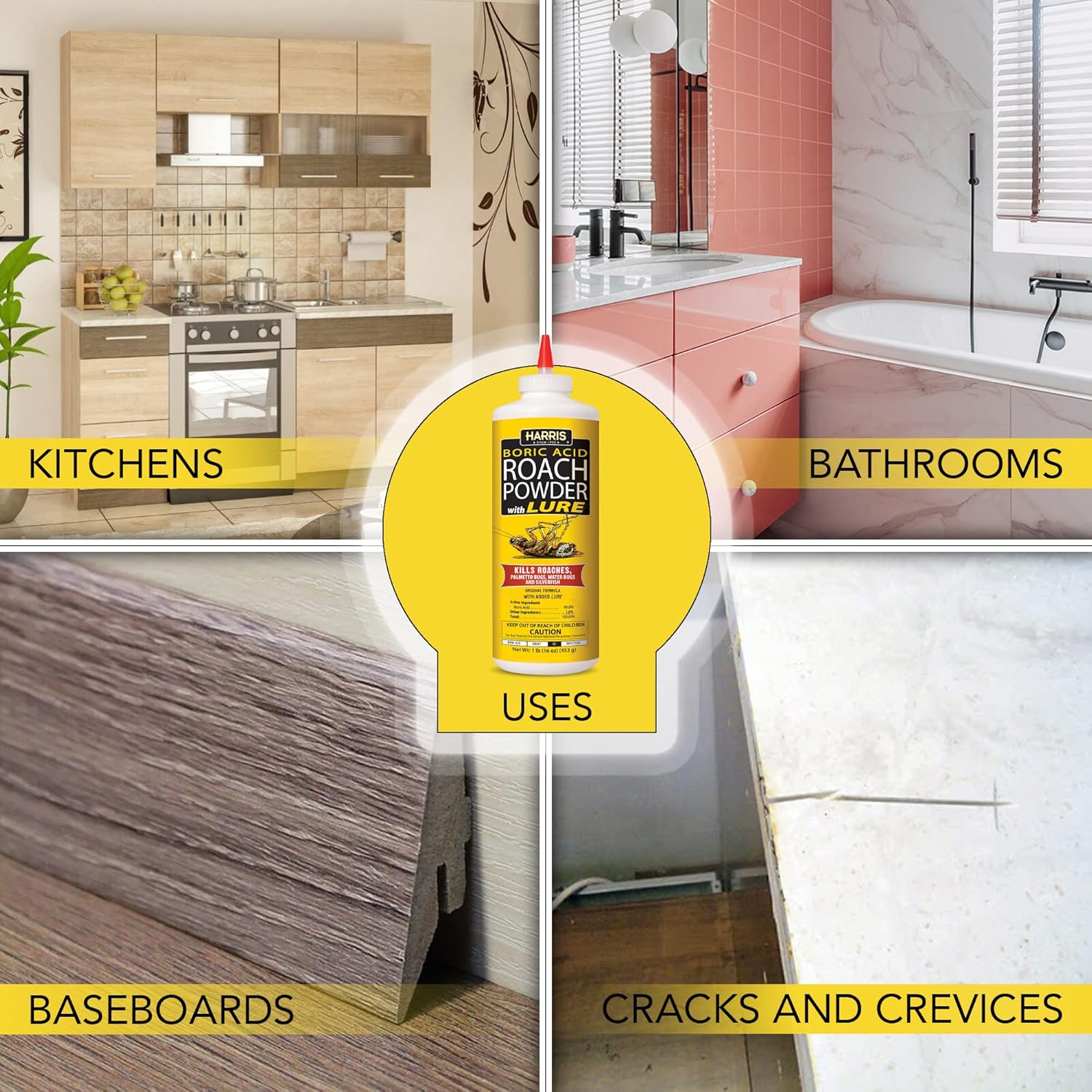
Boric acid is toxic if swallowed. It is not a household cleaner and it is not something to sprinkle around casually. Every label in this roundup restricts application to areas inaccessible to children and pets, and that instruction shapes where a treatment can realistically go: behind and beneath the refrigerator, behind the stove, under the sink cabinet, in the void under a dishwasher, along the back edges of cabinet interiors after removing lower drawers, and into cracks around drain and pipe openings.
Just as important is where it must not go. Do not dust countertops, tables, cutting boards, the inside of a sink basin, or any surface where food is prepared or served, and keep it away from pet bowls and pet bedding. Treat exposed floor edges in rooms where a crawling baby or a dog spends time as off limits, and if any powder ends up visible after application, brush it into the crack or remove it. If you keep small animals, our pet supplies section is a better starting point for anything that goes near a feeding area.
Store the container closed, in its original packaging, in a spot children and pets cannot reach. If someone swallows a boric acid product or you suspect exposure, contact Poison Control or your local emergency number right away and have the label in hand, since it carries the first aid statement the responder will ask about.
Container Size and Realistic Coverage

A small puffer bottle is plenty for an apartment kitchen and one bathroom. A pound sized bottle covers a typical single family home with material left for a follow up round. Thirty two ounce bags and one pound professional containers are aimed at larger homes, multi unit buildings, garages, and anyone who expects to reapply on a schedule. Because these dusts keep working as long as they stay dry, the limiting factor is usually moisture and disturbance rather than the calendar.
Buy for the area you can actually reach. There is no benefit to a five pound container if the only untreated harborage in your home is a strip behind one appliance, and an oversized bag stored in a damp garage tends to clump before you use it up.
Patience, Reapplication, and Knowing the Limits
Boric acid is deliberately slow. That is a feature, because a roach that dies instantly at the bait never carries material back to the harborage, while one that survives long enough to return can pass the active ingredient through the colony by way of droppings and carcasses that other roaches feed on. The Harris powder label notes that insects contacting the powder die within seventy two hours of that contact, but knocking down an established population is a matter of weeks, not days, and anyone promising a clean house by the weekend is selling you something.
Reapply according to the label whenever the material gets wet, vacuumed away, or disturbed by cleaning. Pair the treatment with the unglamorous work: fix the drip under the sink, take the trash out nightly, and stop leaving pet food in a bowl overnight. Boric acid removes the roaches that are already there. Only sanitation and exclusion stop the next wave.
| Product | Format | Applicator | Best suited to |
|---|---|---|---|
| Harris Boric Acid Roach Powder with Lure, 16 oz | Dust with lure | Squeeze bottle with nozzle | Whole home starting point |
| Harris Boric Acid Roach Powder with Duster, 32 oz | Dust with lure | Powder duster included | Large homes and repeat rounds |
| Harris Roach Tablets, 145 count | Bait tablets | Placed by hand | Cabinets, drawers, no dust residue |
| JT Eaton Answer Boric Acid Dust | Dust | Puffer bottle | Precise crack and crevice work |
| Rockwell Labs BorActin Insect Dust | Superfine dust | Bottle with nozzle | Damp basements and pro style jobs |
| Enoz Roach Away Powder, two 16 oz bags | Dust | Bag, duster recommended | Budget coverage for a big treatment |
If a comparison table is how you shop, our articles archive is full of side by side roundups built the same way.
Why You Should Trust Us
We built this shortlist from public product data and verified customer ratings, then filtered it against the one criterion that matters in a pesticide category: an active EPA registration with cockroaches named on the label. That filter removed a surprising number of highly rated listings, including gel baits and granular baits whose active ingredient is not boric acid at all, and a whole shelf of pure boric acid powder sold for cleaning and laundry with no pest label attached. We would rather publish a shorter list than pad it with products we cannot honestly describe.
Every usage detail in this article comes from the manufacturer label or the registered EPA label for that specific product. We do not invent application methods, we do not suggest mixing your own preparations, and we do not recommend using more material than a label allows, because with an insecticide those shortcuts create real risk for the people and animals living in the treated home. Where a claim about timing appears, it is because the label states it. Where we could not verify something, we left it out.
Final Thoughts
For most households, the Harris Boric Acid Roach and Silverfish Killer Powder with Lure is the right first purchase and our best overall pick. It is the most widely used boric acid roach dust in American homes, the lure gives roaches a reason to walk through the treatment, and the pound sized squeeze bottle with its pointed nozzle lets you lay down a thin application without buying anything extra. Step up to the thirty two ounce Harris bag with the duster included if you are treating a large home, a rental property, or a garage, since the packed in duster is what makes a thin application practical at that volume.
Our best value pick is the Enoz Roach Away Boric Acid Powder two pack, which delivers a full thirty two ounces of labeled roach dust across two resealable bags, so you can open one and keep the second dry until you need it. If you want precision rather than volume, the JT Eaton Answer Boric Acid Dust and its puffer bottle place a whisper of powder exactly where you aim it, and Rockwell Labs BorActin is the one we would choose for a humid basement or crawl space because the superfine, non clumping formulation keeps flowing when ordinary powder cakes.
Households that would rather not have loose powder anywhere should start with Harris Roach Tablets. Pressed into drawer wells and cabinet corners and kept well away from anywhere a child or pet can reach, they treat the enclosed spaces roaches love without leaving residue on the surfaces you use every day. Whichever route you take, give it a few weeks, keep the material dry, and check our home and kitchen and category pages for the sealing, storage, and cleanup gear that keeps the problem from coming back.
Frequently Asked Questions
How long does boric acid for roaches take to work in 2026
Individual roaches that contact a boric acid dust die within about seventy two hours according to the Harris label, but that is not the same as clearing an infestation. Roaches have to encounter the material, groom it off, and return to the harborage, and the population declines in stages as that cycle repeats. Expect a noticeable drop over a couple of weeks and a longer tail after that. If a product promises a spotless kitchen in forty eight hours, treat the promise with suspicion rather than the roaches.
Is boric acid safe to use around children and pets
Boric acid is toxic if swallowed, so every label here restricts it to areas children and pets cannot reach. In practice that means behind and under appliances, inside cabinet voids after removing the lower drawers, under sinks, and into cracks around pipes, never on open floors, countertops, or anywhere near food, dishes, pet bowls, or pet bedding. Brush any visible powder into the crack or remove it, and store the container closed and out of reach. If you think a child or animal has swallowed any, call Poison Control or emergency services immediately with the product label in front of you.
Can I use plain boric acid powder from the cleaning aisle instead
We do not recommend it, and that is why none of those products made this list. Bulk and pharmacy grade boric acid is sold for laundry, cleaning, and industrial use, and its label says nothing about roaches, approved application sites, or the precautions required when treating a home. Using it for pest control means working with no directions at all. A registered roach product costs very little more and comes with the placement instructions and safety statements that make the job defensible. You can compare the labeled options in our health and household picks as well.
Should I use dust or tablets for the best boric acid for roaches results
Use dust where you need reach and tablets where you need tidiness. Dust travels into wall voids, appliance housings, and the narrow gaps roaches use as highways, and it is the better choice for a serious infestation. Tablets stay put, leave no residue on surfaces, and are easy to count and retrieve, which suits cabinets, drawer wells, and homes where loose powder is a non starter. Many readers use dust in inaccessible voids and tablets inside cabinetry, and follow each product label separately rather than treating the two as interchangeable.
When should I stop treating myself and call a professional
Call a licensed pest control professional if you are still seeing roaches in daylight after several weeks of correct label use, if you find roaches in multiple rooms or in bedrooms rather than just the kitchen, if you live in an apartment or attached building where the source is likely a neighboring unit or shared wall, or if anyone in the home has asthma or another condition that makes exposure a concern. A heavy German cockroach infestation is genuinely difficult to end with over the counter products alone, and a professional can treat the whole structure, including the areas a homeowner cannot legally or safely reach.
Write Your Review
No reviews yet. Be the first to share your experience!